 By
By 
Federal student loan repayment changed significantly in 2026.
The SAVE Plan is over. The new Repayment Assistance Plan, or RAP, and Tiered Standard Repayment Plan became available July 1, 2026. Millions of former SAVE borrowers are also receiving notices telling them to choose another repayment plan.
The most important thing for former SAVE borrowers is this:
There is not one nationwide 90-day deadline.
Your federal loan servicer gives you your own deadline. If you were enrolled in SAVE, find that notice before making a repayment decision.
Private student loans are not affected by these federal repayment changes.
Key takeaways
- SAVE ended in March 2026.
- RAP and Tiered Standard became available July 1, 2026.
- Former SAVE borrowers generally receive a 90-day plan-selection period communicated by their servicer.
- Borrowers who make no choice can be moved into Standard or Tiered Standard.
- RAP bases payments on AGI and dependents and generally has a $10 minimum payment.
- IBR remains available for qualifying loans disbursed before July 1, 2026.
- PAYE and ICR may remain available for qualifying older loans, but both are scheduled to end no later than July 1, 2028.
- If all of your loans were disbursed on or after July 1, 2026, RAP is the only income-driven repayment plan available.
- Parent PLUS borrowers have separate rules, and the key July 1, 2026 consolidation deadline has passed.
- Grad PLUS generally ended for new graduate and professional borrowing, subject to a limited transition exception.
- Eligible Direct Loan borrowers can receive a temporary 1 percentage point auto-pay interest-rate reduction through June 30, 2028.
What should former SAVE borrowers do now?
If you were enrolled in SAVE, start with your loan servicer.
Look for the notice telling you when your individual repayment-plan selection period ends.
Federal loan servicers began issuing these notices starting July 1, 2026.
You generally have 90 days based on your servicer’s communication to select another eligible repayment plan.
Do not use another borrower’s deadline as your own.
Then log in to StudentAid.gov and compare the repayment plans available for your actual loans.
Depending on your loan type and disbursement dates, your options may include:
- RAP
- IBR
- PAYE
- ICR
- Standard
- Tiered Standard
Our SAVE Plan ending guide explains what happens to your payments during the transition.
If you are ready to change plans, use our step-by-step guide to switching out of SAVE.
When did SAVE actually end?
SAVE did not end because July 1 arrived.
A federal court order ended the Saving on a Valuable Education Plan in March 2026.
July 1 matters because that was when:
- RAP became available
- Tiered Standard became available
- federal loan servicers began sending transition notices to former SAVE borrowers
The Department of Education said more than 7.5 million borrowers were affected by the SAVE transition.
If you remain in SAVE forbearance, do not assume that means you can ignore the transition indefinitely.
You need to move into another legal repayment plan.
What happens if you ignore the SAVE notice?
If your plan-selection period ends and you have not chosen another repayment plan, your servicer can move your loans into:
- the Standard Repayment Plan, or
- the Tiered Standard Repayment Plan
depending on your loans.
Missing the selection deadline does not immediately put you into default.
But once the replacement plan becomes active, you will have a required monthly payment.
Failing to make that payment can eventually lead to delinquency and default.
The bigger problem is that the automatic plan may not be the best plan for your income or forgiveness strategy.
See what happens if you do nothing after SAVE for the full breakdown.
How does RAP work?
The Repayment Assistance Plan is the major new income-driven repayment plan introduced in 2026.
RAP calculates your required payment mainly from:
- adjusted gross income, or AGI
- number of dependents claimed on your federal tax return
Its annual base payment increases with income.
| AGI | RAP annual base payment |
|---|---|
| $10,000 or less | $120 |
| More than $10,000 to $20,000 | 1% of AGI |
| More than $20,000 to $30,000 | 2% |
| More than $30,000 to $40,000 | 3% |
| More than $40,000 to $50,000 | 4% |
| More than $50,000 to $60,000 | 5% |
| More than $60,000 to $70,000 | 6% |
| More than $70,000 to $80,000 | 7% |
| More than $80,000 to $90,000 | 8% |
| More than $90,000 to $100,000 | 9% |
| More than $100,000 | 10% |
The annual amount is divided by 12.
Then the monthly payment is generally reduced by:
$50 per dependent
The required payment generally cannot fall below:
$10 per month
For a full breakdown, see our Repayment Assistance Plan guide.
RAP also protects against unpaid interest
One of RAP’s biggest features has nothing to do with the initial payment calculation.
Suppose your required RAP payment is smaller than the interest that accrues during the month.
If you make the required payment in full and on time, remaining eligible unpaid monthly interest is subsidized.
That helps prevent the balance from growing simply because the income-based payment was too small to cover interest.
This does not mean RAP loans stop charging interest.
Interest still accrues. RAP addresses the eligible amount left unpaid after your required monthly payment.
RAP also has a principal-matching benefit
RAP includes another balance-protection feature.
If your qualifying monthly payment does not reduce principal sufficiently, the Department can provide an additional principal reduction under the plan’s matching formula.
The benefit can be up to $50, but it is not automatically $50 for every borrower.
For example, someone making a $20 required payment does not simply receive a guaranteed extra $50 toward principal.
The matching amount depends on the required payment and how much principal the borrower’s own payment reduces.
How long does RAP last?
RAP has a:
30-year repayment period
That equals:
360 qualifying monthly payments
If an eligible balance remains after those qualifying payments, it can be discharged under the plan’s rules.
Thirty years is longer than the normal 20- or 25-year forgiveness periods available under IBR for eligible older loans.
That is one reason borrowers who still qualify for both plans should compare more than the monthly payment.
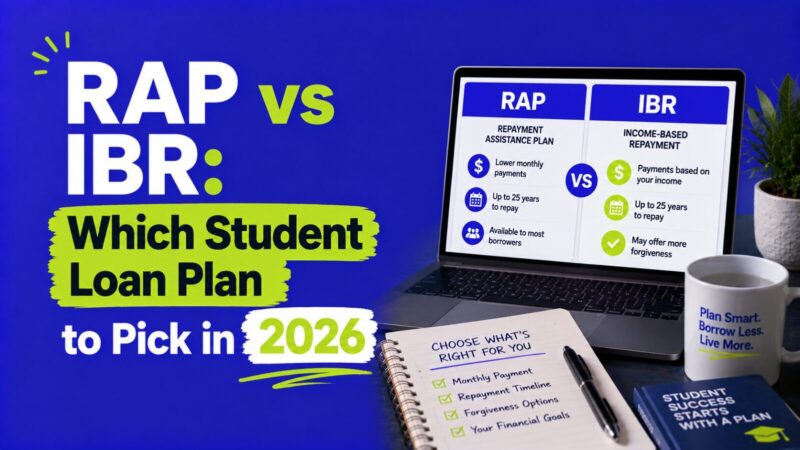
See our RAP vs IBR comparison.
Who can use IBR after July 1, 2026?
IBR still exists.
But the loan’s disbursement date now matters.
Federal Student Aid generally limits IBR to eligible Direct and FFEL Program loans disbursed:
before July 1, 2026
IBR generally charges:
- 10% of discretionary income for certain newer borrowers
- 15% for other qualifying borrowers
and typically provides forgiveness after:
- 20 years
- or 25 years
depending on borrower status.
Because IBR protects 150% of the applicable federal poverty guideline before calculating the payment, some borrowers with older loans can receive a payment lower than RAP.
IBR can even produce a $0 required payment in some cases.
What if all my loans are new?
If all of your loans were disbursed on or after July 1, 2026, Federal Student Aid says:
RAP is the only IDR plan available to you.
That means you cannot simply choose IBR, PAYE or ICR for those new loans.
For fixed repayment, Tiered Standard is another major option.
What if all my loans are older?
If all of your loans were disbursed before July 1, 2026, you may have several IDR choices depending on the loan type.
Those can include:
- RAP
- IBR
- PAYE
- ICR
PAYE and ICR are temporary options at this point because both are scheduled to end no later than July 1, 2028.
What if I have both old and new loans?
This is the group that should be most careful about blanket advice.
If your federal loan portfolio contains loans with different disbursement dates, different loans may have different IDR eligibility.
Do not assume that because one old loan qualifies for IBR, every new loan in your account also qualifies.
Use your StudentAid.gov Dashboard and Repayment Calculator to check the actual loans.
What happens to PAYE and ICR?
PAYE and ICR did not disappear on July 1, 2026.
Certain borrowers with eligible older loans can still use them during the transition period.
But both plans are scheduled to end no later than:
July 1, 2028
Borrowers still enrolled in PAYE or ICR will eventually need to choose another eligible plan.
If you are currently making progress toward PSLF or IDR forgiveness, do not switch blindly.
Compare how a change affects:
- monthly payment
- forgiveness credit
- repayment timeline
- total amount repaid
How does Tiered Standard work?
Tiered Standard is a fixed-payment plan.
Unlike RAP, the payment does not change based on your income.
Repayment periods can be:
- 10 years
- 15 years
- 20 years
- 25 years
depending on the applicable loan balance rules.
A longer repayment period can reduce the monthly payment, but it can also increase the total interest paid.
There is no normal income-driven forgiveness at the end of Tiered Standard.
See our Tiered Standard Repayment Plan guide before choosing it simply because its monthly payment looks manageable.
What do the 2026 changes mean for PSLF?
If you are pursuing Public Service Loan Forgiveness, repayment-plan choice matters.
RAP can count toward PSLF.
IBR can count toward PSLF.
PAYE and ICR can also produce qualifying payments while those plans remain available and the other requirements are satisfied.
The traditional 10-year Standard Repayment Plan can also qualify.
But:
Tiered Standard does not qualify for PSLF.
That makes automatic placement especially risky for former SAVE borrowers pursuing forgiveness.
If you are moved into Tiered Standard and leave the account there, those Tiered Standard payments generally will not advance your PSLF count.
See our PSLF in 2026 guide for the current rules.
What changed for Parent PLUS borrowers?
Parent PLUS loans have their own rules.
Parent PLUS Loans themselves are not eligible for RAP.
Direct Consolidation Loans containing Parent PLUS debt are also generally excluded from RAP.
There was, however, a transition pathway for Parent PLUS borrowers who completed a qualifying Direct Consolidation Loan before July 1, 2026.
Federal Student Aid says a qualifying consolidation loan containing Parent PLUS debt can become eligible for IBR after the borrower makes:
at least one payment under ICR before July 1, 2028
The critical 2026 consolidation deadline has already passed.
If Parent PLUS debt was not consolidated in time, completing a new consolidation now does not recreate the same IDR pathway.
Our Parent PLUS consolidation deadline guide explains the remaining options.
Grad PLUS also changed in 2026
Grad PLUS generally ended for new graduate and professional borrowing beginning July 1, 2026.
For most students subject to the new rules:
- regular graduate annual Direct Unsubsidized limit: $20,500
- regular graduate aggregate limit: $100,000
- professional annual limit: $50,000
- professional aggregate limit: $200,000
- lifetime Title IV borrower limit: $257,500
There is a transition exception for certain students who were already enrolled and borrowing for the same program before July 1, 2026.
Those students may temporarily remain eligible under the old borrowing rules, including Grad PLUS.
Professional-degree classification is also currently affected by ongoing litigation and interim Department guidance, so students near the $20,500 versus $50,000 boundary should verify their classification with their financial aid office.
See our Grad PLUS changes guide for the new limits and exception rules.
There is a temporary 1% auto-pay interest reduction
This is one of the more useful 2026 changes because the enrollment deadline is still ahead.
Eligible borrowers enrolled in automatic payments can receive a total:
1 percentage point interest-rate reduction
The temporary benefit began:
July 1, 2026
and is scheduled to last through:
June 30, 2028
Borrowers who were already enrolled in auto pay generally receive the additional reduction automatically.
If you are not already enrolled, the Department says you need to enroll by:
September 30, 2026
to receive the temporary benefit.
The usual auto-pay reduction was 0.25 percentage point. During this temporary program, the Department adds another 0.75 percentage point to bring the total reduction to 1 percentage point.
The program generally applies to eligible Federal Direct Loans originated after July 1, 2012, including qualifying student and Parent PLUS borrowers.
You must remain enrolled in auto pay to keep receiving the reduction.
Should you refinance because SAVE ended?
Usually, SAVE ending by itself is not a good reason to refinance federal student loans privately.
Private refinancing replaces federal student debt with a private loan.
That can permanently eliminate access to federal benefits such as:
- RAP
- IBR
- PSLF
- federal deferment
- federal forbearance
- certain discharge protections
- future federal relief programs
A private refinance can still make sense in some situations, particularly for high-income borrowers with strong credit who receive a meaningfully lower private rate and are confident they will not need federal protections.
But compare the value of what you are giving up before making an irreversible move.
See our federal vs private student loan refinancing guide.
How do you change repayment plans?
Start at StudentAid.gov.
Log in before using the federal Repayment Calculator if possible so it can use your actual loan data.
Compare:
- monthly payment
- repayment term
- projected total repayment
- interest treatment
- IDR discharge
- PSLF forgiveness
- plan eligibility
For an income-driven plan, allowing the Department of Education to access your federal tax information from the IRS can reduce the amount of income documentation you need to provide manually.
Our step-by-step guide to switching out of SAVE walks through the process.
What I would compare before choosing a plan
Do not choose from the monthly payment alone.
I would compare these seven things:
- Monthly payment
- Total expected repayment
- Repayment length
- Interest treatment
- Existing forgiveness credit
- PSLF eligibility
- What happens if you borrow or consolidate again
A plan that lowers today’s payment by $100 is not necessarily cheaper if it keeps you in repayment for another decade.
The correct answer can also change if you later take out another federal loan.
That makes loan disbursement dates much more important than they were before 2026.
Frequently asked questions
When did SAVE end?
SAVE ended following a federal court order in March 2026.
July 1, 2026 was the launch date for RAP and Tiered Standard and the start of the SAVE transition-notice process.
How long do SAVE borrowers have to choose another plan?
Borrowers generally receive a 90-day period communicated by their federal loan servicer.
There is no single nationwide deadline for every SAVE borrower.
Is RAP available now?
Yes.
RAP became available July 1, 2026.
Its payments are based primarily on AGI and dependents and generally cannot fall below $10 per month.
Is IBR still available?
Yes, but only for eligible loans meeting the current rules.
IBR generally requires qualifying loans to have been disbursed before July 1, 2026.
Did PAYE and ICR end July 1, 2026?
No.
Some borrowers with qualifying older loans may continue using PAYE or ICR during the transition.
Both are scheduled to end no later than July 1, 2028.
What if all of my loans were disbursed after July 1, 2026?
RAP is the only income-driven repayment plan available for those borrowers.
Tiered Standard is the major new fixed-payment alternative.
Does RAP qualify for PSLF?
Yes, when the payment and borrower satisfy the other PSLF requirements.
Does Tiered Standard qualify for PSLF?
No.
Tiered Standard payments do not qualify toward PSLF.
Can Parent PLUS borrowers use RAP?
No.
Parent PLUS Loans and consolidation loans containing Parent PLUS history are excluded from RAP.
Can Parent PLUS borrowers consolidate now to unlock IBR?
The special transition pathway generally required the qualifying Direct Consolidation Loan to have been disbursed before July 1, 2026.
That deadline has passed.
Are Grad PLUS loans completely gone?
For most new graduate and professional borrowing, yes.
Certain students already enrolled and borrowing before July 1, 2026 can temporarily remain eligible under the transition exception.
What is the September 30, 2026 student loan deadline?
Eligible borrowers who are not already enrolled in auto pay generally need to enroll by September 30, 2026 to receive the temporary 1 percentage point interest-rate reduction scheduled through June 30, 2028.
Bottom line
The biggest federal student loan repayment changes of 2026 are already in effect.
If you were in SAVE, the most urgent thing is to find your servicer notice and check your individual plan-selection deadline.
Then look at your loan disbursement dates.
If your loans are older, you may still have several income-driven options.
If all of your loans were disbursed on or after July 1, 2026, RAP is your only income-driven repayment plan.
Parent PLUS and Grad PLUS borrowers also have separate 2026 rules that can materially affect borrowing and repayment.
And if you qualify for the temporary auto-pay reduction but are not enrolled yet, September 30, 2026 is the next important deadline to watch.
For a broader decision, do not compare only the monthly payment. Compare the total repayment cost, forgiveness path, interest treatment and the federal protections attached to each plan.
This article is for general educational purposes only and is not individualized financial, legal or tax advice. Federal student loan rules, repayment plans, court orders, deadlines and individual eligibility can change. Confirm your loan type, disbursement dates, repayment-plan eligibility and personal deadlines through StudentAid.gov and your federal loan servicer before making a repayment decision.