By
By 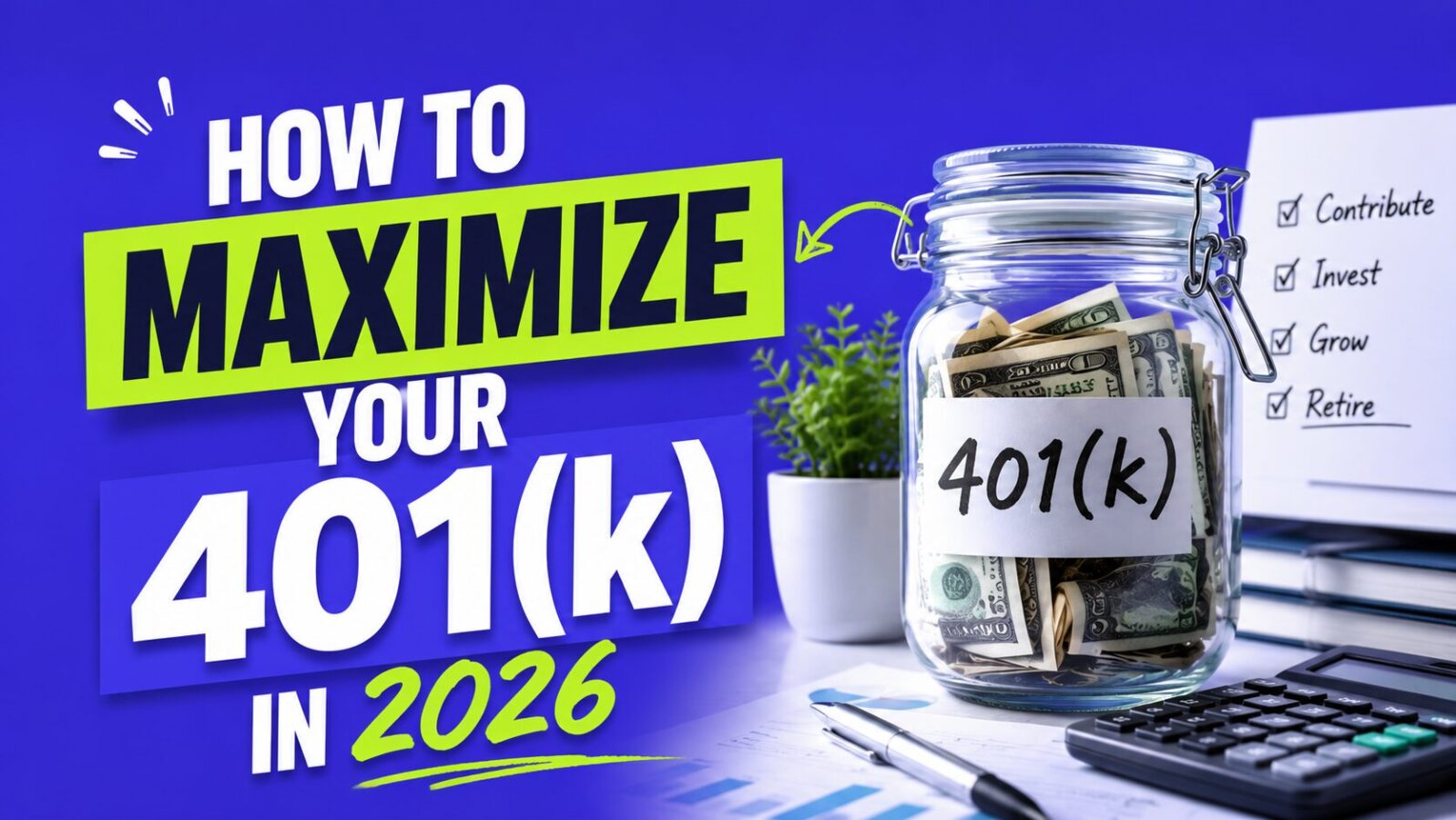
Your 401(k) is the most powerful wealth-building tool most people have access to. But “having a 401(k)” and “maximizing a 401(k)” are two different things. Here is how to get the most from yours in 2026.
Most people set their contribution rate when they are hired and never touch it again, leaving money on the table every year. Tax advantages, employer matching, and automatic payroll deductions make the 401(k) one of the easiest paths to a retirement nest egg, but only if you use it strategically. It is a core piece of the retirement account roadmap.
- Contributing enough to capture your full employer match is the highest-priority move for most workers. A 50% match on contributions up to 6% of salary is an instant 50% boost on that money before it is ever invested. Little else competes with employer match dollars.
- The “1% per raise” rule is the most painless contribution strategy: every time you get a raise, increase your contribution by 1%. You never feel it because you never had the money. Over 5 to 10 years, this alone can move you toward the maximum without changing your lifestyle.
- For most people in their 20s and 30s earning under $100,000, Roth 401(k) contributions are often better: pay tax at today’s likely-lower rate and withdraw tax-free in retirement. Above the 32% bracket, traditional contributions deliver more immediate tax relief. It depends on your tax rate now versus later.
- Expense ratios compound against you. The difference between a 0.05% index fund and a 1.00% actively managed fund on a $100,000 balance over 30 years can exceed $200,000 in lost growth. Favor the lowest-cost index funds in your plan.
- Avoid cashing out a 401(k) when changing jobs. On a $50,000 balance in the 22% bracket, income tax plus the 10% early withdrawal penalty can cost about $16,000. Rolling it to an IRA or your new employer’s plan keeps it growing.
What are the 2026 contribution limits?
| Category | Annual limit (2026) | Per paycheck (biweekly) |
|---|---|---|
| Under age 50 | $24,500 | ~$942 |
| Age 50 and older (catch-up) | $32,500 | ~$1,250 |
| Ages 60 to 63 (SECURE 2.0 super catch-up) | $35,750 | ~$1,375 |
| Combined employee + employer limit | $72,000 |
These limits (IRS, 2026) apply to employee contributions; employer match is on top. See our full 2026 contribution limits guide. If you cannot reach $24,500 this year, that is fine, even small increases make a large long-term difference.
See how much your employer match is worth
Employer Match Calculator
See how much free match you may be leaving on the table, and what full capture is worth over time. Estimates only.
Project your 401(k) balance
401(k) Retirement Calculator
Step 1: Capture the full employer match first
This is the first priority. A 50% match on contributions up to 6% of salary is an instant 50% boost on that money before it is ever invested. Little else competes with employer match dollars.
Common match formulas: dollar-for-dollar up to 3%, 50 cents on the dollar up to 6%, or dollar-for-dollar up to 4%. If you are not sure what your match is, check your plan documents or ask HR today.
Watch vesting schedules. Some employers require 2 to 6 years before matched funds are fully yours. If you leave before vesting completes, you forfeit part or all of the match, so know your schedule before any job change.
Step 2: Increase 1% with every raise
Every time you get a raise, increase your contribution by 1%. You never feel the difference because you never had the money. Starting at 6%, one raise per year at +1% puts you at 10% in 4 years and 15% in 9 years, without reducing your take-home pay. Many plans offer an auto-escalation feature that does this automatically; turn it on if yours has it.
Step 3: Traditional vs Roth 401(k)
| Feature | Traditional 401(k) | Roth 401(k) |
|---|---|---|
| Tax on contributions | Pre-tax (reduces income today) | After-tax (no tax break today) |
| Growth | Tax-deferred | Tax-free |
| Withdrawals in retirement | Taxed as ordinary income | Completely tax-free |
| May fit if | Tax rate higher now than in retirement | Tax rate lower now than in retirement |
| Typical fit | 32%+ bracket, high earners | Under $100K, 20s and 30s |
For many people in their 20s and 30s earning below $100,000, Roth is often the stronger choice, since you are likely in a lower bracket now than at peak earning. Still, the right answer depends on your tax rate today versus later. Our Traditional vs Roth guide walks through it.
Step 4: Choose the right investments
Target-date funds (a simple default for most people): automatically shift from aggressive (mostly stocks) to conservative (more bonds) as you approach retirement. Choose the fund closest to your planned retirement year for automatic rebalancing and broad diversification.
Index fund DIY approach: if your plan offers low-cost index funds, a simple 3-fund portfolio works well:
- 60 to 80% US stock index fund (S&P 500 or total stock market)
- 10 to 25% international stock index fund
- 5 to 20% bond index fund (increase as you age)
The expense ratio rule: under 0.15% is good, over 0.50% is expensive, and over 0.75% is worth reconsidering. On a $100,000 balance over 30 years, the gap between a 0.05% fund and a 1.00% fund can exceed $200,000 in lost growth.
Funds to weigh carefully: company stock above 5 to 10% (a job loss and a savings loss can hit at once), actively managed funds with expense ratios above 0.75% (most have struggled to beat their benchmark long-term), and stable value or money market funds for long-term money (they tend to barely beat inflation).
Why does starting early matter so much?
| Age started | Monthly contribution | Balance at 65 (7% return) |
|---|---|---|
| 22 | $500/month | ~$1,425,000 |
| 25 | $500/month | ~$1,145,000 |
| 30 | $500/month | ~$790,000 |
| 35 | $500/month | ~$535,000 |
| 40 | $500/month | ~$350,000 |
The difference between starting at 22 and starting at 30 is nearly $635,000 from just 8 extra years of compounding. These are illustrative figures at a 7% average return, not a forecast, but few decisions in personal finance carry this kind of leverage.
Common mistakes to avoid
Not enrolling. Some employers auto-enroll you; others do not. If you have to opt in and have not, every month you wait is lost growth and potentially lost match.
Leaving the default contribution rate. Many auto-enrollment plans default to 3%, which is usually not enough. Bump it up as you can.
Cashing out when you change jobs. On a $50,000 balance in the 22% bracket: roughly $11,000 in income tax plus a $5,000 early withdrawal penalty, about $16,000 gone. Roll it to an IRA or your new employer’s plan instead.
Taking a 401(k) loan. The borrowed money stops growing, and if you leave the company the loan may be due within a short window. If you cannot repay it, the balance is treated as a taxable distribution plus penalty.
Never reviewing your investments. Set a yearly calendar reminder to review your allocation and confirm it still fits your age, risk tolerance, and goals.
Frequently Asked Questions
Contribute enough to get the full employer match first, since that is an immediate return no debt payoff matches. Beyond that, pay down high-interest debt (credit cards or loans above about 8%) before increasing contributions further. Once that debt is gone, redirect those payments back to the 401(k). Lower-interest debt (student loans under 6%) can usually be managed alongside retirement saving.
Yes, the limits are separate: $24,500 for the 401(k) and $7,500 for an IRA in 2026. You can fund both if cash flow allows. If you have a workplace plan and your income exceeds the 2026 deduction phase-out ($81,000 single / $129,000 married filing jointly), your traditional IRA contributions may not be deductible, though a Roth IRA may still be available depending on income.
Contribute enough to get the full match regardless. Beyond the match, consider maxing an IRA first ($7,500/year), where you control the investments and can choose low-cost index funds. After maxing the IRA, return to the 401(k) for additional contributions even with a limited menu, since the tax advantages often outweigh modestly higher fund expenses.
It is an advanced strategy that lets you contribute after-tax dollars beyond the $24,500 standard limit, up to the $72,000 combined limit, then convert them to Roth. It requires a plan that allows after-tax (non-Roth) contributions and either in-plan Roth conversions or in-service distributions. If yours does, it is one of the most tax-efficient options for high earners who have maxed standard contributions. See our mega backdoor Roth guide.
The money stays yours. You can leave it in the old plan (fine if the funds are good and the balance is over $5,000), roll it to your new employer’s plan, or roll it to an IRA. A direct rollover to an IRA gives the most control and flexibility for most people. Avoid cashing out, since income tax plus the 10% penalty can consume 30 to 40% of the balance.
Vesting determines when employer match becomes yours. Immediate vesting means it is yours right away. Cliff vesting means 0% until a set date (often 2 to 3 years), then 100%. Graded vesting builds ownership in steps (for example 20% per year over 5 years). Your own contributions are always 100% yours. If your plan uses a 3-year cliff and you are near it, staying a little longer can mean keeping the entire match.
A common order: contribute enough to the 401(k) for the full match, max a Roth IRA ($7,500 in 2026) for its flexibility and no RMDs, then return to the 401(k) toward the $24,500 limit. If your income exceeds the Roth IRA limits (phasing out up to $168,000 single / $252,000 married in 2026), consider a backdoor Roth.
The bottom line
Maximizing your 401(k) is about stacking good habits: capture the full employer match, increase contributions with every raise, choose low-cost index funds, avoid early withdrawals, and let compounding do the heavy lifting. You do not need to hit $24,500 this year, you need to move in that direction consistently.
Use the match calculator above to see what you may be leaving on the table, and the retirement calculator to project where your current contribution rate leads.
- New to retirement accounts? Start with our hub, Retirement Accounts Explained.
- Compare Traditional vs Roth in detail? Read our Traditional vs Roth IRA guide, with income limits and conversion strategies.
- Already maxing the standard limit? Read our mega backdoor Roth guide for how to put much more into Roth.
- Changed jobs and have an old 401(k)? Read our 401(k) rollover guide on moving it without triggering taxes or penalties.
A quick note: this article is for educational purposes only and is not financial, investment, or tax advice. Contribution limits come from the IRS and apply to tax year 2026; verify current figures at IRS.gov before you act. Everyone’s situation is different, so it is worth talking with a qualified financial advisor or tax professional about yours.