 By
By 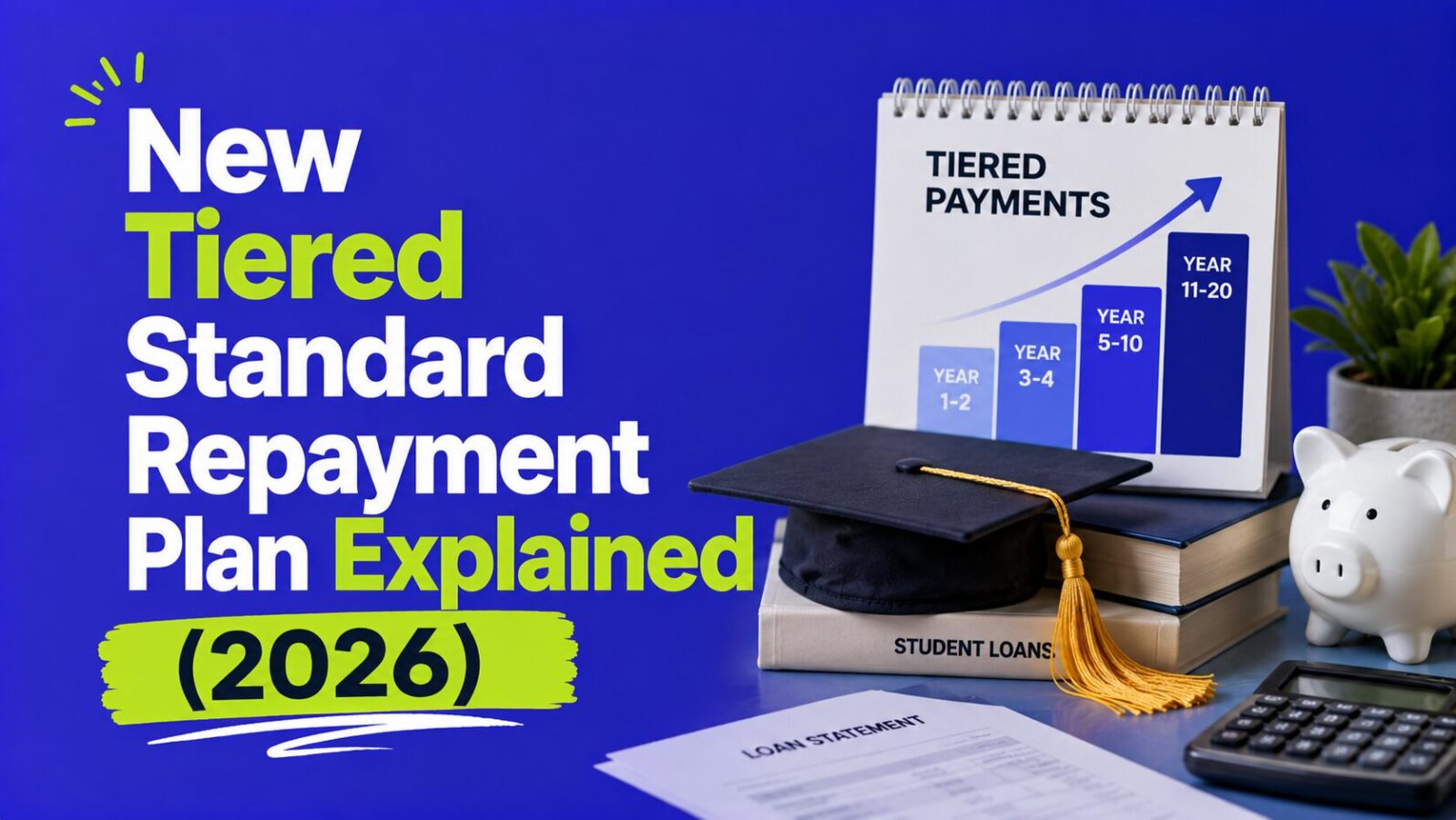
The Tiered Standard Repayment Plan is a new federal student loan repayment plan available since July 1, 2026. It gives you a fixed monthly payment, with a repayment term of 10, 15, 20, or 25 years based on your total outstanding Direct Loan balance.
Unlike RAP, Tiered Standard does not base the payment on your income.
That makes the plan predictable, but there are two major trade-offs:
- There is no built-in forgiveness at the end of the repayment term.
- Tiered Standard payments do not qualify for Public Service Loan Forgiveness.
For borrowers leaving SAVE, Tiered Standard can also become the plan you are automatically placed into if you do not choose another repayment option before your servicer deadline.
Key takeaways
- Tiered Standard uses fixed monthly payments, not income-based payments.
- Your repayment term is 10, 15, 20, or 25 years based on your outstanding Direct Loan balance.
- Scheduled payments are generally at least $50 per month.
- There is no automatic balance forgiveness at the end of the term.
- Tiered Standard does not qualify for PSLF or TEPSLF.
- Borrowers who receive at least one Direct Loan on or after July 1, 2026 can fall under the new Tiered Standard framework for their Direct Loans.
- RAP is the main income-driven alternative under the new system.
- Former SAVE borrowers who make no repayment-plan choice can be moved into Standard or Tiered Standard, depending on their loans.
What is the Tiered Standard Repayment Plan?
Tiered Standard is a fixed-payment federal student loan repayment plan created as part of the 2026 federal student loan overhaul.
It became available July 1, 2026.
Unlike income-driven repayment, the Department does not calculate your required payment from your salary or family size.
Instead, your payment is based primarily on:
- your total outstanding Direct Loan principal balance,
- your interest rates,
- and the repayment term assigned to your balance.
Your payment then remains fixed rather than being recalculated every year because your income changed.
That predictability can be useful.
But it also means losing your job or taking a pay cut does not automatically lower your required payment.
How long is the Tiered Standard repayment term?
Your maximum repayment period depends on the total Direct Loan balance when you enter repayment.
| Outstanding Direct Loan balance | Maximum repayment term |
|---|---|
| Less than $25,000 | 10 years |
| $25,000 to less than $50,000 | 15 years |
| $50,000 to less than $100,000 | 20 years |
| $100,000 or more | 25 years |
The basic trade-off is straightforward:
A longer repayment term can lower your monthly payment, but it usually means paying interest for more years.
So a 25-year Tiered Standard term is not automatically better than a shorter term just because the bill is smaller each month.
What is the minimum Tiered Standard payment?
Tiered Standard payments are generally at least:
$50 per month
The payment can be higher if that is necessary to repay your balance and interest within the required repayment period.
If your remaining balance is below $50, the final payment can be smaller.
This is different from RAP, which generally has a $10 monthly minimum.
Example: $30,000 balance
The Department of Education has illustrated the difference using a borrower with about:
$30,000 in student loans
Under a traditional 10-year Standard repayment schedule, the monthly payment would be around:
$341
Under Tiered Standard, a $30,000 balance falls into the:
15-year repayment tier
The estimated payment in the Department’s example falls to about:
$262 per month
That saves roughly:
$79 per month
But the borrower remains in repayment five years longer.
That is why you should compare both:
- the monthly payment
- the total amount repaid
before choosing the plan.
Who can use Tiered Standard?
Tiered Standard is available for Direct Loans under the new repayment framework.
The most important trigger is receiving a Direct Loan on or after July 1, 2026.
If you have both older Direct Loans and at least one new Direct Loan made on or after that date, the Tiered Standard framework can apply across your Direct Loans.
Eligible loan types can include:
- Direct Subsidized Loans
- Direct Unsubsidized Loans
- Direct PLUS Loans
- Parent PLUS Loans
- Direct Consolidation Loans
Parent PLUS is particularly important because RAP excludes Parent PLUS debt, making Tiered Standard one of the main repayment options for new Parent PLUS borrowing.
Borrowers whose entire loan history predates July 1, 2026 can have additional legacy repayment options.
Tiered Standard vs RAP
For many borrowers in the new system, the most useful comparison is:
Tiered Standard vs RAP
| Feature | Tiered Standard | RAP |
|---|---|---|
| Payment based on | Loan balance and repayment term | AGI and dependents |
| Payment type | Fixed | Adjusts with income |
| General minimum payment | $50 | $10 |
| Repayment period | 10 to 25 years | 30 years |
| Built-in end-of-term forgiveness | No | Yes, after 360 qualifying payments |
| PSLF qualifying | No | Yes |
| Income recertification | No | Yes |
| Unpaid-interest protection | No comparable IDR subsidy | Yes |
| Principal matching | No | Up to $50 under qualifying rules |
The difference is basically this:
Tiered Standard asks how much you owe.
RAP asks how much you earn.
That can produce very different monthly payments.
When can Tiered Standard produce the lower payment?
There is no universal winner.
Suppose two borrowers each owe $75,000.
One earns $45,000.
The other earns $150,000.
Both would fall into the same 20-year Tiered Standard repayment tier because Tiered Standard looks primarily at the balance.
But their RAP payments could be very different because RAP uses AGI.
That means RAP may be much more attractive for a borrower whose income is low relative to debt.
Tiered Standard may look more competitive for someone with substantially higher income.
Dependents also matter under RAP because each qualifying dependent can reduce the monthly RAP payment by $50.
The right question is not:
“Which plan usually has the lower payment?”
It is:
“Which plan gives me the better payment and total repayment cost using my actual loans and income?”
Use the official Federal Student Aid Repayment Calculator before choosing.
Does Tiered Standard qualify for PSLF?
No.
Tiered Standard payments do not qualify toward:
- Public Service Loan Forgiveness
- Temporary Expanded Public Service Loan Forgiveness
This is one of the plan’s biggest disadvantages.
If you work for a qualifying government or nonprofit employer and expect to pursue PSLF, Tiered Standard can cost you qualifying progress.
RAP can qualify for PSLF.
IBR may also qualify for borrowers with eligible older loans.
See our PSLF changes in 2026 guide before choosing a repayment plan if public-service forgiveness is part of your strategy.
What about the traditional Standard Plan?
Do not confuse Tiered Standard with the old Standard Repayment Plan.
They are both fixed-payment plans, but they work differently.
Traditional Standard Plan
For most non-consolidation Direct Loans under the older system:
10-year repayment term
and payments are generally at least:
$50 per month
Certain older consolidation loans can have longer Standard repayment periods.
Tiered Standard
The repayment term automatically varies with your Direct Loan balance:
- under $25,000: 10 years
- $25,000 to $49,999: 15 years
- $50,000 to $99,999: 20 years
- $100,000 or more: 25 years
That is why a borrower with a large balance can receive a much longer fixed repayment period under Tiered Standard.
Does Tiered Standard forgive the loan after 25 years?
No.
This is one of the easiest parts of the plan to misunderstand.
A 25-year Tiered Standard term does not mean:
make payments for 25 years and whatever remains gets forgiven.
The scheduled payment is designed to pay your loan in full by the end of the assigned repayment term.
That is fundamentally different from RAP.
Under RAP, a remaining eligible balance may be discharged after 360 qualifying monthly payments.
Tiered Standard has no comparable built-in forgiveness feature.
That does not mean a borrower using Tiered Standard could never receive another type of federal discharge.
Programs such as disability discharge or other statutory forgiveness programs have their own rules.
But Tiered Standard itself does not provide end-of-term forgiveness.
Who may benefit from Tiered Standard?
Tiered Standard deserves consideration if you:
- want a predictable payment,
- have stable income,
- can comfortably afford the fixed payment,
- are not pursuing PSLF,
- do not need an income-based payment,
- prefer a defined payoff date,
- or have a large balance and want a longer fixed repayment term.
The biggest advantage is predictability.
If your income rises substantially, your required Tiered Standard payment does not automatically increase because your salary changed.
That can be appealing to borrowers expecting strong income growth.
You can still pay it off faster
The assigned repayment term is a maximum repayment period.
It does not mean you must stay in debt for all 15, 20, or 25 years.
Federal student loans generally have:
no prepayment penalty
So if your finances improve, you can pay more than the required amount and pay off the debt early.
That can reduce the interest cost of choosing a longer Tiered Standard term.
Who should think twice?
Tiered Standard may be a weaker choice if:
- your income is low compared with your debt,
- your income is unstable,
- you expect your earnings to fall,
- you have dependents that could lower a RAP payment,
- you are pursuing PSLF,
- you want income-driven forgiveness,
- or your main priority is keeping the required monthly payment as low as possible.
The fixed payment is both the plan’s biggest advantage and its biggest weakness.
It is predictable when your income is strong.
It can become difficult if your finances suddenly get worse.
What happens to Parent PLUS borrowers?
Parent PLUS borrowers need special attention under the new repayment rules.
New Parent PLUS loans are not eligible for RAP.
Direct Consolidation Loans containing Parent PLUS history are also generally excluded from RAP.
But Tiered Standard is available for eligible Direct PLUS Loans made to parents under the new framework.
That means a parent who takes out new Parent PLUS debt after July 1, 2026 can have a much narrower repayment menu than an undergraduate or graduate student borrower.
For existing Parent PLUS debt, rules depend heavily on when the loans were borrowed or consolidated.
Our Parent PLUS consolidation deadline guide explains the transition rules.
What if you are leaving SAVE?
Former SAVE borrowers are being required to move into another legal repayment plan.
Federal loan servicers began sending notices starting July 1, 2026.
Your servicer gives you an individual selection period, generally around 90 days from the notice.
There is no single nationwide September deadline for every SAVE borrower.
If you fail to choose another plan, your loans can eventually be moved into:
- Standard
- or Tiered Standard
depending on your loan history.
Automatic placement does not mean the plan is the best option for you.
That matters especially if you:
- have low income,
- want income-driven repayment,
- or are pursuing PSLF.
See what happens if you do nothing after SAVE before allowing automatic enrollment to decide for you.
Our step-by-step guide to switching out of SAVE explains how to compare and change plans.
Before choosing Tiered Standard, check four numbers
Do not choose the plan based only on the monthly bill.
Compare:
- Monthly payment
- Repayment period
- Total amount repaid
- Forgiveness benefits you would give up
Suppose Tiered Standard lowers your required payment by $100 per month.
That sounds attractive.
But if the change extends repayment by another 10 years and eliminates a realistic PSLF strategy, that $100 monthly savings could be expensive in the long run.
Frequently asked questions
What is the Tiered Standard Repayment Plan?
Tiered Standard is a fixed-payment federal Direct Loan repayment plan available beginning July 1, 2026.
Your maximum repayment period is 10, 15, 20, or 25 years based on your outstanding Direct Loan balance.
Is Tiered Standard income-driven?
No.
Your payment is not calculated from your income or number of dependents.
What is the minimum Tiered Standard payment?
Scheduled payments are generally at least $50 per month, unless the remaining balance itself is below $50.
How long is the Tiered Standard repayment period?
The maximum term is:
- less than $25,000: 10 years
- $25,000 to $49,999: 15 years
- $50,000 to $99,999: 20 years
- $100,000 or more: 25 years
Does Tiered Standard qualify for PSLF?
No.
Payments under Tiered Standard do not count as qualifying PSLF or TEPSLF payments.
Does Tiered Standard offer forgiveness after 25 years?
No.
The plan is designed to repay the loan in full during the assigned fixed term.
Can Parent PLUS borrowers use Tiered Standard?
Yes, eligible Direct PLUS Loans made to parents can use Tiered Standard under the new framework.
Parent PLUS borrowers generally cannot use RAP.
Can I switch from Tiered Standard to RAP?
Potentially, if your loans are eligible for RAP.
Check the plans shown for your actual loans in StudentAid.gov before switching.
Is Tiered Standard better than RAP?
Neither plan is automatically better.
Tiered Standard provides predictable fixed payments and a maximum 10- to 25-year payoff period.
RAP bases payments on income and dependents, has stronger balance protections, can provide forgiveness after 30 years and can qualify for PSLF.
Compare your actual monthly payment and total cost under both.
Bottom line
Tiered Standard gives eligible federal Direct Loan borrowers fixed monthly payments over a maximum 10- to 25-year repayment period based on outstanding loan balance.
Its biggest advantage is predictability.
Your payment does not automatically rise because your income goes up, and larger balances receive longer repayment terms.
But that simplicity comes with real trade-offs.
Tiered Standard does not provide built-in end-of-term forgiveness, and its payments do not qualify for PSLF or TEPSLF.
If you have stable finances, can comfortably make the fixed payment and are not pursuing forgiveness, Tiered Standard may be a reasonable choice.
If your income is low or unpredictable, you have dependents or PSLF matters to you, compare RAP before choosing Tiered Standard.
And if you are being moved out of SAVE, do not assume automatic enrollment will select your best plan.
Check your servicer deadline and compare the options yourself first.
For the broader picture, see our federal student loan changes in 2026 and RAP vs IBR comparison.
This article is for general educational purposes only and is not individualized financial, legal or tax advice. Federal student loan rules, repayment options and administrative procedures can change. Verify your loan eligibility, payment estimate and deadlines through StudentAid.gov or your federal loan servicer before changing repayment plans.