 By
By 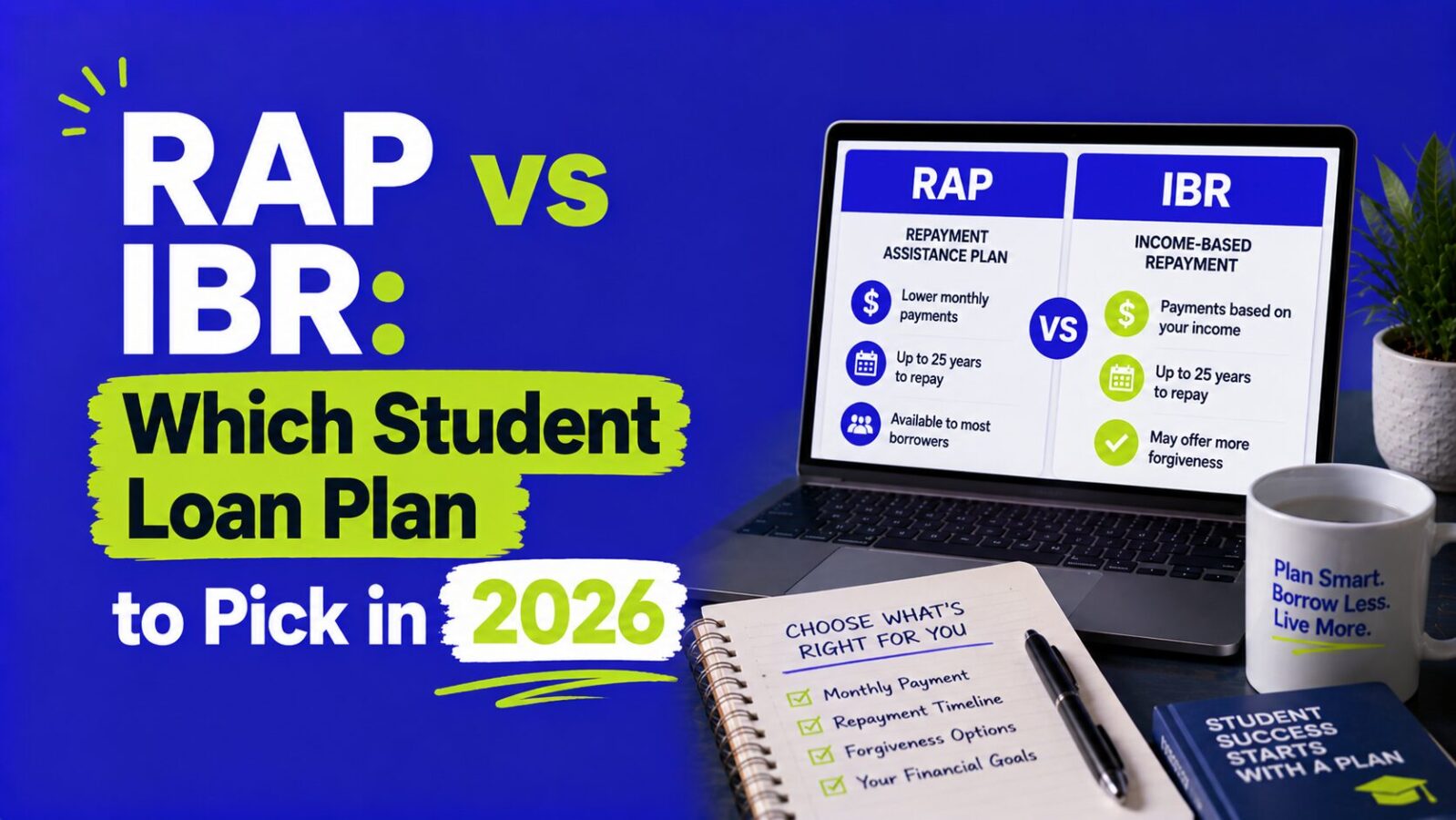
Neither RAP nor IBR is automatically better in 2026. If you are eligible for both, start by comparing the actual monthly payment each plan gives you.
RAP has stronger protection against unpaid interest and includes a principal-matching benefit. IBR can produce a lower payment, especially at low incomes, because it protects part of your income before calculating what you owe. IBR also has a shorter 20- or 25-year forgiveness timeline compared with RAP’s 30 years.
There is also a major eligibility catch. IBR is generally limited to eligible loans disbursed before July 1, 2026. If you receive a new federal loan disbursed on or after July 1, 2026, RAP becomes your only income-driven repayment option.
If you are working toward Public Service Loan Forgiveness, both RAP and IBR can produce qualifying payments. In that situation, the plan with the lower monthly payment may matter more than the separate 20-, 25-, or 30-year IDR forgiveness timeline.
Key takeaways
- RAP uses AGI directly: the base payment ranges from 1% to 10% of adjusted gross income.
- RAP reduces your monthly payment by $50 per dependent, with a general minimum payment of $10.
- IBR uses discretionary income: generally AGI minus 150% of the applicable federal poverty guideline.
- IBR payments are generally 10% or 15% of discretionary income depending on your borrowing history.
- IBR can produce a $0 payment. RAP generally cannot because it has a $10 minimum.
- RAP has stronger ongoing protection against unpaid interest.
- RAP can also provide an additional principal reduction of up to $50 under its matching rules.
- IBR forgiveness generally takes 20 or 25 years. RAP requires 360 qualifying payments over at least 30 years.
- Both RAP and IBR can count toward PSLF.
- Tiered Standard does not count toward PSLF.
- Qualifying IBR payments can count toward RAP’s 360-payment requirement, but RAP payments generally do not count toward IBR forgiveness.
RAP vs IBR at a glance
| Feature | RAP | IBR |
|---|---|---|
| Payment basis | Percentage of AGI | Percentage of discretionary income |
| Income rate | 1% to 10% | Generally 10% or 15% |
| Income protected first | No poverty-guideline allowance | 150% of applicable poverty guideline |
| Dependent adjustment | $50 per dependent per month | Family size changes poverty allowance |
| Minimum payment | $10 | Can be $0 |
| Payment cap | No comparable regular 10-year Standard cap | Capped at applicable 10-year Standard amount |
| Unpaid-interest protection | Broad ongoing subsidy after qualifying payment | Mainly first 3 years on subsidized loans |
| Principal benefit | Up to $50 under matching rules | None |
| IDR forgiveness | 30 years | 20 or 25 years |
| PSLF eligible | Yes | Yes |
| New loans after July 1, 2026 | RAP remains available | IBR generally unavailable |
The biggest mistake is comparing RAP and IBR only by the percentage.
The percentages apply to different amounts of income.
A 10% RAP rate can therefore produce a very different payment from a 10% IBR rate.
How does RAP calculate your payment?
RAP uses your adjusted gross income, or AGI, without first subtracting a poverty-guideline allowance.
Its base annual payment schedule is:
| AGI | RAP annual base payment |
|---|---|
| $10,000 or less | $120 |
| More than $10,000 to $20,000 | 1% of AGI |
| More than $20,000 to $30,000 | 2% |
| More than $30,000 to $40,000 | 3% |
| More than $40,000 to $50,000 | 4% |
| More than $50,000 to $60,000 | 5% |
| More than $60,000 to $70,000 | 6% |
| More than $70,000 to $80,000 | 7% |
| More than $80,000 to $90,000 | 8% |
| More than $90,000 to $100,000 | 9% |
| More than $100,000 | 10% |
That annual amount is divided by 12.
RAP then subtracts:
$50 per dependent claimed on your federal tax return
The final required payment generally cannot fall below:
$10 per month
One detail matters here: these are not marginal brackets like federal income tax brackets.
If your AGI puts you in the 9% RAP band, the 9% calculation generally applies to your AGI for purposes of the base payment.
For a more complete explanation, see our Repayment Assistance Plan guide.
How does IBR calculate your payment?
IBR works differently.
Instead of applying its percentage directly to AGI, it first protects part of your income.
IBR discretionary income is generally:
AGI − 150% of the applicable federal poverty guideline
Your payment is then generally:
- 10% of discretionary income if you meet the IBR definition of a newer borrower, or
- 15% of discretionary income for other eligible IBR borrowers.
The annual result is divided by 12.
IBR also has a payment cap. Your required payment generally cannot exceed the applicable amount you would have paid under the 10-year Standard Repayment Plan.
Because IBR protects 150% of the poverty guideline, borrowers with sufficiently low income can have:
$0 monthly payments
RAP generally cannot because its minimum is $10.
Example: RAP vs IBR at $95,000 of AGI
Suppose a borrower has:
- $95,000 AGI
- a family size of two
- loans eligible for both RAP and IBR
RAP
$95,000 falls into RAP’s 9% band.
$95,000 × 9% = $8,550 per year
Divide by 12:
$8,550 ÷ 12 = $712.50
Assume the borrower claims one qualifying dependent:
$712.50 − $50 = $662.50 per month
Estimated RAP payment:
$662.50
IBR
For a family of two in the 48 contiguous states and Washington, D.C., the 2026 federal poverty guideline is $21,640.
IBR generally protects 150%:
$21,640 × 150% = $32,460
Estimated discretionary income:
$95,000 − $32,460 = $62,540
Under the 10% IBR formula:
$62,540 × 10% ÷ 12 ≈ $521 per month
Under the 15% formula:
$62,540 × 15% ÷ 12 ≈ $782 per month
So the same borrower could see:
- RAP: about $663
- 10% IBR: about $521
- 15% IBR: about $782
before considering IBR’s Standard-plan payment cap.
That is why you cannot decide which plan is cheaper based on income alone.
When can RAP be the better choice?
RAP deserves a close look when balance growth is one of your biggest concerns.
If your required RAP payment is not enough to cover all the interest that accrues for the month, the remaining eligible unpaid interest is subsidized after you make the required payment in full and on time.
In practical terms, your balance generally should not keep growing simply because your required RAP payment is too low to cover the month’s interest.
RAP also includes a principal-matching benefit.
If your qualifying payment reduces principal by less than the amount required under the matching formula, the government can provide an additional principal reduction.
The benefit can be up to $50, but it is not automatically $50.
For example, if your required RAP payment is only $10 and none of it reaches principal, the matching amount would not simply become $50 regardless of what you paid.
RAP may be attractive if:
- your RAP payment is similar to or lower than IBR,
- unpaid interest is causing your balance to grow,
- you have dependents who reduce your RAP payment,
- you expect to remain in repayment for a long time,
- or your newer loans make IBR unavailable.
The trade-off is the forgiveness timeline.
RAP requires 360 qualifying payments over at least 30 years before remaining eligible debt can be forgiven.
When can IBR be the better choice?
IBR can be better when its actual monthly payment is lower.
Its biggest advantage is that it does not apply the payment percentage to your entire AGI.
It first protects 150% of the applicable poverty guideline.
That can make a major difference for lower-income borrowers.
IBR can even produce a $0 required monthly payment, while RAP generally bottoms out at $10.
IBR also offers a shorter forgiveness timeline:
- generally 20 years for qualifying newer borrowers
- generally 25 years for other IBR borrowers
RAP is 30 years.
IBR also caps your required payment at the applicable 10-year Standard amount, which can matter if your income increases substantially later.
IBR may therefore be worth keeping if:
- it gives you a clearly lower payment,
- you qualify for a $0 payment,
- you already have years of progress toward IBR forgiveness,
- the shorter 20- or 25-year timeline matters to you,
- or RAP’s AGI-based formula produces a much higher payment.
Does IBR have an interest subsidy?
Yes, but it is much narrower than RAP’s.
Under IBR, if your required payment does not cover all the interest on eligible subsidized loans, the federal government generally covers the remaining interest for the first three consecutive years under the applicable rules.
RAP’s benefit is broader.
For qualifying RAP months, unpaid interest left after your full, on-time required payment can be subsidized on eligible loans without the same three-year limit.
So the better comparison is:
RAP has stronger ongoing protection against balance growth. IBR has a more limited interest subsidy.
RAP vs IBR for PSLF
If you are pursuing Public Service Loan Forgiveness, the decision looks different.
Both RAP and IBR are qualifying repayment plans for PSLF.
PSLF can forgive the remaining eligible Direct Loan balance after the equivalent of:
120 qualifying monthly payments
while you meet the program’s other requirements, including qualifying employment.
Because PSLF has its own 120-payment timeline, RAP’s 30-year forgiveness period and IBR’s 20- or 25-year period usually do not determine when a successful PSLF borrower receives forgiveness.
That means the monthly payment becomes especially important.
Suppose:
- IBR payment = $300
- RAP payment = $450
If both payments count equally toward PSLF and you expect to complete PSLF, paying an extra $150 per month under RAP may provide little benefit.
But RAP’s balance protections could still matter if you are not certain you will stay in qualifying public-service employment long enough to finish PSLF.
See our PSLF in 2026 guide for the current requirements.
Be careful when switching from IBR to RAP
This is one of the most important differences in the new rules.
Forgiveness credit does not move equally in both directions.
Qualifying payments you previously made under IBR can count toward RAP’s requirement of 360 qualifying payments.
But qualifying payments made under RAP generally do not count toward IBR’s forgiveness requirement.
That creates a real switching risk.
Suppose you already have 15 years of qualifying IBR repayment.
Do not switch to RAP simply because one month’s RAP estimate is slightly lower.
First check:
- how much IBR forgiveness credit you already have,
- how many years remain,
- whether the RAP savings are large enough to justify switching,
- and whether PSLF changes the calculation.
Your existing forgiveness progress can be worth more than a small reduction in today’s payment.
What if you receive a new loan after July 1, 2026?
This date matters a lot.
IBR generally applies only to eligible loans disbursed before July 1, 2026.
Federal Student Aid also states that if you receive a new federal loan disbursed on or after July 1, 2026, RAP becomes the only income-driven repayment option available to you.
For borrowers in the new system, the main repayment choices generally include:
- RAP, the income-driven option
- Tiered Standard, the new fixed-payment option
That distinction is particularly important if you want PSLF.
RAP can count toward PSLF. Tiered Standard does not.
See our Tiered Standard Repayment Plan guide before choosing between them.
What should former SAVE borrowers do?
SAVE did not end on July 1.
A federal court order ended the SAVE Plan on March 10, 2026.
Affected borrowers were then moved through a transition process in which servicers sent notices telling them to select another repayment plan.
Borrowers generally receive 90 days from their individual notice to choose an eligible plan.
RAP became available July 1, 2026, which is why that date also appears so often in current repayment guidance.
If your loans still qualify for both RAP and IBR, compare them rather than assuming RAP is automatically the replacement for SAVE.
Our guide to switching out of SAVE walks through the transition.
Estimate your RAP payment
Use the calculator below for a quick estimate:
RAP Payment Estimator
Then compare the result with the official repayment options shown in Federal Student Aid’s Repayment Calculator.
Your actual payment can depend on:
- income,
- tax filing status,
- spouse’s income,
- spouse’s federal loan balance,
- dependents,
- loan type,
- and disbursement dates.
The calculator is a starting point, not a replacement for checking your actual StudentAid.gov account.
What about taxes on RAP or IBR forgiveness?
This changed after 2025.
The temporary federal tax exclusion that covered many types of student loan forgiveness expired after December 31, 2025.
Under current federal tax rules, student loan debt forgiven through income-driven repayment in 2026 or later may generally be treated as taxable cancellation-of-debt income, unless another exclusion applies.
That means eventual forgiveness under RAP or IBR could create a federal tax bill under today’s law.
But both plans have long repayment periods.
Tax law could change many times before a borrower reaches forgiveness, especially someone starting a 30-year RAP timeline today.
Do not build a decades-long repayment strategy around the assumption that today’s tax rules will still exist at forgiveness.
PSLF is different. Under current federal law, debt forgiven through PSLF is not treated as federal taxable income.
See our guide to the student loan forgiveness tax bomb for more detail.
Should you refinance instead?
Refinancing is a completely different decision.
When you refinance federal student loans with a private lender, the federal loans are paid off and replaced with private debt.
You permanently give up federal benefits tied to those loans, including access to:
- RAP
- IBR
- federal income-driven repayment
- PSLF
- federal deferment and forbearance protections
- future federal relief programs that might apply
Refinancing can make sense for some borrowers with stable finances and a strong private rate offer, but it should not be treated as a simple way to lower an IDR payment.
Read should you refinance student loans? before giving up federal protections.
FAQ
Is RAP always cheaper than IBR?
No.
RAP and IBR use completely different payment formulas.
RAP applies an income percentage directly to AGI and then reduces the payment by $50 per dependent.
IBR first protects 150% of the applicable federal poverty guideline.
Either plan can produce the lower payment.
Can IBR have a $0 monthly payment?
Yes.
A sufficiently low-income borrower can have $0 of discretionary income under IBR and therefore a $0 required payment.
RAP generally has a minimum payment of $10.
Does RAP stop student loan interest?
RAP does not eliminate your interest rate.
Instead, if your full, on-time required RAP payment does not cover all eligible interest that accrued for the month, the remaining unpaid interest can be subsidized under the plan’s rules.
Does every RAP borrower get $50 toward principal?
No.
The principal benefit is up to $50 and depends on how much your qualifying payment actually reduces principal.
It is not an automatic $50 government payment every month.
Which is better for PSLF, RAP or IBR?
Both can count toward PSLF.
If you expect to complete PSLF, compare the monthly payments carefully because PSLF uses its own 120-payment forgiveness path.
The separate RAP and IBR long-term forgiveness timelines are usually less important for a successful PSLF borrower.
Is IBR forgiveness faster than RAP?
Generally, yes.
IBR forgiveness usually requires 20 or 25 years of qualifying repayment.
RAP requires 360 qualifying payments over at least 30 years.
Can I switch from IBR to RAP?
Eligible borrowers can switch, but check your existing forgiveness progress first.
Qualifying IBR payments can count toward RAP’s 360-payment requirement.
RAP payments generally do not count toward IBR forgiveness.
Can I use IBR after taking a new loan after July 1, 2026?
Generally no.
Federal Student Aid says that if you receive a new federal loan disbursed on or after July 1, 2026, RAP is your only income-driven repayment option.
Does Tiered Standard count toward PSLF?
No.
Current PSLF rules list RAP and IBR as qualifying repayment plans but specifically exclude the Tiered Standard Plan.
Bottom line
Do not choose between RAP and IBR based only on the headline percentage. Run both calculations.
RAP offers stronger protection against balance growth through its unpaid-interest subsidy and principal-matching benefit. But it has a $10 minimum payment and a 30-year forgiveness timeline.
IBR can produce a lower payment because it protects 150% of the applicable poverty guideline before calculating what you owe. It can also reach $0 and offers forgiveness after 20 or 25 years.
If you are pursuing PSLF, focus heavily on the required monthly payment because both RAP and IBR can count toward PSLF’s separate 120-payment path.
And if you already have years of IBR forgiveness credit, do not switch casually. IBR payments can count toward RAP’s timeline, while RAP payments generally do not count back toward IBR forgiveness.
For the wider picture, see our guide to federal student loan changes in 2026.
This article is for general educational purposes only and is not individualized financial, legal, or tax advice. Federal student loan regulations, repayment plans, court orders, forgiveness rules, and tax laws can change. Check your current loan details, forgiveness progress, and repayment options through StudentAid.gov and your federal loan servicer before changing plans.