By
By 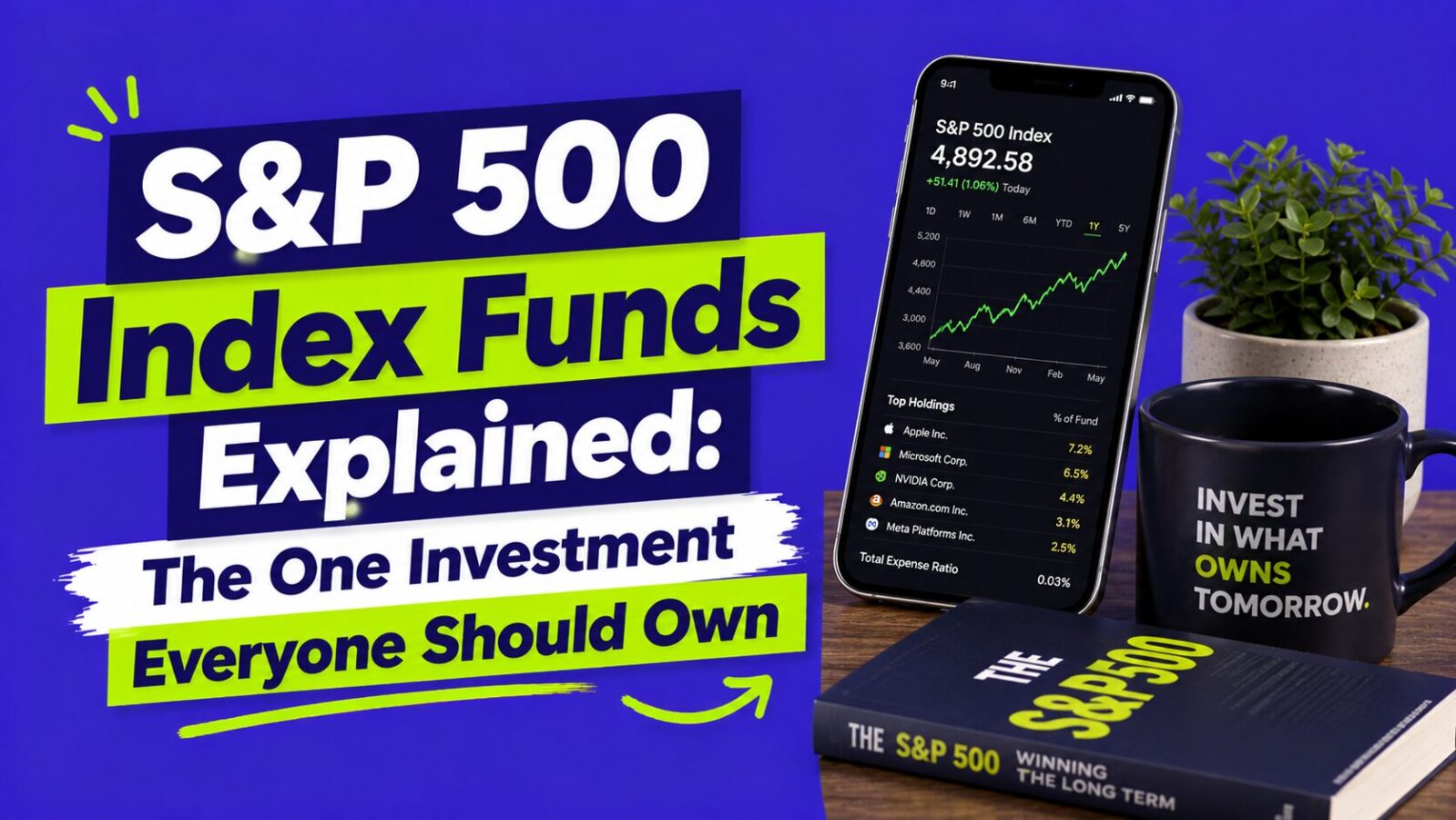
The S&P 500 index fund is the most recommended investment in history. Warren Buffett bets on it. Financial advisors default to it. Here is what it actually is, how to buy it, and why it works.
In 2007, Warren Buffett made a million-dollar bet: an S&P 500 index fund would outperform a collection of hedge funds over 10 years. He won by a landslide. The index fund returned 125.8% over the decade. The hedge funds returned 36%. The best investors on Wall Street, with all their resources and expertise, could not beat a fund that simply buys 500 stocks and holds them.
That bet captures everything you need to know about S&P 500 index funds. They are simple, cheap, and over long periods, they beat most professional investors.
- An S&P 500 index fund buys all 500 of the largest US companies in one purchase. One share of VOO gives you a tiny ownership stake in Apple, Microsoft, Amazon, JPMorgan, and 496 other companies simultaneously.
- The S&P 500 has returned roughly 10% per year nominally (7% after inflation) over the past 100 years — through world wars, the Great Depression, the 2008 financial crisis, and a global pandemic. It has recovered from every single crash in history.
- Over 15 years, roughly 85 to 92% of actively managed funds underperform the S&P 500 index. The fund manager picking stocks on your behalf is very likely to earn you less than just buying the index.
- VOO, FXAIX, IVV, and SWPPX all track the same 500 stocks. The only meaningful difference is expense ratio (0.015% to 0.03%) and which brokerage offers them. Pick whichever is available in your account.
- Every 1% in annual fees costs you roughly 20% of your portfolio over 30 years. On $500,000, that is $100,000 gone to fees. An S&P 500 index fund at 0.03% costs you $0.30/year on $1,000 invested.
What is the S&P 500?
The S&P 500 (Standard and Poor’s 500) is a stock market index that tracks 500 of the largest publicly traded companies in the United States. It is maintained by S&P Dow Jones Indices and is widely considered the best single measure of the US stock market.
The index includes companies across every sector: technology (Apple, Microsoft, Nvidia), healthcare (UnitedHealth, Johnson and Johnson), finance (JPMorgan, Berkshire Hathaway), consumer goods (Amazon, Procter and Gamble), energy (ExxonMobil), and more.
It is market-cap weighted, meaning larger companies have a bigger influence on the index. Apple, with a market cap over $3 trillion, affects the index more than a smaller company worth $20 billion. The top 10 holdings typically represent 30 to 35% of the total index weight.
What the S&P 500 is NOT: It is not the entire stock market. It excludes small-cap and mid-cap companies (roughly 3,000+ US stocks), and it excludes all international stocks. For total market exposure, VTI (Vanguard Total Stock Market) is the alternative — see the comparison below.
What is an S&P 500 index fund?
An S&P 500 index fund is a mutual fund or ETF that buys all 500 stocks in the S&P 500 index in the same proportions as the index. When you buy one share, you instantly own a tiny piece of all 500 companies. The fund does not try to pick winners or time the market. It simply mirrors the index. This passive approach means extremely low fees (0.03% or less for the best funds), zero active management decisions, and returns that match the index minus the tiny expense ratio.
The best S&P 500 index funds in 2026
| Fund | Type | Expense ratio | Minimum | Best for |
|---|---|---|---|---|
| Vanguard S&P 500 ETF (VOO) | ETF | 0.03% | $1 (fractional) | Most investors |
| Fidelity 500 Index (FXAIX) | Mutual fund | 0.015% | $0 | Fidelity account holders |
| Schwab S&P 500 Index (SWPPX) | Mutual fund | 0.02% | $0 | Schwab account holders |
| SPDR S&P 500 ETF (SPY) | ETF | 0.0945% | $1 (fractional) | Active traders (not recommended for buy-and-hold) |
| iShares Core S&P 500 (IVV) | ETF | 0.03% | $1 (fractional) | BlackRock/iShares preference |
VOO, FXAIX, SWPPX, and IVV are essentially identical products with negligible fee differences. They all track the same 500 stocks. Pick whichever is available in your brokerage account. SPY is the oldest and most traded S&P 500 ETF, but its expense ratio (0.0945%) is roughly 3x higher than VOO or IVV — for long-term buy-and-hold investors, VOO or IVV is the better choice. FXAIX at 0.015% is the cheapest option.
Which S&P 500 fund should I buy?
Find the right fund for your account
Select your brokerage:
See how your investment grows over time
Compound Interest Calculator
Try setting the return to 7% (real after-inflation return) vs 10% (nominal historical average). Then compare adding $0/month vs $200/month. The gap between those two scenarios shows why monthly contributions matter more than your starting amount.
Historical performance: what to expect
According to data from NYU Stern School of Business, the S&P 500 has delivered these average annual returns:
| Period | Average annual return (nominal) | Context |
|---|---|---|
| 10-year (2016 to 2025) | ~12 to 13% | Strong bull market period |
| 20-year (2006 to 2025) | ~10 to 11% | Includes 2008 and 2020 crashes |
| 50-year (1976 to 2025) | ~10.5% | Multiple recessions included |
| Since inception (1926 to 2025) | ~10% | Includes Great Depression |
These are nominal returns before inflation. Adjusted for inflation, the real return is roughly 7% annually — the number used in our compound interest calculator above.
Important context: “Average 10% per year” does not mean 10% every year. The S&P 500 has had calendar years ranging from -38% (2008) to +34% (2019). The average is what you get over decades, not what you see every year. In any single year, anything can happen. Over 20+ years, the direction has always been up.
Why index funds beat most active managers
The S&P SPIVA Scorecard, published annually, tracks how actively managed funds perform against their benchmarks:
| Time horizon | % of active large-cap funds that underperform the S&P 500 |
|---|---|
| 1 year | ~55 to 60% |
| 5 years | ~75 to 80% |
| 15 years | ~85 to 92% |
The longer the time horizon, the more overwhelmingly index funds win. Active managers charge higher fees (typically 0.5 to 1%+ per year vs 0.03% for index funds), and most of their stock-picking decisions add costs without adding returns. Every 1% in annual fees costs you roughly 20% of your portfolio value over 30 years. On a $500,000 portfolio, that is $100,000 gone to fees instead of compound growth.
How to buy an S&P 500 index fund
- Open an account. Fidelity, Schwab, or Vanguard are the best brokerages for long-term index fund investing. All three have $0 minimums and $0 commissions. Open a Roth IRA first if you qualify — tax-free growth for decades.
- Search for the fund. Use the fund picker above to find the right ticker for your account. VOO at any major brokerage, FXAIX at Fidelity, SWPPX at Schwab.
- Buy with any amount. Fractional shares let you invest any dollar amount, even $50.
- Set up automatic contributions. Monthly contributions on payday ensure you invest consistently. This is dollar-cost averaging — you buy more shares when prices are low and fewer when prices are high.
- Check it quarterly, not daily. Market noise triggers emotional decisions that hurt returns. Set it, check it quarterly, and let compounding do the work.
S&P 500 vs total stock market (VOO vs VTI)
The S&P 500 (VOO) holds the 500 largest US companies. The total stock market (VTI) holds roughly 3,600 US companies, including all the small and mid-cap stocks not in the S&P 500. Over the past 20 years, VTI and VOO have had nearly identical returns (within 0.1 to 0.2% per year). The S&P 500 represents roughly 80% of the total US stock market by value, so they are deeply correlated.
| Feature | VOO (S&P 500) | VTI (Total Market) |
|---|---|---|
| Number of stocks | 500 | ~3,600 |
| Focus | Large-cap US only | All US stocks (large, mid, small cap) |
| Expense ratio | 0.03% | 0.03% |
| 20-year return difference | Within 0.1 to 0.2% — essentially identical | |
| Best for | Simplicity, large-cap focus | Maximum diversification |
For most investors, the choice between VOO and VTI is essentially meaningless. Pick one and stick with it. Read the full comparison in our index funds guide.
What about international stocks?
The S&P 500 is 100% US stocks. The US represents roughly 60% of global stock market capitalization. Adding an international fund like VXUS (Vanguard Total International) gives you exposure to companies in Europe, Japan, Canada, China, India, and emerging markets. Most financial advisors and the Bogleheads community recommend 20 to 40% international allocation alongside US stocks. Read our 3-fund portfolio guide for the complete allocation strategy.
Frequently Asked Questions
Is the S&P 500 risky?
Yes, in the short term. In any given year, the S&P 500 can drop 20 to 40% — it dropped 34% in just one month during the COVID crash of 2020. But over any 20-year period in recorded history, the S&P 500 has been positive. The risk diminishes dramatically with time horizon. If you will not need the money for 15+ years, short-term volatility is largely irrelevant — your job is simply to stay invested and not sell during downturns. The risk of investing in the S&P 500 long-term is far lower than the risk of not investing at all, because inflation quietly erodes money left in savings accounts.
Can the S&P 500 go to zero?
Theoretically possible but practically implausible. It would require every major US corporation to fail simultaneously — Apple, Microsoft, JPMorgan, ExxonMobil, and 496 others all going bankrupt at the same time. The S&P 500 has survived the Great Depression (down 86% from 1929 to 1932 but recovered), two world wars, the dot-com crash (down 49%), the 2008 financial crisis (down 57%), and a global pandemic (down 34%). It has recovered from every crash in its history. In a scenario where the S&P 500 goes to zero, no financial instrument would retain value — including cash, bonds, or gold.
Should I invest a lump sum or dollar-cost average?
Research from Vanguard suggests lump sum investing outperforms dollar-cost averaging roughly two-thirds of the time, because the market trends up over time and money invested earlier has more time to grow. However, dollar-cost averaging (investing a fixed amount monthly) is psychologically easier for most people — it removes the paralysis of “should I invest now or wait for a dip?” For long-term investors, the more important factor is consistency. Whether you invest $12,000 today or $1,000/month for 12 months, staying invested matters far more than perfect timing.
What is the difference between VOO and SPY?
Both track the exact same S&P 500 index and hold the identical 500 stocks in the identical proportions. The differences: VOO charges 0.03% annually, SPY charges 0.0945%. On $100,000 invested, that is $30/year vs $94.50/year — a $64.50 difference that compounds over decades. SPY has much higher trading volume, making it better for institutional investors and traders who need instant liquidity. For long-term buy-and-hold investors (which describes most people), VOO or IVV is the strictly better choice. There is no reason a regular investor should choose SPY over VOO.
How much money do I need to start investing in an S&P 500 fund?
As little as $1. Fractional shares, now available at Fidelity, Schwab, Vanguard, Robinhood, SoFi, and most major brokerages, let you buy a fraction of a VOO share for any dollar amount. If VOO trades at $540 and you have $50, you buy roughly 0.09 shares. The minimum investment for mutual fund versions (FXAIX, SWPPX) is $0 at Fidelity and Schwab. The only real minimum is wanting to start — and $50, $100, or $200/month invested consistently will grow to substantial wealth over decades.
Should I buy S&P 500 funds in a Roth IRA or a regular brokerage account?
Roth IRA first, always — up to the $7,000 annual limit (2026). In a Roth IRA, all growth is completely tax-free when withdrawn in retirement. If your S&P 500 fund grows from $7,000 to $75,000 over 30 years, you pay $0 in taxes on that $68,000 of gains. In a regular taxable brokerage account, you pay capital gains tax when you sell. The tax-free compounding in a Roth IRA is one of the most powerful wealth-building tools available. After maxing your Roth IRA, use a taxable brokerage for additional investments — but the Roth IRA bucket gets filled first.
What happens to my S&P 500 fund when the market crashes?
The value of your fund drops in proportion to the index decline. If the S&P 500 falls 30%, your fund falls roughly 30%. What you should do: nothing. Do not sell. If you are still contributing monthly, keep contributing — you are now buying shares at a 30% discount. Every major S&P 500 crash in history has been followed by a recovery that exceeded the pre-crash level. The 2008 crash (down 57%) was fully recovered by 2013. The 2020 COVID crash (down 34%) was fully recovered in 5 months. The investors who sell during crashes lock in permanent losses; the investors who hold (or buy more) benefit from the recovery.
How does an S&P 500 index fund make money?
Two ways: price appreciation and dividends. Price appreciation is the increase in the value of the 500 underlying stocks — when Apple’s stock goes up, your fund goes up proportionally. Dividends are the cash payments that many S&P 500 companies distribute to shareholders quarterly. Your fund collects these dividends and either distributes them to you (you receive a cash payment) or automatically reinvests them in additional fund shares (most brokerages offer dividend reinvestment, called DRIP, for free). Over the long term, reinvested dividends have historically contributed roughly 2 to 4% of the total S&P 500 annual return — a significant portion of the overall 10% average.
The bottom line
The S&P 500 index fund is not exciting. It will not make you rich overnight. What it will do is give you broad exposure to the US economy’s largest companies, charge you almost nothing in fees, and compound your money at roughly 10% per year over decades — outperforming the vast majority of professional fund managers in the process.
Use the compound interest calculator above to see what consistent investing looks like for your specific numbers. Use the fund picker to find the right ticker for your brokerage account. Then open an account, set up automatic monthly contributions, and let time do the work.
Next steps:
- Want a complete portfolio strategy? Read our 3-fund portfolio guide to add international stocks and bonds alongside your S&P 500 fund.
- Ready to open an account? Read our Fidelity review — $0 minimum, $0 commissions, and FXAIX at 0.015% expense ratio.
- Just starting out? Read our investing with $1,000 guide for the full account setup sequence before buying your first fund.