By
By 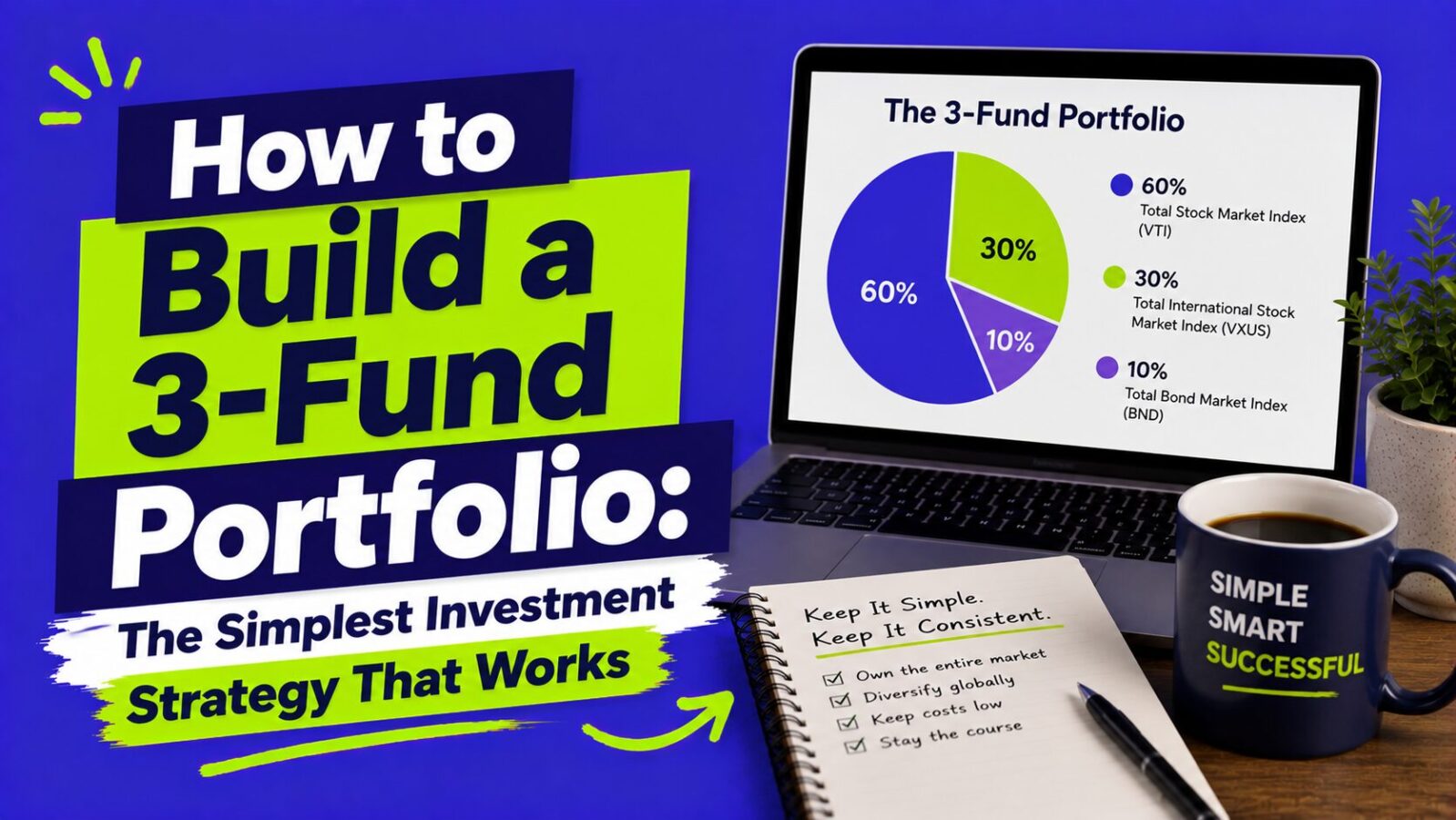
The 3-fund portfolio uses just three index funds to build a diversified, low-cost investment portfolio. Here is how to set one up, which funds to use, and why simplicity beats complexity.
Wall Street wants you to believe investing is complicated. That you need dozens of funds, alternative investments, sector bets, and a financial advisor charging 1% to manage it all. The 3-fund portfolio proves otherwise.
The 3-fund portfolio is a strategy popularized by the Bogleheads community (followers of Vanguard founder Jack Bogle). It uses exactly three low-cost index funds to give you exposure to the entire global stock and bond market. Three funds. Total diversification. Rock-bottom fees.
It is the investment strategy recommended by most financial independence writers, endorsed by Nobel Prize-winning economists, and used by millions of investors who understand that simplicity and low fees beat complexity and high fees over the long term.
- Three index funds cover every publicly traded stock and bond in the world: one US fund, one international fund, one bond fund.
- The blended expense ratio is roughly 0.03 to 0.07% per year — you pay $3 to $7 annually per $10,000 invested.
- Your allocation (how much of each fund) matters more than which specific fund you pick. 60/30/10 is a solid starting point for most investors in their 20s.
- Rebalance once per year. That is all the maintenance this portfolio ever needs.
- Hold bonds in tax-advantaged accounts (IRA, 401k). Hold stock index funds in taxable accounts for maximum tax efficiency.
What Is the 3-Fund Portfolio?
The 3-fund portfolio consists of three broad index funds:
1. US Total Stock Market Index Fund. Covers every publicly traded US company: large-cap, mid-cap, and small-cap. Roughly 4,000 stocks in one fund. Gives you exposure to the entire US economy including technology, healthcare, financials, energy, and every other sector.
2. International Total Stock Market Index Fund. Covers every publicly traded company outside the US: Europe, Asia, emerging markets, and everything else. Roughly 8,000 stocks. Diversifies you beyond the US so you are not 100% dependent on one country’s economy.
3. US Total Bond Market Index Fund. Covers US investment-grade bonds: government bonds, corporate bonds, and mortgage-backed securities. Roughly 10,000 bonds. Provides stability and income, and cushions your portfolio when stocks fall.
Three funds. Over 22,000 individual securities. Global diversification. The blended expense ratio is roughly 0.03 to 0.07%, meaning you pay $3 to $7 per year for every $10,000 invested. Compare that to the average actively managed mutual fund at 0.50 to 1.00% ($50 to $100 per $10,000), or a robo-advisor at 0.25% ($25 per $10,000).
Why Three Funds Instead of One or Ten?
Why not one fund? A single target-date fund is simpler and works perfectly in retirement accounts. But a 3-fund portfolio gives you control over your exact allocation, which matters for tax optimization and personal risk preferences. Target-date funds choose the allocation for you.
Why not ten funds? Adding more funds (REITs, small-cap value, emerging markets, commodities) increases complexity without meaningfully improving diversification. The US Total Stock Market fund already includes REITs and small-cap stocks. The International fund already includes emerging markets. Research from Vanguard shows that a globally diversified stock and bond portfolio captures the vast majority of available diversification benefits.
Three funds hit the sweet spot: maximum diversification, minimum complexity, lowest cost.
The Exact Funds to Use
At Fidelity
| Fund | Ticker | Expense Ratio |
|---|---|---|
| US Total Stock Market | FSKAX | 0.015% |
| International Total Stock Market | FTIHX | 0.06% |
| US Total Bond Market | FXNAX | 0.025% |
Fidelity also offers zero-expense-ratio versions: FZROX (US) and FZILX (International). Genuinely $0 in fund expenses — an excellent option.
At Schwab
| Fund | Ticker | Expense Ratio |
|---|---|---|
| US Total Stock Market | SWTSX | 0.03% |
| International Total Stock Market | SWISX | 0.06% |
| US Total Bond Market | SCHZ / SWAGX | 0.03% |
At Vanguard
| Fund | ETF | Mutual Fund | Expense Ratio |
|---|---|---|---|
| US Total Stock Market | VTI | VTSAX | 0.03% |
| International Total Stock Market | VXUS | VTIAX | 0.07% |
| US Total Bond Market | BND | VBTLX | 0.03% |
All three brokerages offer excellent, nearly identical options. Choose the brokerage where you already have accounts. There is no meaningful performance difference between Vanguard, Fidelity, and Schwab index funds tracking the same indexes.
Use the portfolio builder below to see your exact fund lineup and how to split your investment:
3-Fund Portfolio Builder
Choose your brokerage and risk profile to see your exact portfolio.
Step 1: Where do you invest?
Choosing Your Allocation
The allocation is the percentage you put in each fund. There is no single correct allocation, but here are guidelines based on age and risk tolerance:
- Aggressive (20s to early 30s): 60% US stocks / 30% International / 10% Bonds. This is 90% stocks, 10% bonds. Appropriate for investors with 30+ years until retirement. In a bad year, this portfolio can drop 30 to 40%.
- Moderate (mid-30s to mid-40s): 50% US stocks / 20% International / 30% Bonds. Less volatile but still strong long-term growth potential.
- Conservative (50s to early retirement): 40% US stocks / 15% International / 45% Bonds. Lower expected returns but much lower volatility as you approach the date you need the money.
The exact allocation matters less than having one and sticking to it. Picking 60/30/10 and staying in it through crashes is better than picking the “optimal” allocation and abandoning it the first time markets drop 25%.
On international allocation: A common debate is whether 30% international is too high. The US represents roughly 60% of global market capitalization, so a “market weight” international allocation would be around 40%. Many investors choose 20 to 30% international, which underweights the rest of the world slightly but reflects a home-country comfort level. Either is defensible. The worst choice is no international exposure at all.
See how your allocation grows over time:
Portfolio Growth Calculator
Model your 3-fund portfolio growth over time.
How to Rebalance
Rebalancing means restoring your target allocation when it drifts. If your target is 60/30/10 and a strong stock year pushed you to 70/25/5, rebalancing means selling some stocks and buying bonds until you are back at 60/30/10.
How often: Once per year is sufficient. More frequent rebalancing does not improve returns and increases transaction costs. Set a calendar reminder for January 1 each year.
In retirement accounts (401k, IRA): Sell the overweight asset and buy the underweight asset. No tax consequences since gains inside these accounts are tax-deferred or tax-free.
In taxable accounts: Avoid selling when possible — selling triggers capital gains taxes. Instead, direct new contributions toward the underweight asset class until you are back in balance. This method is slower but tax-free.
Asset Location: Which Fund Goes in Which Account
Asset location is the strategy of placing each fund in the account type that minimizes taxes. It does not change what you own — only where you own it.
Bonds belong in tax-advantaged accounts (IRA, 401k). Bond interest is taxed as ordinary income — up to 37% for high earners. Sheltering it in a Roth IRA or 401(k) means you never pay tax on that interest. If you hold BND in a taxable account, every quarterly dividend is an ordinary income tax event.
US and international stock funds belong in taxable accounts (if you have to choose). Stock index funds generate mostly qualified dividends (taxed at the lower 0 to 20% rate) and rarely distribute capital gains. They are inherently tax-efficient. Additionally, the foreign tax credit only applies to international funds held in taxable accounts — you lose it in an IRA.
In practice, most investors with only retirement accounts do not need to worry about this. Asset location matters most when you have both a taxable brokerage account and retirement accounts and are deciding where to put each fund.
Setting Up the Portfolio Step by Step
- Open a Roth IRA at Fidelity, Schwab, or Vanguard. This is your primary account for building the 3-fund portfolio.
- Decide your allocation. If you are in your 20s, start with 60/30/10 or even 70/30 with no bonds. Use the portfolio builder above.
- Buy the funds. Fidelity: FSKAX + FTIHX + FXNAX. Schwab: SWTSX + SWISX + SCHZ. Vanguard: VTI + VXUS + BND.
- Set up automatic monthly contributions. Choose a fixed dollar amount and split it according to your allocation percentages.
- Rebalance once per year. January 1 calendar reminder. Takes 10 minutes.
- Do nothing else. The 3-fund portfolio works because you leave it alone.
3-Fund Portfolio vs Target-Date Funds
Target-date fund advantages: Completely hands-off, automatically adjusts allocation as you age, no rebalancing needed, available in almost every 401(k).
3-fund portfolio advantages: Control over your exact allocation, potentially lower cost (Vanguard target-date funds cost 0.08 to 0.12% vs. 0.03 to 0.07% for the individual funds), ability to tax-optimize by holding different funds in different account types.
The verdict: For most people, a target-date fund in their 401(k) is the right default. The 3-fund portfolio shines in Roth IRAs and taxable accounts where you have full fund selection flexibility. Use both. Read our target-date fund guide to understand when each makes sense.
Common 3-Fund Portfolio Mistakes
Checking your allocation daily. You rebalance once per year. Daily checking creates anxiety and tempts you to make emotional decisions. Quarterly at most.
Abandoning the portfolio during a crash. The S&P 500 dropped 34% in March 2020. The correct response: keep contributing and rebalance by buying more stocks. The wrong response: selling and waiting for things to feel safer.
Choosing a target allocation that does not match your real risk tolerance. If a 30% portfolio drop would cause you to sell, an 80% stock portfolio is too aggressive regardless of what theory says. Choose the most aggressive allocation you can hold through a crash without abandoning the plan.
Not investing at all while optimizing the portfolio. Being invested in a 60/40 portfolio is infinitely better than waiting to perfect your asset allocation. Start now. Optimize later.
Frequently Asked Questions
Can I build a 3-fund portfolio with just $1,000?
Yes. Fidelity has $0 minimums on FSKAX, FTIHX, and FXNAX. You can invest any dollar amount, including fractional shares. At Schwab and Vanguard, ETF versions (VTI, VXUS, BND) also support fractional shares at most brokerages. There is no minimum balance required to start.
How much of my portfolio should be international?
The most common range is 20 to 40% of your stock allocation. The US represents roughly 60% of global market cap, so a strict market-weight approach would allocate about 40% to international stocks. Many investors prefer 20 to 30% for simplicity or a mild home-country bias. Either is fine. The worst outcome is zero international exposure, which makes your returns entirely dependent on the US market for decades.
What if my 401(k) does not offer these exact funds?
Most 401(k) plans do not have VTI or FSKAX specifically, but they almost always have a close equivalent — look for “Total Stock Market Index,” “S&P 500 Index,” “Large Cap Index,” or “Extended Market Index.” For international, look for “International Index” or “Foreign Stock.” For bonds, look for “Bond Index” or “Fixed Income.” Choose the lowest expense ratio option in each category.
Can I use ETFs and mutual funds interchangeably?
Yes, for the 3-fund strategy they are functionally identical. ETFs trade throughout the day like stocks; mutual funds price once at market close. In retirement accounts, mutual funds are often more convenient for automatic investing (your full contribution is invested at the next NAV). In taxable accounts, ETFs are slightly more tax-efficient. The difference is minor for most investors.
How often should I rebalance?
Once per year is the standard recommendation, and research suggests more frequent rebalancing does not improve returns. Some investors use a threshold approach instead — rebalance whenever any fund drifts more than 5 percentage points from its target (e.g., bonds drift from 10% to 15%). Either approach works. The key is not to rebalance too often, which triggers unnecessary taxes in taxable accounts.
What about taxes when I rebalance?
In tax-advantaged accounts (IRA, 401k), rebalancing has no tax consequences. In taxable accounts, selling a fund to rebalance can trigger capital gains taxes. To minimize this, redirect new contributions toward underweight funds rather than selling overweight ones. If you must sell, prioritize selling assets held more than one year to qualify for the lower long-term capital gains rate (0%, 15%, or 20% depending on income).
Is a 3-fund portfolio better than a target-date fund?
Not necessarily better — different. A target-date fund is simpler (one fund, done) and is ideal in a 401(k) where you have limited fund choices. The 3-fund portfolio gives you more control, slightly lower costs in some cases, and the ability to optimize asset location across accounts. For a Roth IRA or taxable brokerage where you have full fund selection, the 3-fund portfolio is worth the minimal added complexity.
Does the US total market fund overlap with the S&P 500?
Yes, significantly. The S&P 500 represents the 500 largest US companies and accounts for roughly 80% of the US total stock market by market cap. VTI (total market) and VOO (S&P 500) have had nearly identical returns over the past 20 years. The total market fund adds roughly 3,500 smaller companies to the 500 large ones. Either works as Fund 1 in your 3-fund portfolio — the difference in long-term performance is minimal.
The Bottom Line
The 3-fund portfolio is the simplest, cheapest, and most reliable investment strategy available to individual investors. Three funds. One annual rebalance. Rock-bottom fees. Total global diversification.
It will not beat the market. It will not make you rich overnight. It will give you broad market returns at the lowest possible cost over decades — which, as Warren Buffett has repeatedly shown, beats virtually every other strategy over the long term.
Open an account and build your 3-fund portfolio today
Ready to go deeper?
- Want to understand Fund 1 in depth? Read our S&P 500 index funds guide.
- Want to understand Fund 3? Read our bond investing guide.
- Want full automation instead? Read our target-date fund guide — one fund, zero decisions.