By
By 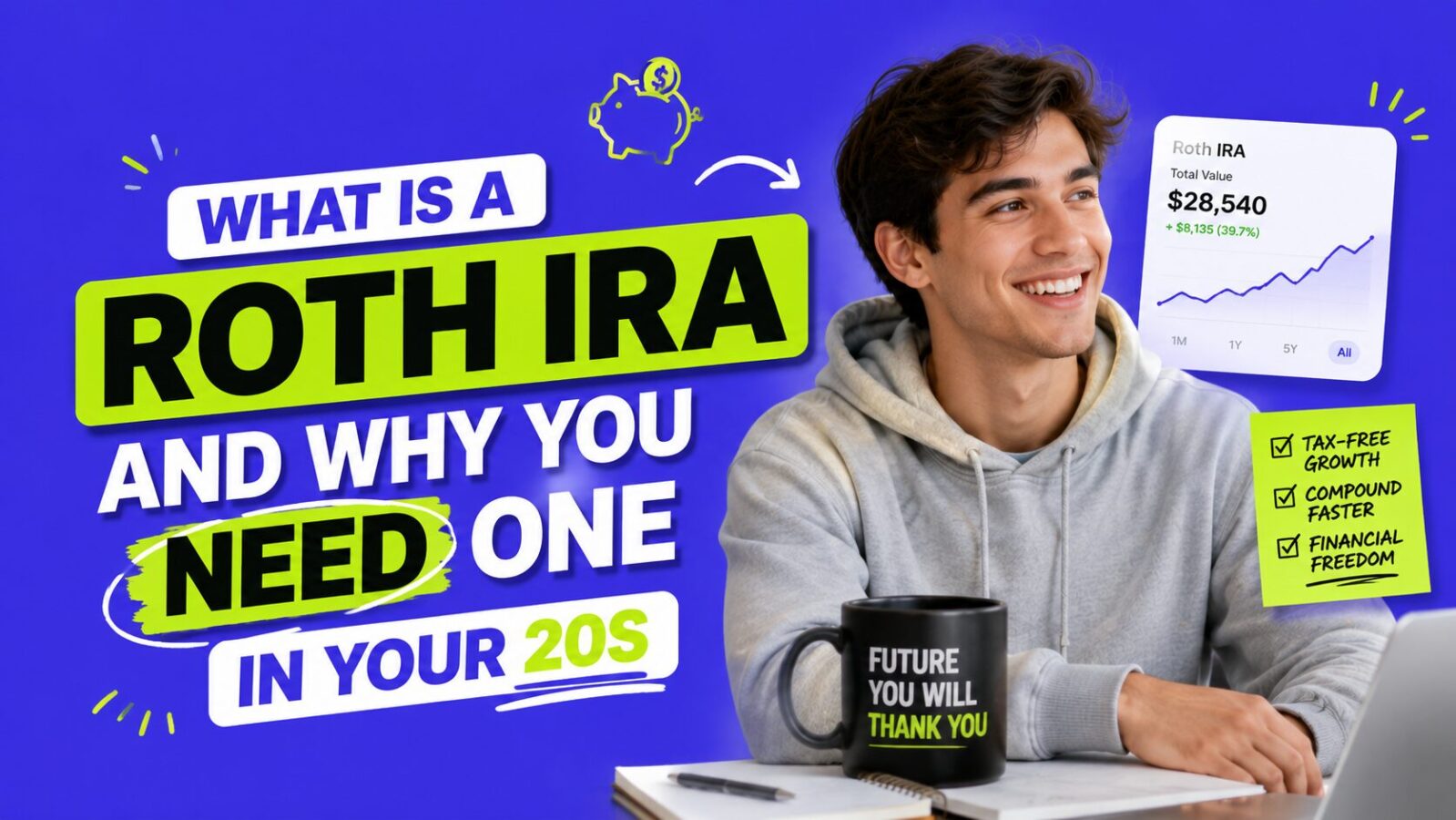
Disclosure: Some links on this page are affiliate links. We may earn a commission at no cost to you if you open an account through them. Our editorial content is not influenced by compensation. See our full disclosure.
A Roth IRA lets your money grow tax-free for decades. If you are in your 20s or 30s and have not opened one yet, you are leaving one of the biggest wealth-building advantages on the table.
If you could pick one financial account to open in your 20s, one that future-you would be most grateful for, it would be a Roth IRA. Not a savings account. Not a regular brokerage account. A Roth IRA. It is one of several retirement accounts worth understanding, and for most young people it is the one to prioritize after a 401(k) match.
The reason is simple: every dollar you put in now grows tax-free for the rest of your life. Not tax-deferred. Tax-free. You will never owe the IRS a cent on those gains, no matter how large they become. At 25, if you invest $500/month in a Roth IRA earning 7% average returns, by 65 you would have roughly $1.2 million, and you would owe zero federal tax when you withdraw it.
That is the deal. Here is how it works.
- A Roth IRA grows tax-free and your retirement withdrawals are tax-free. You pay tax on the money now, never again.
- For 2026 you can contribute up to $7,500, or $8,600 if you are 50 or older (IRS), as long as your income is under the phase-out ($153,000 single / $242,000 married).
- The order that works for most people: capture your full 401(k) match first, then fund the Roth IRA.
- You can withdraw your own contributions (not the earnings) anytime, tax-free and penalty-free, so the money is not locked away.
- Open one in about 10 minutes at Fidelity, Schwab, or Vanguard, then actually invest the cash in a 3-fund or target-date fund.
How a Roth IRA works
IRA stands for Individual Retirement Account. It is not a stock, not a mutual fund, and not a product from a specific company. It is a type of account with special tax rules set by the IRS. You open one at a brokerage (Fidelity, Schwab, Vanguard, SoFi), then buy investments inside it.
There are two types of IRAs. A Traditional IRA lets you deduct contributions from your taxable income now, but you pay taxes when you withdraw the money in retirement. A Roth IRA works in reverse: you pay taxes on your income now (no deduction), but every withdrawal in retirement is completely tax-free. For a deeper side-by-side, see Traditional IRA vs Roth IRA.
Traditional IRA: pay taxes later. Roth IRA: pay taxes now, never again.
For someone in their 20s or 30s earning $40,000 to $100,000, the Roth almost always wins. You are probably in the 12% or 22% tax bracket right now. By retirement, your investments will have grown massively, and tax rates may be higher. Paying 12 to 22% tax on a small amount today to avoid paying any tax on a large amount decades from now is one of the best financial deals available to ordinary people.
The numbers: why starting young matters so much
The power of a Roth IRA comes from time, not the amount you contribute. See for yourself:
Compound Interest Calculator
Start at 25, contribute $500/month for 40 years at 7%: Total contributions $240,000. Final balance roughly $1.2 million. Tax owed on withdrawal: $0.
Start at 35, contribute $500/month for 30 years at 7%: Total contributions $180,000. Final balance roughly $567,000. You contributed only $60,000 less but ended up with $650,000 less. That is the cost of waiting 10 years.
Start at 25, contribute just $250/month for 40 years at 7%: Final balance roughly $610,000. Even at half the contribution, starting at 25 beats starting at 35 with double the monthly amount. These figures are illustrative, not a forecast, and real returns vary year to year. The lesson holds: time wins.
2026 Roth IRA rules at a glance
Contribution limit: For 2026, $7,500 per year if you are under 50, or $8,600 if you are 50 or older (a $1,100 catch-up). Verify current limits at IRS.gov.
Income limits: For 2026, you can contribute the full $7,500 if your Modified Adjusted Gross Income (MAGI) is under $153,000 (single) or $242,000 (married filing jointly). Above those thresholds, the limit phases out. Above $168,000 (single) or $252,000 (married), you cannot contribute directly (IRS). The workaround is the Backdoor Roth IRA.
Age requirement: None. You can open a Roth IRA at any age as long as you (or your spouse) have earned income. Parents can even open a custodial Roth IRA for a teenager with a part-time job.
Withdrawal rules:
Contributions (the money you put in): withdraw anytime, tax-free, penalty-free. No restrictions. Earnings (the growth): withdraw tax-free and penalty-free after age 59.5, as long as the account has been open for at least 5 years. Early withdrawal of earnings: subject to income tax plus a 10% penalty, with some exceptions (first home purchase up to $10,000, qualified education expenses, disability).
The fact that you can pull out contributions anytime is a huge safety net. Your money is not locked away forever.
Roth IRA vs 401(k): which comes first?
This confuses a lot of people. The answer is both, in a specific order (we cover it in full in Roth IRA vs 401(k): which first in 2026):
Step 1: 401(k) up to employer match. If your employer matches 3% of your salary, contribute at least 3%. That match is an instant 100% return. Nothing beats free money. Read our full 401(k) guide for details.
Step 2: Roth IRA up to the $7,500 max. After securing the match, fund your Roth IRA. The investment options are better (you choose your own brokerage and funds), the fees are usually lower, and the tax-free growth is unbeatable.
Step 3: Back to 401(k). If you still have money to invest after maxing the Roth, increase your 401(k) contributions above the match level, up to the $24,500 annual limit for 2026.
Step 4: Taxable brokerage. For anything beyond that.
Most people in their 20s will not get past Step 2, and that is perfectly fine. Getting the employer match plus maxing a Roth IRA is already an excellent retirement strategy.
Roth IRA vs Traditional IRA: how to choose
The core question is: will your tax rate be higher now or in retirement?
Choose Roth if:
- You are in the 12% or 22% bracket now (most people in their 20s and 30s earning under $95,000 single)
- You expect your income to grow significantly over your career
- You want flexibility to withdraw contributions before retirement
- You want tax diversification in retirement
Choose Traditional if:
- You are in the 32%+ bracket now and expect much lower income in retirement
- You need the tax deduction this year to reduce your current tax bill
- You are very close to retirement and the growth window is short
For most readers in their 20s and 30s, the Roth tends to come out ahead. The decision depends on your own tax situation now versus later, so weigh both before you choose.
How to open a Roth IRA: step by step
The process takes about 10 minutes.
Step 1: Choose a brokerage. You want $0 account minimums, $0 commissions, fractional share support, and a clean interface. The top options for beginners are Fidelity (zero-expense-ratio funds, strong research tools), Schwab (excellent customer service, 300+ branches), and Vanguard (the original index fund company). If you want them compared head to head, see where to open a Roth IRA in 2026. Open an account at whichever platform you feel most comfortable with.
Step 2: Open the account. On the brokerage website or app, select “Open an IRA” and choose “Roth IRA.” You will need your Social Security number, date of birth, employer info, and a bank account to link. The process is straightforward.
Step 3: Link your bank account. Connect your checking account so you can transfer money in.
Step 4: Set up automatic contributions. Set a recurring transfer, ideally on payday. To max out $7,500/year, that is $625/month. If you cannot do that much, start with whatever you can. $100/month is fine. $50/month is fine. The amount matters less than the consistency.
Step 5: Buy investments. Your money sitting in a Roth IRA as cash earns almost nothing. You need to invest it. For beginners, a simple 3-fund portfolio works:
- 60% VTI (Vanguard Total US Stock Market ETF)
- 30% VXUS (Vanguard Total International Stock ETF)
- 10% BND (Vanguard Total Bond Market ETF)
Or buy a single target-date fund matching your expected retirement year (like Vanguard Target Retirement 2060 Fund). It automatically adjusts the stock/bond mix as you age. One fund, set it and forget it. Read our 3-fund portfolio guide for the complete setup.
Mistakes to avoid with your Roth IRA
Not investing the money after contributing. This is the number one mistake. People transfer money into a Roth IRA and leave it sitting as cash. The cash earns almost nothing. You must buy stocks, ETFs, or funds inside the account. Contributing and investing are two separate actions.
Overcomplicating the portfolio. You do not need 15 funds. Three index ETFs or one target-date fund is all a beginner needs. Complexity does not improve returns. It increases the chance you will make emotional mistakes.
Contributing more than the limit. The IRS limit is $7,500/year for 2026. If you accidentally put in more, you owe a 6% penalty on the excess for every year it stays in the account. If this happens, contact your brokerage promptly. They can process a “removal of excess contribution” before your tax filing deadline.
Not having earned income. You can only contribute to a Roth IRA if you (or your spouse, if filing jointly) have earned income (wages, salary, self-employment, tips). Investment income, rental income, and Social Security do not count. If you earned $4,000 from a part-time job, your max contribution for that year is $4,000, not $7,500.
Ignoring the income phase-out. For 2026, if your MAGI exceeds $153,000 (single) or $242,000 (married), your contribution limit starts shrinking. Check before contributing the full amount. If you are above the limit, use the Backdoor Roth IRA strategy.
Withdrawing earnings early. You can always withdraw contributions without penalty. But withdrawing earnings before age 59.5 (with the account open for at least 5 years) triggers income tax plus a 10% penalty. Do not touch the earnings before retirement unless you qualify for an exception.
Waiting until December to contribute. You can contribute for a tax year up until the tax filing deadline (usually April 15 of the following year). That means you have until April 15, 2027, to contribute for tax year 2026. But contributing in January of each year rather than waiting until April gives your money an extra 15 months of compound growth.
Frequently Asked Questions
Your Roth IRA passes to your named beneficiaries. Spouses can inherit it and treat it as their own with no required minimum distributions. Non-spouse beneficiaries must generally empty the account within 10 years, but withdrawals remain tax-free.
Yes. They are completely separate accounts, and contributing to a 401(k) does not affect your Roth IRA eligibility (only your income does). Having both is the standard setup: a 401(k) for the employer match and Roth IRA for tax-free growth and wider investment choice.
Start with whatever you can, even $50 or $100 a month. The most important thing is opening the account and building the habit. You can raise contributions as your income grows, and a small amount started early beats a large amount started later.
Yes. Self-employment income (freelance, 1099, small business) counts as earned income for IRA purposes. You may also want a SEP IRA or Solo 401(k) for higher contribution limits, up to 25% of net self-employment income.
The bottom line
The Roth IRA is one of the strongest retirement accounts for most people in their 20s and 30s: tax-free growth, tax-free withdrawals, flexible access to contributions, and no required minimum distributions. The earlier you open one and start contributing, the more powerful it becomes.
Open an account, contribute what you can, buy a total stock market index fund or target-date fund, set up automatic monthly contributions, and let time do the work.
Where to go next:
- New to all of this? Start with our hub, Retirement Accounts Explained, for the full account-by-account roadmap.
- Ready to open your account? Compare the top picks in where to open a Roth IRA in 2026, or read our Fidelity review, Schwab review, and Vanguard review.
- Earn too much for a direct Roth contribution? Read our Backdoor Roth IRA guide, a completely legal workaround available at any income level.
- Want the full investing roadmap? Our investing in your 20s guide covers the complete 401(k), Roth IRA, and taxable account sequence.
A quick note: this article is for educational purposes only and is not financial, investment, or tax advice. Contribution limits and income thresholds come from the IRS and apply to tax year 2026; verify current figures at IRS.gov before you act. Everyone’s situation is different, so it is worth talking with a qualified financial advisor or tax professional about yours.