 By
By 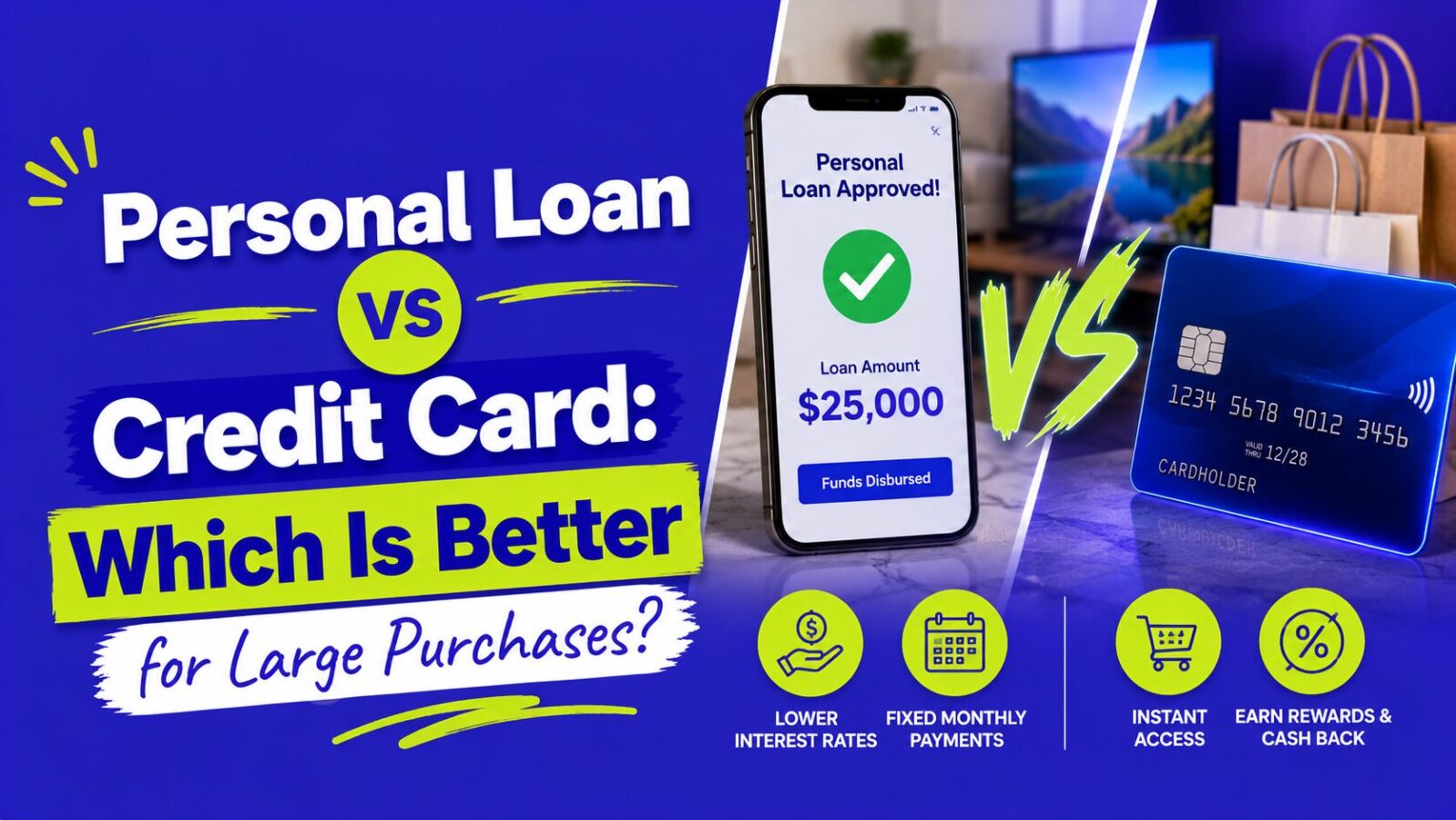
A personal loan is usually the better choice when you need months or years to repay a large purchase and can get a meaningfully lower APR. A credit card is usually better when you can pay the balance in full by the due date or use a true 0% introductory APR and repay it before the promotion ends.
There is no purchase amount where one option automatically wins.
The right comparison is:
APR + fees + payoff time + affordable monthly payment
A $5,000 purchase paid in full on a credit card may cost no interest. The same $5,000 carried for several years at a high card APR could cost far more than a lower-rate personal loan.
Personal loan vs. credit card at a glance
| Personal loan | Credit card |
|---|---|
| Closed-end installment loan | Revolving credit |
| Defined repayment period | No fixed payoff date unless you create one |
| Payments generally follow a set schedule | Required minimum varies |
| Interest rate can be fixed or adjustable | Purchase APR is often variable |
| May charge origination or other fees | Usually no origination fee for purchases |
| Does not count toward revolving utilization | Balance affects revolving utilization |
| No purchase rewards | May earn cash back, points, or miles |
| Generally no 0% purchase promotion | Some cards offer introductory 0% APR |
| Better for structured longer repayment | Better for pay-in-full or qualified 0% financing |
The CFPB describes personal installment loans as closed-end loans repaid in generally fixed installments over a specific period. The interest rate itself can be fixed or adjustable, so check the actual loan terms.
The simplest way to choose
Use this order.
1. Can you pay the credit card in full?
If yes, the credit card may be the cheapest option.
Most cards provide a grace period on purchases. If your card has one, you are eligible for it, and you pay the balance in full by the due date, you can generally avoid purchase interest.
In that situation, taking out an interest-bearing personal loan may add unnecessary borrowing costs.
2. Do you have a true 0% purchase APR?
If yes, calculate whether you can eliminate the balance during the promotional period.
Use:
Purchase amount ÷ months available = target monthly payment
If the payment comfortably fits your budget, a genuine 0% APR offer can be cheaper than a personal loan that charges interest.
3. Otherwise, compare the personal loan APR with the card APR
If the personal loan has a substantially lower all-in borrowing cost, it usually becomes more attractive as the repayment period gets longer.
Federal Reserve data available in 2026 illustrate why this comparison matters. The latest reported average rate for 24-month personal loans at commercial banks was 11.40%, while credit card accounts actually being assessed interest averaged 21.52%. Those are market averages, not rates any particular borrower is guaranteed to receive.
Your actual offers determine the winner.
Personal loans can have fees
Do not compare only the advertised interest rate.
Personal installment loans can include charges such as:
- origination fees;
- documentation fees;
- optional insurance products;
- late fees;
- other lender-specific charges.
The CFPB recommends reviewing the loan disclosures because these charges can increase the total borrowing cost.
For example, a personal loan with a lower interest rate may not be as attractive if a substantial origination fee reduces the amount you actually receive.
Before accepting a loan, check:
How much am I borrowing?
How much money will I actually receive?
What is the APR?
What is the monthly payment?
What is the total of all payments?
Those numbers are more useful than the advertised interest rate alone.
When a personal loan is better
I would lean toward a personal loan when all of these are true:
- you cannot pay the purchase off quickly;
- you do not have a workable 0% credit card offer;
- the loan’s APR is materially lower than the card APR;
- fees do not erase the rate advantage;
- the scheduled payment fits your budget.
The defined repayment structure can also be valuable.
A personal installment loan normally has a set repayment period and generally scheduled installment amounts.
A credit card does not force the same payoff schedule. You can make the required minimum payment and continue revolving the remaining balance.
That flexibility is convenient, but it can also make expensive debt easier to carry for longer.
If structure helps you actually eliminate the debt, that has real value.
When a credit card is better
A credit card makes the strongest case in two situations.
You can pay it in full
If you qualify for the card’s purchase grace period and pay the balance in full by the due date, you can generally avoid purchase interest.
You may also earn rewards or receive applicable card purchase protections.
But rewards should not drive the decision if you will carry the balance.
You can use a true 0% introductory APR
A genuine 0% purchase APR can provide a period during which qualifying purchases do not accrue interest under the promotion.
The key is building the payoff plan before making the purchase.
Suppose the balance is $6,000 and you have 15 months to repay it.
Your target is:
$6,000 ÷ 15 = $400 per month
If $400 is comfortable, the promotion may work.
If your budget supports only $200, the problem is not the reward rate or the credit card brand.
The purchase is too large for the intended payoff period.
Watch out for deferred interest
A true 0% APR offer and a deferred-interest offer are not the same thing.
Deferred-interest promotions often use language such as:
“No interest if paid in full within 12 months.”
Under these programs, interest may accumulate during the promotional period. If the qualifying balance is not paid in full by the deadline, that accrued interest can be charged under the offer’s terms.
That can create a much more expensive result than expected.
Before financing a large purchase, check whether the offer says:
0% introductory APR
or
No interest if paid in full
Do not treat the two phrases as interchangeable.
What about credit utilization?
A large credit card purchase can increase your revolving credit utilization.
FICO calculates revolving utilization using balances and credit limits reported for certain revolving accounts such as credit cards. Installment loans are treated differently and are not included in that revolving-utilization calculation.
For example, a reported $5,000 balance on a card with a $10,000 limit represents 50% utilization on that account.
Higher utilization can affect FICO Scores.
But this does not mean:
“Never go above 30%.”
FICO specifically says the data do not support a universal threshold where a score suddenly falls once utilization crosses 30%. Generally, lower revolving utilization is better, but the scoring impact depends on the rest of the credit profile.
Credit utilization should therefore be a secondary consideration.
Do not accept a substantially more expensive loan solely to manipulate one credit-score factor.
A personal loan can still affect your credit
A common misconception is that a personal loan avoids credit-score effects because it does not count toward revolving utilization.
That is too broad.
Installment debt still appears in the amounts-owed portion of the credit profile, while opening new credit can introduce other scoring factors.
The important distinction is narrower:
A personal loan balance is not revolving credit-card utilization.
That can matter if a very large card purchase would otherwise consume a substantial portion of your available revolving credit.
But borrowing primarily to protect a score usually puts the priorities backward.
Affordability and borrowing cost should come first.
Do credit card rewards change the answer?
Only when the financing cost remains low.
Suppose you put a $5,000 purchase on a card earning 2% cash back.
You earn:
$100
That is useful if you pay the balance without interest.
It is much less meaningful if you then carry thousands of dollars at a high APR.
The CFPB notes that most credit cards with purchase grace periods allow consumers to avoid purchase interest by paying the balance in full by the due date, while carrying a balance can cause interest to apply.
So I would use this rule:
Rewards break ties. They should not justify expensive borrowing.
What if you need to buy something immediately?
An existing credit card has one obvious advantage: the credit line is already available.
A new personal loan requires an application, approval, and funding.
But I would be cautious with the strategy:
“Put it on the card now and refinance it later.”
You cannot know in advance that a lender will approve a future personal loan or balance transfer at favorable terms.
If the purchase can wait, compare financing before taking on the debt.
If it is a genuine emergency and cannot wait, use the most manageable option available and evaluate refinancing afterward based on real offers, not assumed future approval.
Personal loan vs. credit card for home improvement
For a home project that will require a longer payoff period, I would compare personal loan offers first if you do not have an affordable 0% credit card option.
But the size of the renovation alone does not decide it.
A true 0% purchase APR may still be cheaper if:
- the project qualifies;
- the credit limit is sufficient;
- the required payoff payment fits your budget;
- you can eliminate the balance before the promotional period ends.
If you can pay a smaller project in full by the card’s due date, using a credit card may also be simpler.
For much larger renovations, other financing products may be relevant, but secured borrowing introduces different costs and risks and should be compared separately.
Personal loan vs. credit card for medical or dental bills
Before borrowing for medical or dental expenses, first check the bill itself.
Ask whether:
- the amount is correct;
- insurance processed the claim correctly;
- financial assistance is available;
- the provider offers an interest-free payment plan.
Borrowing should come after checking whether the underlying bill can be reduced or paid directly on better terms.
If outside financing is still necessary, use the same framework:
Pay in full if possible → evaluate true 0% financing → compare personal-loan APR and fees with the credit card APR.
How to compare your actual offers
Before deciding, put the real terms side by side.
Personal loan
Write down:
- amount borrowed;
- amount actually disbursed;
- APR;
- origination and other fees;
- monthly payment;
- repayment term;
- total of payments;
- fixed or adjustable rate.
The CFPB notes that personal installment loan rates can be fixed or adjustable and that the terms depend on factors including credit history, income, debt, loan amount, and loan length.
Credit card
Write down:
- purchase APR;
- current balance;
- whether you have a grace period;
- 0% promotional APR, if any;
- promotion end date;
- regular APR afterward;
- whether the promotion uses deferred interest;
- monthly amount required for your chosen payoff date.
Then answer one question:
Which option gives me the lowest realistic borrowing cost with a monthly payment I can consistently afford?
That is the comparison that matters.
Frequently asked questions
Is a personal loan better than a credit card for a large purchase?
Usually when you need a longer payoff period and can qualify for a materially lower APR after fees. A credit card can be better if you can pay in full or use a true 0% APR promotion with a realistic payoff plan.
Is a personal loan always cheaper?
No. Personal loans can carry high APRs and additional fees. Compare the actual loan disclosure with the credit card terms rather than assuming the loan is cheaper because it is an installment product.
Is 0% APR better than a personal loan?
It can be. If it is a genuine 0% purchase APR and you can repay the balance within the promotion, it may cost less than an interest-bearing personal loan.
Check carefully for deferred-interest language, which works differently.
Does a personal loan affect credit utilization?
It does not count toward revolving credit-card utilization in the same way a credit card balance does. It can still affect other parts of your credit profile.
Is 30% credit utilization a hard limit?
No. FICO says there is no universal 30% threshold that determines whether a credit score is good or bad. Lower revolving utilization is generally better, but the impact varies by credit profile.
Should I use a credit card just for the rewards?
Only if the financing still makes sense.
Rewards can add value when you pay in full or otherwise avoid expensive interest. They should not be used to justify carrying a high-APR balance.
The bottom line
Use a credit card when you can pay the purchase in full without interest or have a true 0% APR offer with a payoff plan you can comfortably follow.
Use a personal loan when you need longer to repay and the loan gives you a meaningfully lower all-in APR without unaffordable fees.
Do not make the decision based on arbitrary rules such as:
- “Use a loan above $3,000.”
- “A card is fine for anything under six months.”
- “Never cross 30% utilization.”
Instead:
Check pay-in-full first → check genuine 0% financing → compare personal-loan APR and fees → choose a realistic repayment period → make sure the payment fits your budget.
Current Federal Reserve data show why personal loans deserve a comparison when you would otherwise carry credit card debt: reported 24-month personal-loan rates at commercial banks have recently averaged well below the rates paid on credit card accounts being assessed interest. But averages do not decide your loan.
Your actual offer and your realistic payoff plan do.