 By
By 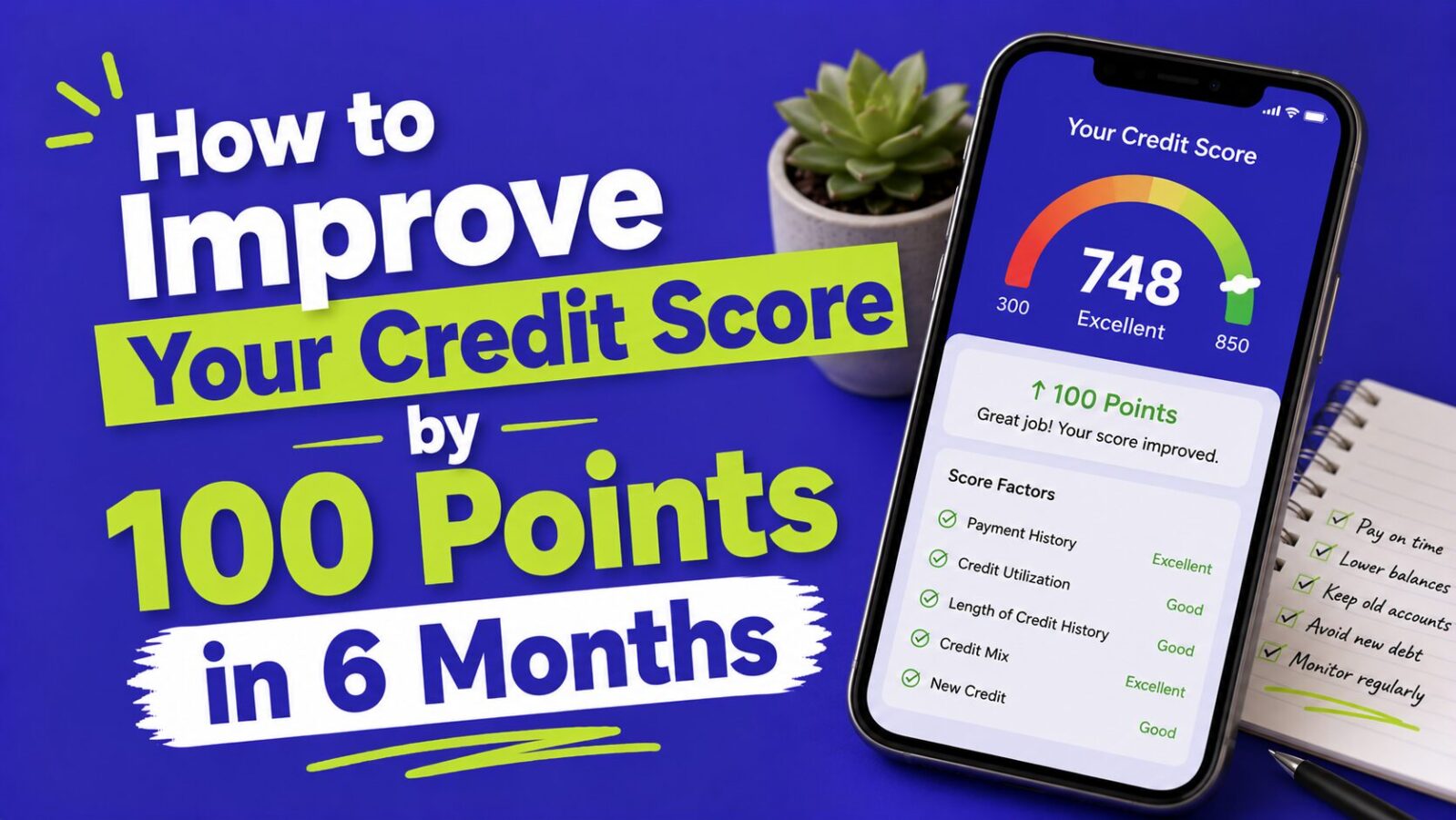
Improving your credit score by 100 points in 6 months is absolutely possible — without paying anyone $500 for “credit repair.” Here is the month-by-month playbook.
Let us get one thing out of the way: improving your credit score by 100 points in 6 months is absolutely possible. It is not a gimmick, and it does not require paying someone for “credit repair.” What it does require is understanding how credit scores actually work, then systematically doing the things that move the needle the most.
If your score is currently in the 500s or 600s, a 100-point jump is very realistic. If you are already at 750, getting to 850 is a different challenge — the higher your score, the harder it is to squeeze out additional points. But for most people reading this, especially those recovering from missed payments, high utilization, or thin credit files, 100 points in 6 months is an achievable goal.
- Payment history (35%) and credit utilization (30%) together control 65% of your FICO score. Mastering those two factors alone is the entire game for most people.
- Utilization has no memory — unlike a late payment that stays 7 years, paying down a balance changes your score at the very next reporting cycle (typically within 30 days). This is the fastest single lever available.
- Roughly 1 in 5 Americans have errors on their credit reports (FTC data). A false late payment removed through a dispute can add 50+ points immediately — free, takes 15 minutes per bureau.
- Becoming an authorized user on a family member’s long-standing, low-utilization card can add years to your average account age overnight — the fastest shortcut for thin credit history.
- Do not pay for credit repair. Everything a paid service does, you can do yourself for free: dispute errors directly with Equifax, Experian, and TransUnion at each bureau’s website.
First: understand what drives your credit score
| Factor | Weight | What it measures | Speed of change |
|---|---|---|---|
| Payment history | 35% | Have you paid your bills on time? | Slow (7 years for negatives) |
| Credit utilization | 30% | How much of your available credit are you using? | Fast (1 billing cycle) |
| Length of credit history | 15% | How long have your accounts been open? | Very slow (months and years) |
| Credit mix | 10% | Do you have different types of credit? | Moderate |
| New credit | 10% | Have you recently applied for new accounts? | Fast (3 to 6 months) |
Find your fastest path to improvement
What Is Your Biggest Opportunity?
Two questions to identify your highest-leverage action right now.
Step 1: What is your current credit score range?
Month-by-month playbook
Month 1: Audit and quick wins
Pull your free credit reports at AnnualCreditReport.com from all three bureaus. Review every account carefully for errors, wrong balances, and accounts you do not recognize. Dispute any inaccuracies directly with each bureau online — they have 30 days to investigate. Removing even one erroneous late payment can boost your score 20 to 50+ points. Sign up for free monitoring at Credit Karma. Check your exact utilization per card.
Month 2: Attack credit utilization
Credit utilization is the fastest-moving lever in your score. Changes show up within one billing cycle. Get each card below 30% (ideally below 10%). Pay before the statement closing date, not just the due date — the bureau captures your statement balance, not your end-of-month balance. Request credit limit increases from each issuer. On a $5,000 limit with a $2,000 balance, getting the limit raised to $8,000 drops utilization from 40% to 25% without paying a single dollar extra.
Month 3: Build positive payment history
Set up autopay on every credit card, loan, and bill for at least the minimum payment. This prevents late payments from torpedoing your score. Deal with existing late payments: call the creditor and ask for a goodwill adjustment if the late was isolated. For collection accounts, negotiate “pay for delete” in writing before you pay.
Month 4: Diversify and strengthen your profile
Become an authorized user on a family member’s long-standing card with perfect payment history. You inherit the full account history immediately without needing to use the card. If your credit is too low for regular cards, a secured credit card (Discover it Secured, Capital One Secured) builds payment history and upgrades automatically after 6 to 12 months. Consider a credit-builder loan from Self or a local credit union — adds an installment account and builds both credit mix and payment history.
Month 5: Advanced optimization
Use Experian Boost (free) to add utility, phone, and streaming payments to your Experian file. Can add 5 to 15 points to your Experian score. Keep old accounts open and active. Stop applying for new credit during this sprint — each hard inquiry drops your score a few points and each new account lowers your average age.
Month 6: Verify and maintain
Check your score across all three bureaus. Confirm dispute results from Month 1 were applied. Create an ongoing maintenance plan: keep utilization below 10% as your default, never miss a payment, check reports quarterly, only apply for new credit when you genuinely need it.
Realistic expectations by starting score
| Starting score | Typical 6-month target | Key levers |
|---|---|---|
| 450 to 550 | 550 to 650 | Disputes, collections, secured card |
| 550 to 650 | 650 to 750 | Utilization + disputes + consistent payments |
| 650 to 720 | 720 to 780 | Perfect utilization + spotless payment history |
| 720+ | Slower gains | Mainly time and ultra-low utilization |
Progress tracker
| Month | Experian | TransUnion | Equifax | Primary action taken |
|---|---|---|---|---|
| Month 1 | Pull reports, file disputes | |||
| Month 2 | Pay down balances, request limit increases | |||
| Month 3 | Set up autopay, goodwill letters | |||
| Month 4 | Authorized user, secured card | |||
| Month 5 | Experian Boost, stop new applications | |||
| Month 6 | Verify disputes, maintenance plan |
What NOT to do
Do not close credit cards. Even unused cards contribute to your available credit and account age. Closing them hurts utilization and history length.
Do not pay for credit repair services. Most charge hundreds of dollars to do things you can do yourself for free — mainly filing disputes. The FTC has shut down numerous credit repair scams.
Do not apply for multiple new accounts at once. Each application creates a hard inquiry and lowers your average account age. One or two maximum during a 6-month period, and only if they serve a clear purpose.
Do not ignore small collections. A $50 medical bill in collections can hurt your score almost as much as a $5,000 collection. Deal with small collections promptly.
Frequently Asked Questions
How long does it take to improve your credit score by 100 points?
For most people starting in the 500s or 600s, 100 points in 6 months is achievable by targeting the highest-impact factors: reducing credit utilization (shows up within 1 billing cycle), disputing errors (resolved in 30 to 45 days), and adding positive payment history. The exact timeline depends on your starting situation. Use the planner above to identify your specific highest-leverage action. For people starting above 700, a 100-point gain in 6 months is unlikely — the higher your score, the smaller the incremental gains.
What is the fastest way to raise my credit score?
The three fastest actions: (1) Pay down credit card balances to under 10% utilization — this can add 20 to 80 points within 30 days. (2) Dispute errors on your credit report — a removed false late payment can add 50+ points immediately. (3) Get added as an authorized user on a long-standing, low-utilization account — this can add years to your average account age overnight. These three actions can sometimes produce a 50 to 100 point improvement in 30 to 60 days depending on your situation.
Does checking my credit score lower it?
No. Checking your own credit score is a “soft inquiry” with zero impact on your score. Check it as often as you want through Credit Karma, your card issuer’s app, or Experian. Only “hard inquiries” — when a lender checks your credit for an application — affect your score, and only by 3 to 10 points temporarily. Checking your own score is not only safe but essential for tracking your improvement progress.
Can I really remove accurate negative items from my credit report?
Accurate negative items cannot be legally removed — that is why “credit repair” companies that promise to remove accurate information are largely scams. However, you can sometimes get accurate information removed through goodwill deletion: calling the creditor and politely asking them to remove an isolated late payment given your otherwise clean history. Many creditors will do this as a courtesy for long-standing customers, especially for one-off lates. Inaccurate information — errors, wrong amounts, accounts you do not recognize — can and should be disputed and removed.
Does paying off a collection account help my credit score?
It depends on which FICO model is being used. Under FICO 9 and FICO 10 (newer models), paid collections carry less weight than unpaid ones. Under FICO 8 (still widely used), paid and unpaid collections impact your score similarly. The best approach: negotiate “pay for delete” — you agree to pay the collection, and the collector agrees in writing to remove the account from your credit report. Not all collectors agree to this, but it is worth asking. Get any pay-for-delete agreement in writing before sending payment.
How do I dispute errors on my credit report?
Go to each bureau’s online dispute portal: Equifax (equifax.com), Experian (experian.com), and TransUnion (transunion.com). Select the inaccurate item, describe the error specifically, and submit any supporting documentation (bank statements, payment confirmations). The bureau has 30 days to investigate. If the creditor cannot verify the information, the bureau must remove it. You should dispute with all three bureaus separately — errors often appear on multiple reports. After 45 days, re-pull your report to confirm corrections were applied.
Will becoming an authorized user help my credit score?
Yes — significantly, if the primary account has a long history, perfect payment record, low utilization, and high credit limit. The entire account history appears on your credit report as if it were your own. A 10-year-old account with perfect payment history added to your report can increase your average account age substantially and demonstrate responsible credit use you have not yet established independently. The risks: if the primary cardholder misses payments or runs up high balances, it hurts your score too. Only become an authorized user with someone you trust completely, and confirm the issuer reports authorized user accounts to all three bureaus before proceeding.
Is Experian Boost actually worth it?
Yes, if your Experian score is lower than your other bureau scores and you have utility, phone, or streaming payment history to add. Experian Boost adds these payments to your Experian file, potentially adding 5 to 15 points. The process is free and takes about 5 minutes. The limitation: it only affects your Experian score, not TransUnion or Equifax. If a lender pulls your TransUnion or Equifax score, Experian Boost provides no benefit for that application. It is most useful if you know a specific lender pulls Experian or if you want to raise your Experian score for general monitoring purposes.
The bottom line
Improving your credit score by 100 points in 6 months comes down to a handful of high-impact actions done consistently:
- Dispute errors on your credit reports (Month 1)
- Slash credit utilization below 30%, ideally below 10% (Month 2)
- Make every payment on time, every time (Months 1 to 6)
- Become an authorized user on a strong account (Month 4)
- Add to your credit mix with a secured card or credit-builder loan (Month 4)
- Use Experian Boost for extra points (Month 5)
- Stop applying for unnecessary new credit during the process
Use the planner above to identify your specific highest-leverage action. There is no magic to it — credit scores are mathematical formulas, and the inputs are things you can directly control. Do the right things consistently for 6 months, and the score will follow.
Related reading:
- Want to understand your score in detail? Read our complete credit score guide — what each range means and the exact levers for your situation.
- Carrying high-interest debt that is limiting your paydown progress? Read our balance transfer guide — 0% APR for 15 to 21 months means every payment goes to principal.
- Ready to use credit cards strategically once your score improves? Read our best no-annual-fee cards guide — the best cards ranked by credit history and spending profile.