By
By 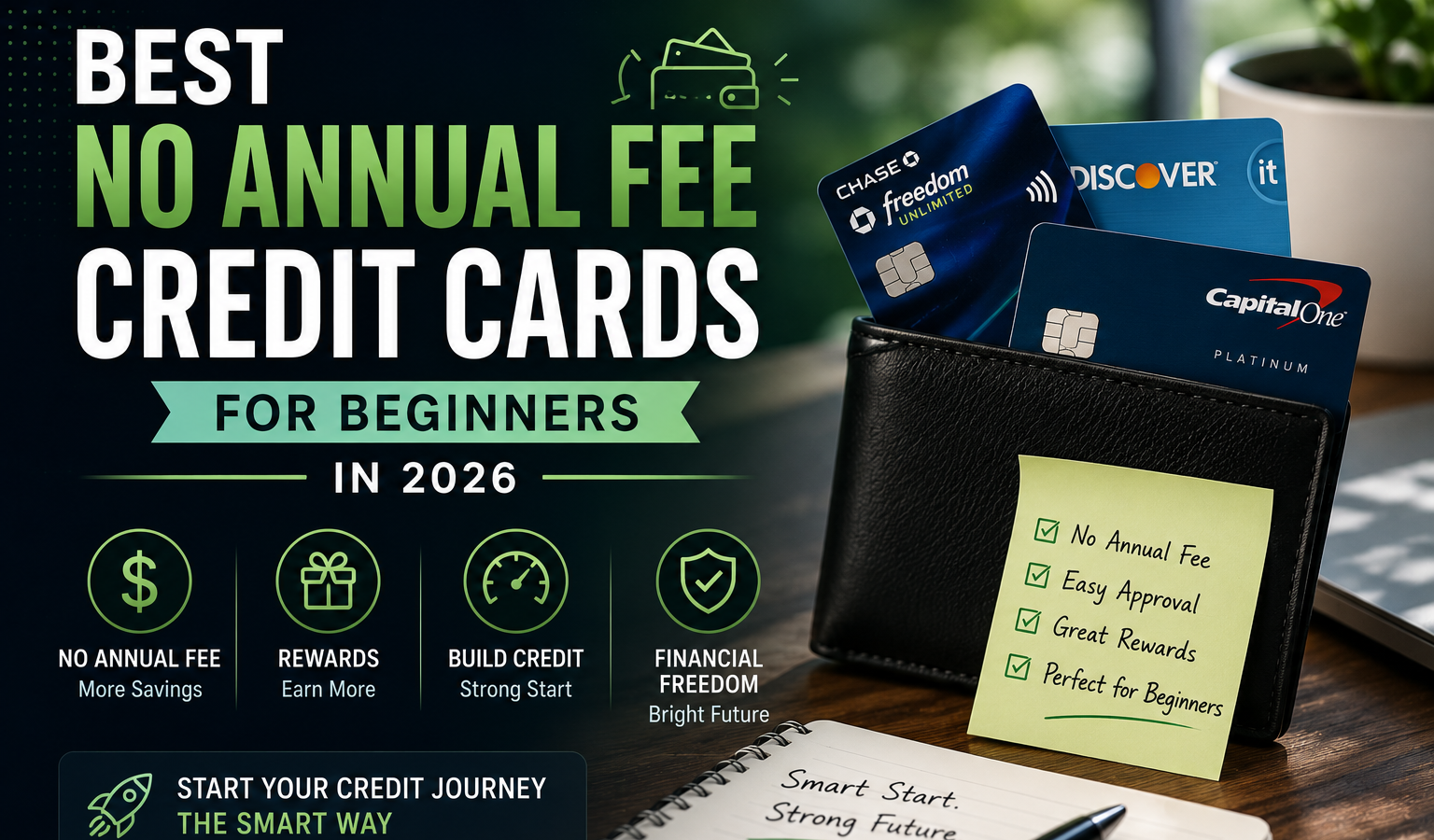
Your first credit card should cost you nothing to hold, build your credit score, and put cash back in your pocket. Here are the best no-annual-fee cards for beginners in 2026, ranked by real value.
A credit card is either the best or worst financial tool you will ever own. Used correctly, it builds your credit score, earns you free cash back on purchases you were going to make anyway, and gives you fraud protection that debit cards cannot match. Used incorrectly, it buries you in 22%+ interest debt.
The key to starting right: pick a card with no annual fee, reasonable rewards, and an approval threshold that matches your credit history. Then pay the full balance every single month. That is the entire strategy.
- No credit history? Discover it Cash Back is the only top card that reliably approves zero-history applicants, and its first-year Cashback Match (all rewards doubled) makes it one of the most rewarding starter cards available.
- The single most important rule: pay the full statement balance every month without exception. A 22%+ APR wipes out every dollar of cash back you earn and then some.
- Two cards are all you need to start: one category-bonus card (Discover, Chase Freedom Flex, or SavorOne) plus a flat 2% card (Citi Double Cash) for everything else. That combination captures 90% of the value with zero complexity.
- Keep credit utilization under 30% (ideally under 10%) at all times — even if you pay in full. High utilization hurts your score even when you carry no balance.
- Premium travel cards with annual fees only make sense after 1 to 2 years of responsible card use, a 700+ credit score, and enough annual spending to justify the fee.
How we ranked these cards
Every card was scored on five criteria weighted toward beginners:
Approval odds (30%). A card that requires 740+ credit is useless if you have a 650 or no credit history. We prioritized cards that approve thin-file and fair-credit applicants.
Reward rate (25%). Effective cash back on a typical spending mix: $800 groceries, $200 dining, $150 gas, $500 everything else per month.
Sign-up bonus (15%). Welcome offers valued on realistic spend, not inflated “up to” claims.
Fees and gotchas (15%). Foreign transaction fees, penalty APR triggers, balance transfer costs.
Credit-building features (15%). Free credit score access, automatic limit increases, graduation paths to better cards.
Our top 5 picks
1. Discover it Cash Back
Discover is the card most financial planners recommend as a true first card. They approve applicants with no credit history at all, including students and recent immigrants — most other issuers require 6 to 12 months of history.
You earn 5% cash back in rotating quarterly categories (groceries, restaurants, gas, Amazon, PayPal depending on the quarter) on up to $1,500 in purchases, and 1% on everything else. The real kicker: Discover matches all the cash back you earn in your entire first year. That effectively doubles your rewards to 10% and 2% for the first 12 months.
No annual fee. No foreign transaction fee. Free FICO score on every statement. If you are starting from zero, this is your card.
2. Chase Freedom Flex
The Freedom Flex offers one of the most generous reward structures among no-annual-fee cards: 5% on travel through Chase, 3% on dining and drugstores (always, not rotating), 5% on rotating quarterly categories, and 1% on everything else. For someone who eats out regularly or picks up prescriptions, the guaranteed 3% on dining and drugstores adds up fast.
The $200 sign-up bonus after $500 in 3 months is achievable on normal spending. Chase typically requires at least 1 year of credit history — if you are starting from zero, get the Discover first and add this 6 to 12 months later as your second card.
3. Bank of America Customized Cash Rewards
You pick one category at 3% cash back: gas, online shopping, dining, travel, drug stores, or home improvement. You earn 2% at grocery stores and wholesale clubs, and 1% on everything else. The combined 3% and 2% categories cap at $2,500/quarter. You can change your 3% category once per month — if you are road-tripping one month, switch to gas. If you are buying furniture, switch to home improvement.
4. Capital One SavorOne Cash Rewards
If dining, groceries, and entertainment are your biggest non-rent expenses — common for people in their 20s living in cities — the SavorOne hits all three at 3%. Capital One approves applicants with fair credit (640+), making this accessible to most beginners who have had at least one credit account for 6+ months. No foreign transaction fee makes it a good travel companion too.
5. Citi Double Cash
The Double Cash earns 2% on every purchase — no categories, no rotating quarters, no activation required. The highest flat-rate cash back with no annual fee. This is an excellent second card after building 6 to 12 months of history. Add it to complement a category-bonus primary card and earn 2% guaranteed on anything your primary does not cover at 3% or higher.
Which card earns the most for your spending?
Enter your typical monthly spending to see which card wins for your wallet:
Cash Back Earnings Calculator
Estimated annual cash back based on your spending. Rotating category bonuses shown separately. Not a guarantee of actual rewards.
Which card should you pick?
No credit history at all? Get the Discover it Cash Back. It is the only top card that reliably approves zero-history applicants, and the first-year Cashback Match makes it one of the most rewarding starter cards available.
6 to 12 months of credit history? Get the Chase Freedom Flex or Capital One SavorOne, depending on whether you spend more at drugstores or restaurants and groceries. Both have strong $200 sign-up bonuses.
Already have a starter card and want a second? Add the Citi Double Cash for a guaranteed 2% on everything your primary card does not cover at 3% or higher.
Want maximum control? The Bank of America Customized Cash lets you pick your own top category and change it monthly. Best if your biggest spending category does not fit the standard dining or grocery pattern.
You do not need more than two cards to start. One primary card with category bonuses and one flat 2% card for everything else captures 90% of the value with zero complexity.
How to use a credit card without going into debt
This section matters more than which card you pick. Credit card debt at 22%+ APR will destroy any cash back you earn.
Rule 1: Pay the full statement balance every month. Not the minimum. Not “most of it.” The full balance. Set up autopay for the full statement balance so you never miss. If you cannot pay the full balance, you are spending more than you earn and need to revisit your budget.
Rule 2: Keep utilization under 30%. Credit utilization is how much of your limit you are using. If your limit is $2,000, keep your balance under $600 at any time. For the best score impact, keep it under 10%.
Rule 3: Never use credit cards for cash advances. Cash advance APR is typically 25 to 30%, and interest starts immediately with no grace period.
Rule 4: Do not open cards just for the sign-up bonus. Each application creates a hard inquiry. Space applications 6+ months apart. Two to three cards in your first two years is plenty.
Rule 5: Do not close old cards. The age of your oldest account affects your credit score. Even if you stop using a card, keep it open (no annual fee = no reason to close it). Put one small recurring charge on it and set up autopay.
How credit cards build your credit score
Your FICO score (300 to 850) determines loan approvals, apartment applications, and future card approvals. A credit card is the fastest way to build it from scratch.
| Factor | Weight | What it means |
|---|---|---|
| Payment history | 35% | Paying on time every month. One missed payment can drop your score 50 to 100 points and stays 7 years. Set up autopay. |
| Credit utilization | 30% | Lower is better. Under 30% is acceptable, under 10% is ideal for maximum score. |
| Length of credit history | 15% | Older accounts help. Do not close old cards. Starting in your 20s gives you a head start. |
| Credit mix | 10% | Different types of credit (card, auto, student loan). Do not take out loans just for this. |
| New credit inquiries | 10% | Each application causes a small, temporary dip. Space applications 6+ months apart. |
With one credit card used responsibly for 6 to 12 months, most people can build a score above 700 — unlocking better cards, lower loan rates, and easier apartment approvals.
When to upgrade to a premium card
Premium cards (like Chase Sapphire Preferred at $95/year or Amex Gold at $250/year) offer higher rewards, travel perks, and bigger sign-up bonuses. But they only make sense when your credit score is 700+, you have mastered paying in full every month, and you spend enough that extra rewards exceed the annual fee.
For most people, that point comes 1 to 2 years after getting their first card. Until then, the no-annual-fee cards above provide 80% of the value at 0% of the cost.
Frequently Asked Questions
Will applying for a credit card hurt my credit score?
A hard inquiry typically drops your score 5 to 10 points for a few months — then it fully recovers. It is minor. The long-term benefit of building a credit history (payment history, length of history, credit mix) far outweighs the short-term inquiry dip. The bigger risk is applying for too many cards at once; space applications 6+ months apart to minimize the cumulative impact.
What is the easiest credit card to get approved for?
Discover it Cash Back and Capital One Platinum (a no-rewards starter card) both approve applicants with no credit history. If you have been denied at both, a secured credit card is your next step — you deposit $200 to $500 as collateral, which becomes your credit limit. Use it for small purchases and pay in full monthly. After 6 to 12 months, you will typically qualify for a regular unsecured card. Discover and Capital One both have graduation paths from secured to unsecured automatically.
Should I carry a small balance to build credit?
No. This is a myth that will not die. Carrying a balance does not help your credit score — it only costs you interest at 20%+ APR. Your score builds from on-time payments (35% of your score) and low utilization (30%), neither of which requires carrying a balance. Pay in full every single month. You still show utilization activity even when you pay in full, because the balance is reported to credit bureaus mid-cycle before you pay it.
How many credit cards should I have?
Start with one. Add a second after 6 to 12 months once you have demonstrated responsible usage. Two to three cards is the sweet spot for beginners: one primary card with category bonuses (Discover, Chase Freedom Flex, or SavorOne) and one flat-rate backup (Citi Double Cash). More than three adds administrative complexity without meaningful additional rewards until you are an experienced optimizer. Never open cards purely to maximize sign-up bonuses — the hard inquiries add up and the card management becomes a part-time job.
Can I get a credit card as a student or with no income?
Yes. Students can list scholarships, grants, work-study income, and parental support as income on applications. The CARD Act requires issuers to consider ability to pay, but income requirements are typically low — roughly $10,000 to $15,000 annual is sufficient for starter cards. Student-specific cards like Discover it Student are designed for this and offer the same rewards as the regular version. If you have no income at all, a secured card with a small deposit is the starting point.
What is a good credit utilization ratio?
Under 30% is the commonly cited guideline — below 30% of your total available credit limit. But for the best score impact, aim for under 10%. If your only card has a $1,000 limit, try to keep your reported balance under $100 whenever possible. One practical trick: pay your card balance once or twice mid-month (before the statement closes and before the balance is reported to bureaus) to keep the reported utilization low even if you spend more than 10% of your limit monthly.
Should I use a credit card or debit card for everyday purchases?
Credit card for almost everything, as long as you pay in full. Credit cards offer: cash back rewards (2 to 5% on purchases you were making anyway), zero-liability fraud protection (much stronger than debit), purchase protection and extended warranties on eligible items, and rental car insurance. Debit cards give you none of these and expose your actual bank account to fraud risk. The only reason to use a debit card is if you cannot trust yourself to pay the credit card balance in full — in which case, the card is the wrong tool until your budget is under control.
What happens if I miss a credit card payment?
A few things happen at once. The issuer charges a late fee (typically $29 to $41). If the payment is 30+ days late, it gets reported to credit bureaus and can drop your score 50 to 100 points — and stays on your report for 7 years. Some cards trigger a penalty APR (up to 29.99%) that can last 6 months or more. The fix: set up autopay for at least the minimum payment as a safety net (then manually pay more or the full balance each month). If you miss a payment, call the issuer immediately — first-time late fees are often waived for customers with otherwise clean histories.
The bottom line
Your first credit card is a credit-building tool first and a rewards card second. Pick one that matches your credit profile — Discover for no history, Chase or Capital One for 6+ months — pay the full balance every month without exception, keep utilization low, and let time do the rest.
The cash back calculator above shows which card actually wins for your spending. Run your real numbers before deciding. Use the card responsibly for 12 months and your credit score will be in a position to access much better options. The journey starts with one card, used correctly, starting now.
Next steps:
- Once your score hits 700+: Read our comparison of cash back vs travel rewards cards to decide whether upgrading to a premium card makes sense.
- Building your overall financial foundation? Read our 50/30/20 budget guide — a credit card is only a good tool if your budget ensures you can always pay in full.
- Want to understand your credit score in detail? See our credit score guide for how each factor is calculated and how to optimize it.