By
By 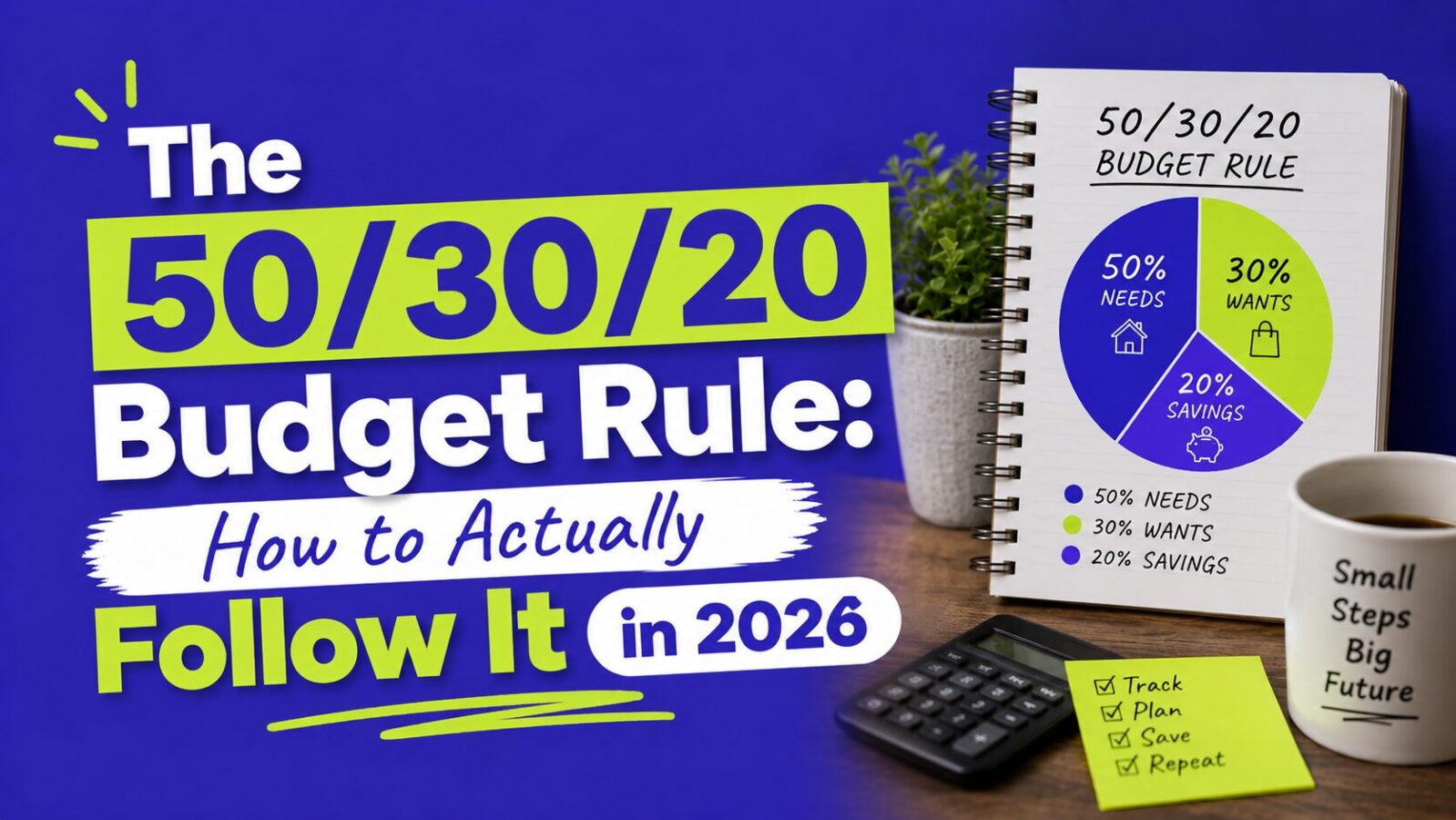
The 50/30/20 rule is the simplest budget that actually works. Here’s how to set it up with your real income, adjust it for expensive cities, and stick with it long enough to change your finances. (New to budgeting entirely? Start with our complete guide on how to budget, then come back here for the method itself.)
Most budgets fail within two months. They fail because they ask you to track every dollar, sort 47 spending categories, and feel guilty about buying coffee. That is not a budget. That is a punishment.
The 50/30/20 rule is different. It gives you three categories, one simple ratio, and enough flexibility to live your life while still building wealth. Senator Elizabeth Warren popularized it in her 2005 book “All Your Worth,” and two decades later it remains the most recommended starting framework by certified financial planners.
If you have never budgeted before, start here. If you have tried budgeting and quit, start here again.
- Split your after-tax pay into 50% needs, 30% wants, 20% savings and debt payoff.
- Use your take-home pay, not your salary, taxes are already removed.
- In expensive cities, shift to 60/20/20 but protect the 20% savings no matter what.
- Automate the 20% on payday so saving happens before you can spend it.
- It is a guideline, not a law, adjust the percentages to your real life.
What is the 50/30/20 rule?
Take your after-tax income (the number on your paycheck, not your salary). Split it into three buckets:
50% Needs. These are expenses you cannot avoid without serious consequences. Rent or mortgage, utilities, groceries, health insurance, minimum debt payments, transportation to work, and phone bill. If skipping it would get you evicted, fired, or sick, it is a need.
30% Wants. Everything that makes life enjoyable but is not survival. Restaurants, streaming subscriptions, gym membership, new clothes, concerts, vacations, that oat milk upgrade at the coffee shop. No guilt here. This money is meant to be spent.
20% Savings and debt payoff. Emergency fund contributions, retirement account contributions (Roth IRA, 401(k) above the minimum), extra debt payments beyond minimums, and investing. This is the bucket that builds your future.
That is the entire system. Three numbers. No spreadsheet with 50 rows. The key phrase is “after-tax income”, your take-home pay, the amount that actually hits your account after federal and state taxes, Social Security, Medicare, and payroll deductions.
See your 50/30/20 split in real numbers
Enter your monthly take-home pay below. The calculator shows exactly how much goes into each bucket.
50/30/20 Budget Calculator
Use the free Monthly Budget Spreadsheet alongside the calculator to track your actual spending against these targets month by month, or build your own with our budget spreadsheet guide.
50/30/20 at every income level
Actual take-home varies by state and circumstances. Use the IRS withholding estimator for a precise number.
| Annual salary (approx. take-home) | Needs (50%) | Wants (30%) | Savings (20%) |
|---|---|---|---|
| $30,000 (~$2,200/mo) | $1,100 | $660 | $440 |
| $50,000 (~$3,400/mo) | $1,700 | $1,020 | $680 |
| $75,000 (~$4,800/mo) | $2,400 | $1,440 | $960 |
| $100,000 (~$6,200/mo) | $3,100 | $1,860 | $1,240 |
At $30K the split is tight and usually requires roommates or a lower cost-of-living area. By $50K it starts to feel comfortable for most people. At $75K and above you have real flexibility, and at $100K you should consider pushing savings past 20% toward financial independence.
Step 1: Find your real take-home pay
Your take-home pay is the amount that actually hits your bank account after taxes, health insurance premiums, and pre-tax deductions. If you earn $55,000/year, your take-home might be around $3,500/month depending on your state and benefits. Check your most recent pay stub. For freelancers and gig workers, average your last 3 to 6 months, subtract 25 to 30% for taxes, and use that lower number. Full system: how to budget on an irregular income.
Step 2: List your needs (the 50%)
Go through your last two months of statements and pull out every true need: rent or mortgage, renter’s/homeowner’s insurance, utilities, groceries, health insurance, transportation to work, phone, minimum debt payments, and childcare. Add them up. If the total is under 50% of take-home, great. If it is over 50%, do not panic, we deal with that below.
The gray areas. Is Netflix a need? Want. Is internet a need? Need, if you require it for work. When in doubt, ask: “Would I face a real consequence within 30 days if I stopped paying this?” If no, it is a want.
Step 3: List your wants (the 30%)
This is the category people feel most conflicted about. Do not. The entire point of 50/30/20 is that you get to spend 30% on things you enjoy, guilt-free, as long as the other two buckets are covered. Dining out, streaming, shopping, hobbies, travel, coffee, gym, all wants. You do not need to cut wants to zero; you need to keep them at or below 30%. Going from 45% to 30% is completely doable once you see the numbers clearly. The best budgeting apps can track this category automatically.
Step 4: Automate the 20% savings
This is the most important step. On payday, before you spend anything, move 20% into savings and investments automatically. Where that 20% should go, in priority order:
- Emergency fund until you have 3 months of expenses. Use a high-yield savings account at 4 to 5% APY, here is how to build one fast.
- 401(k) employer match. If your employer matches 3%, contribute at least 3%. Free money.
- High-interest debt above 7%. Read: 3 proven methods to pay off credit card debt.
- Roth IRA up to $7,000/year (2026 limit). Tax-free growth for decades.
- Taxable brokerage for anything left over.
Do not forget predictable-but-irregular costs (insurance, car registration, holidays). Set up a sinking fund inside your savings bucket so they never blow up a month. For the bigger picture, see how to build wealth in your 20s.
What if your needs exceed 50%?
This is the most common problem, especially in expensive cities where rent alone can eat 35 to 40% of take-home. You have three realistic options:
Option A: Adjust the ratio temporarily. Use 60/20/20 or even 65/20/15. The 20% savings minimum matters more than the exact needs/wants split. Protect savings first, then squeeze wants before touching needs.
Option B: Increase income. A side hustle bringing in $500 to $1,000/month changes the math dramatically.
Option C: Reduce the biggest need. Housing is almost always the largest expense. A roommate, a cheaper neighborhood, or negotiating rent can save $300 to $800/month. If money is genuinely tight, our guide on budgeting on a low income has more tactics.
| Situation | Recommended split | Logic |
|---|---|---|
| Standard (starting point) | 50 / 30 / 20 | Needs / Wants / Savings |
| Expensive city (NYC, SF, LA) | 60 / 20 / 20 | Higher needs, cut wants |
| High-interest debt to pay off | 50 / 20 / 30 | Push 30% toward debt payoff |
| FIRE / aggressive saving | 30 / 10 / 60 | Slash wants to the minimum |
| Extreme cost of living | 65 / 15 / 20 | Protect the 20% savings no matter what |
50/30/20 vs other budgeting methods
Here is how 50/30/20 stacks up against the other popular methods at a glance, so you can tell quickly whether it is the right fit or whether another approach suits you better.
| Method | How it works | Effort | Best for |
|---|---|---|---|
| 50/30/20 | Split take-home pay 50% needs, 30% wants, 20% savings and debt | Low | Beginners who want simple structure |
| Zero-based | Assign every dollar a job until income minus expenses = 0 | High | Paying off debt, detail lovers |
| 80/20 | Save 20% first, spend the other 80% freely (no needs/wants split) | Very low | People who hate categories but still want to save |
| Envelope / cash stuffing | Put a set amount in labeled envelopes; stop when one is empty | Medium | Chronic overspenders in specific categories |
vs zero-based budgeting: A zero-based budget assigns every single dollar a job, down to the penny. More detailed and hands-on. Choose 50/30/20 for simplicity; choose zero-based for maximum control.
vs the 80/20 rule: The 80/20 rule saves 20% and spends the other 80% however you want, without distinguishing needs from wants. Choose 50/30/20 if you tend to overspend on non-essentials.
vs the envelope method: The envelope method uses cash divided into labeled envelopes. Choose 50/30/20 if you mostly use cards and digital payments. Some apps built for the 50/30/20 rule now offer digital envelopes that combine both.
The subscription audit: a quick win
Open your bank statement and list every recurring subscription. Most people discover $50 to $150/month in subscriptions they forgot about or barely use, duplicate streaming services, lapsed free trials, unused gym memberships. Cancel anything you have not used in the past 30 days. You can always re-subscribe. This alone might free up enough to hit your 20% savings target.
How to track without losing your mind
The two-account method. On payday, auto-transfer 20% to savings and 50% to Account A for needs. The remaining 30% stays in Account B for wants. When Account B runs dry, you are done for the month. No spreadsheet needed.
The weekly check-in. Every Sunday, spend 5 minutes in your bank app. Roughly on track? Five minutes a week is enough.
The app approach. Apps like YNAB, Copilot, or Monarch Money auto-categorize transactions against 50/30/20 targets. See our best budgeting apps for the 50/30/20 rule for the full comparison. Pick whichever method sounds least annoying, the best tracking system is the one you actually use.
Real example: $4,200/month take-home
Meet Alex, 27, software QA analyst in Austin. Take-home: $4,200/month.
Needs (target $2,100 / actual $2,080): Rent $1,200. Car payment $280. Car insurance $140. Utilities $120. Groceries $220. Phone $45. Health insurance $75.
Wants (target $1,260 / actual $1,190): Dining out $350. Gym $50. Streaming $40. Shopping $200. Going out $250. Subscriptions/misc $150. Travel fund $150.
Savings (target $840 / actual $930): 401(k) $500 (incl. match). Roth IRA $250. Emergency fund $180.
Alex is actually saving 22%, slightly above target. Some months dining creeps up and travel fund drops. That is normal. The point is the overall pattern, not perfection in any single month.
Common mistakes with 50/30/20
Counting minimum debt payments as savings. Minimums are needs. Only extra payments above the minimum count toward the 20%.
Being too strict too fast. Going from no budget to a perfect split overnight is like going from no exercise to a marathon. Start by tracking for one month, then adjust gradually.
Ignoring irregular expenses. Car registration, annual subscriptions, holiday gifts. Add up yearly irregular expenses, divide by 12, and save that monthly in a sinking fund.
Treating the 30% as a minimum. It is a ceiling for wants, not a target. Happy spending 20% on wants and saving 30%? Even better.
When to graduate from 50/30/20
The 50/30/20 rule is a starting framework, not a permanent destination. Once budgeting is a habit, you might shift to more aggressive saving. Many people graduate to zero-based budgeting for more control, or, in the FIRE community, save 40 to 60% of income. But if you are not budgeting at all, getting to a consistent 50/30/20 split is a massive win.
Frequently asked questions
Yes, but base it on your lowest expected monthly income, not your best month. In good months, the extra goes straight to savings. In lean months, you are already budgeted for the lower amount. Our guide to budgeting on an irregular income covers the full system.
Always net (after-tax take-home pay). Using gross income would mean budgeting money you never actually receive.
Consider a temporary 50/20/30 flip: 50% needs, 20% wants, 30% debt payoff and savings. Once high-interest debt is gone, return to the standard split.
The exact percentages were designed for a different cost-of-living era, and many planners now suggest 60/20/20 for high-cost cities. The principle, separate needs, wants, and savings into clear buckets with hard limits, is timeless. Adjust the numbers to your situation.
Absolutely. Combine both take-home incomes into one number and apply the same percentages. The only extra step is agreeing on what counts as a need versus a want.
The bottom line
The 50/30/20 rule works because it is simple enough to actually follow. Three numbers, one auto-transfer on payday, five minutes a week. Start this week: look at your last paycheck, calculate your three buckets, set up one auto-transfer to savings, and cancel two subscriptions you forgot about. That is the whole first month. Build from there.
- New to budgeting? Read our complete how to budget guide for the full 5-step framework.
- Want more structure? Try our zero-based budget guide.
- Download the template: the free Monthly Budget Spreadsheet is pre-built around 50/30/20.