By
By 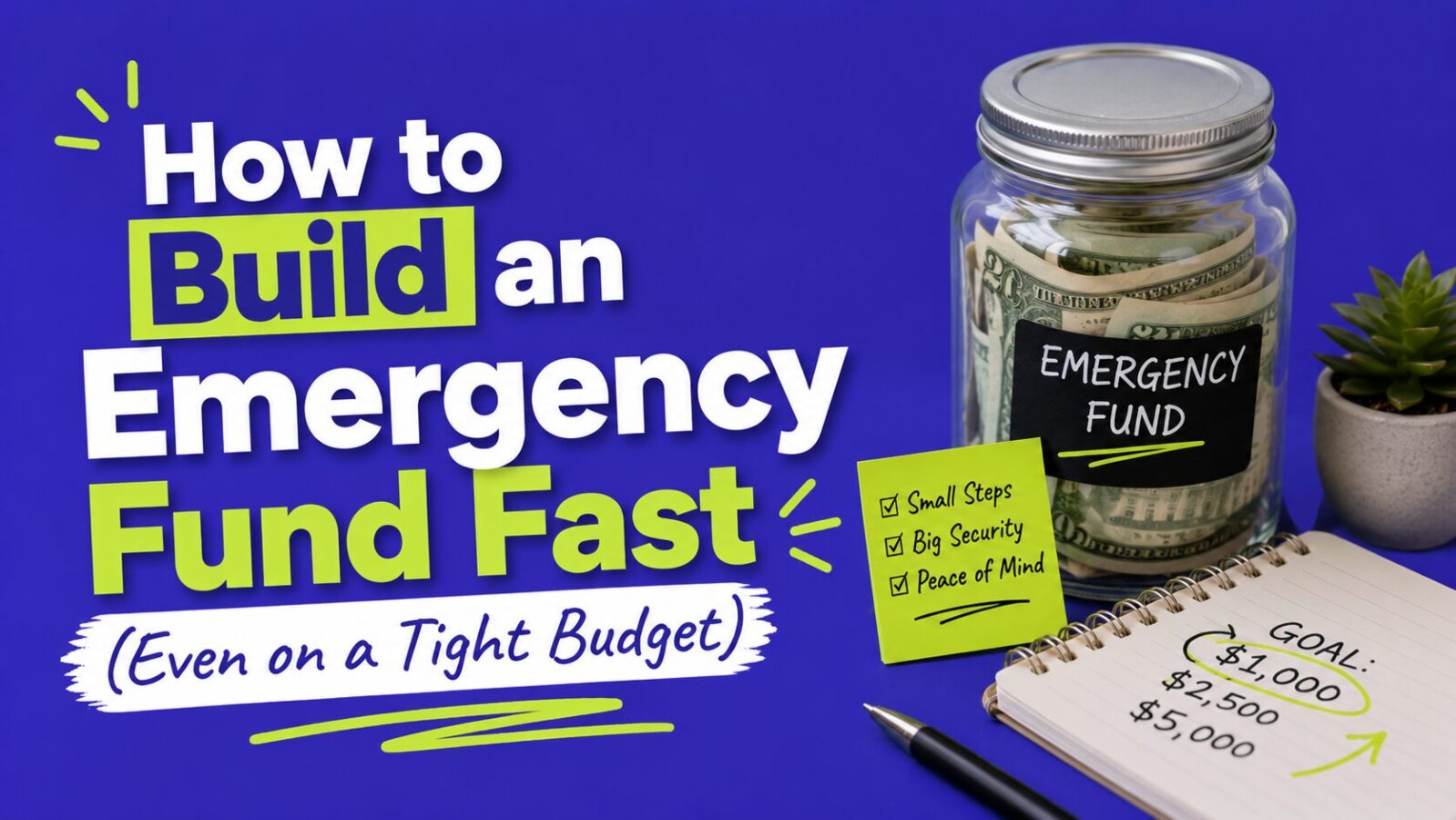
An emergency fund is the difference between a bad month and a financial disaster. Here’s how to save 3 months of expenses fast, even if you’re living paycheck to paycheck.
An emergency fund is a core step in any budget; see where it fits in our how to budget guide.
A 2025 Bankrate survey found that 56% of Americans cannot cover a $1,000 emergency with savings. Not a $10,000 emergency. One thousand dollars. A single car repair, one ER visit, one surprise job loss, and more than half the country is reaching for a credit card or borrowing from family.
An emergency fund fixes this. It is not exciting. It will not make you rich. But it is the single most important financial step you can take before investing, before paying extra on debt, before anything else. Every piece of financial advice starts with “build an emergency fund first” for a reason: without one, every other financial plan falls apart the moment life goes wrong.
The Federal Reserve’s annual survey of household well-being consistently finds a large share of Americans could not cover an unexpected expense from savings. Here is how to build yours as fast as possible.
How much emergency fund do you actually need?
The standard advice is 3 to 6 months of essential expenses. Not 3 to 6 months of income. Essential expenses. That means rent, utilities, groceries, insurance, minimum debt payments, transportation, and phone. Not dining out, not subscriptions, not shopping.
For most single people in their 20s, essential monthly expenses fall between $2,000 and $3,500 depending on location. Your target emergency fund is roughly $6,000 to $10,500 for 3 months, or $12,000 to $21,000 for 6 months.
That might sound overwhelming. It is not, once you break it into stages.
Stage 1: $1,000 starter fund. This covers most single emergencies (car repair, appliance replacement, minor medical bill). Get here as fast as possible. Weeks, not months.
Stage 2: 1 month of expenses. Covers a brief job gap or a larger emergency. Target: 1 to 3 months to reach.
Stage 3: 3 months of expenses. The minimum recommended cushion. This is your real target. Most people can reach this in 6 to 12 months with consistent effort.
Stage 4: 6 months of expenses. For people with irregular income (freelancers, gig workers, commission-based jobs) or single-income households. Build this after Stage 3 is solid.
You do not need to reach Stage 4 before you start investing. Once you have Stage 3, you can invest and continue building toward 6 months simultaneously.
Where to keep your emergency fund
Your emergency fund needs to be:
- Accessible within 1 to 2 business days (not locked in a CD or brokerage account)
- Earning real interest (not sitting in a checking account at 0.01%)
- Separate from your spending money (out of sight, out of mind)
The answer is a high-yield savings account (HYSA). As of early 2026, the best HYSAs pay 4 to 5% APY. On a $10,000 emergency fund, that is $400 to $500 per year, compared to roughly $1 in a traditional bank savings account.
Top options right now: SoFi (4.50% APY with direct deposit), Marcus by Goldman Sachs (4.40% APY), Ally Bank (4.20% APY), and Capital One 360 Performance Savings (4.25% APY). All are FDIC-insured up to $250,000, all have $0 minimums, and all allow free transfers to your checking account.
Do not keep your emergency fund in the stock market. Stocks can drop 30% in a month. If you lose your job during a market crash (which is exactly when layoffs tend to happen), your emergency fund could be worth 30% less right when you need it most. The whole point of this money is that it is safe and available.
How to save $1,000 in 30 days (Stage 1)
This is a sprint, not a marathon. Here are concrete ways to find $1,000 fast:
Sell things you do not use. Walk through your apartment. Old electronics, clothes you have not worn in a year, furniture, textbooks, unused fitness equipment. Facebook Marketplace, Poshmark, OfferUp, and eBay can turn clutter into cash within days. Most people have $200 to $500 of sellable items they have forgotten about.
Cancel and pause subscriptions. Use our Subscription Audit Spreadsheet to list every recurring charge. Most people find $50 to $150/month in subscriptions they barely use. Cancel for now and resubscribe later.
Redirect one paycheck’s “want” money. If you follow the 50/30/20 rule, your wants budget is 30% of take-home. For one month, cut that to 15% and send the rest straight to savings. On a $4,000/month take-home, that is $600 in a single month.
Pick up a quick gig. Donate plasma ($50 to $75 per session, up to twice a week). Drive for DoorDash or Uber on weekends. Freelance using a skill you already have. A focused two-week push can generate $300 to $800.
Negotiate one bill. Call your car insurance, phone plan, or internet provider. Say: “I’m looking at switching to [competitor]. Can you match their rate?” Average savings: $20 to $50/month.
Combine two or three of these strategies and $1,000 in 30 days is realistic even on a tight budget. Tight on income? Our guide on how to budget on a low income has more ways to free up cash.
How to reach 3 months of expenses (Stages 2 and 3)
After the initial sprint, switch to a sustainable pace.
Automate a fixed transfer on payday. Set up an automatic transfer from your checking account to your HYSA on the same day you get paid. Before you see the money, before you can spend it. Start with whatever you can sustain: $100, $200, $400 per paycheck. Increase by $25 every month.
Use the “pay yourself first” rule. Savings is not what is left over after spending. Savings is the first expense you pay, every paycheck, no exceptions. Treat it like rent.
Bank every windfall. Tax refund, work bonus, birthday money, rebate checks, side gig income. All of it goes into the emergency fund until you hit your target. The average US tax refund is around $3,100, more than a full month of expenses for many people.
Use round-up savings. Apps like Acorns and Chime round up every purchase to the nearest dollar and save the difference. Adds $20 to $40/month on autopilot with zero effort.
Track your progress visually. Use our free Savings Goal Tracker to color in each $500 milestone. Visual progress keeps you motivated longer than any spreadsheet of numbers.
The math: how fast can you build 3 months?
Assuming $2,500/month in essential expenses, your Stage 3 target is $7,500:
| Monthly savings | Time to reach $7,500 |
|---|---|
| $200/month | ~37 months |
| $400/month | ~19 months |
| $600/month | ~13 months |
| $400/month + $3,000 tax refund | ~11 months |
Use the calculator below to see your personal timeline:
Emergency Fund Calculator
Common excuses (and honest answers)
“I cannot afford to save anything.” If you earn income and have any discretionary spending at all (eating out, subscriptions, shopping), you can redirect some of it. Even $50/month is $600/year. Start insultingly small. The habit matters more than the amount.
“I will just use my credit card for emergencies.” A credit card is not an emergency fund. It is a high-interest loan. A $2,000 emergency on a card at 22% APR costs $440/year in interest alone if you pay only minimums. Your emergency fund costs nothing and earns 4.5% in a HYSA.
“The stock market returns more than 4.5%.” True over decades. Not true over 6 months when you might need the money. Your emergency fund is not an investment. It is insurance.
“I have too much debt to save.” Save a $1,000 starter fund first, even while paying debt. Without that cushion, one unexpected expense puts you deeper in debt. After $1,000, focus on crushing high-interest debt. See our investing in your 20s guide for the debt vs. invest priority stack. Then resume building to 3 months.
“My income is too irregular to automate.” Save a percentage instead of a fixed dollar amount. Every time money comes in, transfer 15 to 20% immediately. Freelancers actually need a larger emergency fund (6 months instead of 3) because income gaps are part of the job. See our full guide: How to Budget on an Irregular Income
What counts as an emergency?
Real emergencies (use the fund):
- Job loss or significant income reduction
- Medical bills not covered by insurance
- Car repair needed to get to work
- Emergency home repair (broken pipe, failed furnace)
- Unexpected travel for a family emergency
- Emergency pet care
Not emergencies (do not use the fund):
- A sale on something you want
- A vacation opportunity
- Holiday gifts
- A new phone because yours is slow
- Concert tickets that just went on sale
- Moving to a nicer apartment
The test: “Is this unexpected, urgent, and necessary?” All three must be true. If it is not unexpected, budget for it separately. If it is not urgent, save for it in a sinking fund. If it is not necessary, it is a want.
After you hit 3 months: what next?
Keep the fund in the HYSA. Do not move it. Do not invest it. Let it sit there earning 4 to 5% and being boring. That is its job.
Redirect the savings automation to investing. The same auto-transfer that built your emergency fund now goes into your Roth IRA or brokerage account. You already have the habit. Just change the destination.
Consider building to 6 months if you are a freelancer, self-employed, single-income household, or work in a volatile industry.
Replenish immediately if you use it. If a real emergency drains your fund, pause investing and rebuild the fund first. The safety net is always priority number one.
Frequently asked questions
Yes, ideally. Keeping it at a different bank than your checking account adds a small friction barrier that prevents impulsive spending. The 1 to 2 business day transfer time is actually a feature, not a bug. It gives you time to ask “is this really an emergency?”
Virtually none. FDIC insurance covers up to $250,000 per depositor per bank. Your money is guaranteed by the federal government. The interest rate can change (it floats with the Fed rate), but your principal is always safe.
Yes. Money market accounts offer similar rates to HYSAs with the added convenience of check-writing and sometimes a debit card. Either option works. See our HYSA vs CD vs Money Market guide for the full comparison.
No. The entire point is certainty. Even a “conservative” bond fund can lose 5 to 10% in a bad year. Keep 100% of your emergency fund in a HYSA or money market account. Invest other money separately.
Move it to a HYSA today. Open a HYSA, link your current bank, initiate a transfer. Takes 10 minutes. You will earn $400 to $500 more per year on the same money with zero additional risk.
The bottom line
An emergency fund is not glamorous. But it is the foundation that makes every other financial move possible: investing, paying off credit card debt, changing careers, buying a home. Without it, you are one bad month away from financial crisis.
Start today. Open a high-yield savings account, automate a transfer on your next payday, and sell one thing you are not using. Get to $1,000 as fast as you can, then keep going until you hit 3 months of expenses. Future you will be grateful.
Ready to go further?
- Hit your emergency fund target? Read our Roth IRA guide, that is the next account to open after your emergency fund is funded.
- Need help tracking your progress? Download the free Savings Goal Tracker and set your $7,500 target today.
- Want the full financial roadmap? Read our investing in your 20s guide for the complete account priority sequence.