By
By 
Student loan refinancing can save you thousands of dollars in interest, or it can cost you valuable federal protections you will never get back. The difference comes down to your specific situation. This guide breaks down exactly how to refinance student loans, when it is a smart move, when it is a bad idea, and how to walk through the process step by step.
Key Takeaways
- Refinancing replaces your loans with a new private loan at a lower rate, ideally saving thousands in interest.
- Refinancing federal loans into a private loan permanently forfeits income-driven repayment, forgiveness, and federal forbearance.
- Refinance only with strong credit, stable income, and no plans to use federal benefits.
- Always compare offers from several lenders, and never refinance federal loans you might want forgiven.
What Does Refinancing Student Loans Actually Mean?
Refinancing means taking out a new private loan to replace one or more existing student loans. The new loan pays off your old loans, and you move forward with a single loan, ideally at a lower interest rate or with better terms.
Key points to understand upfront:
- Refinancing always results in a private loan. Even if your original loans are federal, the refinanced loan is private.
- It is different from consolidation. Federal Direct Consolidation combines federal loans into one federal loan, keeping federal benefits intact. Refinancing moves everything to a private lender.
- You can refinance both federal and private loans. But whether you should refinance federal loans is a very different question (more on that below).
When Refinancing Makes Sense
Refinancing is a strong move under the right conditions. Here is when it works in your favor.
You Have High-Interest Private Loans
This is the most clear-cut case for refinancing. If you took out private student loans at 7%, 8%, or higher, and your credit score and income have improved since then, you may qualify for a significantly lower rate. Dropping from 8% to 4.5% on a $40,000 loan can save you thousands over the repayment period.
You Have a Stable, Good Income
Lenders look at your income and debt-to-income ratio when setting your rate. If you have landed a solid job with steady paychecks, you are more likely to get favorable terms. Most lenders want to see a debt-to-income ratio below 50%.
Your Credit Score Has Improved
If your credit score has jumped since you originally borrowed (which is common in your late 20s and early 30s), you will likely qualify for better rates. A score above 700 opens the door to competitive offers. Above 750, you will see the best rates available.
You Want to Simplify Multiple Loans
If you are juggling five or six different loans with different servicers, due dates, and interest rates, refinancing into one loan with one payment can simplify your financial life considerably.
You Want to Change Your Repayment Timeline
Refinancing lets you choose a new repayment term. Want to pay off loans faster with higher monthly payments? Choose a 5-year term. Need lower monthly payments? Extend to 15 or 20 years (though you will pay more interest overall).
When You Should NOT Refinance
This is critical. Refinancing is not always the right call, and making the wrong choice here can be very costly.
You Have Federal Loans and Might Need Income-Driven Repayment (IDR)
Federal student loans come with income-driven repayment plans that cap your monthly payment at a percentage of your income. As of 2026 these are IBR for existing borrowers and the new Repayment Assistance Plan (RAP), which launched July 1, 2026 (the older SAVE plan was vacated by a court in March 2026). If your income drops, your payments drop with it. If you refinance to a private lender, you lose access to all of these federal plans permanently. Private lenders do not care if you lost your job. Your payment stays the same.
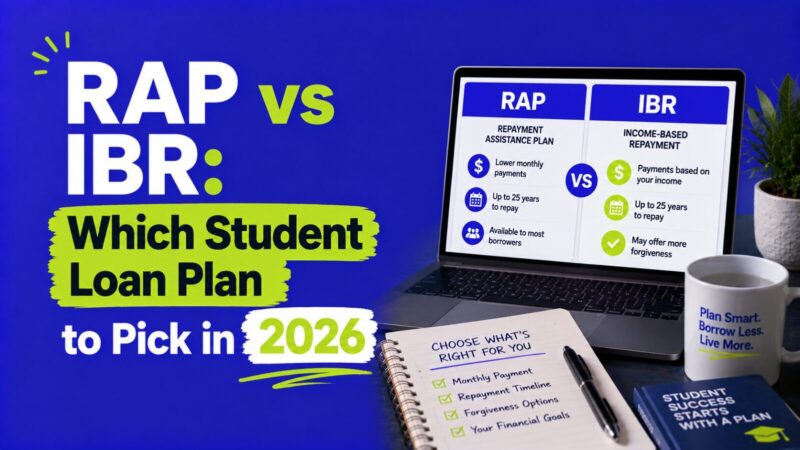
Before refinancing federal loans, make sure you have compared the federal plans you would be giving up. See RAP vs IBR and our full hub on student loan changes in 2026.
You Are Pursuing Public Service Loan Forgiveness (PSLF)
If you work for a government agency or qualifying nonprofit and are working toward Public Service Loan Forgiveness, do not refinance your federal loans. PSLF forgives your remaining federal loan balance after 120 qualifying payments. Refinancing disqualifies you entirely because PSLF only applies to federal Direct Loans. See PSLF in 2026.
You Have Federal Loans with Low Interest Rates
Federal undergraduate loans disbursed in recent years often carry rates between 3.5% and 5.5%. If your federal rate is already competitive, the savings from refinancing may be minimal, and you would still lose federal protections like deferment, forbearance, and forgiveness options.
Your Financial Situation Is Uncertain
If you are between jobs, in an unstable industry, or dealing with inconsistent income, refinancing away from federal protections is risky. The safety net of IDR and federal forbearance options has real value during uncertain times.
You Have a Low Credit Score
If your credit score is below 670, you probably will not qualify for rates better than what you currently have. Refinancing with mediocre credit could actually result in a higher rate. Wait until your score improves.
Fixed vs. Variable Rates: Which Should You Choose?
When you refinance, you will typically choose between a fixed rate and a variable rate.
Fixed Rate
Your interest rate stays the same for the entire loan term. Your monthly payment never changes. Pros: predictability, you know exactly what you will pay every month. Cons: fixed rates are usually higher than initial variable rates.
Variable Rate
Your rate is tied to a benchmark (like SOFR) and adjusts periodically, usually quarterly. It often starts lower than a fixed rate but can increase over time. Pros: lower starting rate. Cons: uncertainty, if rates rise your payments could increase substantially.
Our take: for most borrowers, a fixed rate is the safer choice, especially on longer repayment terms. Variable rates can make sense if you plan to pay off the loan within 3 to 5 years and want the lower initial rate. But on a 10 to 15 year term, the risk of rate increases outweighs the initial savings for most people.
How Refinancing Affects Your Credit Score
Short-term: when you apply, lenders run a hard credit inquiry, which temporarily drops your score by a few points. If you are rate shopping (applying to multiple lenders within a 14 to 45 day window), credit scoring models typically count all inquiries as a single inquiry.
Medium-term: opening a new loan lowers your average account age, which can dip your score slightly.
Long-term: if you make consistent on-time payments, refinancing can actually help your score over time. A lower interest rate also means more of your payment goes toward principal, helping you pay down debt faster.
For a broader look at managing debt strategically, see our complete guide to student loan repayment strategies.
How to Compare Refinancing Offers
Do not just go with the first lender you find. Compare at least 3 to 5 offers before committing. Look at the APR (which includes interest plus fees), the loan term, the monthly payment, any fees (avoid origination fees and prepayment penalties), and borrower protections like forbearance or unemployment options.
See how much you could save by refinancing:
Loan Payoff Calculator
How to Refinance Student Loans: Step by Step
Step 1: Know your current loans. Log into your servicer accounts (or studentaid.gov for federal loans) and note the balance, interest rate, loan type, repayment plan, and whether you are pursuing PSLF or IDR forgiveness.
Step 2: Check your credit score and report. Pull your report free at AnnualCreditReport.com. If your score is below 670, consider waiting and improving it first.
Step 3: Get pre-qualified with multiple lenders. Most lenders offer a pre-qualification check with a soft credit pull (no score impact). Apply to at least 3 to 5.
Step 4: Compare your offers. Line them up side by side. Focus on APR, monthly payment, total interest over the term, and fees.
Step 5: Choose your lender and apply. Provide proof of income, proof of employment, loan statements, and a government-issued ID.
Step 6: Review and sign the loan agreement. Confirm the rate, payment, term, and fees match the quote. Once you sign, the new lender pays off your old loans directly.
Step 7: Set up autopay. Most lenders offer a 0.25% rate discount for autopay. Always take it, and you never miss a payment.
Top Student Loan Refinancing Lenders to Consider
Here is a quick comparison of well-known refinancing lenders in 2026. Always verify current rates directly, these change frequently.
| Lender | Starting APR | Fees | Best For |
|---|---|---|---|
| SoFi | ~5.24% fixed | None | All-around: no fees, unemployment protection, career coaching |
| Earnest | ~5.19% fixed | None | Custom repayment: choose your exact monthly payment |
| Splash Financial | ~5.09% fixed | None | Rate shopping: marketplace shows multiple lenders at once |
| Laurel Road | ~5.24% fixed | None | Healthcare professionals: specialized rate discounts |
| Citizens Bank | ~5.99% fixed | None | Multi-loan discount if you have other Citizens accounts |
Rates shown are representative starting rates for well-qualified borrowers as of early 2026 and vary based on credit score, income, and loan term. Check each lender directly for your personalized rate.
Disclosure: Some lenders above may have affiliate relationships with Finance Pulse. This does not affect our rankings. We recommend Splash Financial and Earnest for most borrowers regardless of affiliate status.
The Decision Framework
Refinancing is likely a good idea if: your loans are private and you can get a lower rate; or your loans are federal, you are not pursuing PSLF, not on IDR, your rate is above 6%, and you have stable income and strong credit; or you want to simplify multiple loans into one payment.
Refinancing is likely not worth it if: you are pursuing PSLF or plan to use IDR; your federal rates are already low (below 4 to 5%); your income or employment is unstable; or your credit score is below 670.
If you are also carrying credit card debt alongside student loans, prioritize the high-interest debt first. Our guide on how to pay off credit card debt fast lays out a clear plan.
Final Thoughts
Knowing how to refinance student loans is about more than just finding a lower rate. It is about understanding the full picture: what you gain, what you give up, and whether the trade-off makes sense for your situation. For private loans with high rates, refinancing is often a no-brainer. For federal loans, the decision is more nuanced. Take stock of your career path, financial stability, and whether federal protections matter to you before making the switch.
FAQ
Should I refinance my federal student loans?
Usually not, unless you have strong credit and no need for federal protections. Refinancing federal loans into a private loan permanently gives up income-driven repayment, forgiveness, and federal forbearance.
When does refinancing student loans make sense?
When you have stable income, good credit (typically 670+), and loans you are certain you will not need forgiveness or income-driven repayment for. The goal is a meaningfully lower interest rate.
Does refinancing student loans hurt your credit?
Applying triggers a hard inquiry that may dip your score a few points temporarily, but most lenders let you check your rate with a soft pull first. A lower rate and on-time payments help your score over time.
Related from Finance Pulse
- Student loan changes in 2026: the complete guide
- RAP vs IBR: which plan to pick in 2026
- Student loans vs credit card debt: which to pay first
- How to pay off student loans fast
This article is for educational and informational purposes only and does not constitute financial advice. Refinancing federal loans is generally permanent, so confirm your rates and what you would give up before deciding.