 By
By 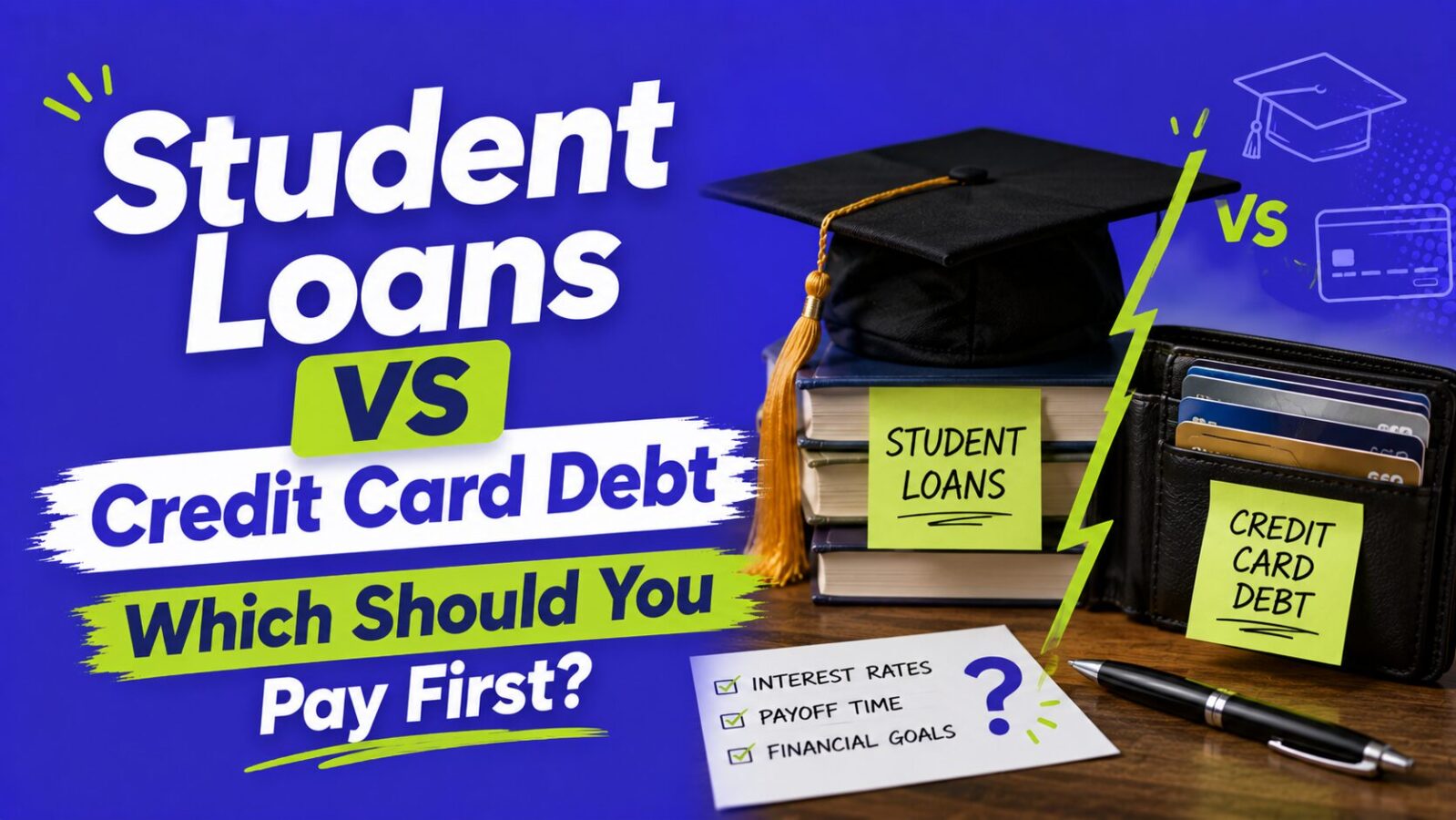
If you have both student loans and credit card debt, make every required payment first, then put your extra money toward the debt with the highest interest rate. For many borrowers, that means paying the credit card first.
The Federal Reserve reported an average APR of 22.15% on credit card accounts that were assessed interest in Q2 2026. By comparison, undergraduate Direct Loans first disbursed from July 1, 2026 through June 30, 2027 have a fixed 6.52% rate. Graduate Direct Unsubsidized Loans issued during that period are 8.07%, and Direct PLUS Loans are 9.07%.
But those are reference points, not the rates you should use for your decision.
Check the actual APR on each credit card and the actual interest rate on each student loan. Then rank the debts from highest to lowest.
The quick answer
| Situation | Where extra money usually goes |
|---|---|
| Credit card has the higher APR | Credit card |
| Private student loan has the higher rate | Student loan |
| Credit card is temporarily at 0% | Depends on when the promotion ends |
| You are pursuing PSLF | Usually avoid unnecessary federal loan prepayment |
| A student loan is delinquent | Get the required payment under control first |
| You cannot afford all minimum payments | Contact lenders or servicers before making extra payments |
The key word is extra.
Paying your credit card first does not mean skipping required student loan payments.
Why the higher-rate debt usually comes first
Suppose you owe:
- $5,000 on a credit card at 22%
- $5,000 on a student loan at 6.5%
As a simplified annual comparison:
$5,000 × 22% = about $1,100
$5,000 × 6.5% = about $325
Leaving the credit card balance outstanding costs far more interest per dollar.
That is why putting an extra $500 toward the higher-rate balance usually reduces your total interest cost more than sending the same $500 to the lower-rate loan.
This is the logic behind the debt avalanche method:
- Make every required payment.
- Put all extra debt-payoff money toward the highest rate.
- When that balance reaches $0, roll the payment into the next-highest rate.
You do not need national averages to use this strategy.
You need your own rates.
Do not use 6.52% as the rate for all federal student loans
This is an easy mistake to make in 2026.
The 6.52% rate applies specifically to undergraduate Direct Subsidized and Direct Unsubsidized Loans first disbursed from July 1, 2026 through June 30, 2027. Graduate Direct Unsubsidized Loans and Direct PLUS Loans issued during that period have different rates. Federal Direct Loans issued in earlier years can also carry different fixed rates.
So instead of asking:
“Are credit cards more expensive than student loans?”
ask:
“Which of my debts has the highest rate right now?”
That produces a much better payoff decision.
Keep required student loan payments current
Do not intentionally allow a federal student loan to become delinquent simply because your credit card APR is higher.
Federal Student Aid says most federal loans enter default after at least 270 days without scheduled payments. If the debt remains unresolved for more than 360 days past due, involuntary collection methods may begin, including Treasury offset and administrative wage garnishment of up to 15% of disposable pay. Required notices apply before these collection actions.
So the payoff rule is:
Required payments on all debts first. Extra payment to the highest rate second.
If you cannot afford the required student loan payment, deal with that problem before making aggressive extra payments elsewhere.
A simple step-by-step strategy
1. List every debt
Write down:
| Debt | Balance | Rate | Required payment |
|---|---|---|---|
| Credit card A | |||
| Credit card B | |||
| Federal student loan | |||
| Private student loan |
Use the rate shown on the actual account or statement.
2. Keep all required payments current
Before making extra payments, make sure required minimums are covered.
Also protect essential expenses such as housing, food, utilities, insurance, and necessary transportation.
3. Rank the debts by rate
For example:
- Card A: 27%
- Card B: 19%
- Private student loan: 11%
- Federal student loan: 5%
Your extra payment order would normally be:
27% → 19% → 11% → 5%
4. Roll payments forward
When Card A reaches $0, do not absorb its old payment into everyday spending.
Add it to what you were already paying on Card B.
That is how the avalanche gains speed without requiring your income to increase.
When should a student loan come first?
Your student loan has the higher rate
This can happen with private student loans.
If your private loan is at 14% and your credit card is currently at 9%, the student loan is the higher-cost debt.
The label does not matter.
The rate does.
Your credit card has a 0% promotional APR
A genuine 0% period changes the short-term math.
Suppose you have:
- Credit card: 0% for another 10 months
- Student loan: 8%
The student loan is currently accruing more interest.
But you cannot ignore the card.
Calculate the monthly amount needed to get the promotional balance to $0 before the 0% period expires. Then decide how much additional cash can safely go toward the student loan.
A promotional balance that becomes expensive in 10 months still needs a payoff plan today.
Your student loan is already behind
Interest optimization becomes secondary if a required account is moving toward default.
Get the loan into a sustainable repayment status first, then resume your highest-rate payoff strategy.
PSLF can change the answer
If you are pursuing Public Service Loan Forgiveness, federal loan prepayment deserves extra scrutiny.
PSLF can forgive the remaining balance on eligible Direct Loans after 120 qualifying monthly payments while the borrower meets the program’s qualifying employment and repayment requirements. Federal Student Aid also states that paying extra does not allow you to reach PSLF sooner because you still need to satisfy 120 separate monthly obligations, although qualifying prepayments can cover certain future months under program rules.
That creates an important distinction.
If you are legitimately on track for PSLF, your goal may not be to eliminate the federal loan as quickly as possible.
Paying extra toward a 20% credit card can make far more sense than voluntarily reducing a federal balance you expect to qualify for forgiveness.
Before relying on PSLF, verify your own loan eligibility, employer eligibility, repayment plan, and qualifying payment count.
What about income-driven repayment in 2026?
Federal repayment options changed materially in 2026.
The Repayment Assistance Plan, or RAP, became available July 1, 2026, and the SAVE Plan ended following a March 10, 2026 court order. Borrowers’ available repayment options now depend partly on their loan types and when the loans were first disbursed.
That does not mean you should switch repayment plans simply to free money for a credit card.
A different plan can change:
- Your required payment
- Your repayment period
- Total interest
- Potential forgiveness
- Eligibility for other benefits
Compare the actual options available for your federal loans before changing plans.
For the purpose of this article, the important rule is simpler:
If your current federal student loan payment is unaffordable, investigate repayment options rather than intentionally missing payments.
Does the student loan interest deduction mean you should pay loans later?
It can slightly affect the calculation, but I would not make it the deciding factor.
For the 2025 tax year, eligible taxpayers can deduct the lesser of $2,500 or the amount of qualified student loan interest actually paid, subject to income and other eligibility rules. The deduction is an adjustment to income, so you do not need to itemize to claim it.
A deduction is not the same as a tax credit.
If you deduct $1,000 of student loan interest, your tax bill does not automatically fall by $1,000.
It reduces taxable income.
So do not keep a 22% credit card balance just to preserve a possible student loan interest deduction.
The interest-rate gap usually matters much more.
Should you use a 0% balance transfer first?
A balance transfer can be useful when high-interest credit card debt is your biggest problem.
But compare the numbers before moving the debt.
The useful test is:
Transfer fee < interest you reasonably expect to avoid
Then calculate the payment needed to clear the balance before the promotional APR expires.
A transfer can change your debt-priority order because a card that was previously at 24% may temporarily become a 0% balance.
That does not mean the debt disappears.
It means you have bought a limited period in which to pay it down more efficiently.
Do not empty your emergency savings just to follow the avalanche
Mathematically, putting every available dollar against a 25% credit card reduces interest quickly.
Practically, leaving yourself with $0 in cash can backfire.
If the next car repair, medical bill, or necessary trip immediately goes back onto the card, you can erase part of your progress.
Before making unusually large extra debt payments, make sure you can still cover:
- Essential monthly expenses
- Required debt payments
- Near-term bills you already know are coming
- At least some unexpected costs
The fastest payoff plan is not useful if you cannot sustain it.
Frequently asked questions
Should I pay off student loans or credit cards first?
Pay all required payments, then usually put extra money toward whichever debt has the highest rate.
For many borrowers, that will be the credit card because revolving card APRs can be much higher than federal student loan rates. The Federal Reserve reported a 22.15% average APR on accounts assessed interest in Q2 2026, while new 2026-27 undergraduate Direct Loans carry a 6.52% fixed rate. Your own rates may differ.
Should I stop paying student loans to pay off credit cards?
No.
Prioritizing a card means directing extra money toward it while continuing to meet the required student loan payment.
What happens if I stop paying federal student loans?
Most federal loans generally enter default after at least 270 days without scheduled payments. If a default remains unresolved beyond 360 days past due, federal involuntary collections may begin, including Treasury offset or administrative wage garnishment.
What if my private student loan has a higher rate than my credit card?
Then the private student loan may be the better target for extra payments.
Use the actual interest rates rather than assuming all credit cards are more expensive than all student loans.
Should I pay extra on student loans if I qualify for PSLF?
Usually review your PSLF strategy first.
PSLF is based on 120 qualifying monthly payments and forgives the qualifying balance that remains. Paying extra does not let you bypass the 120-month requirement.
Is student loan interest tax-deductible?
Eligible taxpayers may deduct up to $2,500 of qualified student loan interest, subject to IRS rules and income limits. It is a deduction from income, not a dollar-for-dollar tax credit.
The bottom line
For most people deciding between student loans and credit card debt, the best default strategy is not “always pay the card” or “always pay the student loan.”
It is:
- Make every required payment.
- Compare your actual rates.
- Put extra money toward the highest-rate debt.
- Protect valuable federal loan benefits before making large extra payments.
- Roll each eliminated debt payment into the next balance.
In many real-world cases, the credit card will come first because its APR is much higher.
But there are important exceptions.
A private student loan can have the higher rate.
A 0% card promotion can temporarily reverse the order.
PSLF can make voluntary federal loan prepayment counterproductive.
And if a student loan is already delinquent, fixing the required payment may matter more than optimizing a few percentage points of interest.
Keep every account current, protect the benefits that actually matter, and send your extra dollar to the debt where it saves you the most.