By
By 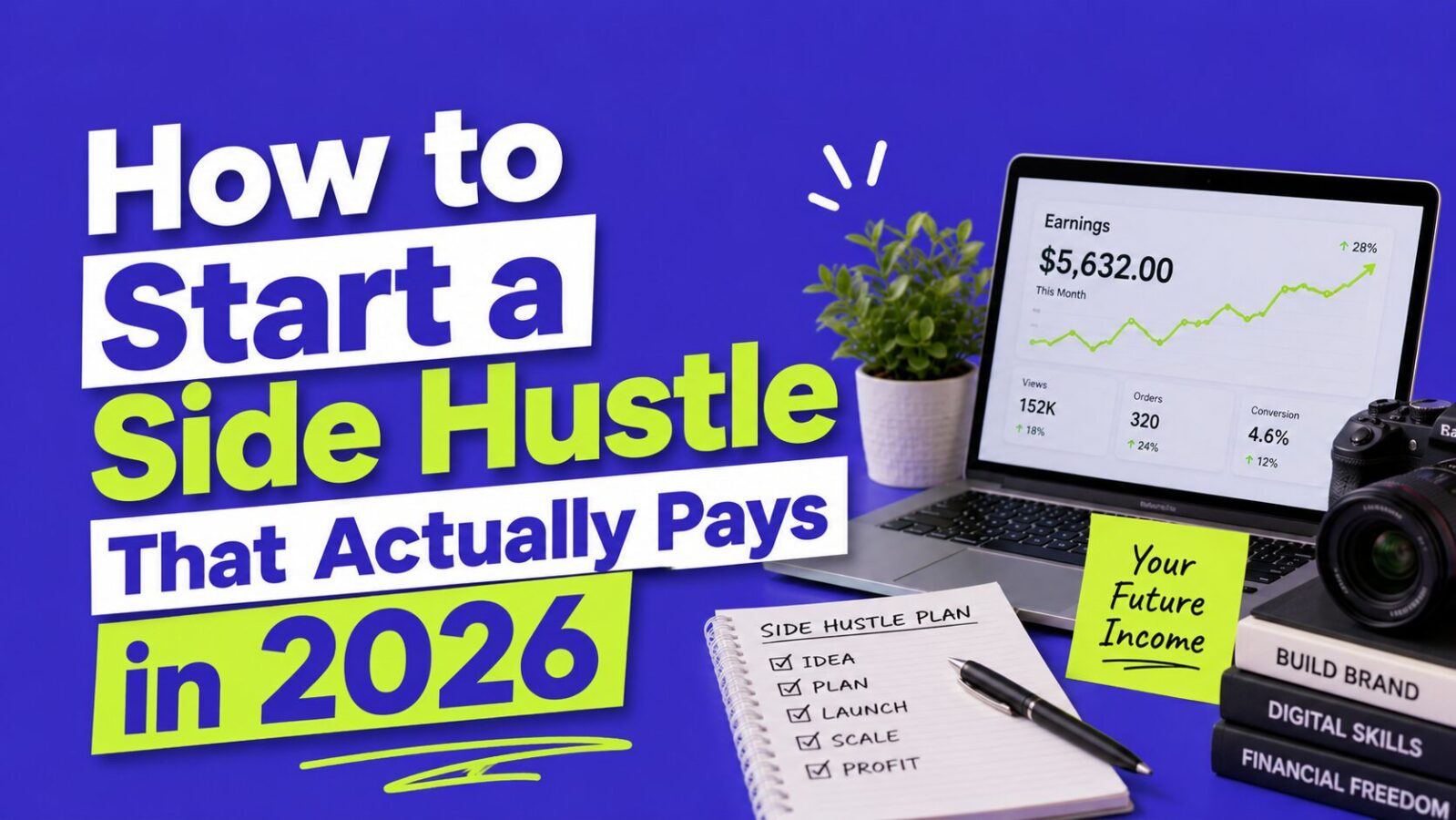
A side hustle bringing in $500 to $2,000/month changes everything: faster debt payoff, bigger investments, and the freedom to quit a job you hate. Here are the side hustles that actually pay in 2026, ranked by realistic income.
- A side hustle bringing in $500 to $2,000 a month can accelerate debt payoff, investing, and your emergency fund.
- The best side hustles use a skill you already have, so you start earning fast without a long ramp-up.
- Set aside roughly 25 to 30% of side-hustle income for taxes and track expenses, since this is self-employment income.
- Protect your main job and your time: pick something with flexible hours and a clear payoff per hour.
The average American side hustler earns $810/month, according to a 2025 Bankrate survey. That is $9,720 per year. Invested in index funds at 7% for 20 years, that side hustle income alone grows to roughly $475,000.
Reread that. A side hustle you maintain for a few years does not just pay this month’s bills. If you invest the income, it can fund a significant chunk of your retirement. That is the real power of extra income: it accelerates every other financial goal. Your emergency fund fills up faster. Your credit card debt disappears sooner. Your Roth IRA gets maxed. Your FIRE timeline compresses by years.
One honest caveat: $810 is an average, and averages hide a wide gap. The median side hustler earns closer to $200 a month, because many people dabble while a smaller group treats it like a real business. Roughly 76 million Americans now freelance in some form (about a third of the workforce), so the competition is real. The people who clear $1,000+ a month almost always do skill-based work rather than app-based gig work, which is why the tiers below are ranked by realistic income, not hype. In 2026 the fastest-growing high-earners are AI-adjacent: prompt and automation work, AI-assisted content and design, and helping small businesses adopt AI tools.
This guide covers side hustles that meet three criteria: you can start with $0 to $200 in upfront cost, you can do them around a full-time 9-to-5 job, and they pay real money (not $3/hour survey sites).
See how your side hustle income compounds over time:
Compound Interest Calculator
Tier 1: Skill-based freelancing ($1,000 to $5,000+/month)
These pay the most because you are selling expertise, not time. The barrier to entry is having a marketable skill, which you might already have from your day job, education, or hobbies.
Freelance writing and content creation
What you do: Write blog posts, articles, email newsletters, social media copy, or website content for businesses.
What it pays: $50 to $150 per blog post for beginners. $200 to $500+ per post for writers with niche expertise (finance, tech, healthcare, SaaS). Writers who specialize in one niche earn 2 to 3 times more than generalists.
How to start: Create 3 to 5 sample articles in your niche (publish them on Medium or a personal blog). Set up profiles on Upwork, Contently, or nDash. Cold-email small businesses in your niche with a pitch and sample. Most clients care about your ability to write clearly on their topic, not formal credentials.
Best for: People who write well and have knowledge in a specific industry.
Web design and development
What you do: Build websites for small businesses, usually on WordPress, Webflow, or Shopify.
What it pays: $1,000 to $5,000 per website for beginners. $5,000 to $15,000+ for experienced developers. Monthly maintenance retainers ($100 to $300/month per client) create recurring income.
How to start: Build 3 portfolio sites (your own site counts as one). List on Upwork and Fiverr. Join local business Facebook groups and offer services. Many small businesses still have no website or a terrible one.
Best for: People with any web development or design skills. Even basic WordPress knowledge is enough to start.
Graphic design
What you do: Create logos, social media graphics, presentations, brand identity, packaging design.
What it pays: $50 to $200 per logo for beginners on Fiverr. $500 to $2,000+ per project for experienced designers. Monthly social media design retainers ($300 to $1,000/month) from small businesses are common.
How to start: Build a portfolio on Behance or Dribbble. Start with competitive pricing on Fiverr or 99designs to build reviews. Canva templates for small businesses also sell well on Etsy and Creative Market.
Best for: People who enjoy visual work and know Figma, Adobe Illustrator, or Canva at an advanced level.
Online tutoring and teaching
What you do: Tutor students in school subjects, test prep (SAT, GRE, GMAT), programming, music, or languages.
What it pays: $25 to $50/hour on platforms like Wyzant or Tutor.com. $50 to $100+/hour for private clients in test prep or coding. ESL teaching online pays $15 to $30/hour.
How to start: Sign up on Wyzant, Varsity Tutors, or Preply. For higher rates, find clients through local school parent groups, Nextdoor, or your personal network.
Best for: Anyone with deep knowledge in a school subject, test format, language, or technical skill.
Tier 2: Service-based hustles ($500 to $2,000/month)
These trade time for money more directly, but they require no special skills and you can start immediately.
Delivery and rideshare
What you do: Drive for DoorDash, Uber Eats, Instacart, or Amazon Flex. Or drive passengers for Uber or Lyft.
What it pays: $15 to $25/hour gross for food delivery. $20 to $35/hour gross for rideshare. Amazon Flex pays $18 to $25/hour base with tips.
The math people forget: Gross pay is not your actual income. You pay for gas (roughly $3 to $5/hour), car maintenance and depreciation ($0.10 to $0.20 per mile), and self-employment taxes (15.3%). After expenses, your real hourly rate drops significantly. Track your miles with an app like Everlance or Stride to maximize your tax deductions.
Best for: People who need flexible hours and immediate cash flow. Not ideal long-term because of vehicle costs, but excellent for short-term goals.
Pet sitting and dog walking
What you do: Watch people’s pets while they travel, walk dogs during the day, or provide overnight boarding.
What it pays: $25 to $50 per dog walk (30 minutes). $40 to $80 per night for overnight sitting. $60 to $100+ per night for in-home boarding. Repeat clients create reliable recurring income.
How to start: Create profiles on Rover and Wag. Get your first 5 to 10 reviews by offering slightly lower prices to friends and neighbors. After building reviews, raise rates to market level.
Best for: Animal lovers with flexible schedules. If you work from home, dog walking and daytime sitting fit perfectly into your day.
Reselling and flipping
What you do: Buy undervalued items at thrift stores, garage sales, or Facebook Marketplace and resell them on eBay, Poshmark, Mercari, or Amazon.
What it pays: $500 to $3,000+/month for dedicated resellers.
How to start: Start with what you know. Use the eBay sold listings tool to check what items actually sell for (not asking prices, but completed sales). Start small, reinvest profits into more inventory.
Best for: People who enjoy the hunt and have a good eye for value.
Tier 3: Digital and passive-ish income ($200 to $1,000+/month)
These take longer to build but can eventually earn money with less active time once established.
Content creation (YouTube, TikTok, newsletter)
What you do: Create videos, short-form content, or a written newsletter in a specific niche.
What it pays: YouTube ad revenue starts around $3 to $5 per 1,000 views. TikTok brand sponsorships pay $200 to $5,000+ per post depending on audience size. Newsletters can monetize through sponsorships or paid subscriptions.
Reality check: The vast majority of content creators never earn significant money. The ones who do are consistent, niche-focused, and patient. This is not a quick win. It is a long-term bet on building an audience.
Best for: People who enjoy creating and can commit to a consistent schedule for months before seeing results.
Selling digital products
What you do: Create and sell templates (Notion, Excel, Canva), online courses, ebooks, printables, stock photos, or design assets.
What it pays: $100 to $5,000+/month depending on product quality and marketing. A single well-made Canva template pack can sell hundreds of copies at $10 to $30 each.
How to start: Identify a problem your target audience has. Create a simple solution as a digital product. Sell on Etsy (for templates and printables) or Gumroad (for anything digital). Marketing through TikTok and Pinterest drives the most organic traffic in 2026.
Best for: People with specific expertise who can package it into a reusable product.
Affiliate marketing (blogging)
What you do: Build a blog or website about a topic, create helpful content, and earn commissions when readers buy products through your affiliate links.
What it pays: $0 for the first 3 to 6 months while you build traffic. $200 to $2,000/month after 6 to 12 months of consistent content and SEO work. Top personal finance bloggers earn $10,000 to $50,000+/month.
How to start: Pick a niche, build a WordPress site, write helpful content targeting search keywords, and be patient. SEO traffic takes 3 to 6 months to build.
Best for: People who write well, are patient, and want to build an asset that generates income long after the work is done.
How to choose the right side hustle
Do not pick based on what pays the most. Pick based on the intersection of three factors:
Skills you already have. Using existing skills means you earn more from day one. A graphic designer freelancing on Fiverr earns $50/hour immediately. The same person driving DoorDash earns $15/hour. Same hours, vastly different income.
Time you actually have. Be honest about your schedule. If you work 9-to-6 plus a commute, driving Uber at night means working until 11 PM. That is unsustainable. Freelance writing at your own pace on weekends might be more realistic.
Your current financial goal. Need $1,000 fast for an emergency fund? Delivery and reselling pay immediately. Want to max your Roth IRA ($583/month)? Freelancing at $50/hour for 12 hours/month does it. Working toward FIRE? Build digital products or content that scales without your time.
Taxes: the part nobody wants to talk about
Side hustle income is taxable. All of it. Even if the client does not send you a 1099. Even if you earned less than $600 from one source.
What you owe: Regular income tax at your marginal rate PLUS self-employment tax of 15.3% (Social Security and Medicare). On $10,000 in side hustle income, you could owe $2,500 to $3,700 in combined taxes.
How to reduce the bill:
- Track every business expense. Mileage (67 cents per mile in 2026 for delivery drivers), home office space, equipment, software subscriptions, and internet (partial). These reduce your taxable income.
- Make quarterly estimated tax payments. If you expect to owe more than $1,000 in taxes for the year, the IRS wants quarterly payments (April, June, September, January) via Form 1040-ES.
- Open a separate business checking account. Mixing personal and business money makes expense tracking a nightmare.
- Use accounting software. Wave (free) or QuickBooks Self-Employed ($15/month) automates expense tracking and estimated tax calculations.
Use our free Side Hustle Income Tracker to log all your side income sources, track monthly totals, and see which hustles earn the most per hour.
Taxes are not a reason to avoid a side hustle. They are a reason to track income and expenses properly from day one.
How to avoid burnout
Set a hard stop time. Decide in advance how many hours per week you will hustle (10 to 15 is sustainable for most people) and stop when you hit the limit.
Give it a deadline. “I will drive DoorDash for 6 months to pay off my credit card, then stop.” Tie the hustle to a specific financial target.
Hustle to invest, not to inflate. The biggest mistake: earning an extra $1,000/month and spending an extra $1,000/month. If side hustle income goes straight into investing or debt payoff, you have a finish line. If it goes to lifestyle upgrades, you are on a treadmill.
Build toward leverage. Freelancing trades time for money (good short-term). A blog, digital products, or content library can earn while you sleep (better long-term). Start with time-for-money and transition to scalable income over 12 to 24 months.
Frequently Asked Questions
$500 to $1,000/month is realistic for most people within the first 1 to 3 months. $2,000+/month is achievable with skill-based freelancing after building a client base. The Bankrate average of $810/month is a reasonable expectation.
Not initially. As a sole proprietor, you can earn side hustle income under your own name and SSN. If income exceeds $10,000 to $20,000/year or you want liability protection, consider forming an LLC ($50 to $500 depending on your state). That is a “later” decision, not a “before you start” one.
Check your employment contract. Some companies restrict outside work in competing fields. Most have no issue with unrelated side hustles. Use your own equipment and time, not your employer’s.
If your side income consistently exceeds your salary for 6+ months and you have 6 to 12 months of expenses saved, you have the option (not the obligation) to go full-time on it.
Delivery driving and freelancing pay the fastest (income within days to weeks). Pair the income with the avalanche or snowball method for maximum impact.
The bottom line
A side hustle is not about working yourself to death. It is about compressing your financial timeline. An extra $800/month for 2 years, invested at 7%, becomes roughly $20,000. Directed at credit card debt, it eliminates $19,200 in balances plus thousands in interest you will never pay. Put toward a Roth IRA, it nearly maxes the annual contribution.
Start with one hustle that matches your skills and schedule. Give it 90 days. Track the income. Invest or deploy every dollar toward a specific financial goal. Then decide: scale it, switch it, or stop it. But do not let the money disappear into lifestyle creep.
Your financial future is not determined by your salary alone. It is determined by the gap between what you earn and what you spend. A side hustle widens that gap faster than almost anything else you can do.
Where to put your side hustle income:
- First $1,000: Build your emergency fund — that cushion is what keeps one bad month from wiping out your progress.
- High-interest debt: Read our credit card debt guide for the fastest payoff strategy.
- After debt is gone: Open a Roth IRA and invest every dollar in index funds. That $810/month becomes $475,000 over 20 years.