 By
By 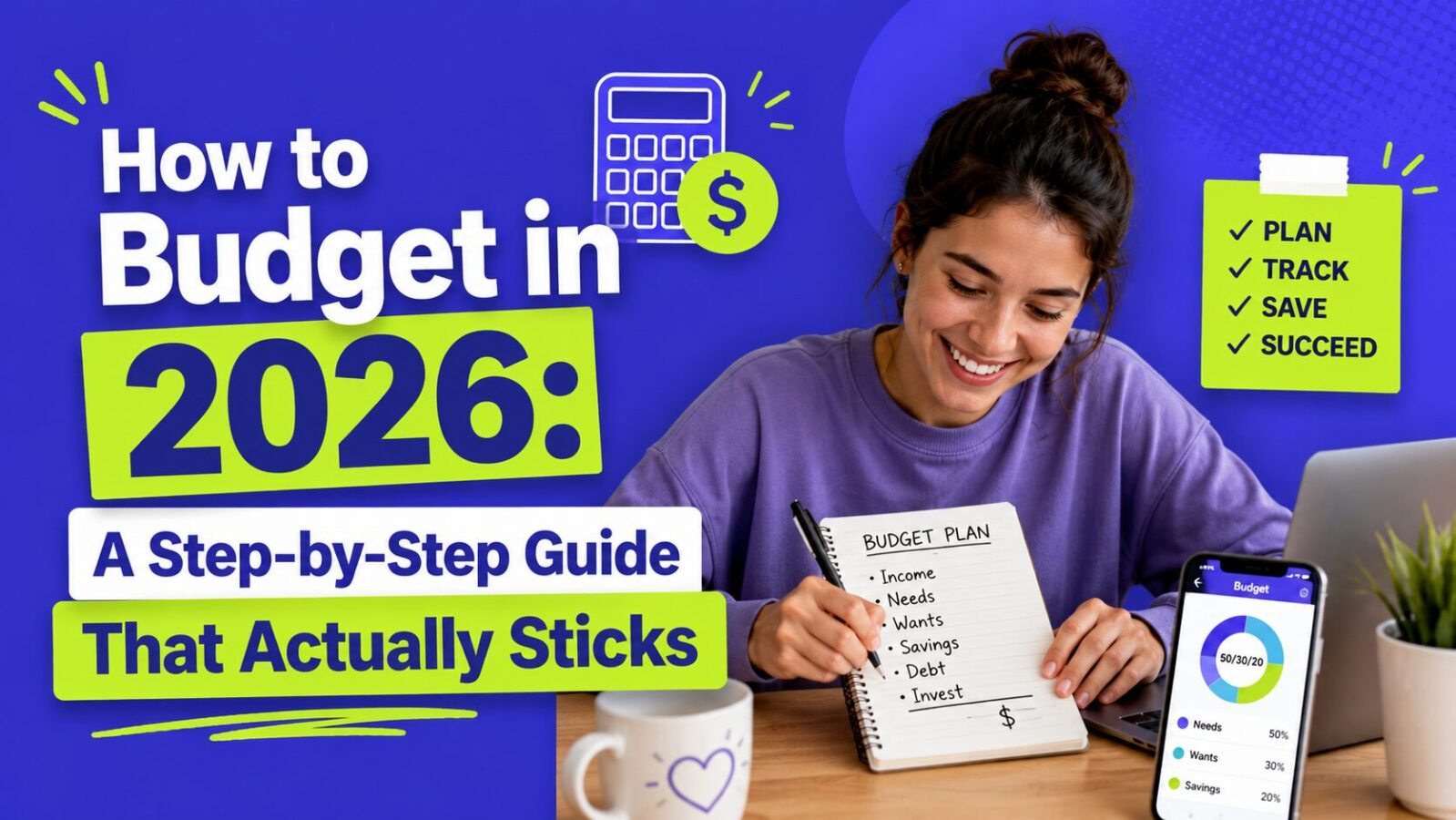
Budgeting is not about restriction. It is about deciding where your money goes before it disappears. This is the complete, no-jargon guide to building a budget in 2026 that you will actually stick with: how to find your real income, track spending without burning out, plan for the irregular bills that wreck most budgets, choose a method that fits your brain, and keep the whole thing running on autopilot. There is an interactive calculator, a side-by-side comparison of every method, real dollar examples, and a free template, so you can stop reading and start doing whenever you are ready.
- Budgeting is six repeatable steps: find your take-home income, track spending, plan for irregular costs, pick a method, build it, then review monthly.
- The step most beginners skip, and the one that breaks budgets, is planning for non-monthly expenses with sinking funds.
- There is no single best method. Match 50/30/20, zero-based, cash stuffing, or pay-yourself-first to your personality (full comparison table below).
- Automation beats willpower: the budgets that last run on auto-transfers, not daily discipline.
- The best budget is simply the one you will actually open next month.
What a budget actually is (and is not)
A budget is a plan for your money. That is the whole concept. You decide in advance how much goes to needs, to the things you enjoy, and to your future, instead of finding out at the end of the month where it all went. A good budget does not stop you from spending. It gives you permission to spend on what matters, because you know the important things are already covered.
The reason most people believe they are “bad with money” is that they have only ever tried to budget through willpower and guilt. Both fail. Every system in this guide is built on structure and automation instead, which is why it survives past the second week. If past budgets have collapsed on you, that is a design problem, not a character flaw, and we explain exactly why budgeting apps fail after 30 days later on.
How to make a budget in 6 steps
Step 1: Find your real take-home pay
Every budget starts with one number: the money that actually lands in your account after taxes, health insurance, and retirement deductions. Not your salary, your take-home pay. Check your most recent pay stub or bank deposit. If you are not sure what your net pay should be, the IRS withholding estimator gives you a precise figure.
One nuance that trips people up: if your 401(k) contribution is already deducted from your paycheck, it is part of your savings, even though it never hits your checking account. Count it. If your income changes month to month from freelancing, gig work, commission, or tips, budget on your lowest typical month and treat anything above it as a bonus. Our full irregular income guide covers the buffer-account system that makes variable pay feel steady.
Step 2: Track where your money actually goes
Before you can change your spending, you have to see it. Pull the last two to three months of bank and credit card statements and sort every expense into two buckets: fixed (rent, insurance, subscriptions, minimum debt payments) and variable (groceries, dining, gas, shopping, fun). Almost everyone finds at least one surprise here, a forgotten subscription, a delivery-app habit bigger than they realized, or fees they did not know they were paying. The Consumer Financial Protection Bureau offers a free worksheet if you want a starting template.
You do not need to track forever or log every penny by hand. Two low-effort options work well: a spreadsheet you build yourself, or an app that auto-imports and categorizes transactions (more on choosing one in Step 5).
Step 3: Plan for the irregular bills (the step that saves budgets)
This is the step almost every budgeting guide skips, and it is the single biggest reason beginner budgets blow up. Most budgets break not on rent or groceries but on the expenses that do not arrive every month: car repairs, annual insurance premiums, holiday gifts, a vet bill, a wedding you are invited to. They feel like surprises, but in aggregate they are completely predictable.
The fix is a sinking fund. Add up your known irregular expenses for the year, divide by 12, and set that amount aside every month in a separate savings bucket. When the bill arrives, the money is already there, and your monthly budget never takes the hit. This one habit separates people who feel in control from people who feel ambushed. Here is the full guide to sinking funds, including the categories most people forget.
Step 4: Choose a budgeting method that fits you
There are only a handful of methods that actually work, and the best one is the one that matches how your brain operates, not the one a guru insists on. Compare them in the table further down, then commit to one for a full month before judging it.
- 50/30/20 is the simplest and best for beginners. Full walkthrough: the 50/30/20 budget rule.
- Zero-based gives the tightest control and is best for paying off debt: how to create a zero-based budget.
- Pay yourself first is the lowest-effort option for people who hate tracking: set up automatic savings.
Step 5: Build it (spreadsheet or app) and automate
Put your method somewhere you will actually see it. If you like control and zero cost, build a budget spreadsheet from scratch. If you want bank syncing and automatic categorization, pick from our best budgeting apps guide (or the apps tuned specifically to the 50/30/20 method).
Then remove yourself from the loop. On payday, set up automatic transfers: savings and investments move out first, sinking-fund money goes to its own account, and bills are on autopay. What is left in checking is your guilt-free spending money. Automation is what turns a budget from a chore you must remember into a system that runs without you.
Step 6: Track, review, and adjust monthly
Your first budget will be wrong, and that is fine. Spend five minutes each week glancing at where you stand, and 15 minutes at month-end comparing plan to reality. Move money between categories, raise the ones you consistently underfunded, and start the next month before it begins. By month three, your budget will closely match your real life, and as your savings grow you can watch the bigger picture with a net worth tracker.
Budgeting methods compared
Most guides champion one method and ignore the rest. Here is a neutral side-by-side so you can pick by fit, not by hype.
| Method | How it works | Pros | Cons | Best for |
|---|---|---|---|---|
| 50/30/20 | Split take-home pay 50% needs, 30% wants, 20% savings and debt | Simple, flexible, low effort | Too loose for big overspenders | Beginners |
| Zero-based | Assign every dollar a job until income minus expenses = 0 | Maximum control, fast debt payoff | Most time-consuming | Debt payoff, detail lovers |
| Cash stuffing (envelopes) | Put cash (or digital buckets) in labeled envelopes; spend only what is in each | Hard stop on overspending, very tactile | Cash is clunky; not ideal online | Chronic category overspenders |
| Pay yourself first | Automate savings on payday, spend the rest freely | Almost zero effort, builds savings automatically | Will not fix an overspending problem | People who hate tracking |
| 60/30/10 | 60% needs, 30% wants, 10% savings (or flipped for savers) | Realistic in high-cost cities | Lower savings rate | High cost-of-living areas |
Calculate your budget
Enter your monthly take-home pay to see your split instantly. Use it as a starting point, then adjust the categories to your real life.
50/30/20 Budget Calculator
Real budget examples at different income levels
Percentages are easier to believe in dollars. Here are three realistic monthly budgets. Yours will differ, but the shape is what matters.
Example 1: Entry-level, $3,000/month take-home (with a roommate)
| Category | Amount |
|---|---|
| Rent (split with roommate) | $850 |
| Groceries | $300 |
| Utilities + phone | $150 |
| Transportation | $200 |
| Insurance | $150 |
| Dining + fun | $400 |
| Subscriptions + misc | $200 |
| Emergency fund | $300 |
| Roth IRA | $250 |
| Extra student loan payment | $200 |
| Total | $3,000 |
That is roughly a 55/20/25 split, tilted toward savings and debt because a roommate keeps housing low. On a tight income, our low-income budgeting guide covers assistance programs and deeper cost cuts.
Example 2: Freelancer, variable income (budget on a $3,200 floor)
| Category | Amount |
|---|---|
| Rent | $1,200 |
| Groceries + household | $400 |
| Utilities + phone + internet | $200 |
| Transportation | $150 |
| Health insurance | $250 |
| Dining + fun | $400 |
| Sinking funds (taxes already set aside separately) | $200 |
| Emergency fund / buffer | $400 |
| Total | $3,200 |
The freelancer budgets on their lowest realistic month and routes every above-floor dollar to taxes, the buffer, and investing. Note taxes are set aside the moment income arrives, before anything here.
Example 3: Dual-income household, $7,000/month take-home
| Category | Amount |
|---|---|
| Mortgage | $2,000 |
| Groceries | $700 |
| Utilities + phones + internet | $400 |
| Two cars (payments, gas, insurance) | $900 |
| Dining, fun, travel | $1,200 |
| Sinking funds (home, car, gifts) | $400 |
| Two Roth IRAs + extra 401(k) | $1,000 |
| House/long-term savings | $400 |
| Total | $7,000 |
Couples do best with one shared view of the whole household. Our guide on talking about money with your partner covers the “yours, mine, ours” setup.
Budgeting for Millennials and Gen Z
Most budgeting advice was written for a steady salary, a single household, and no student debt. Real life in 2026 looks different. A few adjustments that matter:
Student loans. Treat the minimum payment as a need and any extra payment as savings/debt payoff in your 20% bucket. If payments are squeezing everything, that is a signal to revisit your repayment plan before cutting your grocery budget to the bone.
Buy now, pay later. BNPL feels free but it is debt, and four overlapping “pay in 4” plans can quietly consume a paycheck. Add every active BNPL plan to your fixed expenses so you can see the real total. If it is more than a line or two, treat it like the high-interest debt it can become.
Roommates and split costs. Budget your share, not the total bill, and use a shared note or app so nobody fronts rent and chases reimbursements. Splitting housing is the single most powerful lever for keeping needs under 50%.
Side hustles and gig income. Treat irregular side income as bonus money for savings or debt, not as part of your baseline lifestyle. And if you are tired of hiding financial choices from friends, the honest “I am saving for X” approach of loud budgeting makes restraint socially easier.
How to actually stick to your budget
Knowing the math is the easy part. Lasting with it is the real challenge, and it is mostly psychology, not discipline.
Automate first, track second. Every decision you remove is a decision you cannot fail. Auto-transfers for savings and bills do more than any tracking app, because they work even in the weeks you ignore your finances.
Budget for fun on purpose. A budget with zero discretionary money is a crash diet. It will not last. Name a guilt-free spending category and protect it.
Expect to blow it sometimes. Overspending one month is data, not failure. Adjust the category and move on. The people who succeed are not the ones who never overspend, they are the ones who do not quit after they do.
Try a short no-spend challenge. A one or two week no-spend stretch (only true essentials) resets habits and reveals how much of your spending is autopilot. Treat it as an experiment, not a punishment.
Free budget template
Want a head start instead of a blank page? Grab our free Monthly Budget Spreadsheet (pre-built with categories and a 50/30/20 split), then File > Make a copy to save your own. Paid biweekly or on a variable income? The Paycheck Planner matches each expense to the paycheck it comes from.
Frequently asked questions
Three steps get you going: find your monthly take-home pay, list your fixed costs, and subtract to see what is left. Then pick a simple method (the 50/30/20 rule is easiest) and automate one savings transfer on payday. You do not need a perfect budget on day one, you need a habit.
It splits your after-tax income into 50% needs, 30% wants, and 20% savings and debt payoff. It is popular because it is simple and flexible enough to actually follow. See our full 50/30/20 guide for examples at every income level.
A common target is 20% of take-home pay toward savings and debt payoff. If that is not realistic yet, start with any amount and automate it, the habit matters more than the size early on. Build an emergency fund first, then invest.
Budget on your lowest typical month, not your average, and treat anything above that floor as a bonus for savings or taxes. A buffer account smooths the highs and lows. Full system: our irregular income guide.
It depends on your style, but strong free options include Goodbudget (envelopes), EveryDollar’s free tier, and your bank’s built-in tools. Compare them in our best budgeting apps guide. A free spreadsheet is also hard to beat for control.
Nothing dramatic. Move money from another category to cover the overage, note what triggered it, and adjust next month’s plan. One bad month is normal. Quitting is the only real failure, and it usually comes from shame, not from the numbers.
The bottom line
Budgeting comes down to six repeatable steps: know your take-home income, see where it goes, plan for the irregular bills, choose a method that fits you, build and automate it, then review once a month. You do not need to be perfect and you do not need willpower. You need a system that runs in the background and a goal worth running it for.
Start this week: calculate your take-home pay with the tool above, pick one method from the comparison table, set up a single automatic transfer to savings, and open a sinking fund for your next big irregular bill. Everything else in this guide is here when you are ready to go deeper.