Skip to content
Advertiser Disclosure: We may earn a commission when you click links to products from our partners. Learn more.

How to Create a Zero-Based Budget (Give Every Dollar a Job)

Growing money business finance and saving money investment concept stacking coins

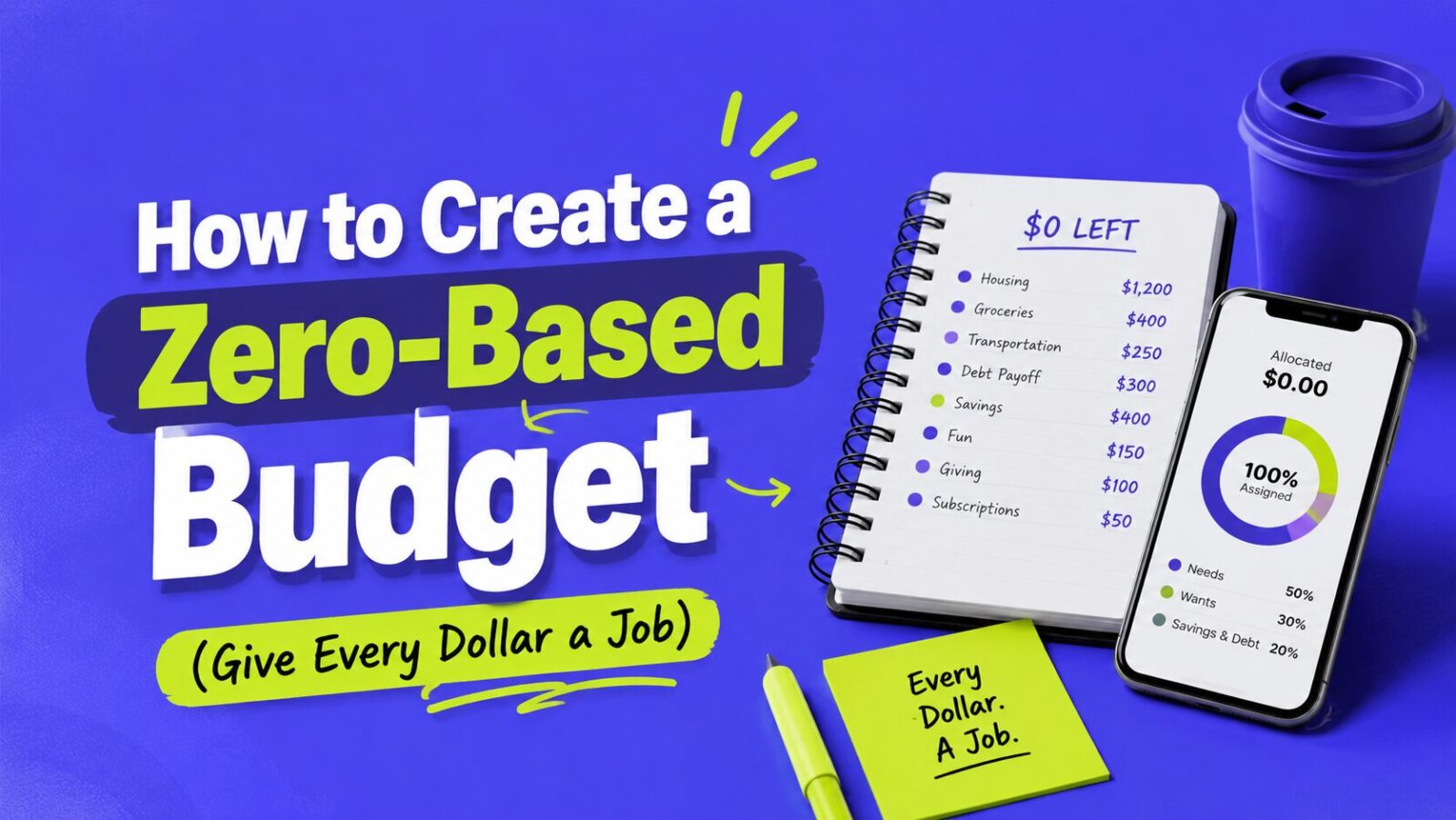
A zero-based budget assigns every dollar of income to a specific purpose. Nothing is “leftover.” Here is how to set one up, the best apps to use, and why it works better than tracking expenses after the fact.

In our 50/30/20 budget guide, we covered the simplest budgeting framework: 50% needs, 30% wants, 20% savings. It works well for people who want a loose structure. But if you have tried the 50/30/20 rule and still cannot figure out where your money goes, or if you are living paycheck to paycheck and need tighter control, the zero-based budget is the next level.

The concept is simple: income minus expenses equals zero. Every dollar of your take-home pay is assigned to a specific category before the month begins. Rent, groceries, gas, fun money, Roth IRA contribution, emergency fund savings, student loan payment. Nothing is “leftover.” Nothing is “extra.” Every dollar has a job.

This is not about restricting your spending. It is about deciding in advance where your money goes instead of wondering where it went.

How a zero-based budget works

Step 1: Write down your total take-home pay for the month.

Step 2: List every expense category and assign a dollar amount to each one.

Step 3: The total of all categories must equal your take-home pay. Income minus all assigned amounts equals $0.

Example for $4,500/month take-home:

CategoryAmount
Rent$1,350
Utilities (electric, water, internet)$180
Groceries$450
Car payment$320
Car insurance$130
Gas$120
Phone$65
Health insurance (employee portion)$85
Student loan payment$280
Subscriptions (streaming, Spotify)$35
Dining out$200
Personal spending (clothes, hobbies)$150
401(k) contribution (after match)$200
Roth IRA contribution$300
Emergency fund savings$250
Haircut/grooming$40
Pet expenses$60
Gifts/holidays$50
Miscellaneous/buffer$135
Total$4,500

Income ($4,500) minus total expenses ($4,500) = $0. Every dollar is assigned.

Notice that savings and investments (401(k), Roth IRA, emergency fund) are line items, not afterthoughts. In a zero-based budget, saving is an expense, just like rent. You pay yourself first by building it into the plan.

Zero-based budget vs. 50/30/20

Both are valid approaches. The difference is precision:

50/30/20: Broad categories. You allocate 50% to needs, 30% to wants, 20% to savings. You do not track individual spending categories. Easy to maintain, but vague. Works best for people who naturally spend within their means.

Zero-based: Every category gets a specific dollar amount. You track spending against each category during the month. More effort, but much more control. Works best for people who overspend in specific categories (dining, shopping) or who need to maximize every dollar.

You can combine both: use the 50/30/20 framework to set your broad targets, then use zero-based budgeting to allocate the specific dollars within each category.

Step-by-step: creating your first zero-based budget

1. Calculate your monthly take-home pay

If you are paid biweekly, multiply your per-paycheck amount by 2. If you have irregular income (freelancing, tips, side hustle), use your lowest expected monthly income as the baseline. Budget conservatively.

If your income varies significantly, budget on last month’s actual income. This means you are always one month behind, which creates a natural buffer, which is exactly what you want. This is the one-month-ahead strategy in practice.

2. List your fixed expenses first

Fixed expenses are the same every month: rent, car payment, insurance, phone, student loan minimum, subscriptions. These are easy because the amounts do not change.

3. Estimate your variable expenses

Variable expenses fluctuate: groceries, dining, gas, entertainment, personal spending. Look at your last 3 months of bank and credit card statements to find your averages. Use those averages as starting points.

Do not set unrealistic targets. If you have spent $500/month on groceries for the past 6 months, budgeting $300 is setting yourself up to fail. Start with $475 and work down gradually.

4. Build in savings and investments

Treat these as non-negotiable line items:

These come before discretionary spending. If you cannot fit both savings and your desired lifestyle spending, cut the discretionary categories first.

5. Add a miscellaneous buffer

Life is unpredictable. A $50 to $150 “miscellaneous” or “buffer” category handles the small surprises: a parking ticket, a last-minute gift, a household item that breaks. Without a buffer, unexpected costs blow up the entire budget.

6. Make it equal zero

Add up everything. If income minus expenses is positive ($200 left over), assign that $200 somewhere: extra debt payment, extra savings, or increase a spending category. If it is negative (spending exceeds income), reduce categories until it balances.

The budget must hit exactly $0. That is the discipline. If you cannot make it work, your expenses are too high or your income is too low, and you need to address one or both (see our guides on cutting expenses and increasing income).

Best budgeting apps for zero-based budgets

YNAB (You Need a Budget) – $14.99/month or $99/year

YNAB is the gold standard for zero-based budgeting. It was built specifically for this method. Every dollar gets assigned to a category. When you overspend in one category, YNAB forces you to move money from another, which makes tradeoffs visible and intentional.

YNAB syncs with your bank accounts, imports transactions automatically, and has a mobile app for on-the-go tracking. The 34-day free trial lets you try before committing.

Average YNAB user saves $600 in the first 2 months and $6,000 in the first year (according to YNAB’s internal data). The $99/year cost pays for itself quickly if it changes your behavior.

EveryDollar (free tier, or $17.99/month for premium)

Created by Dave Ramsey’s team. The free version is a manual-entry zero-based budgeting tool. Clean interface, simple to use. The premium version ($17.99/month) adds bank syncing and transaction importing.

Good for people who want a straightforward zero-based budget without YNAB’s learning curve.

Spreadsheet (free)

A Google Sheets or Excel spreadsheet works perfectly for zero-based budgeting. Create categories, assign amounts, and update manually throughout the month. Free, fully customizable, and you own your data.

The downside: no bank syncing, no mobile alerts, and requires manual discipline.

Pen and paper (free)

A notebook and pen. Write your categories and amounts at the start of each month. Track spending by hand. Low-tech but effective for people who prefer physical formats.

How to stick with a zero-based budget

Review weekly (5 minutes)

Every Sunday, check your spending against your budget categories. Are you on track? Did you overspend on dining out? Do you need to shift money from one category to another? A weekly check-in catches problems early before they become month-end budget blowouts.

Adjust categories monthly

Your first zero-based budget will not be perfect. That is normal. After the first month, review what worked and what did not. Increase underfunded categories. Decrease overfunded ones. By month 3, your budget will closely match your actual spending patterns.

Allow guilt-free spending

The biggest reason budgets fail: they feel punishing. A good zero-based budget includes categories for fun: dining out, entertainment, personal shopping, hobbies. As long as the spending is within the budgeted amount, it is guilt-free. You planned for it. You can enjoy it.

Use cash envelopes for problem categories

If you consistently overspend on dining or shopping, withdraw that category’s budget in cash at the start of the month. When the cash is gone, you are done spending in that category. The physical limitation prevents overspending. This is the “envelope method” and it works for people who struggle with card-based spending.

Automate the boring parts

Set up automatic transfers for savings and investments on payday. Set up autopay for fixed bills (rent, insurance, student loans). The fewer manual actions required, the more likely you stick with the budget. Your mental energy should go toward the variable categories (groceries, dining, personal) where active decisions matter.

Zero-based budgeting for irregular income

If you are a freelancer, have a side hustle, or work on commission, your monthly income varies. Here is how to adapt:

Budget on last month’s income. Whatever you earned in March funds your April budget. This eliminates the guessing game. You know exactly how much you have to work with.

Prioritize categories. List your categories in order of importance: rent, food, utilities, insurance, minimum debt payments at the top. Fun money, shopping, dining at the bottom. If income is lower than expected, fund from the top down and cut from the bottom up.

Build a bigger buffer. People with variable income need a larger emergency fund (6 months instead of 3) and a bigger miscellaneous buffer in their monthly budget.

Bank extra income. In high-income months, resist the urge to spend more. Direct the surplus to savings, debt payoff, or next month’s budget buffer.

Zero-based budgeting for couples

If you share finances with a partner, the zero-based budget becomes a communication tool. Both partners see exactly where the money goes, and both agree on the allocations before the month begins.

How to set it up together:

  1. Combine both incomes for total household take-home pay
  2. List shared expenses (rent, utilities, groceries, joint savings goals)
  3. Assign personal spending amounts for each partner (“your fun money” and “my fun money”)
  4. Agree on shared financial goals and their monthly funding amounts
  5. Both partners review the budget weekly

The personal spending categories are critical. Each person gets an agreed amount to spend however they want, no questions asked. This preserves autonomy within the shared financial framework.

Frequently asked questions

Is zero-based budgeting too restrictive? Only if you make it restrictive. You control the categories and amounts. If you want $300/month for dining out, budget $300. The budget does not tell you what to spend on. It tells you how much. The freedom is in choosing your priorities.

What if I overspend in a category? Move money from another category to cover it. Went $50 over on groceries? Take $50 from entertainment or clothing. The budget always stays at zero. YNAB calls this “rolling with the punches.” It is expected and built into the system.

Do I need an app? No. A spreadsheet, notebook, or even a napkin works. Apps add convenience (bank syncing, mobile tracking, reports) but are not required. Start with whatever format you will actually use.

How long does zero-based budgeting take each month? Initial setup: 30 to 60 minutes. Monthly updates: 15 to 20 minutes. Weekly check-ins: 5 minutes. Total: roughly 1 to 2 hours per month. For context, the average American spends 2+ hours per day on social media. You can afford 30 minutes per week on your finances.

Can I use the zero-based method with the 50/30/20 rule? Absolutely. Use 50/30/20 as your high-level framework, then use zero-based budgeting to assign specific dollar amounts within each category. They are complementary, not competing.

What about annual or quarterly expenses? Divide annual expenses by 12 and include them as a monthly line item. Car insurance of $1,200/year becomes $100/month in your budget, saved in a sinking fund. When the bill comes, the money is ready.

The bottom line

A zero-based budget is the most powerful budgeting method because it forces intentionality. Every dollar is assigned before you spend it. Nothing leaks out. Nothing is wasted. And paradoxically, giving every dollar a job feels more freeing than having no plan, because you spend without guilt on the things you already decided matter to you.

Start this month. Write down your income. List your categories. Make it equal zero. The first month will be imperfect. By month three, you will wonder how you ever managed money without it.

Start investing the money your budget frees up

Leave a Reply

Your email address will not be published. Required fields are marked *