 By
By 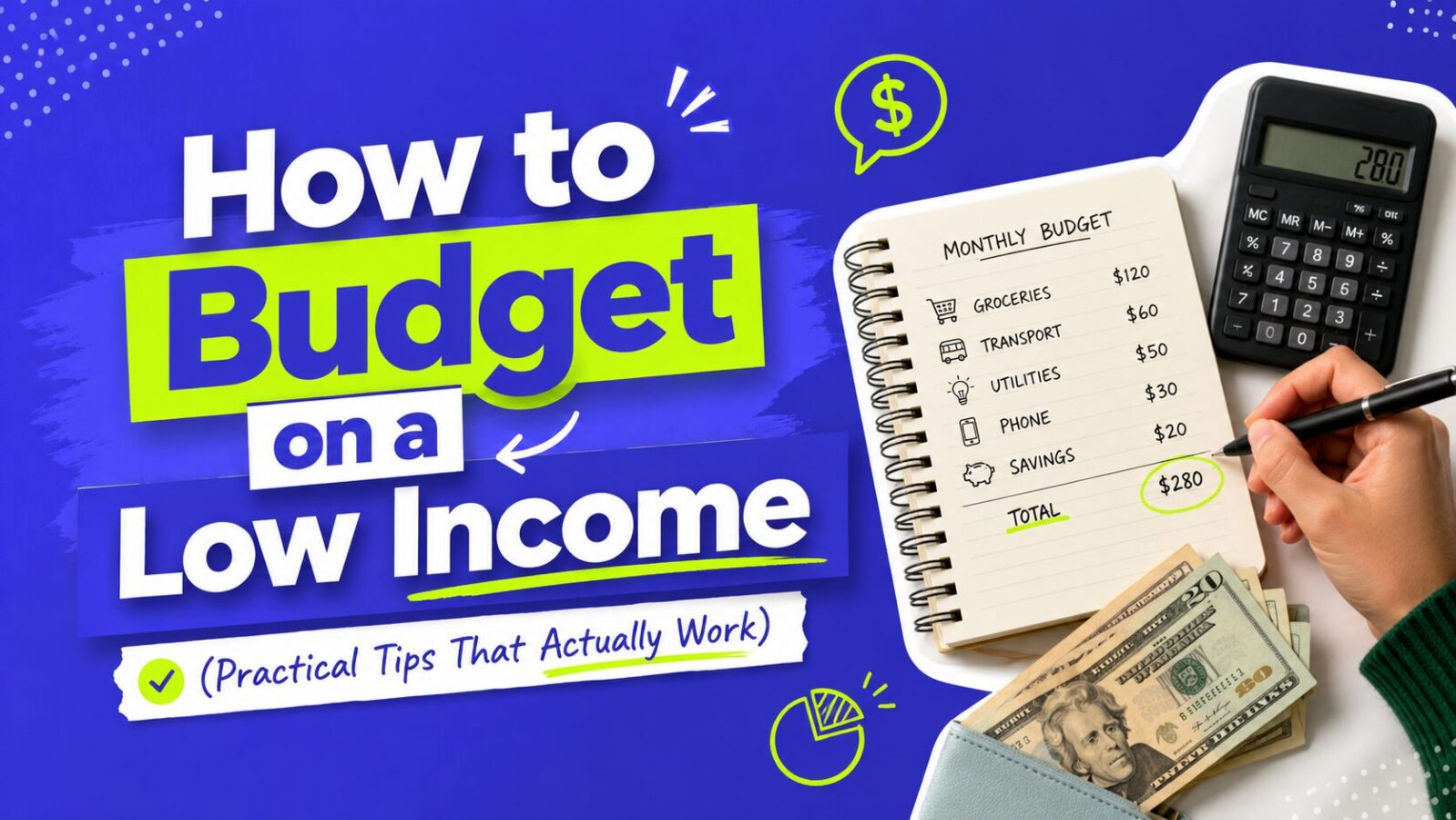
Most budgeting advice on the internet is written for people who have money left over at the end of the month. It assumes you have wiggle room to optimize, categories to trim, and disposable income to redirect. If you are earning under $35,000 a year, that advice often feels disconnected from your reality.
These tactics build on the fundamentals in our how to budget guide.
When your paycheck barely covers rent and groceries, being told to “cut out lattes” is not just unhelpful, it is insulting. You are not broke because of lattes. You are dealing with a genuine income constraint, and you need strategies that acknowledge that.
This guide covers practical, no-judgment budgeting strategies for people with limited income: how to prioritize when there is not enough, where to find help you might not know about, ways to bring in extra money, and free tools to keep everything on track.
Why budgeting matters even more on a low income
The less money you make, the more each dollar matters. When you are living on $2,500/month, a $50 mistake hits much harder than it does for someone bringing home $8,000. That is exactly why budgeting is more important, not less, when your income is limited.
A budget is not a restriction. It is a decision-making tool. It helps you answer the question “what is the most important thing for this money to do?” before the money disappears into the chaos of daily life.
According to research from the Consumer Financial Protection Bureau, households that actively track their spending are significantly more likely to have emergency savings and less likely to rely on high-cost borrowing like payday loans. That holds across all income levels.
Step 1: Know your actual numbers
Before you can budget, you need to know exactly what you are working with.
Calculate your true take-home pay. Include all income sources: primary job wages, part-time or gig work, government benefits (SNAP, SSI, housing assistance), child support received, and any other regular income. If your income varies, calculate your average monthly take-home over the last three to six months.
Track every expense for one month. Review your bank statements or use a free app. Common surprises people discover: convenience store purchases adding up to $80 to $150/month, forgotten subscription services, ATM fees eating $10 to $30/month, and late fees that could be avoided with better timing.
After one month of tracking, use the calculator below to see your targets:
50/30/20 Budget Calculator
Budget Gap Finder
Enter your monthly income and essential expenses to see where you stand.
Step 2: Prioritize the Four Walls
When money is tight, you need a clear hierarchy for spending. Financial experts call the most essential expenses "the four walls": food, shelter, utilities, and transportation.
Food. Feeding yourself and your family is the most basic need. Before any other bill gets paid, make sure you have enough for groceries.
Shelter. Rent or mortgage is typically your largest expense. If you are spending more than 50% of your income on housing, that is a major red flag.
Utilities. Electricity, water, heat, and basic phone service keep your household running. Internet is increasingly a necessity for work and school.
Transportation. You need a way to get to work.
Everything else, including credit card payments and subscriptions, gets addressed only after the four walls are secured. This hierarchy might mean some bills are late during tight months. That is okay. Survival comes first.
Step 3: Apply a modified budget framework
The standard 50/30/20 rule allocates 50% to needs, 30% to wants, and 20% to savings. On a low income, those percentages often do not work. Here is a more realistic framework:
The 70/20/10 approach:
- 70% for essentials: housing, food, utilities, transportation, insurance, minimum debt payments
- 20% for financial goals: building a small emergency fund, paying down high-interest debt
- 10% for everything else: personal spending, entertainment, small treats
If essential expenses consume more than 70% of your income, budgeting alone cannot solve the problem. The strategy becomes: reduce essential costs wherever possible, seek assistance programs to supplement income, and explore ways to increase earnings.
Step 4: Reduce essential costs
Housing: Apply for housing assistance (Section 8, public housing). Consider a roommate: splitting rent can cut housing costs 30 to 50%. Negotiate with your landlord if you have been a reliable tenant. Look into Low-Income Housing Tax Credit (LIHTC) apartments in your area.
Food: Apply for SNAP benefits at Benefits.gov or through your state's Department of Social Services. Use food banks (no income requirement at most locations). Plan meals around weekly store sales. Buy store brands (20 to 30% cheaper with comparable quality). Cook in batches on weekends.
Utilities: Apply for LIHEAP (Low Income Home Energy Assistance Program) for help with heating and cooling bills. Use budget billing to average your annual usage into equal monthly payments. Switch to a cheaper phone plan. Carriers like Mint Mobile and Visible offer plans at $15 to $25/month. The Lifeline program provides discounted phone and internet for qualifying households.
Transportation: Use public transit if available. Monthly passes are almost always cheaper than car ownership. Carpool to work. Keep up with oil changes and tire rotations to prevent expensive repairs.
Step 5: Find assistance programs you might be missing
Many eligible people do not apply for these programs simply because they do not know they exist.
Federal programs:
- SNAP: Food assistance for low-income individuals and families
- Medicaid and CHIP: Free or low-cost health insurance
- LIHEAP: Help with energy bills
- WIC: Nutrition assistance for pregnant women, new mothers, and children under 5
- Earned Income Tax Credit (EITC): A tax credit worth up to $7,830 for qualifying workers in 2026. If you did not claim it on your last return, you might be leaving money on the table.
- Lifeline Program: Discounted phone and internet service
Visit Benefits.gov and use the benefits finder tool to search for all programs you qualify for. Call 211 to connect with local assistance resources.
Step 6: Build a micro emergency fund
Traditional advice says to save 3 to 6 months of expenses. On a low income, start smaller.
The $500 goal. A $500 emergency fund handles most common surprises: a car repair, a medical copay, a broken appliance, an unexpected bill. Research from the Federal Reserve's Survey of Household Economics shows that a significant percentage of Americans cannot cover an unexpected $400 expense. Having $500 set aside puts you ahead of millions of people.
How to build it:
- Start with $5 or $10 per paycheck. Any amount is a start.
- Automate the transfer to savings on payday. Even $20 per pay period adds up to $520/year.
- Save your tax refund. Average EITC recipients get over $2,000 back. Earmark some for the emergency fund.
- Save windfalls: birthday money, rebates, cash back, any unexpected income goes to the emergency fund until you hit your target.
Keep it in a separate account from checking. A high-yield savings account at an online bank earns 4%+ APY while remaining accessible. Read our emergency fund guide for the full strategy.
Step 7: Tackle debt strategically
Prioritize high-interest debt. Credit card debt, payday loans, and personal loans with high interest rates should be your first targets. Make minimum payments on everything else.
Negotiate your debt. Call creditors and ask about hardship programs. Hospitals often offer payment plans and financial hardship discounts for medical bills. For student loans, income-driven repayment plans can reduce your federal loan payments to as little as $0/month based on your income.
Avoid payday loans. Payday loans charge effective annual interest rates of 300 to 600%. A $300 payday loan can easily cost $50 to $90 in fees for a two-week period. Exhaust every other option first: borrowing from family, asking your employer for an advance, using a local assistance program.
Step 8: Explore ways to increase your income
Budgeting can only do so much when income is genuinely too low to cover needs.
Quick income boosts: Sell items you no longer need on Facebook Marketplace, Poshmark, or local consignment shops. Gig work on platforms like DoorDash, Instacart, or TaskRabbit can add $400 to $800/month working 5 to 10 hours per week. Freelance your skills on Fiverr or Upwork. Pick up overtime or extra shifts at your current job.
Longer-term income growth: Workforce development programs in your state may offer free job training in healthcare, IT, skilled trades, or commercial driving. Pell Grants can make community college essentially free for low-income students. Negotiate your current pay. Read our salary negotiation guide for exact scripts.
Read our side hustle guide for a realistic breakdown of which gigs actually pay.
Step 9: Use free financial tools
Free budgeting apps: Goodbudget (free plan) uses the envelope method and works well for tracking spending against categories. EveryDollar (free plan) offers simple zero-based budgeting. Your bank's built-in app may also offer free spending categorization. See our best budgeting apps guide for free options compared.
Free tax preparation:
- IRS Free File: If your adjusted gross income is below $84,000, file federal taxes free.
- VITA (Volunteer Income Tax Assistance): Free tax prep for people earning under $67,000.
- MyFreeTaxes: Free filing option from United Way.
Getting your taxes done correctly and for free is especially important on a low income so you claim every credit you are entitled to, particularly the EITC and Child Tax Credit.
Free financial education: Khan Academy personal finance covers budgeting, saving, credit, and investing at no cost. Many libraries offer free financial literacy workshops.
Step 10: Protect your progress
Build habits, not just budgets. The most important financial tool is the habit of checking in with your money regularly. Set a weekly 10-minute date with your finances to review where you stand.
Avoid lifestyle inflation. When your income increases, resist the urge to immediately upgrade your spending. Direct at least half of any income increase toward your financial goals first.
Celebrate small wins. Saving your first $100 is a bigger deal than most people realize. Paying off even a small debt is worth acknowledging.
If you are living paycheck to paycheck, that guide has additional strategies specifically designed for breaking that cycle.
You are not failing
If you are earning under $35,000 and struggling to make ends meet, that is not a personal failure. Wages have not kept pace with the cost of living in most of the country. Housing costs have outpaced income growth for decades. Budgeting on a low income is harder than budgeting on a higher income. That is just math. But it is not impossible.
Start with one step. Track your spending for a month. Apply for one assistance program. Set up a $10 automatic transfer to savings. One step leads to the next.
Frequently asked questions
The Four Walls method (prioritize food, shelter, utilities, and transportation before anything else) is the most practical approach. Beyond that, the 70/20/10 framework gives you structure without the rigidity of tracking every penny.
Start extremely small. Even $5 per paycheck builds the saving habit. Look for one-time savings: switch to a cheaper phone plan, cancel unused subscriptions, or negotiate a bill. Apply for SNAP, LIHEAP, and other assistance programs to free up money for savings.
Build a $500 emergency fund first, then focus on high-interest debt. Without that cushion, any unexpected expense forces you back into debt, creating a cycle that is hard to break.
Unexpected expenses feel more manageable with even a small emergency fund. Some "unexpected" expenses are actually predictable. Car maintenance, medical visits, and household repairs happen regularly. Use sinking funds to save a small amount each month for these so they do not derail your budget when they arrive.
Take one step today:
- Start tracking your spending this week using Goodbudget free or your bank's built-in app. Just knowing where your money goes is the first win.
- Check if you qualify for assistance programs at Benefits.gov. It takes 10 minutes and could unlock hundreds of dollars per month in SNAP, LIHEAP, or other programs.
- Set up a $10 automatic transfer to a separate savings account on your next payday. The amount does not matter yet. The habit does.