By
By 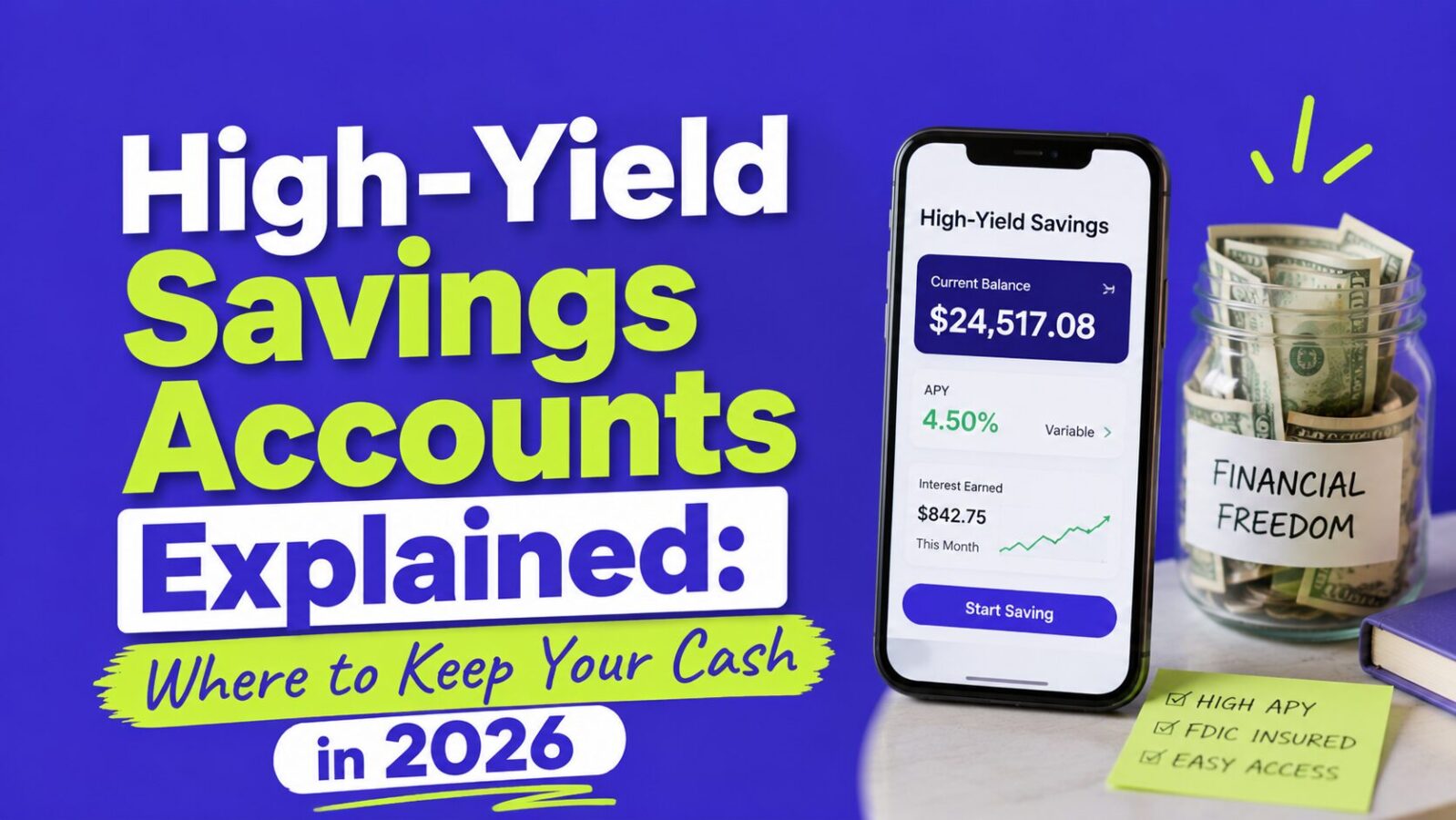
Your savings account is probably paying you 0.01% while inflation runs near 3%. The best high-yield savings accounts pay around 4% APY on the same money, with the same FDIC insurance. Rates have come down from their 2023 to 2024 peaks as the Federal Reserve cut, but the gap over a big-bank account is still enormous. Here is exactly where rates stand in June 2026 and how to switch.
- The best high-yield savings accounts pay about 4% APY in June 2026 (top accessible rates around 4.05% to 4.21%), versus roughly 0.01% at most big banks, on the same FDIC-insured money.
- On a $10,000 balance that is about $400 a year instead of $1, for the same zero risk.
- Rates have fallen from the 5%+ peak of 2023 to 2024 as the Fed cut; the big online names (SoFi, Ally, Marcus, Capital One) now sit around 3.0% to 3.4%, so it pays to compare.
- Use a HYSA for your emergency fund and short-term savings, and invest longer-term money in index funds.
If your savings are sitting in a traditional account at Chase, Bank of America, or Wells Fargo, you are probably earning 0.01% APY. On $10,000, that is $1 per year. Meanwhile inflation is running around 3%, so your savings lose roughly $300 in purchasing power annually. You are effectively paying the bank to hold your money.
A high-yield savings account (HYSA) at an online bank pays about 4% APY right now. That same $10,000 earns roughly $400 per year instead of $1, with the same FDIC insurance and the same government protection. The only real difference is that the bank is online instead of on a street corner.
This is not a complicated financial product and it is not an investment. It is a savings account that pays a fair rate instead of quietly eroding your purchasing power. If you hold any cash savings and are not in a HYSA, switching is one of the easiest financial wins available.
What is a high-yield savings account?
A HYSA is a regular savings account offered by online banks and some credit unions that pays a much higher interest rate than traditional brick-and-mortar banks. That is the entire difference. It works the same way: you deposit money, it earns interest, you withdraw when you need it.
Why do online banks pay more? They do not run thousands of physical branches with rent, utilities, tellers, and security. Those savings get passed to you as higher interest.
Key features of a HYSA:
- FDIC insured up to $250,000 (or NCUA insured for credit unions). Your money is protected by the federal government.
- No lock-up period. Unlike CDs, you can withdraw anytime. Transfers to a linked checking account typically take 1 to 2 business days.
- No minimums at most online banks.
- No monthly fees at the banks listed below.
- Variable interest rate. The APY floats with the Federal Reserve rate, so it rises and falls over time.
Why HYSA rates dropped in 2026
If you opened a HYSA in 2023 and saw 4.5% or even 5%, your rate has quietly slipped. HYSA yields track the Federal Reserve’s benchmark rate. As the Fed cut through late 2025 and into 2026, savings rates followed. The big online names that led the pack at 4.5%+ (SoFi, Ally, Marcus, Capital One) have settled around 3.0% to 3.4%.
The takeaway is not “savings accounts are dead.” A 3% to 4% HYSA still beats a 0.01% big-bank account by hundreds of dollars a year. But the spread between the top payers and the brand names has widened, so it is worth shopping the rate rather than defaulting to whichever bank advertises hardest.
Best high-yield savings accounts (June 2026)
Here is where the major accounts stand right now:
| Bank | APY (June 2026) | Minimum | Monthly fee | Notes |
|---|---|---|---|---|
| Axos ONE Savings | up to 4.21% | $0 | $0 | Top rate; bonus tiers need deposit/balance conditions |
| CIT Platinum Savings | 3.75% (4.10% w/ boost) | $100 | $0 | Higher tier requires $5,000+ balance |
| Wealthfront Cash | 4.05% | $1 | $0 | Up to $2M FDIC via partner banks |
| Marcus by Goldman Sachs | 3.40% | $0 | $0 | Savings only, no checking |
| Synchrony | 3.40% | $0 | $0 | Optional ATM card |
| SoFi | 3.10% (w/ direct deposit) | $0 | $0 | Banking + investing in one app |
| American Express | 3.10% | $0 | $0 | Big-name, simple, savings only |
| Ally | 3.00% | $0 | $0 | “Buckets” + instant Ally-to-Ally transfers |
| Capital One 360 | 3.00% | $0 | $0 | Physical Capital One Cafes in some cities |
Rates as of June 2026. APYs are variable and change with the Federal Reserve rate. A handful of smaller accounts (for example Varo) advertise promotional rates near 5%, but those usually require direct deposit or balance caps. Always verify the current rate and conditions on each bank’s website before opening.
If you want the highest rate
Axos, Wealthfront, and CIT currently lead on yield (roughly 4.05% to 4.21%). Wealthfront is the simplest of the three: 4.05% APY, $1 minimum, no fees, and up to $2 million in FDIC coverage through partner banks. CIT’s top tier needs a $5,000 balance, and Axos’s headline rate depends on meeting deposit conditions, so read the fine print before chasing the number.
If you want a big-name bank or an all-in-one app
Marcus and Synchrony (both 3.40%) are the strongest of the brand names on rate. SoFi (3.10% with direct deposit) is the best pick if you want savings, checking, and investing in one app with instant internal transfers. Ally (3.00%) remains the most polished online bank, and its “buckets” feature lets you split one account into labeled goals (emergency fund, vacation, car) without opening multiple accounts. The dollar difference between 3.0% and 3.4% on a $10,000 balance is only about $40 a year, so for most people the ecosystem and features matter more than the last fraction of a percent.
See how much your bank is costing you
Enter your current savings balance and your bank’s APY to see exactly how much you are earning now versus what you could earn in a HYSA.
What is your bank costing you? Enter your balance and current APY to see the difference.HYSA vs. CD, money market, T-bills, and stocks
HYSA vs. traditional savings (Chase, BofA, Wells Fargo). Traditional banks pay 0.01 to 0.05% APY. On $10,000, that is $1 to $5 per year versus about $400 in a HYSA, with the same federal insurance. There is no rational reason to keep savings at a traditional bank unless you need same-day physical branch access.
HYSA vs. CDs. CDs lock your money for a fixed term in exchange for a guaranteed rate. As of mid-2026, top 1-year CDs pay roughly 4.10 to 4.30% APY. For your emergency fund, a HYSA wins because you need instant access. For money you know you will not touch for 12+ months, a CD can lock in today’s rate before it falls further.
HYSA vs. money market accounts. Similar rates (roughly 3.5 to 4.2%), but money market accounts often include check-writing and a debit card. We slightly prefer HYSAs for emergency funds because the small friction of transferring money out prevents impulsive spending.
HYSA vs. Treasury bills (T-bills). T-bills pay roughly 3.75 to 4.0% as of mid-2026, and the interest is exempt from state and local taxes, which gives them an edge in high-tax states. Buy them directly at TreasuryDirect.gov ($100 minimum) or through a brokerage at Fidelity, Schwab, or Vanguard under “Fixed Income.” T-bills make the most sense for people in high state-income-tax states (California 9.3%+, New York 6.85%+) with $10,000+ to park for a set period.
HYSA vs. the stock market. Do not put your emergency fund in the stock market. Stocks can drop 30% in a month. Your emergency fund needs to be there at the exact amount you deposited plus interest. Stocks are for money you will not touch for 5+ years. Different tools for different jobs. Read our investing in your 20s guide for where to invest beyond short-term savings.
How much to keep in a HYSA
Keep in a HYSA:
- Emergency fund: 3 to 6 months of essential expenses (the primary use case)
- Short-term savings goals under 2 years: vacation fund, car down payment, wedding fund
- Extra cash buffer: 1 to 2 months of expenses above your emergency fund
Do not keep in a HYSA: long-term money (5+ years). Anything you will not need for 5+ years should be invested in index funds inside a Roth IRA or brokerage account. A HYSA near 4% only just keeps pace with inflation. Stocks have historically returned about 7% real (after inflation). Over 20 years, $10,000 in a HYSA grows to roughly $22,000 in nominal terms, while the same $10,000 invested in index funds has historically grown to roughly $39,000.
Use our free Savings Goal Tracker to set targets for each bucket (emergency fund, vacation, car, house down payment) and track your progress.
Before you open a HYSA: one exception
If you are carrying credit card debt at 20%+ APR, paying it off first is mathematically better than opening a savings account.
Earning 4% on $5,000 in savings while paying 22% interest on $5,000 in credit card debt means you are losing roughly 18% net. The HYSA earns you about $200/year. The credit card costs you about $1,100/year. You are roughly $900 behind.
The right order:
- Build a $500 to $1,000 cash buffer first (so you do not add more credit card debt when something breaks)
- Pay off all high-interest debt (above 7 to 8% APR) aggressively
- Once high-interest debt is gone, build your full 3 to 6 month emergency fund in a HYSA
- Then invest everything beyond that
If your only debt is a mortgage or student loans below 6%, open the HYSA now. Low-interest debt and savings can run in parallel. See our credit card debt payoff guide for the fastest ways to clear high-interest debt.
How to open a HYSA (5 minutes)
- Go to the bank’s website or download the app (Wealthfront, Marcus, SoFi, Ally, etc.)
- Click “Open account” and select “Savings”
- Enter your name, email, address, Social Security number, and date of birth
- Link your current checking account for transfers
- Transfer your initial deposit
Your first transfer typically takes 1 to 3 business days. After that, set up automatic transfers from checking to your HYSA on payday.
Will HYSA rates fall further?
Possibly. HYSA rates track the Federal Reserve’s federal funds rate, and they have already fallen from the 5%+ highs of 2023 to 2024. If the Fed cuts again, savings rates will drift lower too. But even at 2 to 3% APY, a HYSA still beats a traditional account paying 0.01% by a massive margin.
Do not try to time interest rates. Open a HYSA now, earn whatever the current rate is, and revisit if rates change. The worst HYSA rate you will ever get is still dramatically better than a traditional bank. If you want to lock a rate for money you will not touch for a year, that is the case for a CD.
Frequently Asked Questions
Top accessible HYSA rates are around 4.05% to 4.21% (Wealthfront, CIT, and Axos lead). The big online names like SoFi, Ally, Marcus, and Capital One now sit closer to 3.0% to 3.4% after the Fed’s rate cuts. A few smaller accounts advertise promotional rates near 5% with direct-deposit or balance conditions.
Yes. Online banks are FDIC insured (or NCUA insured for credit unions) just like Chase or Bank of America. Your deposits are protected up to $250,000 per depositor per bank. Some banks such as SoFi and Wealthfront offer extended coverage through partner bank networks.
They do not have to. Millions of customers keep money in 0.01% accounts out of habit and inertia, and those cheap deposits are extremely profitable. Online banks compete on rate because they cannot compete on branch locations.
Interest is taxed as ordinary income at your marginal tax rate, and the bank sends a 1099-INT in January. If you earn $400 in interest and you are in the 22% bracket, you owe about $88 in federal tax, still hundreds more than the $1 you would have earned at a traditional bank.
HYSA rates are variable and follow the Federal Reserve. As the Fed cut rates through late 2025 and into 2026, savings yields fell from their 5%+ peak. This is normal, not a penalty on you, and it is why comparing rates periodically is worth a few minutes.
The bottom line
Moving your savings from a 0.01% account to a roughly 4% HYSA is the easiest financial upgrade you can make. It takes 5 minutes, costs nothing, carries no risk, and earns you hundreds of dollars a year on money you already have. Even after the recent rate cuts, the gap over a big-bank account is enormous.
Let your emergency fund and short-term savings earn real money while you sleep. Then invest everything else in index funds for the long term.
Ready to take the next step?
- Need to build your emergency fund? Read our emergency fund guide — your HYSA is the right home for those 3 to 6 months of expenses.
- Have extra cash beyond your emergency fund? Read our investing in your 20s guide for where that money should go next.
- Track your savings goals: Download the free Savings Goal Tracker to set targets for each bucket and watch your progress.