 By
By 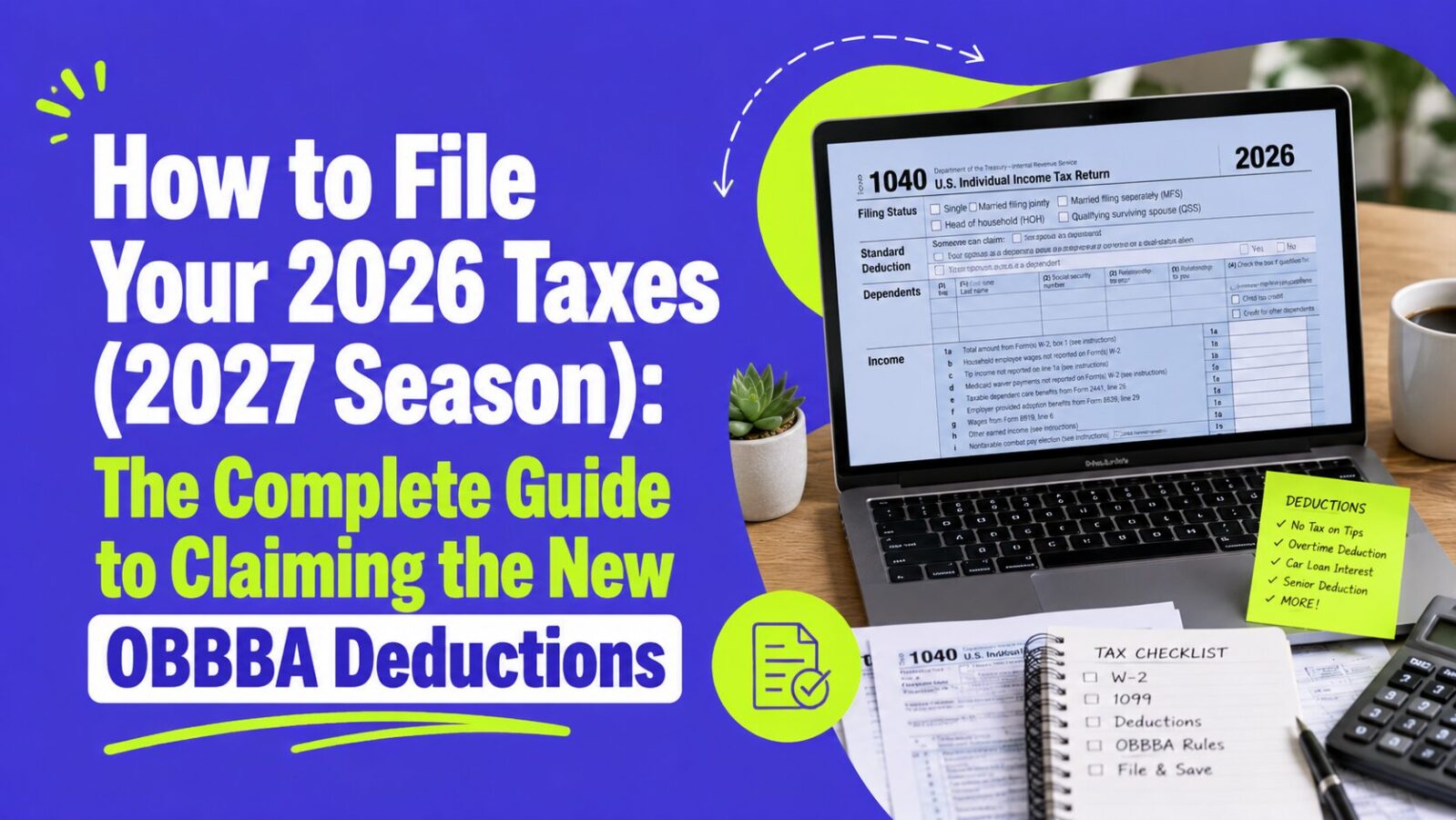
Filing your 2026 federal tax return in 2027 should be easier for many people claiming the new OBBBA deductions because employers and other payers now have dedicated reporting fields for qualified tips and overtime.
The four headline deductions are:
- up to $25,000 of qualified tips,
- up to $12,500 of qualified overtime, or $25,000 on a joint return,
- up to $10,000 of qualified passenger vehicle loan interest, and
- up to $6,000 per eligible taxpayer age 65 or older.
These deductions are claimed through Schedule 1-A, Additional Deductions. They can be used whether you take the standard deduction or itemize, but they are not ordinary above-the-line adjustments that reduce AGI. Schedule 1-A uses modified adjusted gross income to determine eligibility and phaseouts, and the deductions ultimately reduce taxable income.
Also, 2027 is not the first filing season these deductions exist. They became effective for tax year 2025 and were first claimed on returns filed in 2026.
What changes for tax year 2026 is the information reporting, especially the new W-2 and 1099 fields for tips and overtime.
Key takeaways
- The four major OBBBA deductions are claimed on Schedule 1-A, not the normal Schedule 1 adjustments-to-income section.
- You can claim them while taking either the standard deduction or itemized deductions.
- For 2026 W-2s, Box 12 code TP reports cash tips reported to the employer and Box 12 code TT reports qualified overtime compensation. Box 14b reports the Treasury Tipped Occupation Code.
- Qualified overtime generally means the FLSA-required premium portion, such as the extra half of time-and-a-half, not the entire overtime paycheck.
- The car loan interest deduction generally requires a qualifying new personal-use vehicle, U.S. final assembly, and a loan secured by a first lien on the vehicle.
- The enhanced senior deduction is up to $6,000 per eligible person and is separate from the existing additional standard deduction for older taxpayers.
- The expected regular federal deadline for most 2026 calendar-year returns is April 15, 2027. A timely extension generally gives you until October 15 to file, but not extra time to pay.
- The IRS has not yet announced the opening date of the 2027 filing season.
What is actually new when you file 2026 taxes?
The deductions themselves are not new for the first time in 2027.
They took effect for tax years 2025 through 2028. Taxpayers already began claiming them during the 2026 filing season.
The big change for your 2026 income is better reporting.
Employers and other payers now have dedicated fields that help identify qualified tips and overtime. That should reduce some of the record-reconstruction problems taxpayers faced when filing 2025 returns.
For tax year 2026:
- W-2 Box 12 code TP reports cash tips reported to the employer.
- W-2 Box 12 code TT reports qualified overtime compensation.
- W-2 Box 14b reports Treasury Tipped Occupation Codes.
Independent contractors and other nonemployees can also see new information on Forms 1099.
According to IRS Publication 505, qualified tips for 2026 may be separately reported on:
- Form 1099-MISC, Box 13a
- Form 1099-NEC, Box 1b
- Form 1099-K, Box 1c
Qualified overtime may be reported on:
- Form 1099-MISC, Box 14
- Form 1099-NEC, Box 1d
The IRS also added fields for the applicable tipped occupation code on those forms.
That does not mean you should blindly copy every number onto Schedule 1-A. You still have to meet the underlying eligibility rules.
For current IRS reporting guidance, see Publication 505.
Your 2026 standard deduction
The standard deduction for tax year 2026 is:
| Filing status | 2026 standard deduction |
|---|---|
| Single | $16,100 |
| Married filing separately | $16,100 |
| Married filing jointly | $32,200 |
| Head of household | $24,150 |
The Schedule 1-A deductions can be claimed in addition to the standard deduction when you qualify.
That is different from saying they reduce AGI.
A simplified version of the calculation is:
Income
minus applicable adjustments to income
= AGI
then apply the standard or itemized deduction and applicable additional deductions, including Schedule 1-A
= Taxable income
This distinction matters because the income phaseouts for the new deductions are themselves based on modified adjusted gross income.
Quick comparison of the four deductions
| Deduction | Maximum | Phaseout begins |
|---|---|---|
| Qualified tips | $25,000 | $150,000 MAGI, $300,000 joint |
| Qualified overtime | $12,500, or $25,000 joint | $150,000 MAGI, $300,000 joint |
| Qualified car loan interest | $10,000 | $100,000 MAGI, $200,000 joint |
| Senior deduction | $6,000 per eligible person | $75,000 MAGI, $150,000 joint |
The phaseouts do not all use the same calculation.
That matters.
Do not take the phaseout formula from one deduction and automatically apply it to the other three.
How to claim the qualified tips deduction
The qualified tips deduction allows eligible employees and self-employed workers to deduct up to $25,000 of qualified tips.
The IRS’s final regulations list more than 70 tipped occupations across categories including food service, hospitality, personal services, recreation, entertainment, and transportation.
But receiving tips does not automatically make every payment deductible.
Qualified tips generally must be voluntary. A mandatory service charge that the customer cannot reject or change generally is not treated the same way as a voluntary tip for this deduction.
Step 1: Check your W-2 or 1099
If you are an employee, look at:
Box 12, code TP: cash tips reported to the employer.
Box 14b: Treasury Tipped Occupation Code.
The TTOC identifies the occupation associated with the tips. It does not by itself mean every dollar under TP is deductible.
If you are not an employee, look for the new tip-reporting fields on the applicable Form 1099.
Step 2: Confirm that the tips qualify
You must be in an eligible tipped occupation and the payments must meet the qualified-tip rules.
Employees and self-employed workers may potentially qualify, but self-employed taxpayers face additional restrictions.
For example, the deduction generally cannot exceed net income from the trade or business in which the tips were earned, and certain specified service trades or businesses are excluded.
Step 3: Apply the cap and phaseout
The maximum annual deduction is:
$25,000 per return.
The phaseout begins above:
- $150,000 MAGI for most filers
- $300,000 MAGI for married filing jointly
The deduction is reduced by $100 for each $1,000 of MAGI above the applicable threshold under the Schedule 1-A calculation.
If you are married, you generally must file jointly to claim the deduction.
For the detailed filing walkthrough, see How to claim the no tax on tips deduction on your 2026 tax return.
What if your W-2 is missing code TP?
Do not automatically use Form 4137 as a substitute for an incorrect W-2.
For tax year 2026, employers have new reporting requirements for cash tips and tipped occupation codes when those rules apply.
If you believe your W-2 is incorrect, contact payroll and ask the employer to review it.
Form 4137 serves a different purpose. It is used to report Social Security and Medicare tax on certain tip income that was not properly reported to your employer.
Tips reported directly by the taxpayer on Form 4137 may also potentially be considered when calculating the qualified-tip deduction if the requirements are satisfied.
So:
Incorrect employer reporting: contact the employer.
Tips you failed to report to the employer when required: Form 4137 may become relevant.
Those are not the same problem.
How to claim the qualified overtime deduction
The overtime provision is one of the easiest OBBBA rules to misunderstand.
You do not generally deduct your entire overtime paycheck.
Qualified overtime generally means compensation paid above your regular rate because the overtime was required under Section 7 of the Fair Labor Standards Act.
For ordinary time-and-a-half overtime, that generally means the extra half, not the entire 1.5x payment.
Example
Suppose your regular pay is:
$20 per hour
Your time-and-a-half overtime rate is:
$30 per hour
For one overtime hour:
- $20 represents your regular pay
- $10 represents the overtime premium
The $10 premium is generally the amount relevant to the qualified overtime deduction, not the full $30.
Step 1: Check code TT
For 2026 W-2s, qualified overtime compensation is reported in:
Box 12, code TT.
Qualified overtime paid to certain nonemployees may also appear separately on Forms 1099-MISC or 1099-NEC.
Step 2: Confirm that it is qualified overtime
Do not assume every payment an employer calls “overtime” qualifies.
The federal deduction focuses on overtime compensation required under the FLSA.
Contractual premium pay, bonuses, or other extra compensation may follow different rules.
Being salaried also does not automatically determine whether you qualify. What matters is whether the compensation meets the federal qualified-overtime rules.
Step 3: Apply the cap and phaseout
Maximum deduction:
- $12,500 for most returns
- $25,000 for married filing jointly
The phaseout begins above:
- $150,000 MAGI for most filers
- $300,000 MAGI for married filing jointly
The deduction uses the same general $100-per-$1,000 phaseout structure as the qualified tips deduction.
For more detail, see No Tax on Overtime 2026: Rules, Limits and W-2 Code TT.
How to claim the car loan interest deduction
The car loan provision is narrower than the phrase “deduct your auto loan interest” makes it sound.
The maximum deduction is $10,000 of qualified interest actually paid or accrued, not $10,000 simply because you financed a vehicle.
The loan generally must:
- have been incurred after December 31, 2024,
- have been used to purchase the qualifying vehicle,
- be secured by a first lien on that vehicle,
- and finance a vehicle acquired for personal use.
The vehicle generally must:
- be new, meaning its original use begins with the taxpayer,
- fall within an eligible passenger-vehicle category,
- and have undergone final assembly in the United States.
Used vehicles generally do not qualify.
Leases do not qualify.
You can check the broader IRS requirements in Topic No. 505, Interest Expense.
What document should you look for?
Do not look for an ordinary mortgage Form 1098.
The IRS has developed Form 1098-VLI, Vehicle Loan Interest Statement, for vehicle-loan-interest reporting.
As of August 20, 2026, the IRS version available is still a draft form, so you should not rely on a specific final box layout yet.
The draft reporting rules generally apply when a lender receives at least $600 of reportable interest on a specified passenger vehicle loan.
Regardless of the final information-return layout, keep:
- your lender’s interest statement,
- loan documents,
- vehicle information,
- and VIN.
You must include the VIN when claiming the deduction.
The car loan phaseout is different
The deduction begins phasing out above:
- $100,000 MAGI for most filers
- $200,000 MAGI for married filing jointly
Do not use the tips and overtime phaseout formula.
Under the Schedule 1-A calculation, the car loan deduction is reduced by $200 for each $1,000 or fraction of $1,000 of MAGI above the applicable threshold.
That means the maximum $10,000 deduction can phase out relatively quickly.
For the full eligibility and filing rules, see How to claim the car loan interest deduction on your 2026 tax return.
How to claim the $6,000 senior deduction
Eligible taxpayers age 65 or older can claim an enhanced deduction of up to $6,000 per person.
If both spouses qualify and file jointly, the maximum can be:
$12,000.
This deduction is separate from the existing additional standard deduction available to older taxpayers.
For tax year 2026, IRS Publication 505 says someone born before January 2, 1962 may meet the age requirement, subject to the other eligibility rules.
The senior phaseout also uses a different formula
The phaseout begins above:
- $75,000 MAGI for most individual filers
- $150,000 MAGI for married filing jointly
The Schedule 1-A calculation reduces the deduction based on 6% of MAGI above the applicable threshold.
That is not the same calculation used for tips, overtime, or car loan interest.
If you are married, you generally must file jointly to claim the enhanced senior deduction.
A valid Social Security number is also required.
For more detail, see $6,000 senior deduction for 2026: who qualifies and how much is it worth?.
Where do these deductions actually go on the return?
They go on Schedule 1-A, Additional Deductions.
Schedule 1-A contains separate sections for:
- qualified tips,
- qualified overtime,
- qualified passenger vehicle loan interest,
- and the enhanced deduction for seniors.
Do not describe these deductions as going into the ordinary “Adjustments to Income” section of Schedule 1.
That would incorrectly imply that they reduce AGI.
The IRS describes Schedule 1-A as the schedule taxpayers use to calculate these additional deductions and reduce taxable income.
Because the final tax-year 2026 Form 1040 package may still change before filing season, it is also better not to hard-code a particular 2026 Schedule 1-A line number until the final forms are released.
When will your 2026 W-2 arrive?
Employers generally must furnish 2026 Forms W-2 to employees by February 1, 2027.
January 31, 2027 falls on a Sunday, so the deadline moves to the next business day.
Before filing, compare:
- wages,
- federal withholding,
- Social Security and Medicare wages,
- Box 12 code TP if applicable,
- Box 12 code TT if applicable,
- and Box 14b if tipped-worker reporting applies.
If something appears wrong, ask the employer about a correction before rushing to file.
When can you file your 2026 taxes?
As of August 20, 2026, the IRS has not announced the official opening date for the 2027 tax filing season.
A late-January start would be consistent with recent filing seasons, but do not rely on a specific opening date until the IRS announces one.
The regular filing deadline is easier to anticipate.
The IRS’s current draft 2026 Form 4868 identifies:
April 15, 2027
as the due date for most 2026 calendar-year individual returns.
Because that form is still in draft form as of August 2026, check the final IRS filing calendar before relying on the date.
A timely automatic extension generally gives eligible calendar-year filers until:
October 15, 2027
to file.
An extension to file is not an extension to pay.
Tax left unpaid after the regular payment deadline can still accrue interest and potentially penalties.
For updates as filing season approaches, see 2027 tax filing season: When you can file 2026 taxes and get your refund.
Will these deductions make your 2027 refund bigger?
Maybe.
A deduction lowers taxable income and can reduce your federal income tax.
A refund, however, depends on how much tax you already paid through withholding and other payments compared with your final tax liability.
For example, suppose a $10,000 deduction falls entirely within your 22% marginal bracket.
In a simplified calculation:
$10,000 × 22% = $2,200
That can mean roughly $2,200 less federal income tax.
It does not automatically mean your refund will increase by $2,200.
If less tax was withheld from your pay during 2026 because you adjusted your Form W-4 for the deduction, you may already have received some of the benefit through larger paychecks.
For examples, see Will the new OBBBA deductions make your 2027 tax refund bigger?.
Will TurboTax, H&R Block, or FreeTaxUSA handle these deductions?
Major tax preparation products will need to reflect the finalized federal forms and rules for the returns they support.
But do not rely on unverified 2027 prices or product-tier claims in August 2026.
Final tax-year 2026 filing products have not fully launched, and:
- prices can change,
- free-tier eligibility can change,
- supported tax situations can change,
- and the exact workflow for TP, TT, TTOC, and Schedule 1-A can change.
The current versions of several major products already support Schedule 1-A for 2025 returns, but that should not be treated as a guarantee about every 2027 product tier.
For the current comparison, see Best tax software for 2027: TurboTax vs H&R Block vs FreeTaxUSA.
What if you are a gig worker?
Gig and self-employed workers need to separate two questions:
What income must I report?
and
Do any of my tips qualify for the Schedule 1-A deduction?
Those are not the same thing.
Qualified tips can potentially be reported through Forms W-2, 1099-MISC, 1099-NEC, 1099-K, or Form 4137 depending on the circumstances.
Self-employed taxpayers can qualify for the tips deduction when their occupation, tip income, and business meet the requirements, but additional restrictions apply.
A Form 1099-K also reports gross payment activity. It does not automatically tell you your taxable business profit.
For more help, see:
How to file taxes as a gig worker or 1099 contractor in 2027
1099-K threshold for 2026: $20,000 and 200 transactions explained
Freelance Taxes 2026: How Much You Owe, Deductions, and Deadlines
Your 2026 tax filing checklist
Before submitting your return:
- Gather all W-2s, 1099s, brokerage statements, and other tax documents.
- Check your W-2 for codes TP and TT if you received tips or qualifying overtime.
- Check Box 14b for the TTOC if tipped-worker reporting applies.
- Confirm your occupation and tips actually meet the qualified-tip rules.
- Remember that the overtime deduction generally applies only to qualified FLSA overtime compensation, not your entire overtime paycheck.
- Gather your vehicle loan interest records and VIN if claiming qualified car loan interest.
- Confirm the vehicle’s original use, U.S. final assembly, first-lien loan requirement, and other eligibility rules.
- Confirm age and MAGI if claiming the senior deduction.
- Use Schedule 1-A, not regular Schedule 1 adjustments to income, for these deductions.
- Compare your completed return with your source documents before e-filing.
- Pay any federal balance due by the applicable payment deadline even if you request additional time to file.
Frequently asked questions
Is 2027 the first year I can claim the OBBBA tips and overtime deductions?
No.
The deductions took effect for tax year 2025 and were first claimed on returns filed in 2026.
Tax year 2026 adds more standardized information reporting, including W-2 codes TP and TT.
Do I have to itemize?
No.
Eligible taxpayers can claim the Schedule 1-A deductions whether they itemize or take the standard deduction.
Are these above-the-line deductions?
Not in the usual sense of adjustments that reduce AGI.
The IRS places them on Schedule 1-A, Additional Deductions. Schedule 1-A uses MAGI in its calculations, and the resulting additional deduction is applied when determining taxable income.
What does TP mean on my W-2?
Code TP in Box 12 reports cash tips reported to your employer under the 2026 reporting rules.
Box 14b reports the applicable Treasury Tipped Occupation Code.
TP is useful for calculating the deduction, but it is not automatically the amount you can deduct.
What does TT mean?
Code TT reports qualified overtime compensation.
For ordinary time-and-a-half overtime, that generally means the additional half-time premium rather than the entire amount earned during the overtime hour.
Does missing TP or TT mean I automatically lose the deduction?
Not necessarily.
But do not ignore a potentially incorrect W-2.
Contact your employer or payer if information that should have been reported appears to be missing or incorrect.
Other reporting mechanisms can apply in some situations, but the correct treatment depends on why the amount is missing.
Can I deduct interest on a used car?
Generally, no.
The qualified passenger vehicle loan interest deduction requires a vehicle whose original use begins with the taxpayer, along with the other loan, personal-use, first-lien, and U.S. final-assembly requirements.
Leases do not qualify either.
Is Form 1098-VLI final?
Not yet.
As of August 20, 2026, the IRS lists Form 1098-VLI and its instructions as draft tax products.
Do not rely on the draft box layout as final filing guidance.
When are 2026 federal taxes due?
The IRS’s current draft Form 4868 identifies April 15, 2027 as the regular due date for most 2026 calendar-year individual returns.
A valid extension generally gives eligible taxpayers until October 15 to file, but it does not normally postpone the payment deadline.
Verify the final IRS calendar once the 2027 filing season is announced.
Bottom line
Filing your 2026 taxes in 2027 should be more straightforward for people claiming the OBBBA tips and overtime deductions because the 2026 W-2 and Forms 1099 now have dedicated reporting fields.
But avoid three common mistakes.
First, these deductions did not begin with the 2027 filing season. They have applied since tax year 2025.
Second, they belong on Schedule 1-A and should not be described as ordinary above-the-line deductions that reduce AGI.
Third, do not assume the headline maximum is what you personally can claim. Tips, overtime, car loan interest, and the senior deduction each have their own eligibility rules and phaseout calculations.
Before filing, verify your W-2 and 1099 information, use the final 2026 IRS forms once released, and calculate the deduction that actually applies to your situation.
For the bigger picture, see the 2026 OBBBA tax changes complete guide and 2026 federal tax brackets and standard deduction guide.
This article is for general educational purposes and is not individualized tax, financial, or legal advice. IRS forms, instructions, deadlines, and filing procedures for the 2027 filing season may change before filing opens. Always use the final IRS forms and current guidance when preparing your return, and consider a qualified tax professional if your situation is complex.