 By
By 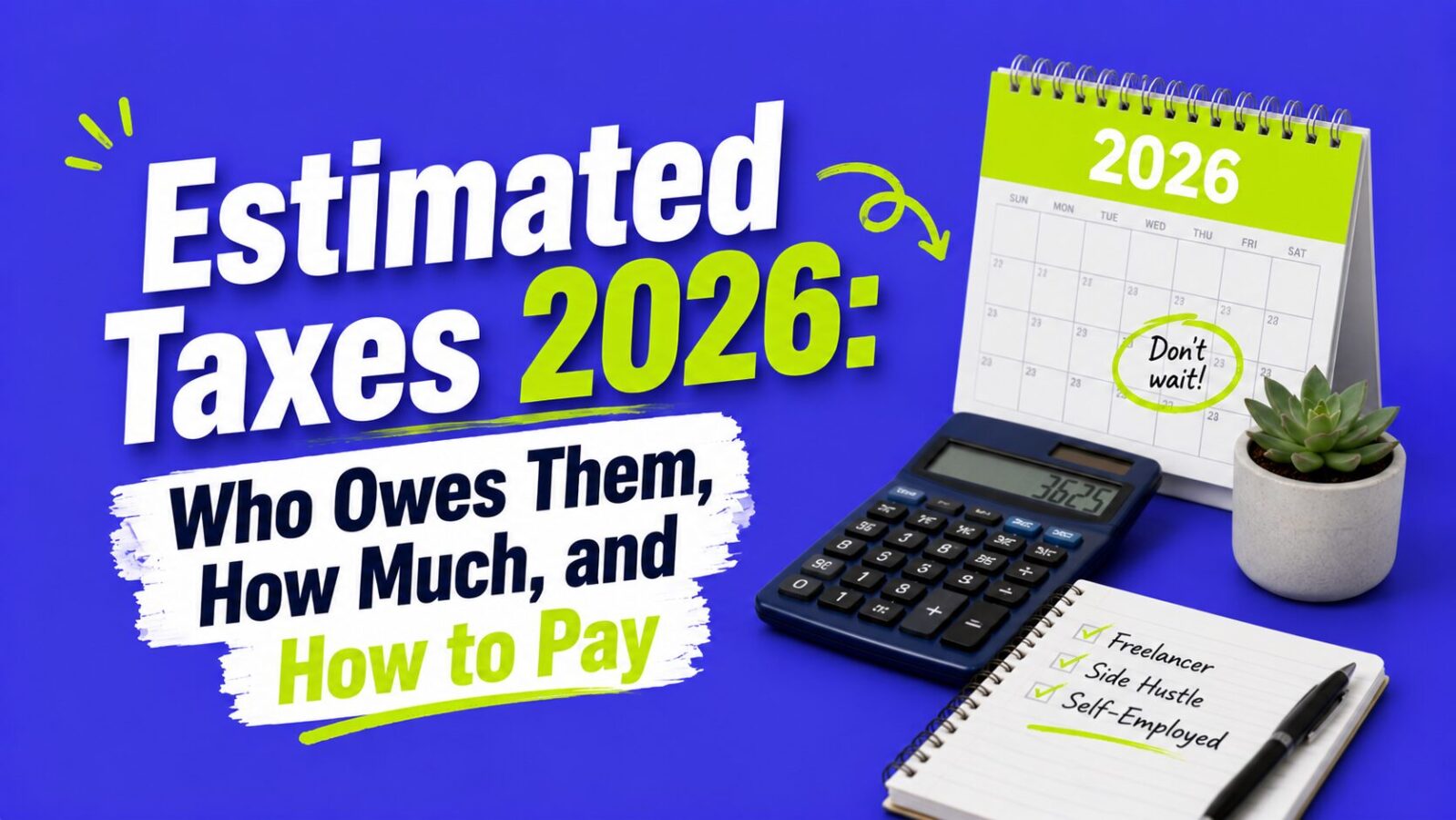
You generally need to make 2026 federal estimated tax payments if you expect to owe at least $1,000 after withholding and refundable tax credits and you will not have enough tax paid during the year.
This commonly affects freelancers, gig workers, business owners, investors, landlords, and W-2 employees who have significant income without federal tax withholding.
For most taxpayers, one of the easiest ways to avoid an underpayment penalty is to meet an IRS safe harbor. In simple terms, you generally need to pay at least:
- 90% of your 2026 tax, or
- 100% of your 2025 tax
Higher-income taxpayers may need to use 110% of their 2025 tax instead.
The next regular 2026 estimated tax deadline is September 15, 2026.
Key takeaways
- You may need estimated payments if you expect to owe at least $1,000 after withholding and refundable credits.
- The standard safe harbor is generally the smaller of 90% of your 2026 tax or 100% of your 2025 tax.
- If your 2025 adjusted gross income was above $150,000, or $75,000 if married filing separately, the prior-year safe harbor generally rises to 110% of your 2025 tax.
- The regular 2026 deadlines are April 15, June 15, September 15, 2026, and January 15, 2027.
- Estimated payments can include both federal income tax and self-employment tax.
- Missing one payment can create a penalty even if you catch up later.
- You can pay electronically. You do not need to mail four checks.
Who has to pay estimated taxes in 2026?
You generally need to think about estimated taxes when both of these are true:
- You expect to owe at least $1,000 in federal tax for 2026 after subtracting withholding and refundable credits.
- Your withholding and refundable credits will be less than the required safe harbor amount.
For most taxpayers, that safe harbor is based on the smaller of:
- 90% of your 2026 tax, or
- 100% of your 2025 tax.
The prior-year rule generally requires your 2025 return to cover a full 12-month tax year.
Estimated payments commonly affect:
- freelancers and independent contractors,
- gig workers,
- sole proprietors,
- partners and some S corporation shareholders,
- investors with large capital gains,
- people receiving significant interest or dividends,
- rental property owners,
- and W-2 employees with substantial untaxed side income.
If you are self-employed, remember that your estimated payments may need to cover self-employment tax as well as regular federal income tax.
Our side hustle tax guide and freelancer tax guide explain those taxes in more detail.
Who may not need estimated payments?
Having side income does not automatically mean you must send quarterly payments.
For example, suppose you have a W-2 job and also make money freelancing. If enough federal tax is withheld from your paycheck to cover the required amount, you may not need separate estimated payments.
You also generally do not need to make estimated tax payments for 2026 if all three of these were true:
- You had no federal tax liability for 2025.
- You were a U.S. citizen or resident alien for all of 2025.
- Your 2025 tax year covered a full 12 months.
For this rule, having no prior-year tax liability generally means your total tax was zero or you were not required to file a federal return.
Farmers and fishermen have special estimated-tax rules, so they should follow the specific IRS instructions rather than relying only on the general percentages in this guide.
What are the 2026 estimated tax deadlines?
Estimated taxes are often called “quarterly taxes,” but the IRS payment periods are not four equal three-month periods.
| Payment | Income period | Due date |
|---|---|---|
| First payment | Jan. 1 to Mar. 31 | April 15, 2026 |
| Second payment | Apr. 1 to May 31 | June 15, 2026 |
| Third payment | June 1 to Aug. 31 | September 15, 2026 |
| Fourth payment | Sept. 1 to Dec. 31 | January 15, 2027 |
The second period covers only April and May, while the final period covers four months.
If a regular deadline falls on a weekend or legal holiday, the due date generally moves to the next business day.
If you are preparing for the next payment, see our Q3 estimated tax deadline guide.
Can you skip the January 2027 payment?
In some cases, yes.
You may be able to skip the January 15, 2027 estimated payment if you file your 2026 Form 1040 or 1040-SR by February 1, 2027 and pay the full balance due with your return.
That does not erase penalties that may already exist from earlier underpaid installments.
How much estimated tax should you pay?
There are two common ways to figure out how much you need to pay to avoid the federal underpayment penalty.
Method 1: Use the prior-year safe harbor
This is often the easier option if your income is similar to or higher than last year.
For many taxpayers, the annual target is based on 100% of the tax from the previous year.
But if your 2025 adjusted gross income was more than:
- $150,000 for most filing statuses, or
- $75,000 if your 2026 filing status is married filing separately,
the prior-year target generally becomes 110% of your 2025 tax.
Then subtract the federal income tax you expect to have withheld during 2026.
The remaining amount is what you may need to cover through estimated payments.
Do not simply divide last year’s Form 1040 line 24 by four
This is where simplified online advice can cause problems.
For a straightforward return, Form 1040 line 24 may be a starting point. But the IRS estimated-tax worksheet requires adjustments for certain taxes and other amounts.
So instead of automatically doing:
Form 1040 line 24 ÷ 4
use the current Form 1040-ES worksheet.
Simple safe harbor example
Suppose your adjusted 2025 tax for estimated-tax purposes is:
$8,000
Your income was below the higher-income threshold, and you expect no federal tax withholding in 2026.
Your prior-year safe harbor would generally be:
$8,000
If you pay in four equal installments:
$8,000 ÷ 4 = $2,000 per payment
Now suppose you expect $2,000 of federal income tax withholding from a W-2 job during 2026.
Your remaining amount would generally be:
$8,000 – $2,000 = $6,000
That works out to about:
$1,500 per installment
This is why you should include withholding in the calculation before deciding how much to send.
Method 2: Use 90% of your expected 2026 tax
The second approach uses your expected tax for the current year.
You estimate your:
- income,
- deductions,
- credits,
- income tax,
- self-employment tax,
- and other applicable federal taxes.
Then calculate how much you need to pay during the year to reach 90% of your expected 2026 tax.
This method may make more sense if your income is much lower in 2026 than it was in 2025.
The downside is that you have to estimate accurately.
If your income turns out to be higher than expected, you could still underpay.
Safe harbor does not mean you will owe nothing at tax time
This is an important distinction.
A safe harbor mainly protects you from the estimated-tax underpayment penalty.
It does not guarantee that your entire 2026 tax bill has been paid.
For example, your income could rise sharply in 2026 while you continue using the prior-year safe harbor.
You might avoid an estimated-tax penalty but still owe a large balance when you file your return in 2027.
Think of safe harbor as a penalty-protection target, not your final tax bill.
What if your income is uneven during the year?
You do not always need to treat your annual income as if it arrived evenly throughout the year.
Suppose you earn very little during the first six months and then receive a large freelance contract or investment gain in August.
The IRS has an annualized income installment method that can base your required payments more closely on when you actually earned the money.
This can help people with:
- seasonal businesses,
- irregular freelance income,
- large investment gains later in the year,
- or bonuses concentrated in one part of the year.
If you use this method, you generally need Form 2210 and Schedule AI when you file your return.
It is more complicated than making four equal payments, but it can prevent you from being treated as though late-year income existed earlier in the year.
W-2 employees with side income have another option
If you have both a regular job and income from freelancing, investing, or another side business, separate estimated payments are not always necessary.
You can submit a new Form W-4 and ask your employer to withhold more federal income tax from each paycheck.
This can be especially useful if you realize later in the year that your side income is creating a tax shortfall.
Withholding receives favorable timing treatment for estimated-tax purposes because it is generally treated as paid throughout the year rather than only on the date it was withheld.
That can make increasing paycheck withholding one of the simplest ways for a W-2 employee to catch up.
How do you pay 2026 estimated taxes?
You have several options.
IRS Direct Pay
IRS Direct Pay lets individuals pay from a checking or savings account without creating a Direct Pay account.
When making an estimated payment, make sure you select the correct:
- payment reason,
- form,
- and tax year.
For a 2026 estimated payment, that generally means selecting:
- Estimated Tax
- Form 1040-ES
- 2026
Check the year carefully before submitting your payment.
Save the confirmation afterward.
IRS Online Account
Your IRS Online Account also lets you make payments and review payment history.
This is useful when you want to confirm that previous estimated payments were credited correctly.
EFTPS
The Electronic Federal Tax Payment System is another free option and can be convenient for taxpayers who make federal payments regularly.
Unlike Direct Pay, EFTPS requires enrollment, so do not wait until the deadline to set it up.
Debit card, credit card, or digital wallet
The IRS also accepts payments through approved third-party payment processors.
These processors normally charge a fee.
If you are paying by credit card mainly to earn rewards, compare the value of those rewards with the processing fee first.
Check or money order
Paper payments are still possible using the appropriate Form 1040-ES voucher.
Use the current 2026 Form 1040-ES instructions because IRS mailing addresses can change.
What happens if you miss an estimated tax deadline?
There is not one flat “missed quarterly payment fee.”
Instead, the federal underpayment penalty depends on factors including:
- how much you underpaid,
- which installment was short,
- how long it remained unpaid,
- and the IRS interest rate for that period.
The IRS calculates underpayments separately for each payment period.
Paying more later does not automatically erase an earlier underpayment
Suppose you were supposed to pay $2,000 on April 15 but paid nothing.
Adding another $2,000 to your September payment does not make the April payment on time.
Paying later can stop the shortage from continuing, but you may still owe a penalty for the period when the money was unpaid.
If you miss a deadline, the practical move is usually to pay the shortage as soon as possible rather than waiting for the next regular payment date.
What is the 2026 underpayment penalty rate?
IRS underpayment rates can change every calendar quarter.
For individuals, the published 2026 rates so far are:
| Calendar quarter | Underpayment rate |
|---|---|
| January to March 2026 | 7% |
| April to June 2026 | 6% |
| July to September 2026 | 7% |
As of August 2026, the IRS has published the 7% annual rate for the third quarter.
Do not assume that rate will automatically apply to the fourth quarter. IRS interest rates are reset quarterly.
The IRS can calculate the estimated-tax penalty for many taxpayers. Form 2210 is used when you need to calculate it yourself or claim certain exceptions.
Some taxpayers can also qualify for a waiver in limited circumstances.
Can you make estimated tax payments monthly?
Yes.
You are allowed to make more than four payments.
For example, a freelancer may find it easier to send money to the IRS every month rather than saving a large amount for each quarterly deadline.
Making monthly payments does not change the official due dates.
The important thing is that you have paid enough by each required deadline.
Do you owe state estimated taxes too?
Possibly.
Federal estimated payments cover only your federal taxes.
If your state has an individual income tax, it may have separate:
- payment thresholds,
- safe harbor rules,
- deadlines,
- online payment systems,
- and penalties.
Do not assume your state follows the same rules as the IRS.
Check your state’s official revenue or taxation department.
Do the new OBBBA deductions affect 2026 estimated taxes?
They can.
The One Big Beautiful Bill Act created several individual deductions that can affect how much federal income tax you expect to owe.
Two of the most widely discussed are deductions for:
- qualified tips,
- qualified overtime compensation.
These deductions apply for tax years 2025 through 2028, so they did not first appear in 2026.
If you reasonably expect to qualify for one of these deductions in 2026, it can affect your estimated taxable income and your estimated federal tax.
The IRS Tax Withholding Estimator has also been updated to reflect major OBBBA changes.
For more detail, see our OBBBA tax changes guide and no tax on tips guide.
What happens to your estimated payments when you file?
Estimated tax payments are simply prepayments of your eventual federal tax bill.
When you file your 2026 tax return in 2027, you report the estimated payments credited to 2026.
You also include any refund from your previous return that you chose to apply toward your 2026 estimated tax.
Your return then calculates whether you:
- still owe additional tax, or
- are due a refund.
Before filing, compare your records with the payment history in your IRS Online Account.
This can help catch a missing or incorrectly applied payment before you submit your return.
For more filing help, see:
- How to file your 2026 taxes in 2027
- How to file taxes as a gig worker or 1099 contractor
- Best tax software for 2027
Frequently asked questions
Do I have to pay estimated taxes in 2026?
You may need estimated payments if you expect to owe at least $1,000 after withholding and refundable credits and you will not pay enough during the year to meet the IRS safe harbor rules.
What is the estimated tax safe harbor for 2026?
For most taxpayers, the annual safe harbor is generally based on the smaller of 90% of your 2026 tax or 100% of your 2025 tax.
For certain higher-income taxpayers, the prior-year percentage rises to 110%.
What are the 2026 estimated tax due dates?
The regular deadlines are:
- April 15, 2026
- June 15, 2026
- September 15, 2026
- January 15, 2027
Can I pay all my estimated tax in January?
You can make a large payment in January, but that does not automatically prevent an underpayment penalty.
The IRS looks at whether enough tax was paid by each required payment date.
An earlier shortage can still create a penalty.
What should I do if I missed a quarterly estimated tax payment?
Pay the shortage as soon as possible.
The penalty generally depends partly on how long the underpayment remained unpaid, so waiting until the next quarter can make it more expensive.
Can I make monthly estimated tax payments?
Yes.
You can pay more frequently than four times a year as long as enough has been paid by each required deadline.
Do W-2 employees ever need estimated taxes?
Yes.
A W-2 employee may need estimated payments if they have substantial income without withholding, such as freelance income, rental income, or investment gains.
Increasing federal withholding through Form W-4 may be another option.
Does estimated tax include self-employment tax?
Yes.
If you are self-employed, your Form 1040-ES calculation can include self-employment tax as well as federal income tax.
Bottom line
For 2026, you generally need to think about estimated taxes if you expect to owe at least $1,000 after withholding and refundable credits and you will not meet an IRS safe harbor.
For many freelancers and business owners, the simplest approach is to:
- calculate the correct prior-year safe harbor using Form 1040-ES,
- subtract expected federal withholding,
- and pay the remaining required amount by the deadlines.
Do not automatically divide last year’s Form 1040 line 24 by four.
Higher-income rules, withholding, changes in income, self-employment tax, and adjustments required by the IRS can all change the result.
The regular 2026 deadlines are:
April 15 → June 15 → September 15 → January 15, 2027
If your income is irregular, the annualized income method may be worth considering. If you also have a W-2 job, increasing paycheck withholding may be easier than sending separate estimated payments.
And if you already missed a deadline, pay the shortage as soon as you can. Catching up can stop the underpayment from continuing, but it does not automatically make an earlier payment timely.
This article is for general educational purposes only and is not individualized tax, legal, or financial advice. Estimated-tax rules can vary based on filing status, income type, prior-year tax, withholding, and other circumstances. Use the current IRS Form 1040-ES and Publication 505 or consult a qualified tax professional before making a payment.