 By
By 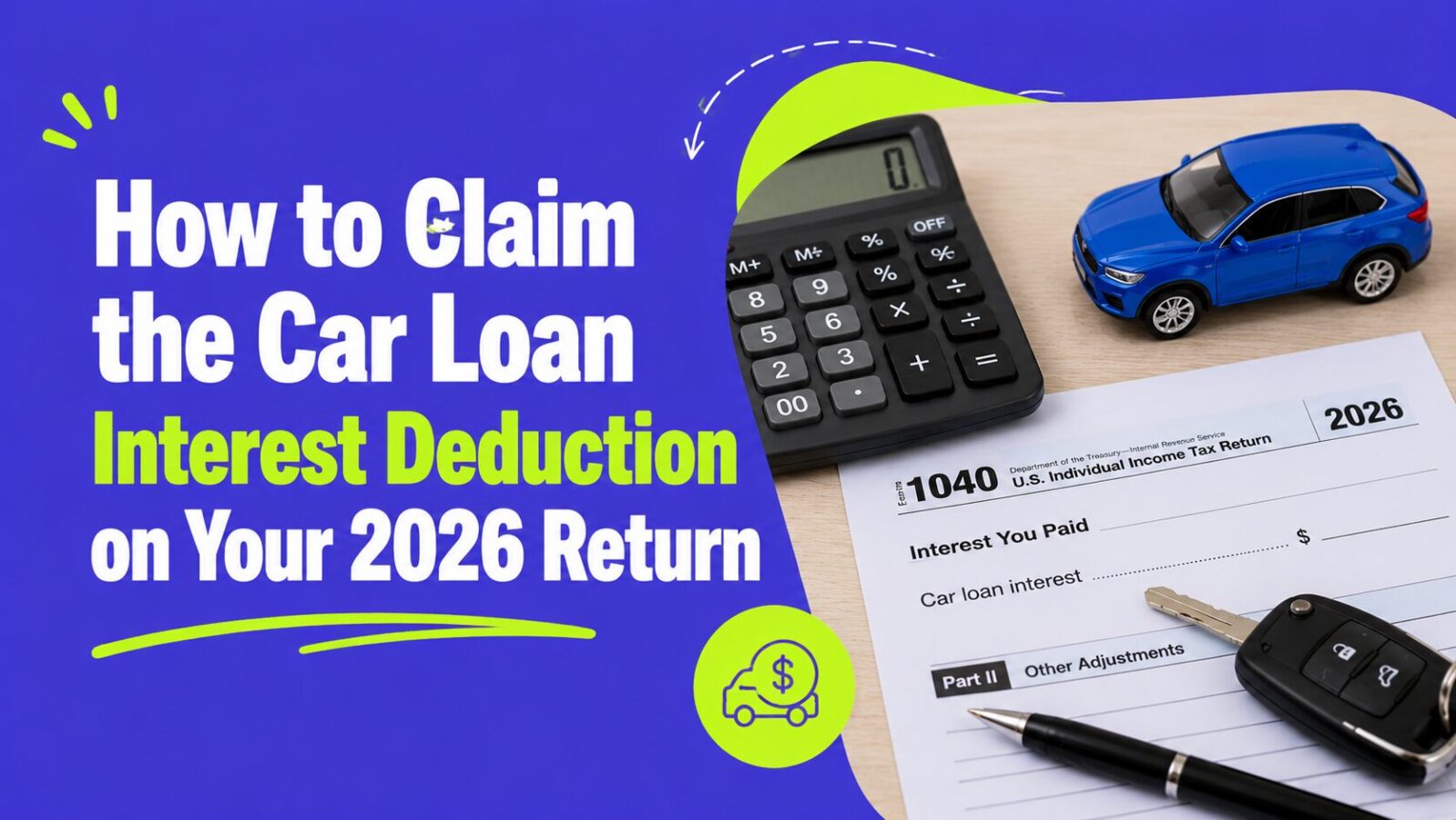
To claim the new car loan interest deduction on your 2026 federal tax return, first confirm that both the vehicle and the loan qualify. Then determine how much qualifying interest you actually paid, apply the $10,000 annual cap and income phase-out, and report the deduction using Schedule 1-A, not the regular Schedule 1.
The biggest eligibility rule is easy to miss: the qualifying loan must have been incurred after December 31, 2024 to purchase a new vehicle for personal use. A loan on a car you bought in 2023 does not become eligible simply because you are still paying interest in 2026.
Key takeaways
- You may deduct up to $10,000 of qualified passenger vehicle loan interest per federal return for tax years 2025 through 2028.
- The loan generally must have been incurred after December 31, 2024 and used to purchase the qualifying vehicle.
- The vehicle must be new, have its final assembly in the United States, and generally have a gross vehicle weight rating under 14,000 pounds. Cars, SUVs, pickups, vans, minivans, and motorcycles can qualify.
- The loan must generally be secured by a first lien on the vehicle.
- You can claim the deduction whether you take the standard deduction or itemize.
- The deduction is claimed through Schedule 1-A, not the normal Schedule 1 adjustment-to-income section.
- The phase-out begins above $100,000 MAGI for most filers or $200,000 for married filing jointly.
- The reduction is $200 for each $1,000, or portion of $1,000, above the threshold.
- You must include the qualifying vehicle’s VIN on your return.
Step 1: Make sure the vehicle qualifies
Do not start with your lender statement. Start with the car.
A qualifying passenger vehicle generally must meet all of these conditions:
- Its original use began with you, meaning it was purchased new.
- Final assembly occurred in the United States.
- It is primarily a vehicle for use on public streets, roads, and highways.
- It has at least two wheels.
- It is a car, minivan, van, SUV, pickup truck, or motorcycle.
- Its gross vehicle weight rating is less than 14,000 pounds.
Used and certified pre-owned vehicles do not qualify
The original use of the vehicle must begin with you.
That excludes:
- Used vehicles
- Certified pre-owned vehicles
- Vehicles previously used by another owner
It does not matter whether the used vehicle has extremely low mileage or was purchased from a franchised dealer.
Motorcycles can qualify
This is worth calling out because some early explanations of the law incorrectly excluded motorcycles.
IRS guidance specifically includes motorcycles among the qualifying vehicle categories, provided the other requirements are met.
Step 2: Verify final assembly in the United States
The automaker’s nationality does not decide eligibility.
What matters is where your specific vehicle underwent final assembly.
The IRS says you can verify final assembly using:
- The vehicle information label attached to the vehicle at the dealership
- The VIN
- The National Highway Traffic Safety Administration’s VIN Decoder
Use the NHTSA VIN Decoder if you are unsure.
I would not rely only on the model name or an internet list. The same model line can sometimes be produced at different plants.
Step 3: Make sure the loan qualifies
A qualifying car is not enough. The financing must qualify too.
Under current IRS guidance, the loan generally must:
- Have been originated after December 31, 2024.
- Have been incurred by you.
- Have been used to purchase the qualifying vehicle.
- Relate to a vehicle purchased for personal use.
- Be secured by a first lien on that vehicle.
That means a normal secured auto loan from a bank, credit union, or dealership can qualify if the other requirements are satisfied.
Personal loans generally do not work
Suppose you take an unsecured $40,000 personal loan and use the money to buy an otherwise qualifying vehicle.
The vehicle may qualify, but the interest generally does not meet this deduction’s first-lien requirement because the debt is not secured by the vehicle.
The same problem can apply to financing secured by another asset rather than by the vehicle itself.
Leases do not qualify
The deduction applies to qualifying interest on a loan used to purchase a vehicle.
Lease payments do not qualify.
A car bought before 2025 does not qualify
This is one of the most important corrections to make.
The deduction does not apply just because you paid interest during 2026.
The qualifying debt generally must have been incurred after December 31, 2024 to purchase the eligible vehicle.
So this situation would not qualify:
You purchased a new U.S.-assembled vehicle in 2023, financed it in 2023, and are still paying the original loan in 2026.
The loan originated too early.
By contrast, a qualifying vehicle purchased and financed in 2025 could potentially generate deductible qualified interest paid in 2026, assuming the other rules are still satisfied.
What if you refinance the loan?
Refinancing does not necessarily kill the deduction.
Current IRS guidance allows interest on a refinancing of a qualifying vehicle loan to remain potentially eligible, generally up to the outstanding qualifying balance when the refinance occurs and subject to the continuing lien requirements.
For example, if you refinance a $24,000 remaining qualifying balance, the rules do not automatically let you turn a $35,000 cash-out refinance into $35,000 of qualifying vehicle debt.
Only the qualifying portion should be considered.
Negative equity can complicate the calculation
Suppose you trade in an old car worth $15,000 while still owing $20,000.
The $5,000 difference is negative equity.
If that amount gets rolled into your new vehicle loan, current IRS reporting guidance says debt attributable to repayment of negative equity on the trade-in vehicle is not part of the specified passenger vehicle loan amount.
That means the interest shown on your overall financing agreement may not always equal your deductible vehicle-loan interest.
This is one reason lender reporting matters.
Step 4: Get your vehicle loan interest statement
For 2026 reporting, the IRS has developed Form 1098-VLI, Vehicle Loan Interest Statement.
Under the current 2026 draft instructions, lenders that receive at least $600 of interest on a specified passenger vehicle loan generally have a Form 1098-VLI reporting obligation for that loan.
The statement is designed to show information including:
- Vehicle loan interest received by the lender
- Vehicle year
- Make
- Model
- VIN
- Loan origination date
- Outstanding principal
One warning is printed directly into the current IRS form design: the amount reported by the lender may not all be deductible because income and vehicle eligibility limitations can still apply.
What if you paid less than $600 of interest?
Under the current draft reporting rules, a lender generally does not have to issue Form 1098-VLI for a particular qualifying loan if it received less than $600 of interest on that loan.
That reporting threshold is not the same thing as a $600 minimum deduction.
Keep your lender statements and other records showing the interest you actually paid.
Because the 2026 Form 1098-VLI currently published by the IRS remains a draft as of August 2026, verify the final form and instructions when you file your 2026 return in 2027.
Step 5: Calculate your starting deduction
Your starting point is the amount of qualified passenger vehicle loan interest paid or accrued for the tax year, subject to the rules that apply to you.
The deduction cannot exceed:
$10,000 per federal return per year.
So:
| Qualified interest | Starting deduction before phase-out |
|---|---|
| $2,500 | $2,500 |
| $6,000 | $6,000 |
| $10,000 | $10,000 |
| $13,000 | $10,000 |
The $10,000 figure is a cap, not a guaranteed deduction.
Step 6: Apply the income phase-out
This is another area where the math is easy to get wrong.
The phase-out begins when MAGI exceeds:
- $100,000 for filing statuses other than married filing jointly
- $200,000 for married filing jointly
Under the current Schedule 1-A calculation, you divide excess MAGI by $1,000, round any fraction up to the next $1,000, and multiply the result by $200.
That reduction is subtracted from your otherwise allowable deduction.
Example: single filer with $130,000 MAGI
Suppose:
- MAGI: $130,000
- Qualified interest: $8,500
You are:
$130,000 – $100,000 = $30,000 above the threshold
Phase-out:
$30,000 ÷ $1,000 = 30
30 × $200 = $6,000 reduction
Starting deduction:
$8,500
After phase-out:
$8,500 – $6,000 = $2,500 deduction
The deduction is not $5,500. The reduction is $200 per $1,000, not $100 per $1,000.
What if MAGI is only slightly above the threshold?
The rule uses each $1,000 or portion of $1,000.
For example, if a single filer’s MAGI were $100,500, the $500 excess is rounded up to one $1,000 unit for purposes of the phase-out calculation.
That produces a $200 reduction under the current Schedule 1-A mechanics.
When is the deduction completely phased out?
If you start with the full $10,000 allowable amount, a $10,000 reduction requires 50 units of $200.
That means the full $10,000 deduction reaches zero at approximately:
- $150,000 MAGI for most filers
- $250,000 MAGI for married filing jointly
But this does not mean everyone below those numbers gets a deduction.
If you paid only $3,000 of qualified interest, your $3,000 deduction can be eliminated much earlier as the phase-out applies.
Think of $150,000 and $250,000 as the point where even the maximum $10,000 starting deduction is gone.
Step 7: Report it on Schedule 1-A, not Schedule 1
The car loan interest deduction is not reported as a traditional adjustment to income on regular Schedule 1.
The IRS created Schedule 1-A, Additional Deductions, for the new deductions covering:
- Qualified tips
- Qualified overtime
- Car loan interest
- Enhanced senior deduction
For the 2025 return, car loan interest appears in Part IV of Schedule 1-A, with the total additional deductions flowing to Form 1040 separately from AGI.
IRS Publication 505 confirms that the car loan interest deduction continues to apply for qualified interest paid or accrued in 2026 on eligible vehicles purchased after 2024.
Use the final 2026 Schedule 1-A and Form 1040 instructions when filing in 2027, because final line numbers can still change.
This is not a traditional above-the-line deduction
You may see the car loan deduction described online as “above the line.”
That wording can be misleading.
The deduction is available whether you take the standard deduction or itemize, which is a major benefit. But Schedule 1-A reduces taxable income through a separate additional-deduction mechanism rather than functioning like the traditional Schedule 1 adjustments that determine AGI.
That distinction matters when another tax rule specifically depends on AGI.
You need the VIN
The IRS requires the VIN of each qualifying vehicle for which you claim the deduction.
Keep records supporting:
- VIN
- Purchase date
- Purchase agreement
- Final assembly location
- Loan origination date
- Loan agreement showing the lien
- Interest paid
- Any refinancing
- Any negative equity or other nonqualifying amounts included in financing
Do not wait until tax season to determine where the vehicle was assembled if you can verify it now.
What if you use the vehicle for both personal and business purposes?
Mixed use is more nuanced than simply saying “business vehicles do not qualify.”
Current IRS instructions treat a vehicle as purchased for personal use when, at the time the debt is incurred, you expect the vehicle to be used more than 50% for personal use under the current regulatory framework.
The 2025 Schedule 1-A also specifically provides for separating interest deducted on Schedule C, E, or F from interest considered for the personal car-loan deduction.
For example, IRS Schedule F guidance states that a self-employed taxpayer with mixed business and personal vehicle use may potentially claim the personal portion through Schedule 1-A while deducting the business-use portion under the applicable business rules.
Do not deduct the same interest twice.
If your vehicle is close to a 50/50 use split or is heavily used in a business, this is a reasonable place to get professional tax advice.
Does a home equity loan qualify if you use it to buy a car?
Generally, not for this particular deduction.
The qualifying vehicle debt needs to satisfy the first-lien requirement on the purchased vehicle itself.
Using money borrowed against your house to buy the vehicle does not turn that debt into a qualifying passenger vehicle loan under this rule.
Separate tax rules may apply to other types of interest, but they should not be confused with the new car loan interest deduction.
How much could the deduction actually save?
Remember that this is a deduction, not a tax credit.
Suppose you qualify for a $3,000 deduction.
If all $3,000 reduces income that otherwise would have been taxed at a 22% marginal federal rate, the simplified federal tax effect would be:
$3,000 × 22% = $660
A $3,000 deduction does not mean you receive $3,000 from the IRS.
That is also why taking on more car debt purely to create more deductible interest is poor math. You would still be paying the lender substantially more interest than the tax deduction gives back.
What about tax software?
TurboTax, H&R Block, FreeTaxUSA, and other providers will need to support the final IRS forms used for the 2027 filing season.
But it is too early in August 2026 to make detailed claims about the exact interview screens, prompts, pricing tiers, or automated workflow each platform will use for 2026 returns.
When those products are finalized, see our Best Tax Software for 2027: TurboTax vs H&R Block vs FreeTaxUSA for the current comparison.
Frequently asked questions
How much car loan interest can I deduct for 2026?
The maximum is $10,000 of qualified passenger vehicle loan interest per federal tax return, before applying the MAGI phase-out.
Can I claim interest on a car I bought in 2023?
No, not on the original 2023 loan under this deduction. The qualifying debt generally must have been incurred after December 31, 2024 to purchase the vehicle.
Does a used car qualify?
No. The original use of the vehicle must begin with you. Used and certified pre-owned vehicles do not meet that requirement.
Can a motorcycle qualify?
Yes. Motorcycles are included among the eligible vehicle types if the other requirements, including U.S. final assembly and the weight limit, are satisfied.
Do I need to itemize?
No. Eligible taxpayers can claim the deduction whether they take the standard deduction or itemize.
Is the deduction reported on Schedule 1?
No. The IRS created Schedule 1-A for the new car loan interest deduction.
What is the income phase-out?
It begins above $100,000 of MAGI for most filers and $200,000 for married couples filing jointly. Under the current Schedule 1-A calculation, the deduction is reduced by $200 for every $1,000 or fraction of $1,000 of excess MAGI.
Do I need Form 1098-VLI?
The IRS has developed Form 1098-VLI for vehicle loan interest reporting. Under the current 2026 draft instructions, lenders generally report when they receive at least $600 of interest on a specified passenger vehicle loan. A taxpayer may still need records even when no form is required because the interest was below the reporting threshold.
Can refinancing still qualify?
Potentially. Interest on a qualifying refinanced loan may remain eligible, generally subject to the outstanding qualifying balance and first-lien requirements.
Can I deduct car loan interest and mortgage interest in the same year?
Potentially, yes, if you separately qualify for each deduction. They are governed by different rules. The qualified car loan interest deduction is handled through Schedule 1-A, while deductible home mortgage interest is generally an itemized deduction on Schedule A.
Bottom line
Claiming the 2026 car loan interest deduction is mostly about proving that the vehicle and the debt qualify before you start calculating the tax break.
Use this order:
- Confirm the vehicle was purchased new.
- Verify final assembly in the United States.
- Confirm the qualifying loan originated after December 31, 2024.
- Make sure the debt is secured by a first lien on the vehicle.
- Determine your qualified 2026 interest.
- Limit it to $10,000.
- Apply the MAGI phase-out.
- Keep your VIN and financing records.
- Use the final 2026 Schedule 1-A when you file in 2027.
The most important correction is simple: paying car loan interest in 2026 is not enough by itself. An old loan from 2023 or 2024 does not suddenly become eligible.
And do not use the wrong phase-out math. The current IRS calculation reduces the deduction by $200 for every $1,000 or portion of $1,000 above the applicable MAGI threshold, not $100.
For the broader filing process, see How to File Your 2026 Taxes: Complete Guide to Claiming the New OBBBA Deductions.
This article is for educational and informational purposes only and is not individualized tax, legal, or financial advice. Some 2026 filing forms, including Form 1098-VLI, are still in draft form as of August 2026. Use the final IRS forms and instructions in effect when you file your 2026 return, and consult a qualified tax professional if your financing includes refinancing, negative equity, or mixed business and personal use.