 By
By 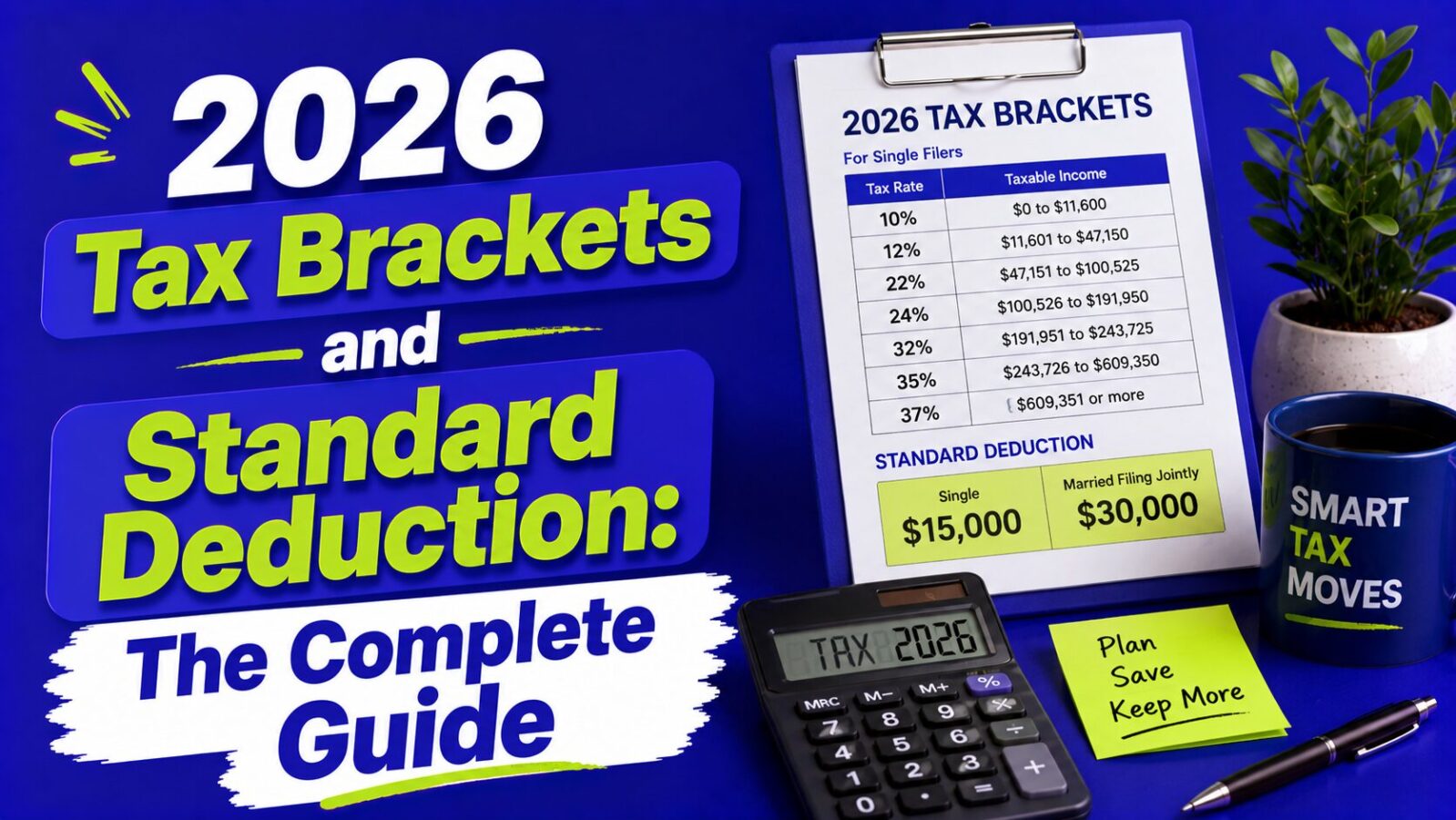
For 2026, the standard deduction is $16,100 for single filers and $32,200 for married couples filing jointly, and the seven tax brackets still run from 10% to 37%. The One Big Beautiful Bill Act made the 2017 tax cuts permanent, so the brackets and the higher standard deduction did not revert at the end of 2025 as they were scheduled to. The dollar amounts adjusted for inflation, rising about 2.7% on average. Here are the full 2026 brackets and deduction amounts, and how they actually work. Because tax situations vary, confirm anything specific to you with a tax professional.
Key Takeaways
- The 2026 standard deduction is $16,100 single, $32,200 married filing jointly, and $24,150 head of household.
- The seven tax brackets (10% to 37%) are permanent, with the top 37% rate starting above $640,600 single and $768,700 married.
- Brackets are marginal: you pay each rate only on the income that falls within that band, not on your whole income.
- Filers 65 or older or blind get an additional standard deduction of $2,050 (single) or $1,650 per qualifying spouse (married).
- Long-term capital gains have their own brackets: 0%, 15%, and 20%, based on taxable income.
FILING YOUR 2026 RETURN?
The 2027 filing season is the first time these deductions appear on a real return. For step-by-step claim instructions, see: How to File Your 2026 Taxes (2027 Season): Complete Guide to Claiming the New OBBBA Deductions.
What is the standard deduction for 2026?
The standard deduction is the flat amount you subtract from your income if you do not itemize. For 2026 it rose with inflation and stays at the higher level the 2017 tax law set, which the One Big Beautiful Bill Act (OBBBA) made permanent. See our complete OBBBA tax changes guide for everything else the law changed.
| Filing status | 2026 standard deduction |
|---|---|
| Single / married filing separately | $16,100 |
| Married filing jointly | $32,200 |
| Head of household | $24,150 |
If you are 65 or older or blind, you get an additional standard deduction on top: $2,050 for single and head-of-household filers, or $1,650 per qualifying spouse for married filers. Taxpayers 65 and older may also qualify for a separate new $6,000 senior deduction, which we cover in our senior deduction guide.
What are the 2026 tax brackets?
There are seven federal income tax rates in 2026: 10%, 12%, 22%, 24%, 32%, 35%, and 37%. The income ranges they apply to depend on your filing status. These are taxable-income figures, meaning income after your standard or itemized deductions.
| Rate | Single | Married filing jointly | Head of household |
|---|---|---|---|
| 10% | $0 to $12,400 | $0 to $24,800 | $0 to $17,700 |
| 12% | $12,400 to $50,400 | $24,800 to $100,800 | $17,700 to $67,450 |
| 22% | $50,400 to $105,700 | $100,800 to $211,400 | $67,450 to $105,700 |
| 24% | $105,700 to $201,775 | $211,400 to $403,550 | $105,700 to $201,775 |
| 32% | $201,775 to $256,225 | $403,550 to $512,450 | $201,775 to $256,200 |
| 35% | $256,225 to $640,600 | $512,450 to $768,700 | $256,200 to $640,600 |
| 37% | Over $640,600 | Over $768,700 | Over $640,600 |
How do tax brackets actually work?
Tax brackets are marginal, which is the single most misunderstood part of the tax code. Being “in the 22% bracket” does not mean you pay 22% on all your income. You pay each rate only on the portion of income that falls inside that bracket, and lower portions are taxed at lower rates.
Take a single filer with $60,000 of taxable income in 2026. They pay 10% on the first $12,400 ($1,240), 12% on the income from $12,400 to $50,400 ($4,560), and 22% only on the last $9,600 from $50,400 to $60,000 ($2,112). That works out to about $7,912 in tax, an effective rate of roughly 13.2%, even though their top bracket is 22%. Earning one more dollar is taxed at your top rate, but your average rate is always lower.
This is why a raise or some side income never “bumps your whole salary into a higher bracket,” a common worry. Only the dollars above each threshold are taxed at the higher rate, so taking on more income always leaves you with more after tax, never less.
What are the 2026 capital gains brackets?
Long-term capital gains, from assets held more than a year, are taxed at their own lower rates of 0%, 15%, and 20%, based on your taxable income. The OBBBA left these unchanged.
| Rate | Single (taxable income over) | Married filing jointly (over) | Head of household (over) |
|---|---|---|---|
| 0% | $0 | $0 | $0 |
| 15% | $49,450 | $98,900 | $66,200 |
| 20% | $545,500 | $613,700 | $579,600 |
This is why a single filer with taxable income under about $49,450 can pay 0% on long-term gains. Short-term gains, from assets held a year or less, are taxed as ordinary income at the brackets above.
What did the OBBBA make permanent?
Without the 2025 law, the brackets and standard deduction were set to revert to lower, pre-2018 levels, and roughly 62% of taxpayers would have faced a tax increase in 2026. The OBBBA prevented that by making permanent the seven-bracket structure, the higher standard deduction, the elimination of the personal exemption (still $0), and the 20% qualified business income deduction for pass-through owners. It also kept the top rate at 37% rather than letting it rise to 39.6%.
On top of locking those in, the law added new deductions for tips, overtime, seniors, and U.S.-assembled car loan interest, and raised the Child Tax Credit to $2,200. Those are covered in the OBBBA hub guide.
Should you take the standard deduction or itemize?
You take whichever is larger. Most people, about 90% of filers, take the standard deduction because their itemizable expenses do not exceed it. You would itemize only if your deductible expenses, mainly state and local taxes (now capped at $40,400), mortgage interest, and charitable gifts, add up to more than your standard deduction.
For a married couple, that means clearing $32,200 in itemized deductions before itemizing pays off. If you are new to filing or not sure which applies, our beginner tax filing guide walks through the choice, and tax software compares both automatically.
FAQ
What is the standard deduction for 2026?
$16,100 for single filers, $32,200 for married filing jointly, and $24,150 for head of household. Filers 65 or older or blind get an extra $2,050 (single) or $1,650 per qualifying spouse.
What are the 2026 federal tax brackets?
Seven rates: 10%, 12%, 22%, 24%, 32%, 35%, and 37%. For single filers the 37% rate starts above $640,600, and for married filing jointly it starts above $768,700.
Does being in the 22% bracket mean I pay 22% on everything?
No. Brackets are marginal, so you pay 22% only on the income within that band. Income below it is taxed at 10% and 12%, so your effective rate is lower than your top bracket.
Did the standard deduction or brackets change under the new tax law?
They were made permanent rather than reverting to lower pre-2018 levels, and the dollar amounts rose with inflation for 2026. Most filers see little change from 2025.
What are the 2026 capital gains tax rates?
Long-term gains are taxed at 0%, 15%, or 20% depending on taxable income. A single filer under about $49,450 of taxable income can pay 0% on long-term gains.
Bottom line: For 2026 the standard deduction is $16,100 single and $32,200 married, and the seven brackets from 10% to 37% are now permanent after the OBBBA. Remember that brackets are marginal, so your effective tax rate is always lower than your top bracket, and most filers come out ahead taking the standard deduction.
How to Claim This on Your 2026 Return
Now that you know the rules, here is how to actually claim it when you file. The step-by-step guides below cover which boxes to check on your W-2, where the deduction appears on Form 1040, and how the major tax software platforms handle it:
- How to File Your 2026 Taxes (2027 Season): Complete Guide to Claiming the New OBBBA Deductions
- Will Your Refund Be Bigger in 2027? How the New Deductions Change Your Return
- Best Tax Software for 2027: TurboTax vs H&R Block vs FreeTaxUSA
This article is for educational and informational purposes only and is not tax advice. Tax figures adjust each year and your situation is unique. We want you to feel clear, not overwhelmed, so confirm the numbers that apply to you with a qualified tax professional, or at irs.gov, before you file.