 By
By 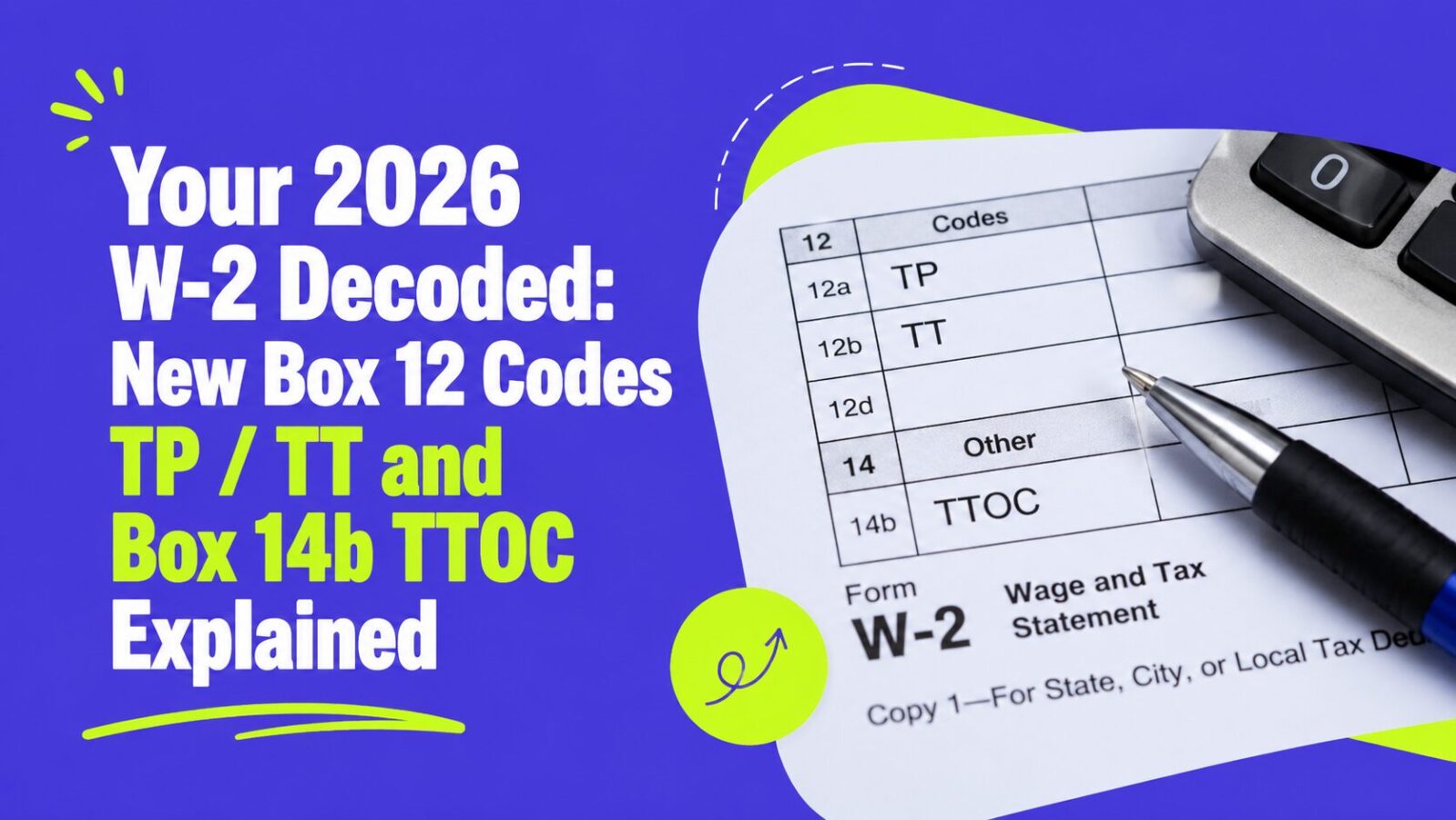
Your 2026 W-2 has several changes that matter if you received tips or qualifying overtime.
The most important are Box 12 code TP, Box 12 code TT, and the new Box 14b for Treasury Tipped Occupation Codes. These fields help you calculate the new federal deductions commonly called “no tax on tips” and “no tax on overtime.”
But there is an important distinction:
The number shown next to TP is not automatically the amount you can deduct. And neither deduction goes on the regular Schedule 1. The IRS says the tips and overtime deductions are calculated on Schedule 1-A (Form 1040).
Here is what each new field actually means.
Key takeaways
- Box 12 code TP reports the total cash tips you reported to your employer. It is information used to calculate the tips deduction, not necessarily your final deductible amount.
- Box 12 code TT reports qualified overtime compensation. For ordinary time-and-a-half overtime, that generally means only the extra “half” premium above your regular rate, not your entire overtime paycheck.
- Box 14b reports up to two Treasury Tipped Occupation Codes, or TTOCs, connected with the work in which you earned tips.
- A TTOC does not by itself guarantee that every dollar reported under TP is deductible. Other eligibility requirements still apply.
- The tips deduction is capped at $25,000, while the overtime deduction is capped at $12,500, or $25,000 for married couples filing jointly. Both phase out at higher MAGI.
- Both deductions are available whether you take the standard deduction or itemize.
- They are calculated on Schedule 1-A, not the regular Schedule 1 used for adjustments to income.
- Employers generally must furnish 2026 W-2s to employees by February 1, 2027.
What changed on the 2026 W-2?
The IRS redesigned parts of Form W-2 for tax year 2026 to support new reporting requirements.
For tipped workers, Box 14 was split into:
- Box 14a: Other
- Box 14b: Treasury Tipped Occupation Code(s)
The IRS also added Box 12 codes related to the new law:
- TP: total cash tips reported to the employer
- TT: qualified overtime compensation
There is another new Box 12 code worth knowing about: TA, which is used for certain employer contributions to Trump Accounts.
So TP and TT are important 2026 additions, but they are not the only new Box 12 codes on the form.
What does Box 12 code TP mean?
This is the biggest place to be careful.
The official 2026 W-2 instructions define code TP as the:
total amount of cash tips reported to the employer.
That is not the same as saying:
“This is your tips deduction.”
To claim the federal tips deduction, the tips still have to meet the qualified-tip rules.
Among other requirements, qualified tips generally must be voluntary cash or cash-equivalent tips received in an occupation included on Treasury’s list of occupations that customarily and regularly received tips.
The deduction is also subject to:
- A $25,000 annual cap
- A MAGI phaseout above $150,000, or $300,000 for married couples filing jointly
- A valid Social Security number requirement
- A joint-return requirement if you are married
The deduction is available whether you itemize or take the standard deduction.
So think of TP as an input to the calculation, not the final answer.
For more detail on which jobs qualify, see our guide to occupations eligible for the no-tax-on-tips deduction.
Why TP is not extra income
The amount in Box 12 with code TP generally represents tips already included in the wage and tip reporting elsewhere on your W-2.
You do not add TP on top of Box 1 again.
Suppose your W-2 shows:
- Box 1 wages, tips and other compensation: $42,000
- Box 12 TP: $18,000
You do not report $60,000 of wage income.
The TP amount helps identify reported cash tips that may be relevant when calculating the new deduction.
But you also should not automatically subtract the entire $18,000.
If all $18,000 meets the qualified-tip requirements and you satisfy the other eligibility rules, the full amount may potentially enter the deduction calculation. If some tips do not qualify, your deductible amount can be lower.
What does Box 14b mean?
Box 14b is new for 2026 and reports your Treasury Tipped Occupation Code, or TTOC.
Treasury uses three-digit codes for tipped occupations.
The qualifying occupations fall into categories including:
- Beverage and food service
- Entertainment and events
- Hospitality and guest services
- Home services
- Personal services
- Personal appearance and wellness
- Recreation and instruction
- Transportation and delivery
Your employer reports the applicable occupation code. You do not make up your own code when filing.
But Box 14b is more nuanced than simply:
“Code present = deduction approved.”
A TTOC does not automatically prove your deduction
An employer can report up to two occupation codes in Box 14b.
If you received tips in more than two occupations, the employer generally reports codes for two of them.
There is another important rule: if you received any tips in a nonqualifying occupation, code 000 must be included as one of the reported occupation codes.
This is another reason not to blindly copy TP onto your tax return as your deduction.
You still need to determine how much of your reported tip income actually satisfies the qualified-tip rules.
Box 14b helps with that determination. It does not replace it.
What does Box 12 code TT mean?
Code TT is more specific than TP.
The IRS says TT reports your total qualified overtime compensation.
For this deduction, qualified overtime generally means compensation paid above your regular rate because the overtime was required under Section 7 of the Fair Labor Standards Act.
For someone paid time-and-a-half, that normally means only the extra half-time premium qualifies.
Example
Suppose your regular rate is:
$30 per hour
Your FLSA overtime rate is:
$45 per hour
For one overtime hour:
- $30 is your regular-rate compensation
- $15 is the overtime premium
The $15 premium, not the entire $45, is the amount relevant to the qualified overtime deduction.
That distinction is essential because “no tax on overtime” does not mean every dollar earned during overtime hours is deductible.
How much overtime can you deduct?
The maximum qualified overtime deduction is:
- $12,500 for most individual returns
- $25,000 for married couples filing jointly
The deduction begins phasing out when MAGI exceeds:
- $150,000 for most filers
- $300,000 for married filing jointly
You must have a valid Social Security number, and married taxpayers generally must file jointly to claim the deduction.
Those limitations mean that even if Box 12 TT shows $14,000, a single taxpayer does not automatically deduct the full $14,000.
Where do the tips and overtime deductions go?
The IRS created Schedule 1-A for four deductions introduced by the 2025 tax law:
- Qualified tips
- Qualified overtime
- Qualified passenger vehicle loan interest
- Enhanced senior deduction
The tips and overtime deductions can be claimed by taxpayers who take the standard deduction or taxpayers who itemize.
However, they are not the same as traditional adjustments to income reported on regular Schedule 1.
That distinction matters because you should not assume these deductions reduce adjusted gross income in the same way as a traditional IRA deduction or student loan interest deduction.
The main 2026 W-2 boxes to understand
You do not need to memorize every W-2 field, but these are the ones most taxpayers should recognize:
| Box | What it shows |
|---|---|
| 1 | Wages, tips and other taxable compensation reported for federal income tax purposes |
| 2 | Federal income tax withheld |
| 3 | Social Security wages, subject to the annual wage base |
| 4 | Social Security tax withheld |
| 5 | Medicare wages and tips |
| 6 | Medicare tax withheld, including Additional Medicare Tax withholding when applicable |
| 7 | Social Security tips reported to your employer |
| 8 | Allocated tips |
| 12 | Various coded items, including TP and TT for 2026 |
| 14a | Other employer-provided information |
| 14b | Treasury Tipped Occupation Code(s) |
| 15 to 20 | State and local wage and tax information |
For 2026, the Social Security wage base is $184,500.
The total of Social Security wages in Box 3 and Social Security tips in Box 7 generally cannot exceed that amount.
A note about Box 6 and Additional Medicare Tax
Do not use your filing status to decide whether your employer should have withheld Additional Medicare Tax.
Employers generally begin withholding the additional 0.9% Medicare Tax when Medicare wages paid by that employer exceed $200,000 during the calendar year, regardless of the employee’s filing status.
Your actual Additional Medicare Tax liability is reconciled on your federal tax return and can differ because the tax thresholds vary by filing status.
What about allocated tips in Box 8?
Box 8 is different from TP.
The IRS instructs employers to report allocated tips in Box 8 and not include that amount in Boxes 1, 3, 5 or 7.
Do not automatically assume Box 8 is either fully deductible or fully nondeductible under the new tips rule.
Allocated and unreported tips can require additional reporting, including Form 4137 in applicable situations, and the qualified-tip rules still have to be applied.
If you have a material amount in Box 8, carefully follow the final Schedule 1-A and Form 4137 instructions rather than relying only on the W-2.
What if TP, TT or Box 14b looks wrong?
Do not immediately assume that a blank box means your employer made a mistake.
Start by comparing the W-2 with your own records.
If TP looks wrong
Compare:
- Your reported tip records
- Pay statements
- Box 7
- Your occupation or occupations during the year
- Box 14b TTOCs
Remember that TP reports cash tips reported to the employer, not your final tax deduction.
If TT looks wrong
Confirm that the overtime was actually overtime required under the applicable FLSA rule and compare the amount with your payroll records.
Employer-paid overtime above what federal law requires is not automatically qualified overtime for this deduction.
If Box 14b is missing
If your employer reports cash tips using code TP, the 2026 W-2 instructions also require the applicable Treasury Tipped Occupation Code information in Box 14b.
Contact payroll if the fields appear inconsistent.
If your employer agrees the W-2 is incorrect, ask for a Form W-2c, Corrected Wage and Tax Statement.
Do not simply invent a TP, TT or TTOC amount on your return because you think the original form should have contained one.
When should you receive your 2026 W-2?
Employers generally must furnish 2026 W-2s to employees by February 1, 2027.
The usual January 31 date falls on a Sunday in 2027, so the deadline moves to the next business day.
The deadline for filing 2026 Forms W-2 with the Social Security Administration is also February 1, 2027.
If your W-2 arrives and something looks wrong, contact your employer promptly so there is time to correct it before you file.
How do you use TP and TT when filing?
When preparing your 2026 federal return in 2027:
- Enter the W-2 itself as reported.
- Do not add TP or TT to Box 1 wages a second time.
- Use TP, the TTOC and other required information to determine your qualified-tip deduction.
- Use TT when determining the qualified-overtime deduction.
- Apply the deduction caps and MAGI phaseouts.
- Confirm the Social Security number and filing-status requirements.
- Calculate the deductions on Schedule 1-A using the final 2026 IRS instructions.
Do not enter TP or TT as a regular Schedule 1 adjustment.
For a full walkthrough, see our guide to filing your 2026 taxes in 2027.
What about TurboTax, H&R Block and FreeTaxUSA?
It is too early to make detailed claims about exactly how each provider’s 2027 filing-season software will handle every new 2026 W-2 prompt.
The software used to file 2026 returns will need to implement the final IRS forms and electronic-filing specifications.
So I would not promise that one platform will automatically interpret every TP, TT and TTOC situation until those filing products are actually released.
When the 2027 versions are available, our Best tax software for 2027: TurboTax vs H&R Block vs FreeTaxUSA will compare their pricing, form support, and filing experience.
Frequently asked questions
What is Box 12 code TP on a 2026 W-2?
TP reports the total amount of cash tips reported to your employer.
It provides information used to calculate the qualified-tips deduction, but the TP amount is not automatically your final deduction.
What is Box 12 code TT?
TT reports qualified overtime compensation.
Under the federal rule, that generally means the overtime premium above your regular rate. For ordinary time-and-a-half pay, only the extra half-time portion is qualified overtime compensation.
What is Box 14b?
Box 14b reports Treasury Tipped Occupation Codes associated with the occupations in which you received reported cash tips.
The employer can report up to two codes. Code 000 is used when tips were received in a nonqualifying occupation.
Does TP equal my tips deduction?
Not necessarily.
Your final deduction depends on whether the tips satisfy the qualified-tip rules, your MAGI, the $25,000 cap, filing status, and other requirements.
Are TP and TT amounts already included in my income?
The compensation is generally already reflected in the appropriate wage and tip reporting on your W-2.
Do not add the Box 12 amount to Box 1 again simply because you see TP or TT.
Do I claim tips and overtime deductions on Schedule 1?
No.
The qualified tips and qualified overtime deductions are calculated on Schedule 1-A (Form 1040).
Do tips become exempt from Social Security and Medicare tax?
No.
The new federal income tax deduction does not generally remove payroll taxes from tips. Reported tips remain subject to Social Security and Medicare taxes under the normal rules.
Is all overtime tax-free now?
No.
The law provides a federal income tax deduction for qualified overtime compensation, generally the FLSA-required premium portion above your regular rate.
The compensation remains subject to applicable payroll taxes, and the deduction is subject to caps, phaseouts, and other requirements.
When should I receive my 2026 W-2?
Employers generally must furnish 2026 W-2s by February 1, 2027.
Bottom line
The new TP, TT and Box 14b fields make it easier to identify information needed for the 2026 tips and overtime deductions, but you should not treat those numbers as automatic deductions.
Remember the three distinctions:
TP reports cash tips reported to your employer. It is not necessarily the final amount you can deduct.
TT reports qualified overtime compensation. For ordinary time-and-a-half overtime, that generally means the extra half-time premium, not the entire overtime wage.
Box 14b reports your tipped occupation code. It helps identify which occupation generated the tips, but it does not override the other qualified-tip requirements.
Most importantly, both deductions are calculated on Schedule 1-A, not regular Schedule 1, and both remain subject to their own caps, MAGI phaseouts, and eligibility rules.
If any new W-2 field does not match your payroll or tip records, contact your employer before guessing at the correct number yourself.
For the full filing process, see How to file your 2026 taxes in 2027.
This article is for educational and informational purposes only and is not individualized tax, legal, or financial advice. IRS forms and filing instructions can be updated before the 2027 filing season. Use the final 2026 Form W-2, Schedule 1-A and Form 1040 instructions when filing, and consult a qualified tax professional if your wage, tip or overtime reporting is unclear.