 By
By 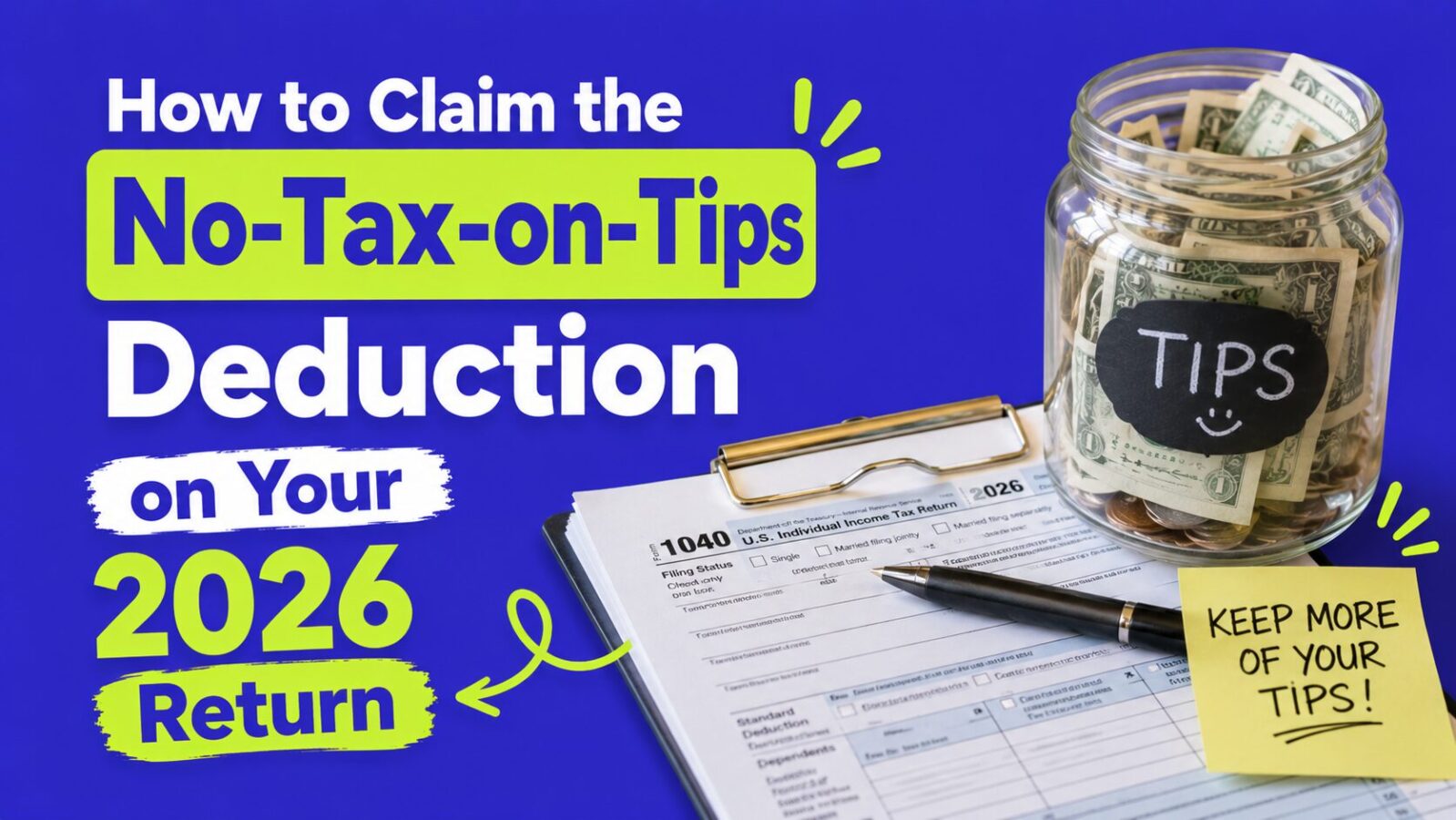
To claim the no tax on tips deduction for 2026, first report all of your taxable tip income as usual. Then calculate the amount that meets the IRS definition of qualified tips and claim the allowable deduction on Schedule 1-A with your 2026 Form 1040.
For W-2 employees, your 2026 W-2 should include Box 12 code TP for cash tips reported to your employer and Box 14b for your Treasury Tipped Occupation Code. Those fields help calculate the deduction, but Box TP should not automatically be treated as the final deductible amount without checking the eligibility rules.
The maximum deduction is $25,000 per return. It begins phasing out when modified adjusted gross income exceeds $150,000, or $300,000 for married couples filing jointly. Married taxpayers must file jointly to claim it.
Key takeaways
- Report your tip income first. The deduction does not let you leave taxable tips off your return.
- Maximum deduction: $25,000 of qualified tips per return.
- Income phaseout: The deduction is reduced by $100 for every $1,000 of MAGI above $150,000, or $300,000 for married filing jointly.
- 2026 W-2 code TP: Reports total cash tips reported to your employer.
- W-2 Box 14b: Reports your Treasury Tipped Occupation Code.
- Claim the deduction on Schedule 1-A, not Schedule 1 Adjustments to Income.
- You can use the standard deduction too. The tips deduction is available to both itemizers and non-itemizers.
- Form 4137 tips can qualify if they meet the other requirements.
- FICA does not disappear. Applicable Social Security and Medicare taxes still apply to tip income.
- The deduction is temporary under current law and applies to tax years 2025 through 2028.
Step 1: Make sure your occupation qualifies
The first question is not how much you earned in tips. It is what job you were doing when you earned them.
The IRS finalized a list of occupations that customarily and regularly received tips on or before December 31, 2024. It groups qualifying occupations into categories covering areas such as food and beverage service, entertainment, hospitality, home services, personal services, personal appearance and wellness, recreation and instruction, and transportation and delivery.
Examples include many restaurant workers, bartenders, hotel workers, salon workers, drivers, and other traditionally tipped occupations.
But being paid a tip is not enough by itself.
The tip must generally be received while working in an occupation on the IRS list.
See our full guide to occupations eligible for the no tax on tips deduction if you are unsure about your job.
Step 2: Make sure the payment is actually a qualified tip
The deduction applies to qualified tips, not every payment that a business calls a tip.
IRS rules generally require the tip to be:
- paid in cash or a cash equivalent
- received directly from a customer or through a qualifying tip-sharing arrangement
- paid voluntarily
- connected with a qualifying tipped occupation
Cash equivalents include credit card, debit card, check, certain gift cards, qualifying electronic payments, and similar payments that can be exchanged for a fixed dollar amount.
Mandatory service charges are different
Suppose a restaurant automatically adds an 18% charge to every large-party bill and customers cannot remove or change it.
That mandatory amount is generally not a qualified tip for this deduction, even if the restaurant distributes the money to servers.
IRS final guidance distinguishes voluntary customer tips from required service charges.
That distinction matters before you ever look at the $25,000 limit.
For the broader rules, see No Tax on Tips 2026: How the deduction works.
Step 3: Check your 2026 W-2
If you are an employee, your 2026 W-2 has new reporting fields related to the tips deduction.
| W-2 field | What it means |
|---|---|
| Box 12, code TP | Total cash tips reported to your employer |
| Box 14b | Treasury Tipped Occupation Code(s) |
| Box 7 | Social Security tips |
| Box 8 | Allocated tips, when applicable |
| Box 12, code TT | Qualified overtime compensation, if applicable |
IRS instructions specifically define TP as the total amount of cash tips reported to the employer.
That wording matters.
Box TP is not automatically your deduction
It is tempting to look at TP, copy the number onto your tax return, and stop there.
Do not do that.
Box TP reports cash tips. Your deduction depends on whether those tips meet the qualified-tip rules.
Box 14b helps identify the occupation in which the tips were earned. IRS W-2 instructions even require code 000 when some reported tips were earned in a nonqualifying occupation.
So think of TP and 14b as inputs to the calculation, not as the IRS saying:
“This exact dollar amount is automatically deductible.”
Step 4: What if Box TP or Box 14b is wrong?
Compare your W-2 with your pay stubs and your own tip records.
If your employer appears to have omitted or incorrectly reported the new tip information, contact payroll or the employer before filing and ask them to review the W-2.
IRS instructions provide procedures for correcting Box 12 and Box 14b information using Form W-2c.
But a missing Box TP does not mean the only legally correct response is to abandon the deduction.
The correct next step depends on why the amount is missing.
If you failed to report employee tips to your employer, Form 4137 may be part of the filing process.
Step 5: What if you did not report some cash tips to your employer?
Those tips do not simply disappear.
Employees generally use Form 4137, Social Security and Medicare Tax on Unreported Tip Income, to report qualifying unreported tips and calculate applicable Social Security and Medicare taxes.
More importantly, the IRS explicitly says tips reported directly by an employee on Form 4137 can be used for the qualified tips deduction if they satisfy the other requirements.
So this statement is incorrect:
“If the tips were not coded TP by your employer, they cannot qualify.”
The better rule is:
The tips must be properly reported through an accepted IRS reporting route and independently satisfy the qualified-tip rules.
IRS currently recognizes tips reported on Form W-2, applicable Forms 1099, or directly by an employee on Form 4137.
Step 6: Add qualified tips from all jobs
The $25,000 limit applies to your return, not separately to each employer.
Suppose you had two qualifying restaurant jobs:
- Job A qualified tips: $14,000
- Job B qualified tips: $13,000
- Total: $27,000
Before considering the income phaseout, your maximum deduction would be $25,000, not $27,000.
The same limit applies regardless of filing status.
Step 7: Apply the MAGI phaseout
The deduction begins shrinking when MAGI exceeds:
- $150,000 for single, head of household, and other non-joint filers
- $300,000 for married filing jointly
The reduction is $100 for every $1,000 that MAGI exceeds the threshold.
Example 1: $20,000 of qualified tips
Suppose you are single and have:
- Qualified tips: $20,000
- MAGI: $165,000
You are $15,000 above the $150,000 threshold.
$15,000 ÷ $1,000 = 15
15 × $100 = $1,500 reduction
Your tentative deduction becomes:
$20,000 – $1,500 = $18,500
Example 2: why there is no universal income cutoff
Suppose instead you have only $10,000 of qualified tips.
Once the phaseout has reduced that $10,000 to zero, your deduction is gone.
That happens sooner than it would for someone starting with the full $25,000 deduction.
So statements such as:
“The tips deduction disappears at $400,000 of income.”
are incomplete.
Around $400,000 for a single filer would eliminate a full $25,000 deduction, but a smaller starting deduction can disappear at a lower MAGI. The correct calculation depends on how many qualified tips you actually have.
Step 8: Claim it on Schedule 1-A, not Schedule 1
This is one of the most important corrections to older guides.
The qualified tips deduction is claimed on Schedule 1-A, Additional Deductions.
It is not reported as a Schedule 1 Part II adjustment to income alongside deductions such as student loan interest or deductible IRA contributions.
IRS Publication 505 specifically directs taxpayers with qualified tips in 2026 to use their information-return amounts when calculating the deduction on Schedule 1-A (Form 1040).
Does the deduction reduce AGI?
Not in the way a traditional above-the-line Schedule 1 adjustment does.
Schedule 1-A deductions are used in determining taxable income after AGI.
That is why describing this as an “above-the-line deduction that reduces AGI” is misleading.
The good news is that you can still claim it whether you use the standard deduction or itemize.
Step 9: You can still take the standard deduction
The new tips deduction does not force you to itemize.
For tax year 2026, the basic standard deduction is:
| Filing status | 2026 standard deduction |
|---|---|
| Single | $16,100 |
| Married filing separately | $16,100 |
| Head of household | $24,150 |
| Married filing jointly | $32,200 |
Those amounts are separate from an eligible Schedule 1-A tips deduction.
So a qualifying single taxpayer could potentially take the $16,100 standard deduction and an allowable qualified tips deduction.
They are different deductions applied through different parts of the return.
Step 10: Remember the married-filing-jointly rule
If you are married, the law generally requires you to file a joint federal return to claim the qualified tips deduction.
The taxpayer receiving the tips must also satisfy the applicable Social Security number requirement.
This is easy to miss if you normally file married filing separately.
Do not calculate the deduction before confirming that your filing status qualifies.
Does the deduction eliminate Social Security and Medicare taxes?
No.
This is why the phrase “no tax on tips” can be misleading if read literally.
2026 W-2 instructions state that reported tips remain generally subject to federal income-tax withholding and employer and employee Social Security and Medicare taxes under the applicable rules.
The Schedule 1-A deduction can reduce federal taxable income.
It does not retroactively erase applicable FICA taxes on those tips.
Will claiming the deduction automatically make your refund bigger?
Not necessarily.
A deduction reduces taxable income. It is not a dollar-for-dollar tax credit.
Suppose a taxpayer has a $10,000 allowable tips deduction.
The tax savings depend on where that deduction falls within the person’s federal tax calculation. It does not mean the IRS sends them an extra $10,000.
Whether your refund increases also depends on:
- federal income tax already withheld
- other income
- deductions
- credits
- filing status
- self-employment tax
- other taxes owed
So it is safer to say the deduction can reduce your federal income tax rather than promise that every tipped worker will receive a larger refund.
What if you are self-employed?
The deduction is not limited to W-2 employees.
Qualifying self-employed workers can also claim it when the tips and occupation meet the rules.
For 2026, IRS Publication 505 says qualified-tip information can appear on:
- Form W-2, Box 12 code TP
- Form 1099-MISC, Box 13a
- Form 1099-NEC, Box 1b
- Form 1099-K, Box 1c
The associated Treasury Tipped Occupation Code is reported separately on the applicable form.
Self-employed taxpayers have an additional limitation: their qualified tips deduction cannot exceed the net income, before this deduction, from the trade or business in which the tips were earned.
Tips included in business income can also remain subject to self-employment tax.
What if you also earned qualified overtime?
The tips deduction and qualified overtime deduction are separate.
For 2026 W-2 reporting, qualified overtime is reported with Box 12 code TT.
If you independently qualify for both deductions, you can potentially claim both through Schedule 1-A.
But do not treat your entire overtime paycheck as automatically deductible. The federal overtime deduction has its own definition and limitations.
How should you use tax software?
The safest advice in August 2026 is not to promise that a particular TurboTax, H&R Block, FreeTaxUSA, or other product tier will handle the 2027 filing season in a specific way or at a specific price.
Those products and their 2027 tax-year support can still change before filing season begins.
When you choose software, confirm that the current 2027 version supports:
- 2026 Form W-2 code TP
- W-2 Box 14b occupation codes
- Form 4137, if needed
- Schedule 1-A
- qualified tips phaseout calculations
- qualified overtime, if applicable
- self-employment reporting, if applicable
Do not choose software solely because an old review says it supports a form that did not exist in previous filing seasons.
A simple claim checklist
Before filing your 2026 return, confirm that you have done each of these:
- Reported all taxable tip income.
- Confirmed your occupation appears on the IRS qualifying list.
- Separated voluntary qualified tips from mandatory service charges or other nonqualifying amounts.
- Reviewed Box TP and Box 14b on every W-2.
- Completed Form 4137 if you have employee tips that must be reported there.
- Combined qualified tips from all sources.
- Applied the $25,000 maximum.
- Applied the MAGI phaseout if your income exceeds the threshold.
- Confirmed you meet the SSN and filing-status rules.
- Claimed the allowable deduction on Schedule 1-A using the final 2026 IRS instructions.
FAQ
What is Box 12 code TP on a 2026 W-2?
IRS W-2 instructions define code TP as the total amount of cash tips reported to the employer. Box 14b reports the Treasury Tipped Occupation Code associated with the work in which the tips were earned.
Is Box TP automatically the amount I can deduct?
No. Box TP reports cash tips reported to your employer. Your deductible amount still depends on whether the tips are qualified, whether the occupation qualifies, the $25,000 cap, your MAGI, and the other eligibility rules.
Where do I claim the no tax on tips deduction for 2026?
IRS guidance directs taxpayers to calculate the qualified tips deduction on Schedule 1-A (Form 1040). It is not a Schedule 1 adjustment to income.
Is the tips deduction above the line?
It is better not to describe it that way. The IRS treats it as an additional Schedule 1-A deduction used in calculating taxable income rather than a Schedule 1 adjustment that reduces AGI. You can still claim it whether you take the standard deduction or itemize.
Can unreported cash tips qualify?
Potentially, yes. Employee tips reported directly on Form 4137 can qualify for the deduction when they satisfy the other federal requirements.
What is the maximum no tax on tips deduction?
The maximum is $25,000 per return, subject to the income phaseout and other eligibility requirements.
When does the tips deduction phase out?
The deduction begins phasing out when MAGI exceeds $150,000, or $300,000 for married filing jointly. It is reduced by $100 for every $1,000 above the applicable threshold.
Can I claim the tips deduction and the standard deduction?
Yes. The IRS says the qualified tips deduction is available to taxpayers who itemize and those who do not.
Do I still pay Social Security and Medicare taxes on tips?
Generally, yes. The federal deduction does not eliminate applicable Social Security and Medicare taxes on tip income.
Can self-employed workers claim the deduction?
Yes, if the occupation, tips, reporting, and other requirements are met. The deduction for a self-employed person also cannot exceed qualifying net income from the business in which the tips were earned.
How long does the no tax on tips deduction last?
Under current federal law, the qualified tips deduction applies for tax years 2025 through 2028.
Bottom line
Claiming the 2026 no tax on tips deduction is not as simple as copying Box TP onto Schedule 1.
Start by reporting all taxable tips. Then determine which tips meet the IRS definition of qualified tips, confirm that the occupation qualifies, combine eligible amounts from all jobs, apply the $25,000 cap and any MAGI phaseout, and claim the final deduction on Schedule 1-A.
For W-2 employees, Box TP and Box 14b make the process easier, but they are not substitutes for the eligibility rules. And if some employee tips were not reported to your employer, Form 4137 does not automatically destroy your deduction. Properly reported Form 4137 tips can qualify when the other requirements are satisfied.
Most importantly, remember what the slogan leaves out: “no tax on tips” is a federal income-tax deduction. It does not make every tip tax-free and does not erase Social Security or Medicare taxes.
For the full eligibility rules, read No Tax on Tips 2026. If you only need to check your occupation, see the qualifying tipped occupations list.
This article is for educational and informational purposes only and is not tax, legal, or financial advice. Tax forms, filing procedures, software features, and state tax treatment can change before the 2027 filing season. Use the final IRS forms and instructions for tax year 2026 when filing your return.