 By
By 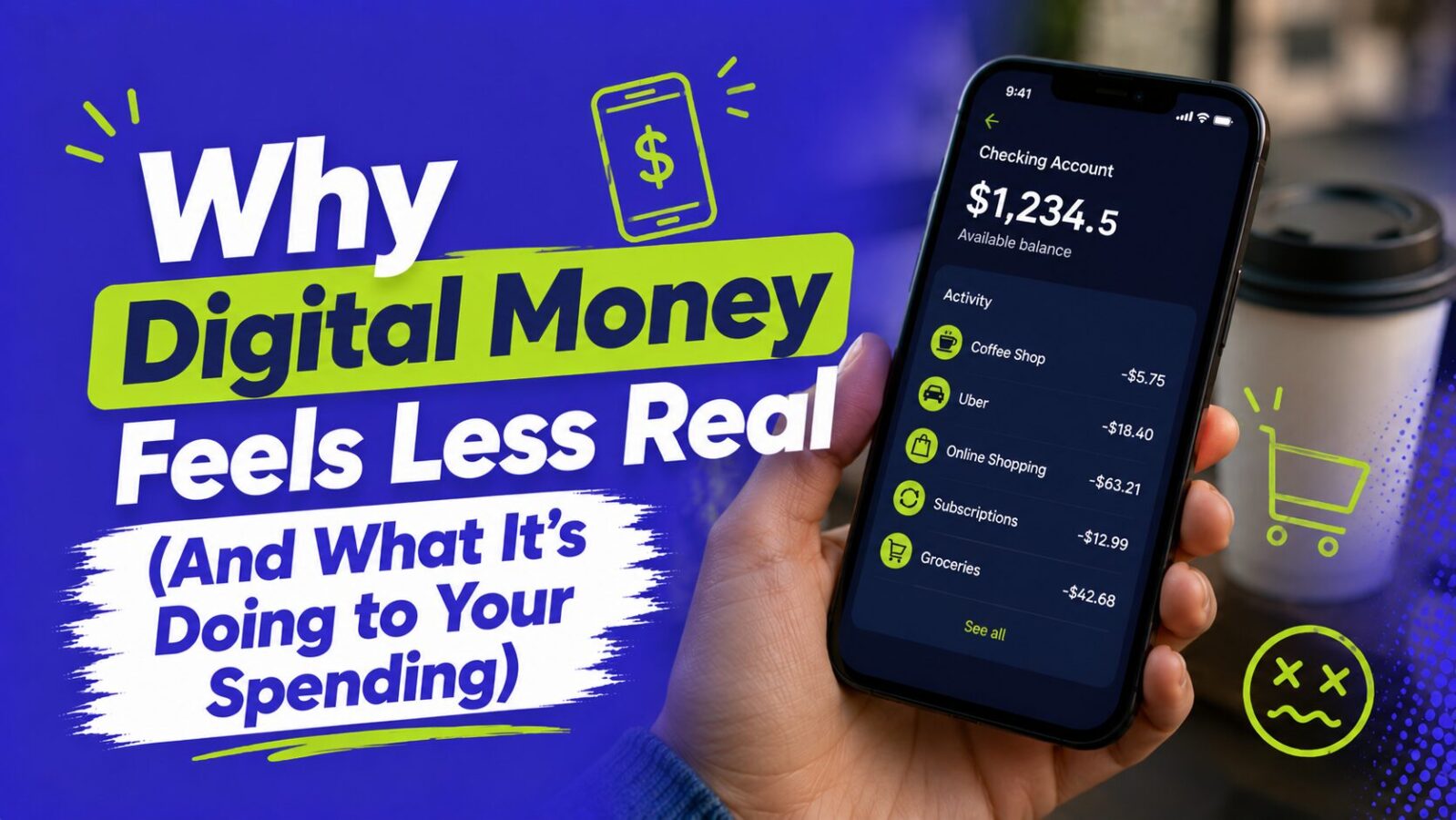
Digital money can feel less real because the act of buying something is increasingly separated from the feeling of giving money up.
With cash, the cost is visible. You count the bills, hand them over, and immediately have less money in your wallet.
With a card or phone, the transaction can happen in seconds. With Buy Now Pay Later, even the full price can be broken into smaller future payments.
Researchers call part of this experience the pain of payment, the negative psychological feeling associated with losing money now or expecting to lose it later.
But there is an important correction to the popular version of this idea:
Research does not show that every person automatically spends more as payments become more digital.
Electronic payments can feel less painful or less noticeable than cash, but the effect on actual spending varies by payment method, person, and context.
FinancePulse view: Do not abandon digital payments. Use them where convenience helps you, and add friction only where that convenience repeatedly makes it harder to notice what you are spending.
What does “pain of payment” actually mean?
Pain of payment is not a claim that buying something literally hurts your brain in the same way as physical injury.
It describes the unpleasant psychological experience of recognizing that your financial resources are being reduced. A 2023 review of the research defines it broadly enough to include both immediate financial loss and the anticipation of losing money later.
Neuroscience provides some support for the idea that cost creates an aversive component during purchasing decisions.
In a well-known fMRI study, attractive products were associated with activity in reward-related brain regions, while excessively high prices were associated with increased activity in the insula before participants decided whether to buy.
That is interesting evidence about how people process purchasing decisions.
It does not justify saying:
Paying cash activates physical pain centers and tapping your phone does not.
The practical lesson is much simpler:
The more noticeable the cost feels at the moment of purchase, the more opportunity you may have to reconsider it.
Does cash feel more painful than digital payment?
There is evidence that it can.
A 2024 study using a large survey of Dutch consumers found that electronic payments generally produced lower reported pain of paying than cash. Contactless payments were also viewed as less useful for preventing overspending, while cash was viewed as more useful.
But the findings were not as simple as:
cash → debit → credit → phone → BNPL
with every step producing less pain.
The results varied by payment method and by whether researchers looked at respondents with experience using that method. Some types of electronic payment felt less painful than cash, while other comparisons were less straightforward.
So I would not rank every payment method on a universal “pain scale.”
A better conclusion is:
Cash often makes the outflow of money more visible. Some electronic methods make it less salient. What that does to actual spending depends on the situation.
Do cards and tap-to-pay actually make you spend more?
This is where the evidence becomes mixed.
Older research frequently found a credit card effect, with consumers spending more or showing a higher willingness to pay when using cards rather than cash.
But a 2021 paper ran four studies involving 692 participants and was unable to consistently reproduce that effect. Its meta-analysis of earlier research still found an overall credit-card effect, but also suggested that it had weakened over time and varied by research setting.
The same research tested mobile payments.
Mobile payments tended to feel more convenient and sometimes less painful, but those differences did not consistently produce more spending across the studies.
That distinction is important.
You can reasonably say:
Tap-to-pay can make payment feel easier.
You cannot confidently say:
Tap-to-pay makes everyone spend more.
If you personally spend the same amount regardless of whether you use cash, card, or your phone, there is no reason to make your life harder just because a behavioral-finance theory exists.
Why can digital money still feel less real?
Even when digital payments do not increase total spending in every experiment, they change several features of the payment experience.
The money is less visible
With cash, the reduction is physical.
With digital payment, the cost becomes a number in an account that you may not look at until later.
The transaction requires fewer actions
A payment can take one tap instead of taking out a wallet, counting cash, waiting for change, or even entering a card PIN.
That convenience is useful.
It also means there may be less time between wanting something and owning it.
Payment can be separated from consumption
Credit lets you receive something now and move the actual cash outflow into the future.
BNPL goes further by dividing that future obligation into smaller payments.
This separation does not automatically create irresponsible spending.
But it can change which number feels most important when you make the decision.
BNPL deserves more caution than ordinary tap-to-pay
Buy Now Pay Later is not simply another convenient checkout method.
It is borrowing.
And recent evidence on BNPL gives us more reason to worry about spending effects than the evidence on ordinary mobile payments.
A 2026 Central Bank of Ireland experiment using a nationally representative Irish sample found that participants spent an average of 4.39% more when using BNPL than when using debit cards in the experiment. The researchers also found evidence that prior BNPL use could make available funds feel larger and increase discretionary spending.
That does not mean every person who uses BNPL will overspend by 4.39%.
It means that in this particular experimental setting, changing the payment structure changed spending behavior.
The CFPB also found that BNPL use frequently overlaps with other borrowing. In its study of U.S. consumers, more than three-fifths of BNPL borrowers had multiple simultaneous BNPL loans at some point during the year studied, and BNPL borrowers tended to carry higher balances on other unsecured credit products than nonusers.
Those findings do not prove BNPL caused the other debt.
They do show why it should be treated as credit rather than as a harmless checkout feature.
The biggest BNPL trap is focusing on the installment instead of the price
Suppose something costs $400.
You can think about it as:
$400
or:
4 payments of $100
The total obligation has not disappeared.
But $100 can become the number your brain uses to decide whether the purchase feels affordable.
That creates two different questions:
Can I afford the next $100 payment?
and:
Is this purchase worth committing $400 of my money to?
The first question is not enough.
Whenever you use BNPL, I would look at the full purchase price and your total outstanding installment obligations before deciding.
Is this really a willpower problem?
I would not describe it as either purely willpower or purely technology.
Digital payments are intentionally designed to make transactions faster and easier.
That is usually a benefit.
At the same time, behavior is influenced by the environment in which decisions happen. If buying something takes almost no effort, there are fewer natural opportunities to reconsider it.
The useful response is not:
I need more discipline.
It is:
Where would a small amount of friction improve my decisions?
That is a much easier problem to solve.
How to make digital spending feel more real
You do not need to switch back to cash for your entire life.
Use friction selectively.
Turn on transaction alerts
Have your bank or credit card notify you when a transaction posts.
The goal is not to make you feel guilty.
It is simply to reconnect the tap with the dollar amount.
A purchase that disappears from your awareness immediately after checkout is harder to track than one you see again on your screen.
Review transactions once a week
You do not need a complicated budgeting ritual.
Once a week, scan:
- checking transactions;
- credit card purchases;
- BNPL payments.
Look for spending you barely remember making.
Those are the categories where adding friction may have the most value.
Use cash for one problem category
Cash does not need to become your entire budgeting system.
If you repeatedly lose track of spending on dining, nightlife, convenience shopping, or another category, try cash there for a month.
Treat it as an experiment.
If nothing changes, stop.
If seeing a finite amount of money disappear helps you stay closer to your target, you have found a useful tool.
Add a waiting period to larger discretionary purchases
There is nothing scientifically magical about a 24-hour or 48-hour rule.
The value comes from the pause.
If you regularly regret impulse purchases, choose a dollar amount that matters to your budget and wait before completing non-essential purchases above it.
The purchase may still be worth making tomorrow.
You simply give yourself a second opportunity to decide.
Look at the full BNPL price
Do not ask only:
Can I make this installment?
Ask:
Would I still buy this if I had to think about the entire price today?
Then check your existing installment payments before adding another one.
Automate good decisions too
Frictionless technology can work in your favor.
Automatic savings transfers, retirement contributions, and recurring debt payments reduce the number of times you need to choose the financially useful action.
The same design principle that makes spending easy can also make saving easy.
Remove friction from behaviors you want to repeat. Add friction to behaviors you regularly regret.
What if digital payments do not make you overspend?
Then keep using them.
Behavioral research describes tendencies and average effects, not a diagnosis for every consumer.
You do not need to use cash because someone online told you that Apple Pay is psychologically dangerous.
Look at your own behavior.
If you:
- stay within your spending plan;
- pay credit cards as intended;
- know what you owe;
- rarely regret impulse purchases;
- use BNPL cautiously or not at all;
then digital convenience may be working perfectly well for you.
Finance should solve actual problems, not theoretical ones.
Frequently asked questions
Why does digital money feel less real?
Digital payments can make the financial outflow less visible and separate the purchase from the physical act of giving up money.
Research on pain of payment finds that electronic methods can feel less painful than cash, although the effect differs across payment methods and consumers.
Does paying with cash make you spend less?
Possibly, but not for everyone.
Cash can make the cost more salient, and research has linked payment method with spending behavior. However, newer studies have not consistently replicated the traditional finding that cards always increase spending.
Does Apple Pay or tap-to-pay make you spend more?
The evidence does not support saying that mobile payments always increase spending.
A 2021 series of studies found that mobile payments could feel easier or less painful without consistently increasing willingness to pay or basket size.
If tap-to-pay affects your own impulse spending, adding transaction alerts or another small barrier may still help.
Does Buy Now Pay Later make people spend more?
There is evidence that it can.
A 2026 experiment found that participants spent 4.39% more with BNPL than with debit cards in that study.
That percentage should not be treated as a universal prediction for every BNPL user.
Is digital overspending a willpower problem?
Not entirely.
Individual habits matter, but the design and convenience of a payment system can also shape how a transaction feels.
Instead of depending entirely on self-control, identify where small structural changes such as alerts, waiting periods, or spending limits improve your decisions.
Should I stop using digital payments?
Probably not unless they are causing a specific problem for you.
Digital payments are convenient and can also make positive financial behaviors easier to automate.
Use cash or extra friction selectively where your own spending history shows that you need it.
The bottom line
Digital money can feel less real because modern payments make the outflow of money less visible and easier to complete.
Research supports the idea of a pain of payment and finds that electronic payments can feel less painful than cash.
But do not take the idea too far.
Cards and tap-to-pay do not reliably make every consumer spend more, and there is no scientifically established ladder showing that each increasingly digital payment method always causes progressively worse spending.
BNPL is the area where I would be more cautious because it combines frictionless checkout with actual borrowing, and recent experimental evidence shows that the structure can increase spending.
So do not make every payment harder.
Make good behaviors easy and problem behaviors slightly harder.
Use transaction alerts if spending disappears from your awareness. Use cash for one category if it helps. Add a pause before purchases you often regret. Look at the full cost of BNPL rather than the next installment. Automate saving before discretionary spending begins.
The goal is not to make money feel painful.
It is to make the cost visible enough that convenience does not make the decision for you.