 By
By 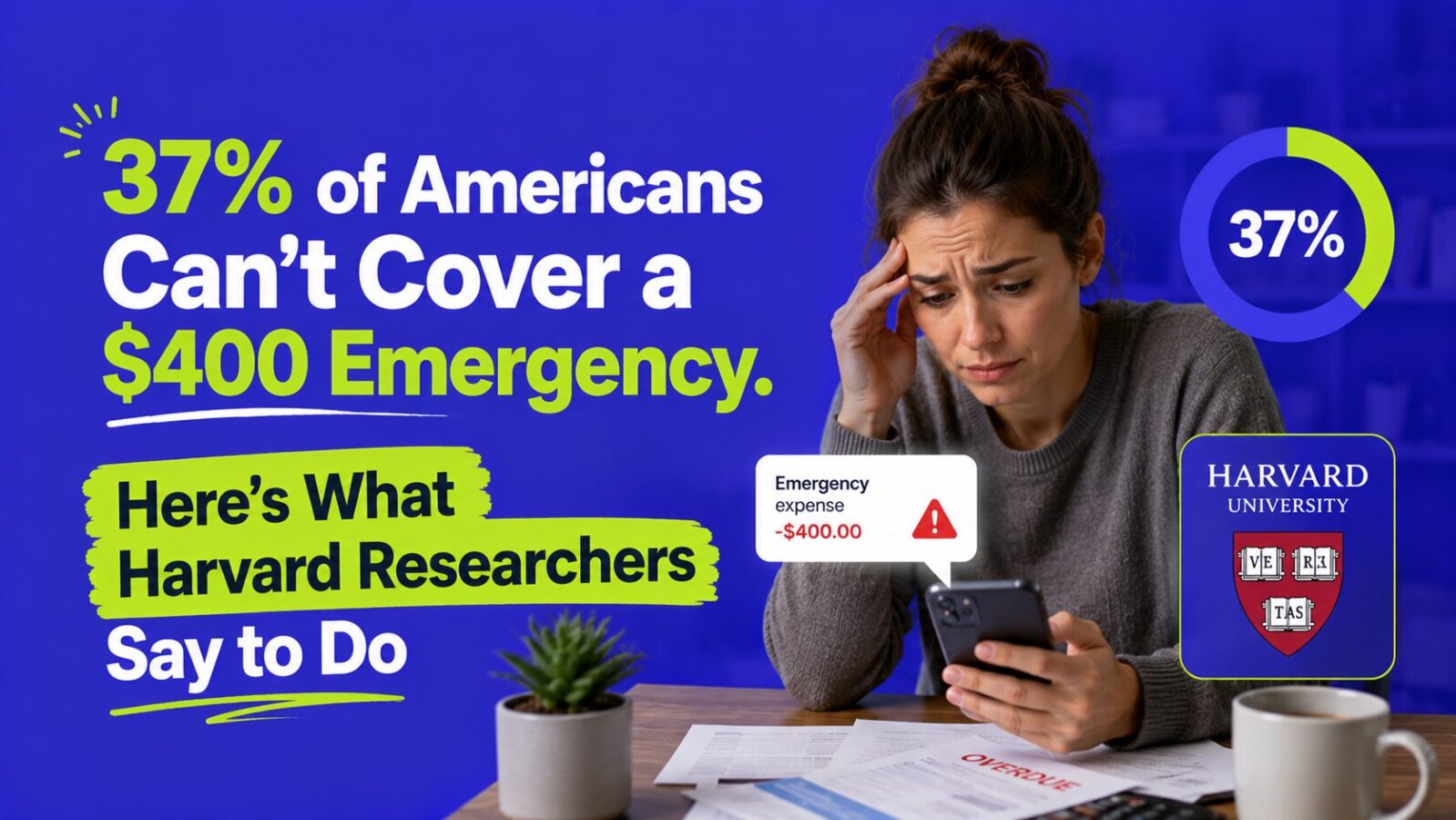
To build an emergency fund, start with a manageable cash buffer, automate a contribution you can actually afford, and gradually work toward several months of essential expenses.
Automation can make that process easier because it removes a repeated saving decision. But it cannot fix a budget where there is consistently no money left to save.
That distinction matters.
Federal Reserve data for 2025 show that 63% of U.S. adults said they could cover a $400 unexpected expense using cash, savings, or a credit card paid off at the next statement. The remaining 37% would use another method or could not cover the expense. Only 12% of all adults said they could not pay the $400 expense by any means.
So the emergency-savings problem is significant, but “37% of Americans cannot afford $400” overstates what the survey actually found.
How to build an emergency fund
I would use this order:
- Build your first $1,000 or another manageable starter buffer.
- Automate a contribution around payday.
- Work toward one month of essential expenses.
- Then build toward roughly 3 to 6 months based on your risks.
- Keep the money safe and accessible.
- Adjust the automatic contribution when your cash flow changes.
The first goal is not to reach six months immediately.
It is to create enough cash that the next unexpected expense is less likely to become expensive debt.
Start with a smaller target
A three-to-six-month emergency fund can be a large number.
If your essential expenses are $3,000 per month, six months means:
$3,000 × 6 = $18,000
That can make someone starting from $0 feel as if emergency saving is impossible.
Instead, build it in stages.
Stage 1: Your first $1,000
Fidelity currently recommends starting with $1,000 in emergency savings, then building toward 3 to 6 months of essential expenses. It treats $1,000 as a starting milestone, not a complete emergency fund.
I like that framing.
$1,000 will not cover every emergency.
It can still make a meaningful difference if you suddenly need to pay an insurance deductible, replace a necessary appliance, or cover part of an unexpected repair.
Stage 2: One month of essential expenses
Once you have the first buffer, work toward one month of expenses you truly need to pay.
That might include:
- housing;
- basic food;
- utilities;
- transportation;
- insurance;
- minimum debt payments;
- essential healthcare;
- necessary childcare.
If those expenses total $2,500, your next milestone is simply:
$2,500
Stage 3: Several months of expenses
Fidelity’s current general guideline is to eventually hold around 3 to 6 months of essential expenses, with potentially more appropriate for people with dependents, unstable income, an unreliable vehicle, or higher employment risk.
That is a guideline, not a rule.
Someone with two stable household incomes and few financial obligations might choose a different amount from a self-employed parent supporting a family.
Why automation can help
The strongest argument for automation is not that it magically creates discipline.
It changes the default.
A 2024 NBER study examined voluntary short-term payroll savings programs at five U.K. employers.
Employees had access to an account that could automatically receive payroll contributions while remaining available for withdrawals.
Take-up under the opt-in system was extremely low: no more than 0.7% of eligible employees activated an account. Among participants whose accounts could be observed for a full year and who remained employed, 87% were still receiving an automatic payroll contribution in month 12.
That 87% number needs context.
It does not mean:
“87% of people who automate savings succeed.”
The people in that calculation had already chosen to enroll, remained with their employer, and had enough observation time.
A second set of U.K. workplace experiments gives stronger evidence about automation itself.
Researchers compared opt-in saving with automatic enrollment. Nine months later, participation was 48 percentage points higher under automatic enrollment. At another employer, the difference was again 48 percentage points in month 18 of employment. Average short-term savings balances were also higher under automatic enrollment.
That supports a narrower conclusion:
Making saving automatic can substantially increase participation in a savings program.
It does not prove that automation alone produces an adequate emergency fund.
How to automate emergency savings
You do not need a formal workplace savings program.
The CFPB suggests two simple approaches.
Schedule an automatic bank transfer
Set a recurring transfer from checking to savings.
For example:
Payday: Friday
Automatic transfer: $75
Destination: Emergency savings
If you are paid every two weeks, that would contribute:
$75 × 26 = $1,950 per year
before interest.
The CFPB describes recurring transfers as one of the easiest ways to make saving consistent.
Split your direct deposit
Ask your employer whether your paycheck can be divided between multiple accounts.
For example:
$100 → savings
remainder → checking
The CFPB specifically recommends checking whether your employer supports split direct deposit as another way to automate savings.
This can be particularly useful because the money never needs to sit in your spending account first.
Do not automate too much
A recurring transfer is useful only if it fits your cash flow.
The CFPB cautions that automatic transfers can create overdraft problems when there is not enough money in checking when the transfer occurs.
So if $200 every payday repeatedly leaves you short, do not treat reducing the transfer as failure.
Change it to $100.
Or $50.
The right automatic contribution is the amount you can repeatedly save without borrowing it back.
What if you have no money left to automate?
Then automation is not your first problem.
Look at cash flow.
The latest Fed data show a strong connection between having money left after monthly spending and having emergency reserves.
In 2025, 86% of adults who said they always had money left over at the end of the month reported having three months of emergency savings. Among people who said they never had money left over, only 13% had that level of savings.
That does not prove leftover cash causes emergency savings by itself, but the relationship is not surprising.
You cannot automate money that does not exist.
If your monthly cash flow is consistently at zero or negative, look first for changes such as:
- reducing recurring costs;
- changing bill timing;
- directing irregular income to savings;
- using part of a tax refund or bonus;
- increasing income where realistic.
The CFPB specifically identifies one-time inflows such as tax refunds as opportunities to accelerate emergency savings.
Do younger adults have less emergency savings?
Yes, according to the Fed’s latest data.
In 2025, the share reporting enough emergency savings to cover three months of expenses was:
- 37% for ages 18 to 29
- 49% for ages 30 to 44
- 55% for ages 45 to 59
- 71% for ages 60 and older
That is much more useful than saying young adults “should” have a particular dollar amount.
Someone earning $35,000 and someone earning $150,000 should not have the same emergency-fund target.
Essential expenses and financial risks should determine the amount.
Where should you keep your emergency fund?
Emergency money should be:
safe
reasonably accessible
separate from everyday spending
For many people, a savings account is a straightforward choice.
The CFPB recommends considering a dedicated bank or credit-union account where emergency money is safe and accessible.
A high-yield savings account can also make sense if it offers competitive interest without sacrificing access or introducing fees that undermine the benefit.
Do not chase the highest APY at the expense of usability.
Emergency money has a job.
Its primary job is not maximizing returns.
It is being available when something goes wrong.
Is your savings account FDIC insured?
If your emergency fund is kept in an eligible deposit account at an FDIC-insured bank, FDIC coverage is generally automatic.
The standard insurance limit is currently $250,000 per depositor, per insured bank, per ownership category.
Eligible deposit products include savings accounts, checking accounts, money market deposit accounts, and CDs.
Stocks, bonds, mutual funds, and crypto assets are not FDIC-insured deposit products.
For a normal emergency fund, the $250,000 limit will rarely be the deciding issue.
The more important step is simply confirming that the bank itself is FDIC insured.
Should your emergency fund be at another bank?
It can be, but it does not have to be.
A separate bank may make emergency money feel less available for casual spending.
The same bank may make transfers quicker and account management simpler.
I would use this test:
Is the money inconvenient enough that I won’t casually spend it, but accessible enough that I can use it during a real emergency?
That balance matters more than whether two different bank logos are involved.
What counts as an emergency?
An emergency fund should generally cover unexpected and necessary expenses, not spending you simply forgot to plan for.
Examples might include:
- job loss;
- urgent vehicle repairs;
- necessary medical costs;
- unexpected home repairs;
- emergency travel for a serious family situation.
A predictable annual insurance premium is not an emergency.
Neither is a vacation.
Those should ideally have their own sinking funds or savings categories.
Keeping that distinction clear prevents your emergency fund from becoming a general-purpose spending account.
How quickly should you build it?
There is no deadline.
Suppose your first goal is $1,000.
If you can save:
$50 per month → about 20 months
$100 per month → about 10 months
$200 per month → about 5 months
Then a tax refund or other one-time income could shorten the timeline.
Do not increase the contribution to an unsustainable level simply because you want the target faster.
Consistency matters more than creating a savings plan you abandon after two months.
A practical emergency-fund plan
If you are starting today, I would do this:
Step 1: Calculate one month of essential expenses.
Step 2: Set $1,000 as an initial milestone if you need a smaller target.
Step 3: Open or designate a savings account for emergencies.
Step 4: Schedule an automatic transfer around payday.
Step 5: Start with an amount that does not create cash-flow problems.
Step 6: Send part of bonuses, refunds, or other windfalls to the fund when appropriate.
Step 7: After reaching $1,000, work toward one month of expenses.
Step 8: Gradually build toward a larger reserve based on your household risk.
That is enough.
You do not need multiple calculators or a complicated savings system.
Frequently asked questions
How many Americans cannot cover a $400 emergency?
The most accurate wording is that 37% of U.S. adults in the Fed’s 2025 survey said they would not cover a $400 emergency entirely with cash, savings, or a credit card paid off at the next statement.
That does not mean all 37% were unable to pay. Only 12% of all adults said they could not cover the expense by any means.
How much should I have in an emergency fund?
There is no universal amount. Fidelity currently suggests starting with $1,000 and eventually working toward about 3 to 6 months of essential expenses. Your own target should reflect expenses, dependents, income stability, and other financial risks.
Does automatic saving work?
U.K. workplace experiments found much higher participation under automatic enrollment than opt-in saving, including differences of about 48 percentage points in two settings. That is strong evidence that defaults can influence participation, but it does not guarantee that automation alone will produce enough savings for every household.
How much should I automatically save each paycheck?
There is no universal percentage. Start with an amount you can consistently transfer without causing overdrafts or forcing you to use debt for ordinary expenses.
Where should I keep emergency savings?
A separate, accessible savings account at an insured bank or credit union can be appropriate. If using an FDIC-insured bank, eligible deposits are generally insured up to $250,000 per depositor, per insured bank, per ownership category.
The bottom line
Automation is one of the most useful tools for building an emergency fund, but cash flow comes first.
Research from U.K. workplace savings programs shows that automatic enrollment can dramatically increase participation compared with making employees actively opt in.
But the system still needs money to work with.
So I would use this sequence:
Create some room in your cash flow → choose a small first target → automate an affordable contribution → build toward one month of essentials → expand the fund as your finances allow.
Do not interpret “three to six months” as the amount you must somehow save immediately.
And do not interpret $1,000 as a complete emergency fund.
They are stages of the same process.
The best emergency fund is not the one that matches an internet benchmark. It is the one large enough to protect your household from the risks you actually face, built through a contribution you can keep making.