 By
By 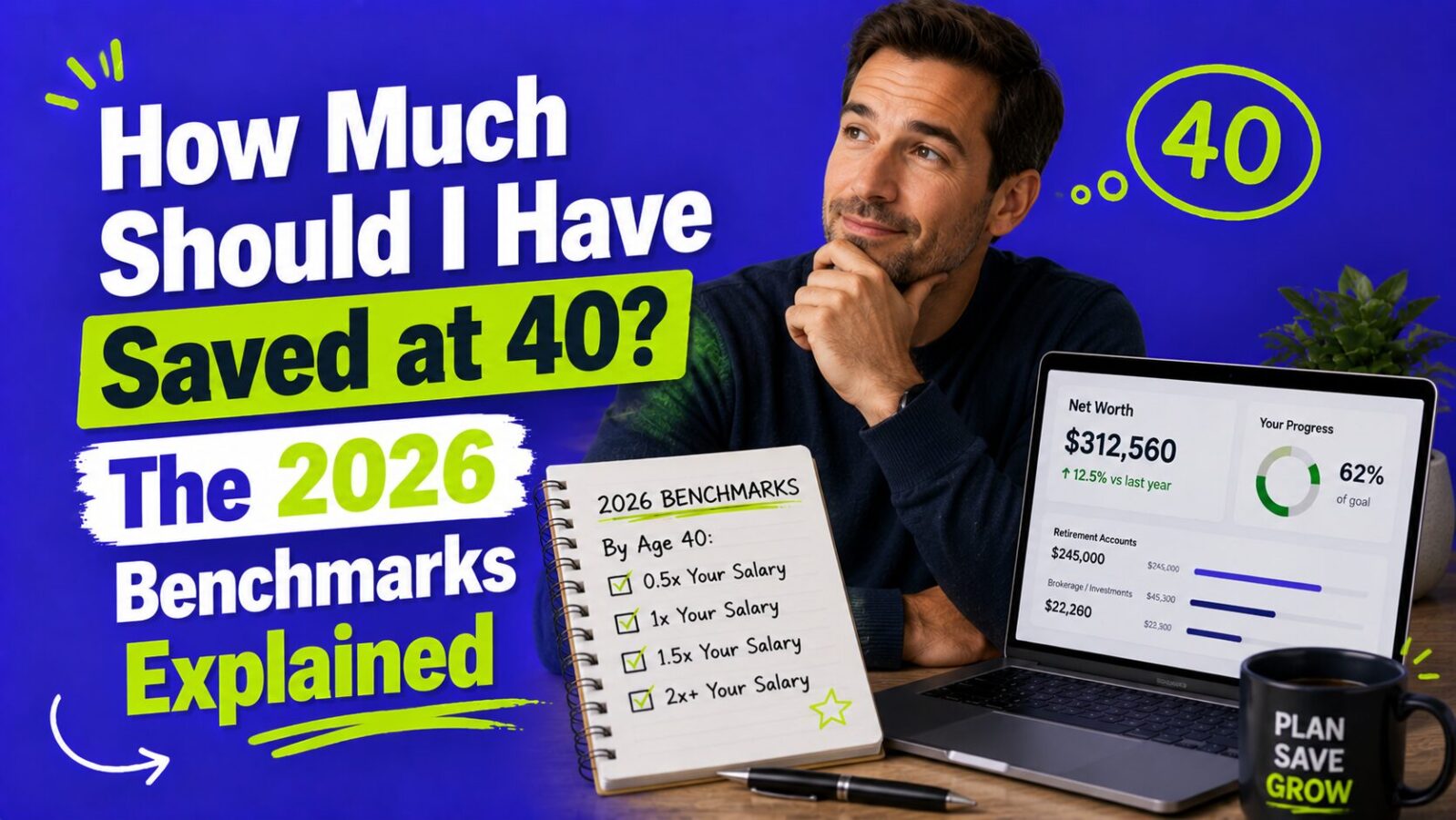
A widely used retirement guideline is to have about 3 times your annual income saved by age 40. If you earn $75,000, that works out to roughly $225,000 in retirement savings.
But 3x salary is not a universal requirement.
Fidelity’s current framework assumes retirement around age 67, saving about 15% of pretax income over your working life including employer contributions, starting around age 25, and no pension income. Change those assumptions and your appropriate target can change too.
So I would use 3x salary as a checkpoint, not a financial grade.
How much should you have saved by 40?
Fidelity currently suggests these retirement savings milestones:
| Age | Retirement savings guideline |
|---|---|
| 30 | 1x current income |
| 40 | 3x current income |
| 50 | 6x current income |
| 60 | 8x current income |
| 67 | 10x current income |
These are age-based planning factors expressed as multiples of your current income.
At age 40, that means:
| Annual income | 3x guideline |
|---|---|
| $50,000 | $150,000 |
| $75,000 | $225,000 |
| $100,000 | $300,000 |
| $150,000 | $450,000 |
The arithmetic is simple.
Whether the number is appropriate for you is the harder question.
What does the 3x benchmark assume?
This is the part that often disappears when the benchmark gets repeated online.
Fidelity’s current retirement model assumes a saver who:
- begins around age 25;
- saves about 15% of pretax income, including employer contributions;
- retires around age 67;
- has more than half of retirement assets in stocks on average during the working years;
- has no pension;
- experiences relatively continuous employment and wage growth.
Those assumptions are reasonable for building a general model.
They will not describe everyone’s financial life.
If you started your career later, recently received a large raise, expect a pension, took time out of the workforce, or want to retire earlier, your appropriate savings path may look different.
That does not make the benchmark useless. It means you should understand what it is measuring before deciding whether you are behind.
What should count toward the 3x target?
For a practical comparison, I would count assets that are genuinely intended to fund retirement, such as:
- 401(k) and 403(b) balances;
- traditional and Roth IRAs;
- other retirement-plan balances;
- taxable investments you have specifically set aside for retirement.
I would generally not add your primary home’s full market value, your car, emergency savings, or money reserved for near-term expenses just to reach 3x.
This is a FinancePulse decision rule rather than a separate Fidelity requirement.
The goal is to answer:
How much do I actually have available to fund retirement?
not:
How high can I make my net worth look?
Why comparing yourself with the “average 40-year-old” can mislead you
You may see articles claiming that the typical 40-year-old has a specific retirement balance.
Be careful with those comparisons.
The Federal Reserve’s 2022 Survey of Consumer Finances remains its most recent completed SCF. Its statistics are reported for families, with age based on the family’s reference person. For most asset categories, its interactive tables report median and mean holdings among families that actually hold the asset.
The Fed explicitly notes that its charts generally show:
the share of families owning an asset plus the median and mean holdings among those that own it.
That is not the same thing as saying:
“The median individual 40-year-old has $X saved.”
It is also not directly comparable with Fidelity’s guideline based on multiples of an individual’s current income.
For retirement planning, your own savings rate and retirement goal are more useful than trying to beat a peer-group median.
What if you have less than 3x salary at 40?
First, figure out why.
Suppose you earn $100,000 today and have $180,000 saved.
Fidelity’s simple age-40 benchmark would be:
$100,000 × 3 = $300,000
So you are below it.
But imagine that you earned $65,000 until last year and recently moved into a $100,000 role.
Your benchmark jumped dramatically because your current income changed.
Your retirement account did not suddenly become worse.
That is why I would look at four things before worrying about the gap:
How much are you saving now?
When do you want to retire?
What other retirement income do you expect?
Is your current contribution rate increasing or falling?
Those questions tell you more about your trajectory.
Your savings rate may matter more than today’s balance
If you are below the age-40 guideline, one of the strongest levers you still control is how much you contribute going forward.
Fidelity currently suggests working toward retirement contributions of about 15% of pretax income annually, including employer contributions. It also acknowledges that your appropriate rate can vary based on when you started, when you plan to retire, your existing savings, and your expected lifestyle.
If you earn $75,000, 15% would equal:
$75,000 × 15% = $11,250 per year
But if your employer contributes 5% of pay and you receive the full contribution, you would not necessarily need the entire 15% to come from your own paycheck under Fidelity’s framework.
And 15% does not need to become an all-or-nothing rule.
If you currently save 6%, moving to 8% is progress.
Then increase it again when cash flow improves.
What should you do at 40 if you’re behind?
I would focus on these five moves.
1. Understand your employer retirement plan
Check:
- your current contribution rate;
- the employer matching formula;
- whether employer contributions vest over time;
- the investments available;
- plan fees.
Do not assume you are receiving the full employer contribution just because your company offers a match.
Know the actual formula.
2. Increase your savings rate
If your current retirement plan is not on track, more contributions are usually a more controllable solution than trying to earn unusually high investment returns.
You might increase your contribution by one percentage point now and repeat the process after future raises.
The precise schedule matters less than moving in the right direction.
3. Address expensive debt
Do not build retirement savings while ignoring extremely expensive revolving debt.
Paying down debt gives you a known reduction in future interest costs.
Future investment returns are uncertain.
This does not mean everyone with debt should stop retirement contributions. An employer match, emergency savings needs, taxes, and the debt’s actual rate all matter.
But high-cost debt deserves to be part of the retirement conversation because interest payments reduce the money available for long-term saving.
4. Review your investment allocation
Being behind does not mean you should automatically take more risk.
Instead ask whether your current investments fit:
- your retirement horizon;
- ability to tolerate market declines;
- other financial assets;
- retirement goals.
Someone at 40 who plans to retire around 67 may still have decades before retirement, but that alone does not determine the correct stock allocation.
5. Estimate the retirement income you actually need
Eventually, move beyond salary multiples.
Start with:
Expected retirement spending
then subtract expected sources of retirement income such as:
Social Security + pension + other dependable income
The remaining amount is what your portfolio may need to support.
SSA currently allows you to see personalized retirement benefit estimates through a my Social Security account using your actual earnings record, and you can compare estimates at different claiming ages.
That makes your own SSA estimate much more useful than plugging a generic Social Security number into a calculator.
How much can you contribute in 2026?
If you want to increase retirement savings, make sure you are using current limits.
For 2026, the IRS limits employee elective deferrals to most 401(k), 403(b), and governmental 457 plans to:
$24,500
The total annual contribution limit across traditional and Roth IRAs is:
$7,500, or your taxable compensation if that is lower.
These are maximum legal contribution limits, not amounts a 40-year-old is required to save.
Someone can have a solid retirement plan without maxing both accounts.
Should you use a 401(k) or IRA if you’re catching up?
There is no universal rule that everyone should max an IRA after receiving an employer match.
Compare the actual accounts available to you.
A workplace plan may be attractive when it offers:
- an employer contribution;
- low-cost investment choices;
- simple payroll deductions;
- high contribution capacity.
An IRA may add:
- additional investment choices;
- another source of tax-advantaged retirement space;
- Roth or traditional treatment when you meet the applicable rules.
For 2026, Roth IRA eligibility and traditional IRA deductibility can depend on income, filing status, and workplace retirement-plan coverage. The IRS increased both the IRA contribution limit and several related income phase-out ranges for 2026.
The account label matters less than whether the strategy increases the amount you actually retain for retirement at a reasonable cost.
What if you want to retire before 67?
Then I would give the 3x-at-40 benchmark much less weight.
Fidelity’s baseline guidelines assume retirement around age 67 and specifically notes that retiring earlier generally requires more saving.
If you want to stop working at 55, model a retirement beginning at 55.
That means accounting for:
- fewer years of contributions;
- a longer period funded by your portfolio;
- healthcare before Medicare eligibility;
- when Social Security begins;
- expected spending;
- taxes;
- investment risk.
Do not simply use a generic 25x-expenses FIRE formula and assume the answer is precise.
Withdrawal rates are planning assumptions, not guaranteed outcomes.
Even Fidelity’s current general retirement guidance describes roughly 4% to 5% of initial savings as a guideline rather than a promise that every portfolio will support the same withdrawal rate.
What if you have only 1x salary saved at 40?
Do not try to jump from 1x to 3x immediately.
Build a plan from where you are.
For example:
Current salary: $80,000
Current retirement savings: $80,000
Current retirement contribution: 7%
Instead of focusing only on the $160,000 gap between 1x and 3x, ask:
Can I increase 7% to 8% now?
How much does my employer contribute?
Could I increase again after my next raise?
Is expensive debt limiting my ability to save?
Do I still plan to retire at 67?
Those are decisions you can act on.
The benchmark itself cannot fix the gap.
What if you have nothing saved at 40?
Then I would stop thinking about 3x salary for the moment.
The immediate goal is to begin.
Start with your workplace retirement plan if one is available.
Find out what the employer contributes.
Choose a contribution you can sustain.
Review the available investments.
Then create a schedule for increasing the contribution over time.
You may eventually need to combine several changes, such as:
- saving more;
- spending less in retirement;
- working longer;
- using Social Security strategically.
But you do not need to solve all of those questions before making the first contribution.
What if you already have more than 3x salary?
Being above the benchmark does not mean you should stop saving.
Review whether:
- your retirement age has moved earlier;
- your spending expectations have changed;
- your portfolio is too concentrated;
- fees are reasonable;
- your contribution rate still supports your goals.
A benchmark tells you how you compare with one model.
It does not tell you your plan is finished.
Frequently asked questions
How much should I have saved by 40?
A commonly used Fidelity guideline is about 3 times your current annual income in retirement savings by age 40. Someone earning $75,000 would therefore have an age-40 reference point of about $225,000.
Is 3x salary by 40 a rule?
No. Fidelity presents age-based savings factors as retirement planning guidelines. Its model assumes factors including retirement around 67, saving beginning around 25, no pension, and roughly 15% annual retirement saving including employer contributions.
Does the 3x salary target include my house?
For a useful retirement comparison, I would count assets genuinely intended to fund retirement rather than adding the full market value of your primary home simply to reach the target.
Is it bad to have only 1x salary saved at 40?
It means you are below Fidelity’s general 3x guideline, but it does not tell you whether retirement is impossible. Review your contribution rate, retirement age, existing assets, employer benefits, expected Social Security, debt, and spending goals.
How much should I save for retirement each year?
Fidelity currently suggests working toward roughly 15% of pretax income annually, including employer contributions, while noting that individual targets vary.
What are the 2026 401(k) and IRA limits?
The 2026 employee elective-deferral limit for most 401(k), 403(b), and governmental 457 plans is $24,500. The combined traditional and Roth IRA contribution limit is $7,500, subject to compensation and other applicable rules.
The bottom line
About 3x your annual income by age 40 is a useful retirement checkpoint, not a universal amount everyone must have.
Fidelity’s current model assumes a long saving period beginning around age 25, retirement around age 67, approximately 15% annual retirement saving including employer contributions, and no pension income.
So use the benchmark to decide what to inspect next:
Near or above 3x: keep saving and confirm that your retirement age, investments, and expected spending still fit the plan.
Below 3x: review your current savings rate, employer benefits, debt, retirement age, and expected Social Security.
Starting from very little: stop trying to erase the entire benchmark gap at once. Begin contributing, increase the percentage when your finances allow, and build the plan around the years you still have ahead.
And I would ignore claims that the “average 40-year-old” proves you are ahead or behind.
The Fed’s latest SCF is still the 2022 survey, and its age-group asset statistics are family-level data that often report balances only among families holding the asset. They are not a clean substitute for a personalized retirement target.
At 40, the 3x number matters only if it helps you make a better decision from here.