By
By 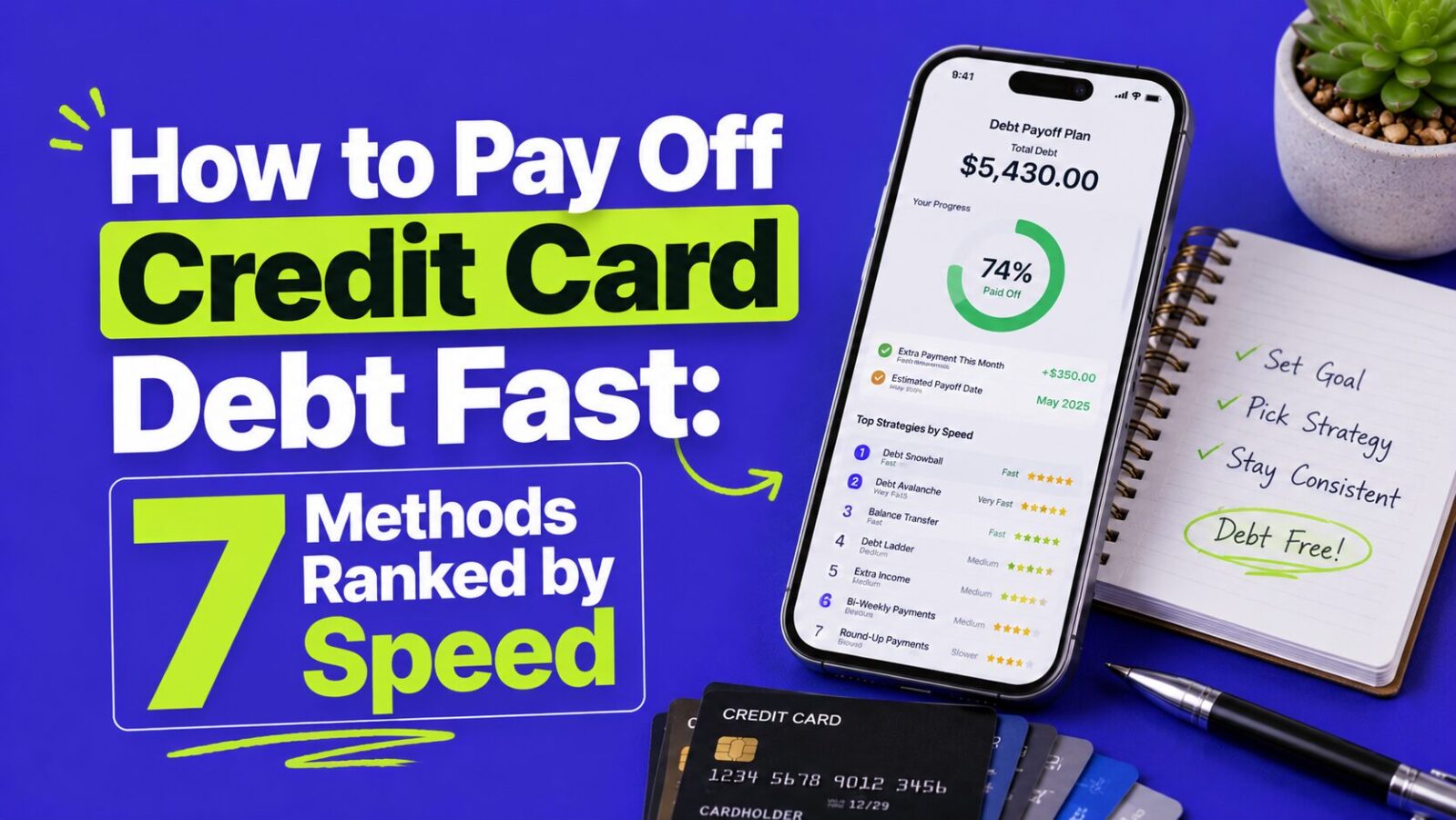
The fastest way to pay off credit card debt is to put the maximum possible amount toward the balance each month while cutting your interest rate, usually with a 0% balance transfer or a lower-rate consolidation loan. At a roughly 21.5% average APR, credit card debt is the most expensive common debt in America, so every month you carry a balance, interest eats into your payment. Here are seven methods ranked by how quickly they get you to $0.
Key Takeaways
- Cut the rate and maximize the payment; that combination, not any trick, is what works.
- 0% balance transfers are fastest for moderate balances if you finish before the promo ends.
- A consolidation loan is fastest for large balances by replacing 21.5% with a lower fixed rate.
- Extra income aimed entirely at one card is the single most powerful accelerator.
Balance Transfer to a 0% APR Card
Best for: $3,000 to $15,000 in card debt with a 670+ score. A 0% balance transfer temporarily removes interest, so every dollar hits the principal. On $8,000 at 21.5% paying $400 a month, you would pay about $1,640 in interest over 24 months; transfer to a 0% card for 18 months with a 3% fee ($240) and you clear it paying only that fee. Current options include the Citi Double Cash, Wells Fargo Reflect, and Discover it Balance Transfer (promo lengths run roughly 18 to 21 months with about a 3% fee, and terms change, so verify before applying). The risk: any balance left when the 0% period ends converts to the regular APR (often 18% to 28%), so only use this if you will finish in time. See our guide on whether consolidation hurts your credit.
Debt Consolidation Personal Loan
Best for: $10,000+ across multiple cards with a 670+ score. A personal loan at roughly 10% to 14% replaces several 21.5% balances with one fixed payment, sending more of each dollar to principal. On $20,000 at 21.5% paying $600 a month, payoff takes about 50 months and $9,800 in interest; the same payment on a 12% loan finishes in about 40 months and around $3,800 in interest.
Debt Avalanche
Best for: multiple debts and a disciplined payer. Pay minimums on everything, then put every extra dollar on the highest-rate card. When it is gone, roll its full payment to the next-highest rate. This kills the most expensive debt first and gives the fastest total payoff and least interest of any do-it-yourself method.
Debt Snowball
Best for: multiple debts and anyone who needs quick wins. Pay minimums on everything, then attack the smallest balance first. Research shows higher completion rates than the avalanche because clearing whole accounts builds momentum. It costs slightly more interest, but more people actually finish.
Estimate Your Payoff
Use this calculator to see your payoff time and total interest at different payment levels:
Credit Card Payoff Calculator
Increase Income Specifically for Debt
Best for: anyone who can earn extra and commit it entirely to debt. An extra $500 a month aimed only at payoff can cut a 4-year timeline to under 2 years for many moderate balances, because it adds money rather than rearranging it. The key word is entirely: extra income that lands in a general spending pool does nothing predictable, while income with a specific job (kill the Visa) works because it is directed before it can be spent.
Negotiate a Lower Interest Rate
Best for: anyone with a year-plus of decent payment history. Call and ask for a lower rate; it works more often than people expect, because banks want to keep reliable customers. A simple script: “I have been a customer for [X] years and always paid on time. I am working to pay down my balance and looking at lower-rate cards. Is there anything you can do to lower my rate?” Surveys have found most cardholders who ask receive a reduction, often several percentage points, and on a $5,000 balance a 6-point cut saves about $300 a year with no other changes.
Lump Sum Payments When Available
Best for: anyone getting a windfall. A tax refund, bonus, inheritance, or sale proceeds applied straight to your highest-rate debt immediately shrinks the interest-generating principal. A $3,000 refund on an $8,000 balance at 21.5% does not just erase $3,000; it saves roughly $645 in future interest. The temptation to spend a windfall is real, but paying down a 21.5% balance is one of the highest guaranteed returns available.
What Does NOT Work?
- Minimum payments only. On $8,000 at 21.5%, minimums take over 30 years and cost more than the original balance. They keep you in debt by design.
- Debt settlement when you can pay. It damages your credit for 7 years and can create a tax bill, so it fits only when you cannot afford minimums and the alternative is bankruptcy.
- Cash advances to pay debt. Cash advance APRs run about 25% to 29% with no grace period, moving debt from bad to worse.
FAQ
What is the fastest way to pay off credit card debt?
Lower your interest rate and maximize your payment. For moderate balances, a 0% balance transfer is fastest; for large balances, a lower-rate consolidation loan. Both work only if you keep payments high and avoid new charges.
Is the debt avalanche or snowball faster?
The avalanche pays off fastest and cheapest overall by targeting the highest rate first. The snowball is slightly costlier but has higher completion rates because clearing small balances builds momentum.
Does asking for a lower interest rate actually work?
Often, yes. Most cardholders with good payment history who ask receive a reduction. It costs nothing to call, and even a few points off saves real money on a carried balance.
Why won’t minimum payments get me out of debt?
Because most of each minimum goes to interest at 21.5%. On an $8,000 balance, minimums can take over 30 years and cost more than you originally borrowed.
Bottom Line
To pay off credit card debt fast, cut your rate with a 0% transfer or consolidation loan, throw the maximum at the balance, and aim any extra income or windfalls entirely at your highest-rate card. Avoid the traps (minimums only, cash advances, premature settlement), and pick avalanche for speed or snowball for motivation. To go deeper, see our guides on whether consolidation hurts your credit, how much credit card debt is too much, and credit utilization.
This article is for educational and informational purposes only and is not financial advice. Card rates and balance transfer terms change frequently, so confirm current offers with the issuer.