By
By 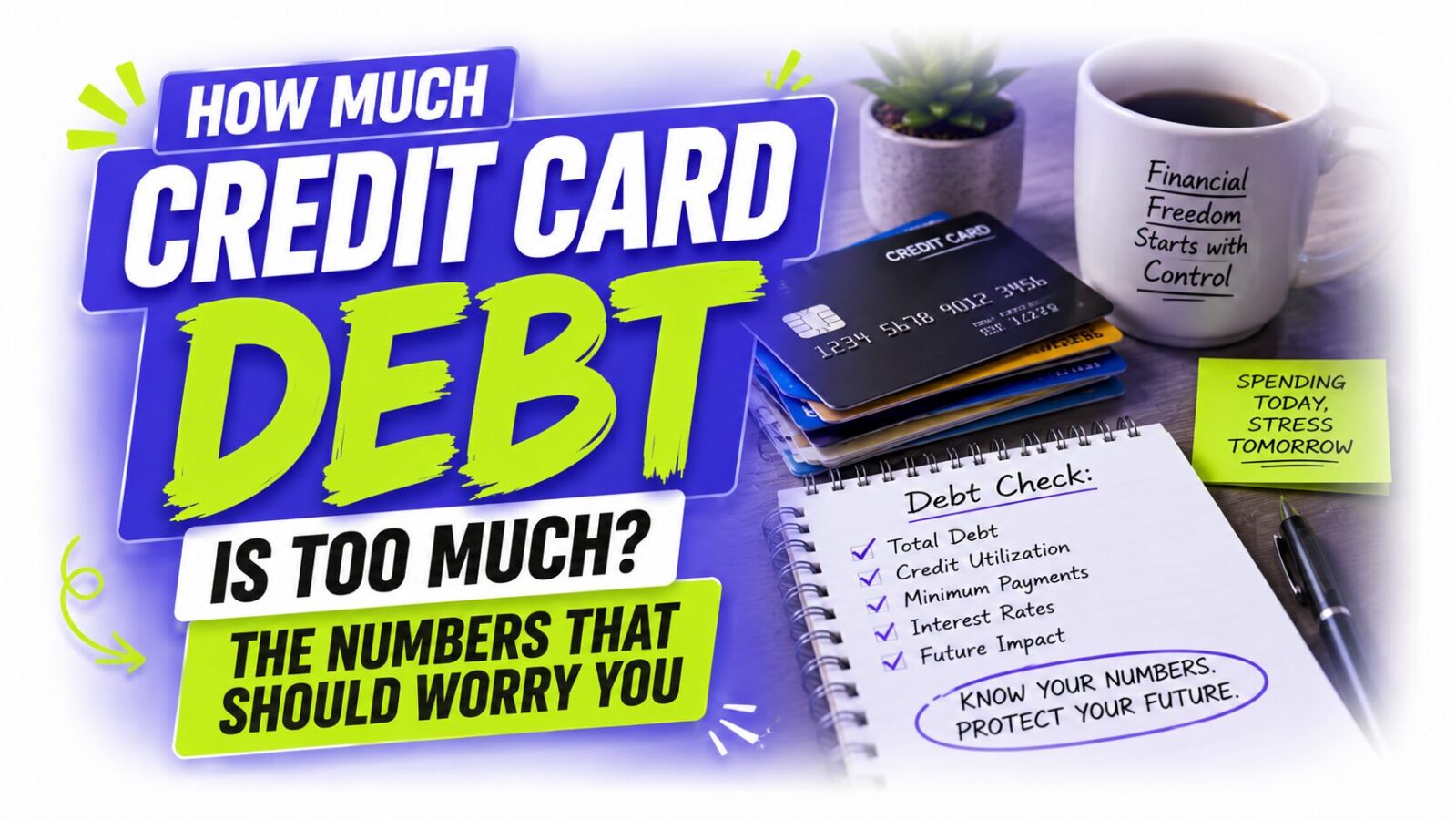
There is no single dollar figure that defines “too much” credit card debt. What matters is how it compares to your income and credit limits, whether you can pay more than the minimum, and whether it is growing or shrinking. The clearest warning signs: utilization over 30%, minimum payments above 10% of your income, and a balance that is higher today than six months ago. Here are the benchmarks that actually matter.
Key Takeaways
- Utilization over 30% of your total limits signals you are carrying too much relative to your credit.
- Minimum payments over 10% of gross income put you in a danger zone.
- A balance growing despite payments is the clearest red flag of a structural problem.
- The fix depends on severity, from aggressive payoff to consolidation to credit counseling.
What Three Ratios Define “Too Much”?
Credit utilization (affects your score). This is your total balances divided by your total limits; $3,000 on a $10,000 limit is 30%. Under 10% is excellent, 10% to 30% is good, 30% to 50% starts to hurt your score, over 50% is significantly damaging, and over 90% signals distress to lenders. If your combined balances exceed 30% of your limits, you are carrying too much relative to your available credit. See our guide on credit utilization.
Minimum payments as a share of income. If your total card minimums exceed 10% of gross monthly income, you are in a danger zone. Earning $4,000 a month with minimums over $400 means too much debt for your income, and at minimums only the payoff takes decades.
The 12-month test. Could you pay off your entire balance in 12 months if you focused aggressively? If no, the debt is meaningfully constraining your life. If yes but you are not doing it, it is a priorities question. If you cannot even keep up with minimums, the situation needs immediate action.
What Are the Real Warning Signs?
Regardless of the dollar amount, these behaviors mean you have crossed into problem territory:
- Making only minimum payments and never paying extra.
- Using one card to pay another as a habit, not a one-time strategy.
- Carrying a balance while still adding new purchases to the same card.
- Not knowing each card’s balance without checking.
- Feeling anxious when you check a balance.
- A balance that is higher today than six months ago despite payments.
That last one is the clearest signal: if your balance grows despite payments, interest is outpacing what you pay, and you are moving backward.
How Do You Check If Your Debt Is Growing?
Pull your statement from six months ago and compare that balance to today’s. If it is higher despite six months of payments, you have a structural problem: you are charging more than you pay off. No budgeting trick fixes a structural deficit; the spending level itself has to change. See our guide on paying off debt on a low income.
What Is the Average Credit Card Debt by Age?
| Age group | Average balance | Average APR |
|---|---|---|
| 18-29 | ~$2,800 | ~22% |
| 30-39 | ~$5,800 | ~22% |
| 40-49 | ~$8,100 | ~21% |
| 50-59 | ~$8,900 | ~21% |
| 60+ | ~$6,200 | ~20% |
These averages include people with $0 balances, so among households that actually carry a balance the figure is higher. Being “average” is not safe when the average includes 30-year payoff timelines at minimum payments.
What Should You Do Once You Know It’s Too Much?
The answer depends on severity:
- Utilization over 30% but payments manageable: an aggressive payoff plan targeting the highest-rate balance first.
- Cannot afford more than minimums: consolidate to a lower rate or move balances to a 0% APR card.
- Balance growing despite payments: an emergency budget reset before any payoff strategy makes sense.
- Cannot afford minimums: contact your issuer about hardship programs, use nonprofit credit counseling, or evaluate bankruptcy.
Estimate Your Payoff
Use this calculator to see how long your balance will take to clear and what the interest costs:
Credit Card Payoff Calculator
FAQ
How much credit card debt is too much?
There is no fixed dollar amount. The red flags are utilization over 30% of your limits, minimum payments over 10% of gross income, and a balance that keeps growing despite payments.
What credit utilization is considered bad?
Over 30% starts to hurt your score, over 50% is significantly damaging, and over 90% signals financial distress. Under 10% is ideal for your credit score.
Is average credit card debt a safe amount?
Not necessarily. Averages include people carrying balances for decades at minimum payments, so matching the average can still mean you are in a costly, slow-payoff situation.
What should I do if my balance keeps growing?
Stop the bleeding first with a budget reset, since interest is outpacing your payments. Then attack the highest-rate balance, and consider consolidation, a 0% transfer, or credit counseling.
Bottom Line
Credit card debt is “too much” when utilization tops 30%, minimums exceed 10% of your income, or your balance grows despite payments, not at any single dollar figure. Check whether your balance is shrinking or growing, attack the highest-rate debt, and escalate to consolidation or counseling if minimums are a struggle. To go deeper, see our guides on credit utilization, improving your score fast, and paying off debt on a low income.
This article is for educational and informational purposes only and is not financial advice. Average figures are estimates and vary by source, and your situation is individual. Confirm current rates and options with your card issuer.