By
By 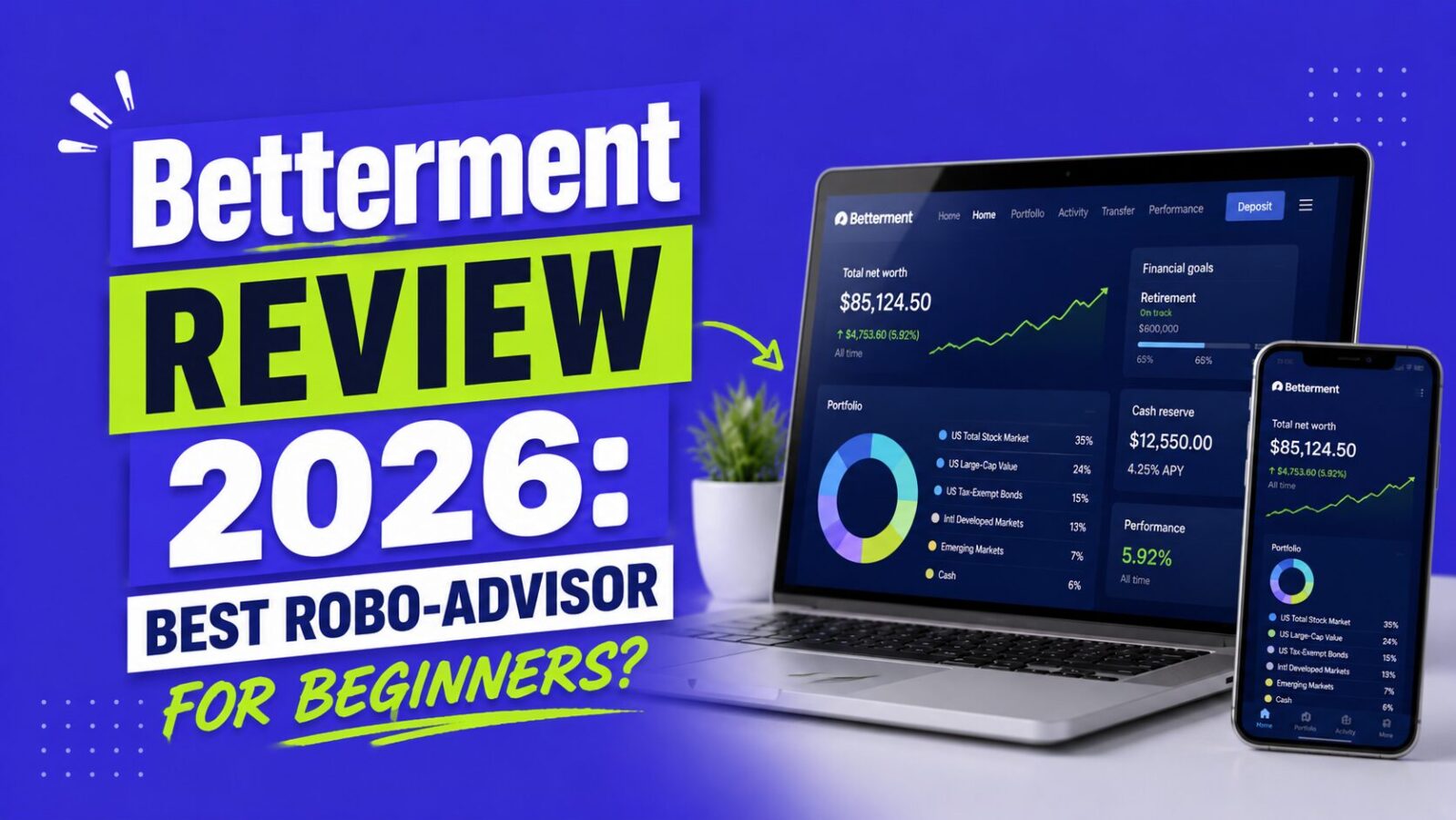
- $0 minimum to start
- Daily tax-loss harvesting included
- CFP access on Premium plan
- Goal-based sub-portfolios
- 0.25% fee adds up at scale
- No direct indexing under $100K
- No 529 college savings plans
- Premium plan requires $100K
- Betterment Digital charges 0.25% per year with no minimum balance. Your all-in cost (fee + ETF expenses) is roughly 0.28 to 0.40%.
- Tax-loss harvesting is included free on all taxable accounts and can offset or exceed the 0.25% fee for investors in higher tax brackets.
- Betterment is ideal for investors who want full automation with no decisions. It is not ideal for DIY investors or those who want to pick their own funds.
- For retirement-only accounts, a target-date fund at 0.08 to 0.12% does the same job at lower cost. Betterment adds the most value in taxable accounts.
- The $100K Premium plan adds unlimited Certified Financial Planner access — worth considering if you have complex financial questions.
If you have been thinking about investing but the idea of picking individual stocks makes you want to crawl under a weighted blanket, a robo-advisor might be exactly what you need. And when people talk about robo-advisors, Betterment is usually the first name that comes up.
Betterment launched in 2010 and essentially invented the modern robo-advisor category. Since then, it has grown to manage over $40 billion in assets and attracted hundreds of thousands of investors who would rather let algorithms do the heavy lifting than spend their weekends analyzing earnings reports.
But is Betterment actually worth it in 2026, or have competitors caught up? Here is everything you need to know.
How Betterment Works
At its core, Betterment is an automated investment platform that builds and manages a diversified portfolio on your behalf. You answer a few questions about your goals, timeline, and risk tolerance, and the platform creates a portfolio tailored to your situation using Modern Portfolio Theory.
- Sign up and answer questions about your financial goals and risk tolerance
- Betterment builds a portfolio using low-cost ETFs from Vanguard and iShares
- Deposit money via bank transfer, direct deposit, or rollover
- Betterment manages everything — rebalancing, dividend reinvestment, and tax optimization
- Adjust as needed by changing goals or risk levels at any time
There is no minimum balance requirement for the Digital plan, which makes Betterment accessible even if you are just starting out with a few hundred dollars.
Account Types Available
| Account Type | Details |
|---|---|
| Individual Taxable | Standard brokerage account for general investing |
| Traditional IRA | Tax-deductible contributions, taxed on withdrawal |
| Roth IRA | After-tax contributions, tax-free growth and withdrawals |
| SEP IRA | For self-employed individuals and small business owners |
| Joint Account | Shared taxable account for couples |
| Trust Account | For investing through a trust |
| Cash Reserve | High-yield cash management, 4%+ APY, FDIC-insured up to $2M |
| Checking | No-fee checking with ATM reimbursements |
The ability to manage multiple account types under one dashboard is genuinely convenient. You can see your Roth IRA, taxable account, and emergency fund in one place.
Betterment’s Fee Structure
Digital Plan: 0.25% Annual Fee
The Digital plan charges a 0.25% annual management fee on your total balance. That means if you have $10,000 invested, you pay about $25 per year. On $100,000, you pay $250 annually. This fee is in addition to the underlying ETF expense ratios (typically 0.03 to 0.15%), making your all-in cost roughly 0.28 to 0.40%.
Premium Plan: 0.65% Annual Fee
The Premium plan costs 0.65% annually and requires a minimum balance of $100,000. The key addition is unlimited access to Certified Financial Planners (CFPs) via phone or video call. A standalone CFP might charge $200 to $400 per hour, so the math can work in your favor if you use the service regularly for complex questions.
Fee Comparison
| Platform | Annual Fee | Minimum |
|---|---|---|
| Betterment Digital | 0.25% | $0 |
| Betterment Premium | 0.65% | $100,000 |
| Wealthfront | 0.25% | $500 |
| Schwab Intelligent Portfolios | $0 | $5,000 |
| Vanguard Digital Advisor | ~0.20% | $3,000 |
| Fidelity Go | $0 (under $25K) | $10 |
Schwab’s zero-fee option looks attractive, but Schwab holds 6 to 10% of your portfolio in low-yield cash, creating a drag on long-term returns. There is no free lunch.
Portfolio Construction
Betterment builds portfolios using low-cost ETFs from Vanguard, iShares (BlackRock), and Goldman Sachs. Your portfolio gets divided between stocks and bonds based on your risk profile.
Stock allocation typically includes: US Total Stock Market (VTI or similar), US Value Stocks, International Developed Markets (VEA), and Emerging Markets (VWO).
Bond allocation typically includes: US Investment-Grade Bonds, US Municipal Bonds (in taxable accounts for tax efficiency), International Bonds, Short-Term Treasuries, and TIPS.
Betterment automatically adjusts your stock-to-bond ratio as you approach your goal date. The underlying ETFs typically carry expense ratios of 0.03 to 0.07% — far cheaper than actively managed funds at 0.50 to 1.00%.
Tax-Loss Harvesting
One of Betterment’s standout features is automatic tax-loss harvesting, included at no extra cost on all taxable accounts.
When an investment drops in value, Betterment sells it to realize a tax loss and immediately replaces it with a similar (but not identical) investment to maintain your portfolio’s risk profile. That harvested loss can offset capital gains or up to $3,000 in ordinary income per year, with unused losses carrying forward indefinitely.
Betterment claims this strategy can add roughly 0.77% in after-tax returns annually, though actual results vary. The platform checks for opportunities daily and handles all wash-sale rule complexity automatically. For investors in the 22%+ tax bracket with taxable accounts, this alone can more than cover the 0.25% fee.
Tax-Coordinated Portfolios
If you have both taxable and tax-advantaged accounts at Betterment, the platform offers tax coordination (asset location). Betterment might hold bonds (which generate ordinary income) in your IRA while keeping stocks (benefiting from lower capital gains rates) in your taxable account. According to Betterment’s research, proper asset location can boost after-tax returns by an additional 0.10 to 0.50% per year — handled automatically.
Goal-Based Investing
Unlike platforms that give you a single portfolio, Betterment takes a goal-based approach. You can set up multiple goals — each with its own timeline, risk level, and target amount:
- Retirement with projected income needs and an age-based glide path
- Emergency fund with a conservative allocation
- Major purchase such as a house down payment in 3 to 5 years
- General wealth building for long-term growth
Each goal gets its own sub-portfolio with an appropriate allocation. Your retirement goal 30 years out might be 90% stocks, while your house down payment goal in three years is much more conservative.
Cash Reserve Account
Betterment’s Cash Reserve account currently offers an APY over 4%, well above the national average for savings accounts. It is FDIC-insured up to $2 million through a sweep program across partner banks. No fees, no minimum, unlimited transfers. For anyone already investing through Betterment, this is a strong place to keep an emergency fund under one dashboard.
Socially Responsible Investing
Betterment offers three SRI portfolio options: a Broad Impact portfolio (general ESG), a Climate Impact portfolio (climate solutions companies), and a Social Impact portfolio (gender and racial diversity focus). These use ESG-focused ETFs with slightly higher expense ratios than the core portfolio.
Crypto Portfolios
Betterment offers crypto portfolios for investors who want digital asset exposure, allocating between 5% and 50% of a dedicated crypto goal to a basket of cryptocurrencies. The crypto portfolio carries an additional annual fee and the holdings are not SIPC-insured. For new investors, establish your core portfolio foundation before exploring this option.
Betterment vs Wealthfront
| Feature | Betterment | Wealthfront |
|---|---|---|
| Minimum | $0 | $500 |
| Annual fee | 0.25% | 0.25% |
| Human advisor access | Yes (Premium, $100K+) | No |
| Tax-loss harvesting | Daily | Daily |
| Direct indexing | No | Yes ($100K+) |
| Financial planning tools | Goal tracking | Advanced (Path) |
| 529 plans | No | Yes |
| Crypto | Yes | No |
Wealthfront wins on tax optimization for accounts over $100,000 thanks to direct indexing and stock-level tax-loss harvesting. Betterment wins on flexibility — $0 minimum, CFP access, wider account types, and a more approachable interface for beginners.
Betterment vs Schwab Intelligent Portfolios
Schwab charges no management fee and has automatic rebalancing and tax-loss harvesting. But it requires $5,000 to start and holds 6 to 10% of your portfolio in cash (in Schwab’s bank sweep account earning low interest). That cash drag costs roughly 0.10 to 0.20% per year in opportunity cost, making the “free” fee comparable to Betterment’s 0.25% once you account for it. For smaller portfolios, Betterment’s fully-invested approach is a genuine advantage.
Who Is Betterment Best For?
Betterment is an excellent fit for: beginner investors who want a hands-off approach with no minimum, goal-oriented savers who want multiple sub-portfolios for different objectives, investors who value simplicity over control, and tax-conscious investors with taxable accounts who benefit from automated tax-loss harvesting.
Betterment may not be the best choice for: active traders who want individual stock selection, high-balance investors focused primarily on tax efficiency (Wealthfront’s direct indexing is better above $100K), DIY investors comfortable managing their own 3-fund portfolio, and investors whose money is 100% in retirement accounts (a target-date fund at 0.08% does the same job cheaper).
Pros and Cons
- $0 minimum on Digital plan
- Daily tax-loss harvesting, free
- Multiple goal sub-portfolios
- CFP access on Premium
- 4%+ APY Cash Reserve
- Clean, beginner-friendly app
- Tax coordination across accounts
- SRI and crypto options
- 0.25% fee vs free alternatives
- No direct indexing under $100K
- Premium requires $100K minimum
- No 529 college savings plans
- No individual stock selection
- Crypto carries extra fees
Is Betterment Right for You?
Use the quick quiz to get a personalized take:
Is Betterment Right for Me?
Answer 3 quick questions for a personalized take.
Step 1: How do you prefer to manage investments?
Frequently Asked Questions
Is Betterment safe?
Yes. Betterment is a registered investment adviser regulated by the SEC. Investment accounts are protected by SIPC up to $500,000 (including $250,000 for cash). The Cash Reserve account is FDIC-insured up to $2 million through sweep accounts at partner banks. Betterment holds client assets with third-party custodians, meaning your investments are not at risk if Betterment itself goes out of business.
Can I lose money with Betterment?
Yes. Betterment invests in stocks and bonds, which can decline in value. Betterment does not protect you from market losses — it manages your portfolio to match your risk tolerance, but market risk is inherent in investing. During the 2022 bear market, even conservative Betterment portfolios lost value. The key is maintaining your allocation through downturns rather than switching to cash at the bottom.
How does Betterment make money?
Betterment earns revenue from the 0.25% annual management fee (or 0.65% on Premium). They may also earn revenue from the Cash Reserve and Checking products through their banking relationships. Betterment does not earn commissions on the ETFs it buys for your portfolio — those ETF providers pay Betterment nothing. The fee structure is transparent and straightforward.
Can I withdraw from Betterment at any time?
Yes for taxable accounts — no restrictions, funds arrive in 3 to 5 business days after selling. Retirement accounts (IRA) follow standard IRS rules: withdrawals before age 59.5 may incur a 10% penalty and income tax on pre-tax contributions. Roth IRA contributions (not earnings) can be withdrawn at any time penalty-free. The Cash Reserve account has no withdrawal restrictions.
Does Betterment have a mobile app?
Yes. Betterment has a highly rated iOS and Android app. You can view your portfolio, adjust goals, deposit money, and change your risk level from the app. The mobile experience is consistently praised as one of the cleanest in the robo-advisor space — significantly more polished than legacy brokerages like Vanguard.
How does Betterment compare to a target-date fund?
A target-date fund (like Vanguard 2060 at 0.08%) is simpler and cheaper for retirement accounts. It auto-rebalances and shifts allocation as you age with zero ongoing management. Betterment adds value beyond a target-date fund primarily through: (1) tax-loss harvesting in taxable accounts, (2) tax coordination across multiple account types, (3) goal-based sub-portfolios for non-retirement goals, and (4) CFP access on Premium. If all your money is in a 401(k) or IRA, the target-date fund wins on cost.
Can I transfer my Betterment account to another brokerage?
Yes. You can initiate an ACATS transfer to move your Betterment account to another brokerage. Betterment will transfer your ETF holdings in-kind (without selling) if the receiving brokerage supports those ETFs. If you move to a brokerage that does not support the specific ETFs, they will be sold and the cash transferred — potentially triggering capital gains taxes in a taxable account. Transfers typically take 5 to 10 business days.
Is Betterment worth it for a small account (under $1,000)?
Yes, arguably more so than for large accounts. At $1,000, the 0.25% fee is $2.50 per year — essentially nothing. You get full tax-loss harvesting, automatic rebalancing, goal tracking, and a beginner-friendly interface for $2.50 annually. The fee becomes more worth scrutinizing at $100,000+ (where it is $250/year), not at small balances where the behavioral benefits of automation far outweigh the cost.
The Bottom Line
Betterment remains the gold standard for robo-advisor investing in 2026. The combination of no minimum balance, automatic tax optimization, goal-based investing, and a genuinely well-designed app makes it easy to start and easy to stick with.
The 0.25% fee is reasonable for what you get — especially when tax-loss harvesting can offset or exceed it for investors with taxable accounts. For beginners who want a smart, simple, automated way to grow their money without becoming an investing expert, Betterment is still the first recommendation.
For experienced DIY investors, a 3-fund portfolio at Fidelity or Vanguard will always be cheaper. For high-balance investors focused purely on tax efficiency, Wealthfront’s direct indexing has an edge. But for the vast majority of people who want to invest consistently without thinking about it, Betterment delivers exactly what it promises.
Compare your options:
- See all robo-advisors side by side: Read our best robo-advisors comparison.
- Want to DIY instead? Read our 3-fund portfolio guide for the self-managed alternative.
- Want full automation at lower cost? Read our target-date fund guide — best for retirement accounts specifically.