Skip to content

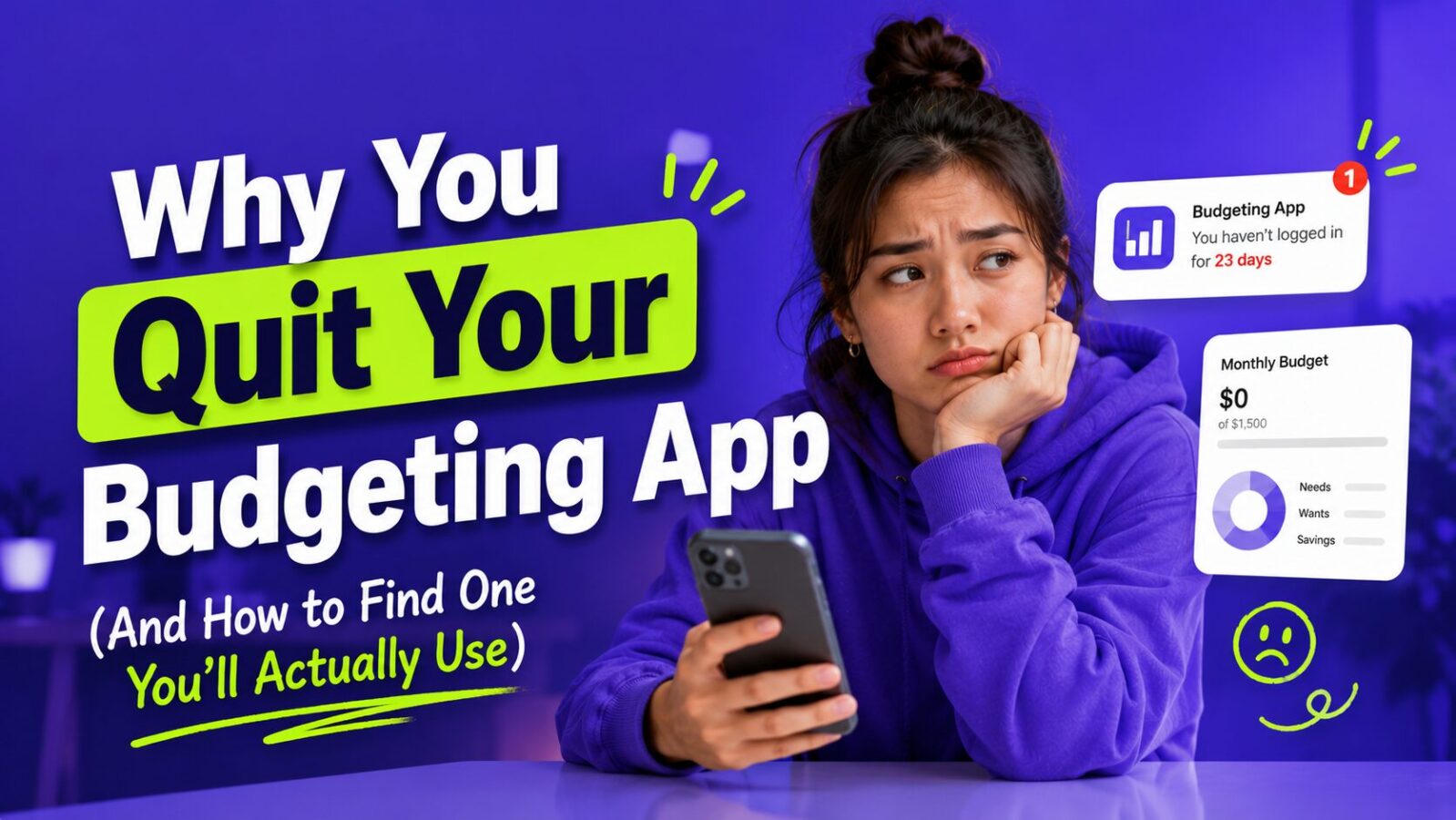
Why You Quit Your Budgeting App (And How to Find One You’ll Actually Use)

Why You Quit Your Budgeting App (And How to Find One You'll Actually Use)

If you have downloaded a budgeting app, used it for a few weeks, and then quietly stopped opening it, you are in the overwhelming majority. Most people who try personal finance apps abandon them within the first month. The apps sit on the home screen for a while, then get moved to a folder, then disappear during the next phone cleanup.

This is not a willpower problem. It is a design and psychology problem. A peer-reviewed study of 208 real Mint app users explains exactly why it happens, and what predicts whether someone actually sticks with a budgeting app long term.

The research, which analyzed how gamification features affect users’ motivation and intention to keep using personal financial management apps, found that the apps people continue using are not necessarily the ones with the most features. They are the ones that make users feel competent and in control. When an app satisfies those two psychological needs, users develop genuine intrinsic motivation to open it. When it does not, the app becomes another obligation people avoid.

What the Research Shows

  • Budgeting apps that make users feel competent and in control build intrinsic motivation to keep using them
  • Motivated users find the app easier to use and more useful, not the other way around
  • A positive attitude toward the app is the strongest predictor of continued use (path coefficient: 0.602)
  • Frequency of use predicts continued use more strongly than demographics, gender, or age
  • Features that drive competence: progress tracking, goal completion, real-time feedback
  • Features that drive autonomy: customizable budgets, personalized categories, user-set goals

The Real Reason You Stopped Using Your Budget App

Most people assume they abandoned their budgeting app because they were too busy, too undisciplined, or because tracking every purchase felt tedious. Those reasons are real, but they are symptoms of a deeper issue: the app never built the psychological foundation that makes sustained use feel worth it.

Self-determination theory, one of the leading frameworks in motivation research, proposes that people develop genuine, lasting motivation for an activity when two core psychological needs are satisfied: the need for competence (feeling skilled and effective at what you are doing) and the need for autonomy (feeling free and self-directed rather than monitored or constrained).

The study, which surveyed 208 users of the Mint app and tested a structural model combining self-determination theory and the technology acceptance model, found that gamification features in the app directly satisfied both needs. Interactions with features like budget setting, expense tracking, alerts, and credit score monitoring predicted stronger feelings of competence (standardized path coefficient: 0.562) and autonomy (0.522) among users. Both results were statistically significant at p less than 0.001.

Here is why this matters practically: when you open a budgeting app and see a progress bar showing you are 68% of the way to your savings goal, your brain registers a sense of competence. When you customize your spending categories to reflect your actual life rather than a generic template, your brain registers autonomy. These are not trivial user experience details. They are the psychological mechanisms that determine whether using the app feels engaging or oppressive.

The Motivation Loop: Why Some Apps Get Stickier Over Time

The research revealed a clear chain of causation that explains why some users develop lasting habits with finance apps while others abandon them quickly.

When gamification features satisfy users’ needs for competence and autonomy, those users develop what the research calls autonomous motivation: the kind of motivation that comes from genuinely wanting to do something rather than feeling pressured to do it. Competence satisfaction predicted autonomous motivation with a coefficient of 0.463. Autonomy satisfaction contributed an additional 0.321.

Autonomous motivation then changes how users perceive the app itself. Users who were intrinsically motivated rated the app as significantly easier to use (coefficient: 0.538) and more useful (0.330). This finding is counterintuitive but important: it is not that an easy-to-use app creates motivation. It is that motivation makes the app feel easier. The experience of the app is shaped by the psychological state you bring to it.

Perceived ease of use and usefulness then combine to create a favorable attitude toward the app. That favorable attitude is the strongest predictor of actually continuing to use it, with a path coefficient of 0.602. This is the complete loop: features that satisfy psychological needs create motivation, motivation improves perceived ease and usefulness, and those perceptions build the attitude that drives continued behavior.

The practical implication: if an app feels hard to use or pointless, the problem may not be the app’s interface. It may be that the app has not yet given you a reason to feel competent or in control. That is a solvable problem with the right setup.

Interactive Quiz

Why Did YOUR Budget App Fail?

Answer 6 questions to identify the real psychological reason you stopped using a budgeting app, and what to look for next.

The Six Features That Actually Predict Whether You Will Keep Using an App

The research identified the specific gamification features within Mint that drove competence and autonomy satisfaction. They map directly to what to look for when evaluating any budgeting app.

1. Goal Setting With Personal Relevance

Apps that let you set specific savings goals tied to things you actually care about (a vacation fund, a down payment, an emergency cushion) create the sense of purpose that drives competence. The goal has to be yours, not a generic savings category the app provides by default. Users who could set and pursue personal financial challenges in the app felt more competent and autonomous as a result.

2. Real-Time Progress Visualization

Progress bars, spending charts, and goal trackers serve a specific psychological function: they show you that your actions are working. The research identified tracking as one of the strongest motivational features in the Mint app (factor loading: 0.768). Seeing a progress bar at 73% toward your savings goal communicates competence more powerfully than any dollar figure alone.

3. Alerts Framed as Information, Not Surveillance

The difference between a helpful alert and a scolding one is framing. An alert saying “you are 80% through your dining budget with two weeks left in the month” gives you information to act on. An alert saying “you overspent in dining again” assigns blame. Alerts satisfied competence needs when they gave users purposeful information about progress, not just records of failure.

4. Customizable Budget Categories

Generic budget categories are one of the most common reasons people abandon apps. Your actual spending does not map neatly onto “Entertainment” and “Personal Care”, it maps onto your life. Apps that let you create, rename, and organize categories to match your reality satisfy the autonomy need that drives intrinsic motivation.

5. Automatic Bank and Account Linking

The research explicitly notes that apps linked directly to bank accounts and credit cards are perceived as significantly easier to use and more useful than manual-entry apps. Manual data entry is a friction point that breaks the habit loop before it forms. If your app requires logging every purchase manually, the effort will always compete against the psychological benefit.

6. Positive Feedback for Achievements

Badges, achievement notifications, credit score improvements, or even a green checkmark when a budget category is on track all serve the same function: they communicate that you have accomplished something (competence) and chose to do it (autonomy). Even simple positive recognition creates the feedback loop that makes the next check-in feel worthwhile.

Why “Easiest App to Use” Is the Wrong Question

The most common approach to choosing a budgeting app is finding the one with the cleanest interface or the least friction. The research suggests this gets the causality backwards.

The study found that users who were autonomously motivated to use the app perceived it as easier to use, not the other way around. Motivation precedes the perception of ease. An app that feels hard to use may feel that way because you have not yet developed the intrinsic motivation to engage with it, not because the interface is objectively difficult.

The right question is not “which app is easiest to use?” It is “which app is most likely to make me feel competent and in control?” That is the app that will get easier over time as motivation builds.

Why Frequency of Use Matters More Than Feature Count

The research tested whether demographic factors like age and gender predicted continued app use. They did not. What did predict continued use, with a coefficient of 0.416, was frequency of use itself.

This confirms what behavioral psychology has long shown: habits form through repetition, and past behavior is the best predictor of future behavior. In the first 30 days of using a budgeting app, the goal is not to track every transaction perfectly. It is to build a regular check-in habit that makes the app part of your financial routine.

Four strategies that build frequency:

  • Enable push notifications for weekly spending summaries rather than turning all alerts off
  • Set a recurring calendar reminder for a five-minute weekly financial check-in
  • Attach the app check-in to an existing habit, such as reviewing it every Sunday morning
  • Start with a single goal rather than a complete budget, so the first sessions feel manageable

Our automatic savings guide covers how to build financial habits through systems rather than willpower, which pairs naturally with the habit-formation approach above.

How to Start Over With a Budgeting App (And Actually Stick This Time)

If you have abandoned budgeting apps before, the mistake was probably not choosing the wrong app. It was setting up a complete budget on day one, immediately seeing every category where spending exceeded an arbitrary limit, and associating the app with financial anxiety instead of financial competence.

A different approach based on what the research shows:

  1. Start with one goal that genuinely matters to you. Not “spend less” but something specific: save $2,000 for a trip, build a $5,000 emergency fund, pay off one credit card. A personally meaningful goal creates the competence signal that keeps you coming back.
  2. Set up automatic bank and card syncing on day one. Remove the manual entry barrier entirely. If every transaction shows up automatically, checking the app requires no effort.
  3. Customize at least three categories to match your actual life. This one action moves the app from generic to yours, which is the autonomy signal the research identifies as essential.
  4. Focus on the habit in weeks one and two. Check the app every day for two weeks, even if only for 60 seconds. Frequency of use is the variable that predicts continued use most strongly. The habit is the win, not the budget.
  5. Set up at least one alert that tells you something positive. A “you are on track for your goal” notification at the end of a week is more motivating than a weekly summary of overspending.

For a full review of the top budgeting apps in 2026, see our YNAB review. If you want a broader framework for managing money before picking an app, our 50/30/20 budget guide covers the foundational structure first.

Frequently Asked Questions

Why do most people stop using budgeting apps?

Research on 208 Mint app users identifies two core psychological causes. First, apps that highlight overspending and failures undermine the sense of competence that drives continued use. Second, apps with generic categories and goals fail to satisfy users’ need for autonomy. When an app does not make you feel skilled and self-directed, using it feels like an external obligation rather than something you choose, and it gets abandoned. Manual data entry requirements compound the problem by adding practical friction on top of the psychological barrier.

What makes a budgeting app actually work long term?

The research found a clear chain: gamification features (progress tracking, goal setting, personalized budgets, alerts) satisfy users’ psychological needs for competence and autonomy. Those needs drive autonomous motivation. That motivation makes the app feel easier to use and more useful. And a positive attitude toward the app, which develops through this chain, is the strongest predictor of continued use (path coefficient: 0.602). Apps that skip any step in this chain tend to get abandoned.

How long does it take to build a budgeting habit?

General habit formation research suggests 60 to 90 days for consistent behaviors to become automatic. For budgeting apps specifically, frequency of use is the most predictive variable for continued use. The practical target: make opening the app a daily or every-other-day behavior for the first two weeks, regardless of how long each session is. The habit itself is what you are building, not the perfect budget.

Is YNAB worth the subscription cost?

YNAB’s zero-based budgeting system is specifically strong on the features the research identifies as driving competence and autonomy: goal-based budgeting, granular category customization, and visual progress tracking. Whether the $14.99 monthly cost is worth it depends on how much value you place on those features versus a free alternative. Our full YNAB review breaks down the cost-benefit for different user profiles.

The Bottom Line

The reason most budgeting apps fail is not that the user lacks discipline. It is that the app never built the psychological foundation for sustained engagement. Apps that make users feel competent and in control create intrinsic motivation. Apps that highlight failures, require constant manual input, or offer generic templates instead of personalized goals do the opposite.

The research on 208 real users shows the chain clearly: the right features satisfy your need for competence and autonomy, those needs drive genuine motivation, that motivation makes the app feel easier and more useful, and a positive experience predicts continued use. Frequency of use then reinforces the habit until checking your finances feels as natural as checking your messages.

Use the diagnostic quiz above to identify why your last app failed. Then apply the five-step restart approach in this article, starting with one meaningful goal rather than a complete budget overhaul. The financial results follow from the habit, not from the sophistication of the app.


Academic Reference
“Making Finance Fun: The Gamification of Personal Financial Management Apps.” Peer-reviewed empirical study. Sample: 208 users of the Mint app. Methodology: partial least squares structural equation modelling (PLS-SEM). Theoretical framework: self-determination theory (Deci and Ryan, 2000) combined with the technology acceptance model (Davis, 1989). All structural model paths significant at p less than 0.001.

Additional supporting research cited in the study includes Bayuk and Altobello (2019) on gamification and financial motivation; Koivisto and Hamari (2019) on motivational information systems; and Ryan and Deci (2000) on intrinsic motivation and self-determination.

Savings Goal Calculator

Result

Written by

We founded Finance Pulse to cut through the noise in personal finance content. We research brokerages, credit cards, and money tools so you don't have to. Every review is independent, every recommendation is one we'd give a friend.

Leave a Reply

Your email address will not be published. Required fields are marked *