By
By 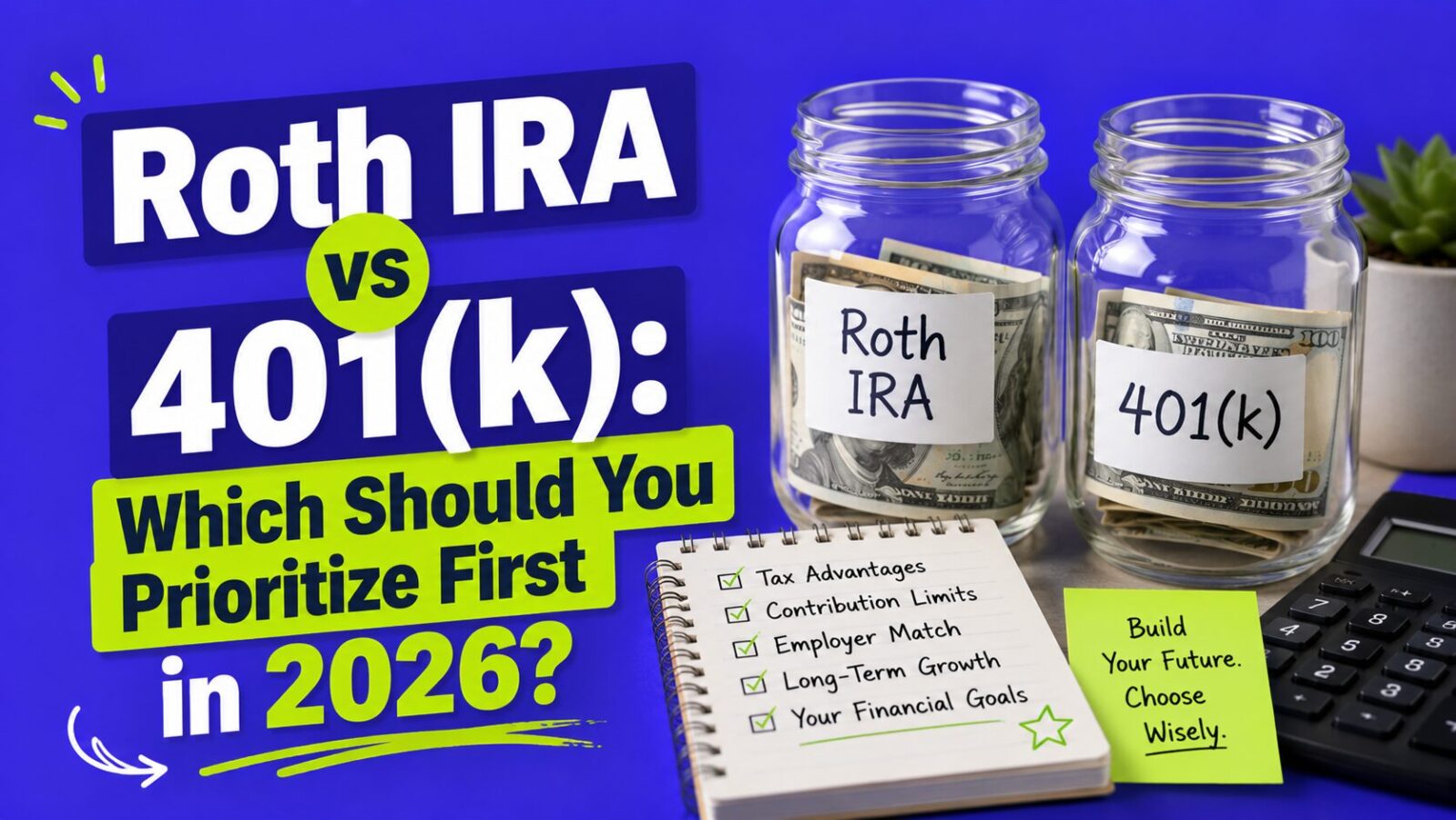
If you have limited dollars and two good options, a workplace 401(k) and a Roth IRA, the order matters. For most people in their 20s and early 30s: contribute to the 401(k) up to the employer match first, then fund a Roth IRA to the limit, then go back to the 401(k). That captures free money, then locks in tax-free growth during your low-tax years. Here is why, and when the order flips.
Key Takeaways
- 401(k) up to the match first; it is an instant 50% to 100% return.
- Then Roth IRA to the limit, for tax-free growth in your low-tax years.
- Then back to the 401(k) for the pre-tax deduction and tax-deferred growth.
- Flip toward traditional if you are in a high bracket now and expect lower in retirement.
What Are the 2026 Contribution Limits?
| 401(k) / 403(b) | Roth IRA | |
|---|---|---|
| Limit (under 50) | $24,500 | $7,000 |
| Limit (50+) | $32,500 (with catch-up) | $8,000 (with catch-up) |
| Income limit | None | Phase-out: $153K-$168K single, $242K-$252K married |
| Employer match | Yes (if offered) | No |
| Contributions | Pre-tax (reduces taxable income now) | After-tax (no deduction) |
| Retirement withdrawals | Taxed as ordinary income | Tax-free (qualified) |
| Required Minimum Distributions | Yes (age 73, rising to 75 in 2033) | None in the owner’s lifetime |
What Is the Decision Framework?
401(k) up to the employer match. Always contribute enough to capture the full match before anything else, since it is an instant 50% to 100% return that no investment can match. If your employer matches 100% up to 3%, contributing 3% puts effectively 6% into your account. If there is no match, skip straight to the Roth IRA.
Roth IRA to the $7,000 limit. After the match, a Roth IRA is the next best use of savings for most people under 40, because withdrawals in retirement are completely tax-free, there are no required distributions in your lifetime, contributions (not gains) can be withdrawn anytime as a backstop, and you are likely in your lowest lifetime tax bracket now, so paying tax now beats paying later.
Back to the 401(k) above the match. Any remaining dollars go into the 401(k) up to $24,500. The pre-tax deduction still lowers your taxable income now, and tax-deferred growth compounds powerfully over decades.
When Should You Flip the Order?
- High income now, lower expected in retirement. In the 32% or 35% bracket, the immediate deduction from pre-tax 401(k) contributions is more valuable than Roth.
- Your income exceeds the Roth limit. Above the 2026 phase-out ($153K to $168K single, $242K to $252K married), use the backdoor Roth or a Roth 401(k) if offered.
- Your employer offers a Roth 401(k). After-tax contributions that grow tax-free with no income limit, and you can use a Roth 401(k) and a Roth IRA together.
- Your 401(k) has bad funds. If plan expense ratios average above 0.50%, prioritize the Roth IRA (where you pick the investments) beyond the match.
What Is the Tax-Bracket Rule of Thumb?
When choosing between Roth and traditional: in the 10% to 22% bracket, lean Roth, since paying tax now is likely cheaper than in retirement. In the 24% to 32% bracket, split to diversify tax risk, using some Roth and some pre-tax. In the 35% to 37% bracket, lean traditional, since the immediate deduction is most valuable. See our guide on the Roth conversion decision.
Estimate Roth vs Traditional
Use this calculator to compare the two based on your tax rates and time horizon:
Roth vs Traditional IRA Calculator
What Is the Quick Answer for New Grads?
If you just started your first job with a 401(k) match: contribute enough to get the full match (often 3% to 6%), open a Roth IRA at Fidelity, Vanguard, or Schwab and fund it up to $7,000, then increase your 401(k) if you have money left. This captures free employer money, locks in tax-free growth during your lowest-tax years, and gives you tax diversification for retirement. See our guide on what to do with graduation money.
FAQ
Should I prioritize a Roth IRA or 401(k)?
Contribute to your 401(k) up to the employer match first (free money), then fund a Roth IRA to the limit, then go back to the 401(k). If there is no match, start with the Roth IRA.
What are the 2026 contribution limits?
$24,500 for a 401(k) ($32,500 at 50+) and $7,000 for a Roth IRA ($8,000 at 50+). The Roth phases out at $153K to $168K single and $242K to $252K married.
Is a Roth or traditional better for me?
Lean Roth in the 10% to 22% bracket, split in the 24% to 32% range, and lean traditional in the 35% to 37% bracket. It comes down to whether your tax rate is lower now or expected to be lower in retirement.
What if I earn too much for a Roth IRA?
Above the income limit, use the backdoor Roth (contribute to a non-deductible traditional IRA and convert) or a Roth 401(k) if your employer offers one, which has no income limit.
Bottom Line
For most people, the order is 401(k) up to the match, then Roth IRA to $7,000, then back to the 401(k), capturing free money first and tax-free growth in your low-tax years. Flip toward traditional if you are in a high bracket now, and use a backdoor or Roth 401(k) if your income is over the limit. To go deeper, see our guides on the Roth conversion decision, graduation money, and lowering your tax bill.
This article is for educational and informational purposes only and does not constitute financial or tax advice. Contribution and income limits are for 2026 and subject to change. Consult a qualified professional for personalized guidance.