Skip to content
Advertiser Disclosure: We may earn a commission when you click links to products from our partners. Learn more.

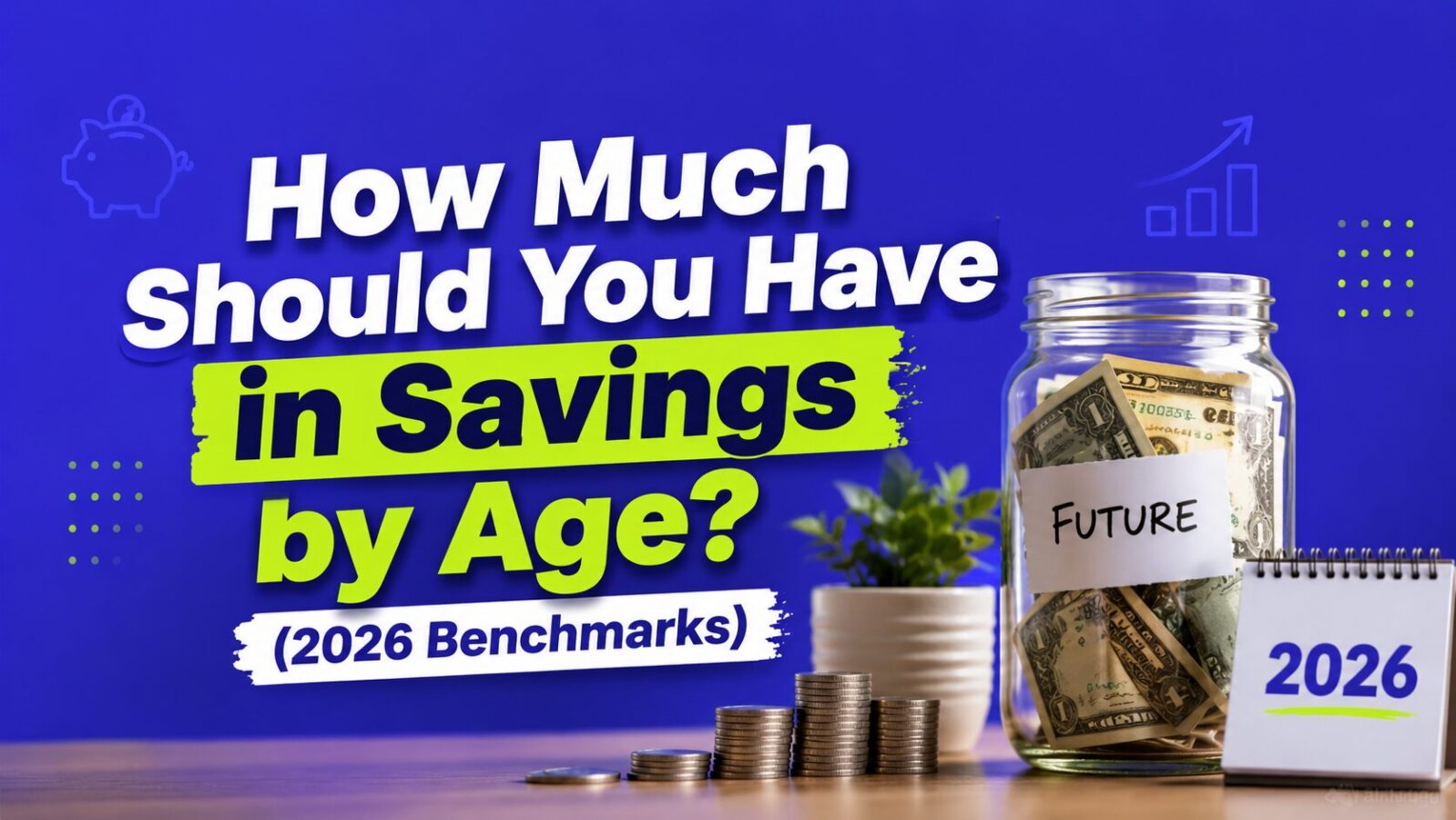
How Much Should I Have in Savings by Age?

How Much Should I Have in Savings by Age?

“Am I saving enough?” It is one of the most common financial questions, and one of the hardest to answer. The right amount depends on your age, income, goals, and where you are starting from.

Still, benchmarks help. They give you a target to aim for and a way to measure progress. Let’s break down how much you should realistically have saved at every stage, from your 20s through your 50s and beyond.

First: savings account balance vs. net worth

Before we dive into the numbers, let’s clear up a common confusion. When people ask “how much savings by age,” they usually mean one of two things:

  1. Cash savings (checking + savings accounts). This is your liquid money, primarily your emergency fund.
  2. Total retirement savings (401(k), IRA, brokerage accounts). This is your long-term wealth.

These are very different numbers. Someone with $8,000 in a savings account and $85,000 in a 401(k) is in a very different position than someone with $85,000 in cash and nothing invested. Both “have savings,” but the second person is actually falling behind on retirement.

Throughout this post, we will cover both: how much liquid cash you need and how much your total retirement savings should be at each age.

Emergency fund: the universal baseline

No matter your age, the first savings benchmark everyone should hit is a fully funded emergency fund. The standard recommendation is 3 to 6 months of essential expenses, not income. Essential expenses include rent or mortgage, utilities, groceries, insurance, minimum debt payments, and transportation.

Here is what that looks like in real numbers:

Monthly essential expenses3-month fund6-month fund
$2,500$7,500$15,000
$3,500$10,500$21,000
$5,000$15,000$30,000

Who needs 3 months vs. 6 months? If you have a stable job, dual income, or strong job market demand in your field, 3 months is a reasonable starting point. If you are self-employed, work in a volatile industry, have dependents, or are a single income household, aim for 6 months. Some financial planners now recommend up to 12 months for freelancers and gig workers.

Keep this money in a high-yield savings account where it earns interest but stays accessible. Do not invest your emergency fund in the stock market.

Savings benchmarks in your 20s (ages 20 to 29)

Your 20s are about building the foundation. Most people in this age range are dealing with entry-level salaries, student loans, and high cost-of-living expenses. Saving feels hard because it genuinely is hard at this stage.

Cash savings target: A starter emergency fund of $1,000 to $2,000 first, then build toward 3 months of expenses. If you are living paycheck to paycheck, even $500 set aside is meaningful progress.

Retirement savings target: According to Fidelity’s retirement guidelines, you should aim to have 1x your annual salary saved for retirement by age 30. If you earn $55,000 at age 30, your 401(k) and IRA balances combined should total around $55,000.

That sounds like a lot, and for many people it is. The key is starting early and letting compound growth do the work. Someone who starts contributing 10% of a $45,000 salary at age 22 with a 7% average return would have roughly $50,000 to $55,000 by age 30.

Priority order in your 20s:

  1. Build a $1,000 starter emergency fund
  2. Contribute enough to your 401(k) to get the full employer match (that is free money)
  3. Pay down high-interest debt (credit cards, personal loans)
  4. Build your emergency fund to 3 months of expenses
  5. Increase retirement contributions toward 15% of income

Savings benchmarks in your 30s (ages 30 to 39)

Your 30s are when things typically accelerate. Incomes are higher, careers are more established, and the gap between people who started saving early and those who did not becomes visible.

Cash savings target: A full 3 to 6 month emergency fund, plus any goal-specific savings. If you are saving for a house down payment, that is a separate pot of money on top of your emergency fund.

Retirement savings target: Fidelity recommends 3x your annual salary by age 40. So if you earn $75,000 at 40, your retirement accounts should hold approximately $225,000.

Here is the decade progression:

AgeRetirement savings target
301x annual salary
352x annual salary
403x annual salary

If you are in your early 30s and nowhere near the 1x target, do not panic. But do take it seriously. Every year you delay makes the catch-up steeper. A 30-year-old who needs to save $55,000 in retirement savings over the next 5 years needs to save roughly $750 per month (assuming 7% returns). A 35-year-old trying to reach 2x salary in 5 years needs significantly more.

Savings benchmarks in your 40s (ages 40 to 49)

By your 40s, retirement savings should be a well-established habit. This decade is about maximizing contributions and watching compounding work.

Cash savings target: 6 months of expenses is the standard at this stage, especially if you have a mortgage, kids, or other dependents. You should also have sinking funds for predictable large expenses (home repairs, car replacement, kids’ activities).

Retirement savings target: Fidelity’s benchmarks continue:

AgeRetirement savings target
403x annual salary
454x annual salary
506x annual salary

If you earn $90,000 at age 45, the target is roughly $360,000 in retirement accounts. At age 50 earning $100,000, the target is $600,000.

These numbers feel large, but remember that growth is nonlinear. Someone with $225,000 at age 40 earning 7% annually will see that grow to roughly $443,000 by age 50 without adding a single dollar. New contributions on top of that growth are what close the gap.

Savings benchmarks in your 50s and beyond

This is the home stretch. The good news: the IRS gives you extra room.

Cash savings target: 6 to 12 months of expenses, especially as you approach retirement. Medical expenses, potential job transitions, and career changes are all more likely in this decade.

Retirement savings target:

AgeRetirement savings target
506x annual salary
557x annual salary
608x annual salary
6710x annual salary

After age 50, you qualify for catch-up contributions: an extra $7,500 per year in a 401(k) on top of the standard limit (for a total of $31,000 in 2026). For IRAs, the catch-up amount is $1,000 extra per year.

How to catch up if you are behind

If you looked at those benchmarks and felt a wave of stress, take a breath. These are guidelines, not judgments. According to the Federal Reserve’s Survey of Economic Well-Being, nearly 40% of Americans could not cover a $400 emergency with cash. Being behind is incredibly common.

Here is how to close the gap:

1. Start with the savings rate, not the balance

Do not fixate on the total number. Focus on the percentage of income you are saving. Going from 0% to 10% is transformative. Going from 10% to 15% is powerful. The balance will follow.

2. Automate aggressively

Set up automatic transfers on payday. Money you never see in your checking account is money you will not spend. Start with whatever you can afford, even $50 per paycheck, and increase it by $25 every quarter.

3. Capture every raise

When you get a raise or bonus, immediately redirect at least half of it to savings or retirement contributions. This is the single best way to accelerate savings without changing your lifestyle.

4. Cut one big expense

Switching to a cheaper phone plan, refinancing a loan, or negotiating one recurring bill can free up $100 to $300 per month. That is $1,200 to $3,600 per year redirected to savings.

5. Use windfalls wisely

Tax refunds, work bonuses, cash gifts, and side hustle income should go directly to your savings goals. A $3,000 tax refund invested annually from age 30 to 65 at 7% growth becomes over $475,000.

6. Take the employer match, no excuses

If your employer offers a 401(k) match and you are not taking the full amount, you are leaving free money on the table. A 50% match on 6% of salary is an instant 50% return. No investment in the world beats that.

What counts as “savings”

When calculating your total savings, include:

  • High-yield savings accounts
  • Checking account buffers (beyond monthly spending needs)
  • 401(k) and 403(b) balances
  • Traditional and Roth IRA balances
  • Brokerage accounts
  • HSA balances (if you treat it as a retirement account)

Do not include:

  • Home equity (it is wealth, but it is not liquid)
  • Cars, furniture, or personal property
  • Crypto holdings (too volatile to count as reliable savings)
  • Money you owe yourself from loans against your 401(k)

Frequently asked questions

Is it better to save cash or invest for retirement?
Both, but prioritize in this order: starter emergency fund, employer 401(k) match, full emergency fund, then max out retirement accounts. Keeping too much in cash means inflation erodes your purchasing power. Investing without an emergency fund means you will be forced to sell investments at bad times.

How much should I keep in a savings account vs. invested?
Your emergency fund plus any money you will need within the next 1 to 3 years belongs in a savings account. Everything else should be invested. Holding $50,000 in a savings account “just in case” when your emergency fund only needs to be $15,000 means $35,000 is losing to inflation.

Do these benchmarks apply if I have student loans?
Yes, but the 1x salary by 30 target is harder to hit when you are making loan payments. Focus on getting the employer match, building your emergency fund, and paying off high-interest debt. Once high-interest debt is gone, redirect those payments to retirement savings.

What if I make significantly less than the median income?
The salary multipliers still apply as percentages, but the absolute numbers will be lower. Someone earning $35,000 should target $35,000 in retirement savings by 30, not $55,000. The ratio matters more than the raw number.

The bottom line

The “right” amount of savings depends on your age, income, and goals, but the benchmarks are clear: 3 to 6 months of expenses in cash, and a retirement balance that scales from 1x your salary at 30 to 10x your salary at 67.

If you are behind, the best time to start was years ago. The second best time is today. Every dollar you save now has more time to grow than a dollar you save next year. Automate your savings, capture your raises, and focus on the savings rate rather than the balance. The numbers will follow.

Leave a Reply

Your email address will not be published. Required fields are marked *