By
By 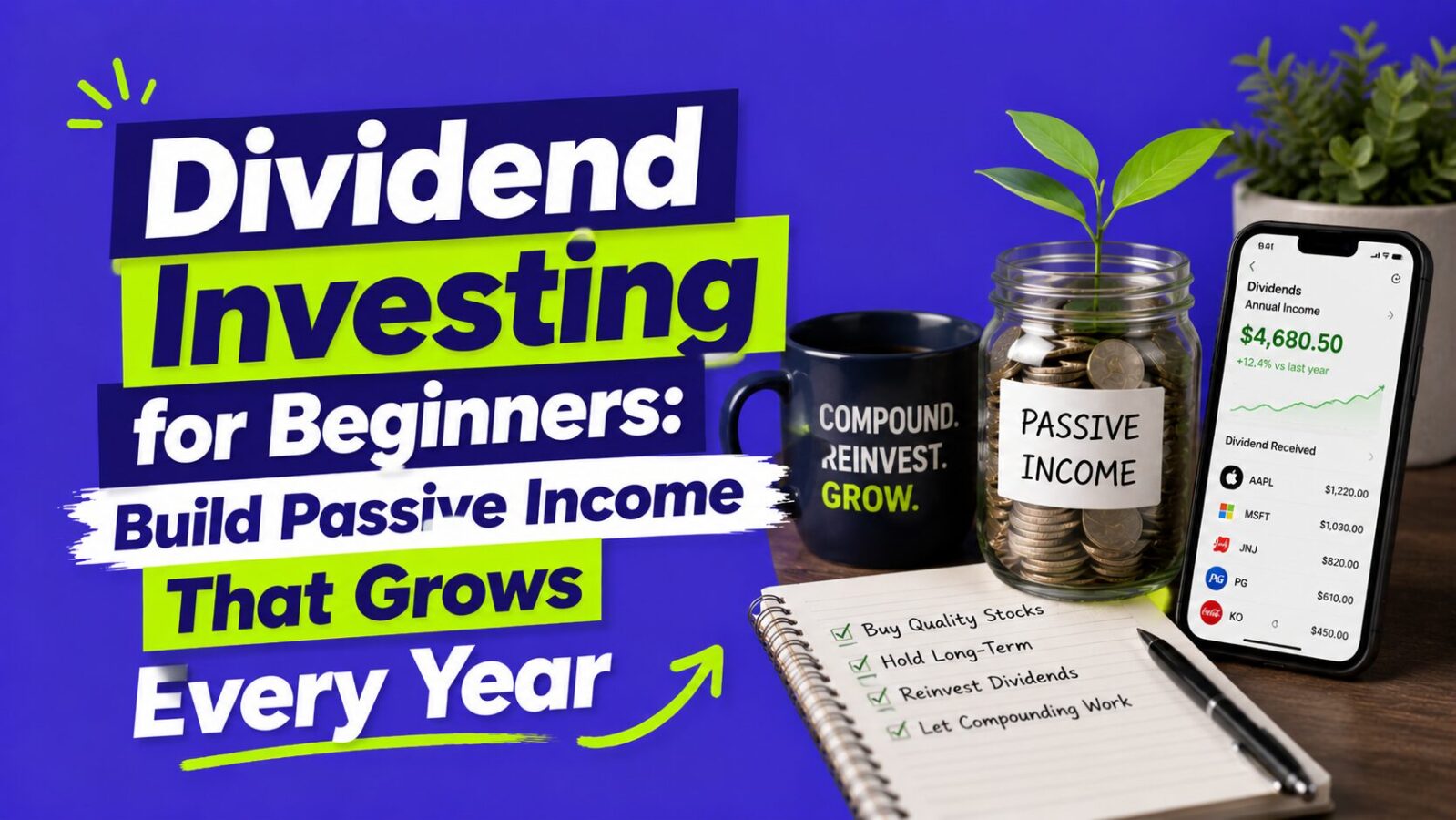
Dividend stocks pay you just for owning them. Here is how dividend investing works, the best dividend ETFs for beginners, and whether dividends actually make sense for young investors.
The idea of getting paid just for owning something is appealing. You buy shares of a company, and every quarter, it sends you cash. You do nothing. No work, no selling, no timing the market. Just money appearing in your account.
That is dividend investing. Companies that generate more profit than they need to reinvest share the excess with shareholders as dividends. Some companies have increased their dividends every year for 25, 40, or even 50+ consecutive years: a growing stream of passive income that requires zero effort after the initial investment.
But dividend investing is also one of the most misunderstood strategies in personal finance. Before you go all-in on high-yield dividend stocks, you need to understand when dividends make sense, when they do not, and how they fit into the broader portfolio you are building with your 401(k) and Roth IRA.
How dividends work
When a company earns a profit, it has two choices: reinvest into the business or return cash to shareholders. Companies that return cash do so through dividends.
Dividend yield is the annual dividend payment divided by the stock price. If a company pays $4/year in dividends and the stock trades at $100, the yield is 4%. If you own $10,000 of that stock, you receive $400/year in dividends.
Payment frequency. Most US companies pay dividends quarterly. Some pay monthly. The payment lands in your brokerage account as cash, which you can spend or reinvest.
Dividend reinvestment (DRIP). Most brokerages let you automatically reinvest dividends to buy more shares. Your dividends buy more shares, which generate more dividends, which buy more shares. That is classic compound growth.
Dividend growth. The best dividend companies increase their dividend every year. If a company pays $2/share this year and increases by 7% annually, it pays $3.93 ten years from now. Your income nearly doubles in a decade without buying a single additional share.
Compound Interest Calculator
Types of dividend-paying investments
Individual dividend stocks
Companies like Johnson and Johnson, Coca-Cola, Procter and Gamble, Microsoft, and Apple pay regular dividends. Dividend Aristocrats are S&P 500 companies that have increased their dividend for 25+ consecutive years. Dividend Kings have increased dividends for 50+ consecutive years.
Individual stock picking is not recommended for beginners. Start with ETFs.
Dividend ETFs (recommended for beginners)
A dividend ETF holds dozens or hundreds of dividend-paying stocks in one fund.
Schwab U.S. Dividend Equity ETF (SCHD): The most popular dividend ETF for good reason. Holds roughly 100 high-quality US dividend stocks selected for financial strength, dividend growth, and yield. Current yield: roughly 3.3 to 3.8%. Expense ratio: 0.06%. SCHD focuses on quality over yield. It avoids the highest-yielding stocks (which are often in financial trouble) and holds companies with strong balance sheets.
Vanguard High Dividend Yield ETF (VYM): Holds roughly 450 high-dividend US stocks. Broader than SCHD. Current yield: roughly 2.8 to 3.2%. Expense ratio: 0.06%.
Vanguard Dividend Appreciation ETF (VIG): Focuses on dividend growth rather than high current yield. Holds companies that have increased dividends for 10+ consecutive years. Current yield: roughly 1.7 to 2.0%. Expense ratio: 0.06%. Best for investors prioritizing long-term growth over current income.
iShares Core Dividend Growth ETF (DGRO): Similar to VIG with slightly broader criteria. Current yield: roughly 2.2 to 2.5%. Expense ratio: 0.08%.
For most beginners: SCHD or VYM. If you want one dividend ETF, SCHD has the best track record of total return plus meaningful yield.
REITs for dividend income
Real estate investment trusts are required to distribute 90%+ of taxable income as dividends. REIT ETFs like VNQ yield 3.5 to 4%+. However, REIT dividends are taxed as ordinary income, so hold them in tax-advantaged accounts. Read our real estate investing guide for the full breakdown.
The honest truth: should young investors focus on dividends?
Dividend investing has a massive fan base on YouTube and social media. But for investors in their 20s and 30s, prioritizing dividends over total return is usually a mistake.
Why dividends are not “free money”
When a company pays a $1 dividend, its stock price drops by $1 on the ex-dividend date. You receive $1 in cash, but your shares are worth $1 less. You have the same total value. The dividend did not create wealth. It transferred wealth from your shares to your cash balance.
In a taxable account, you then owe tax on that $1 dividend. So you actually end up with less total wealth than if the company had retained the money and reinvested it.
Total return is what matters
Total return = price appreciation + dividends. A stock that grows 10% with no dividend has the same total return as a stock that grows 7% with a 3% dividend.
Over the past 20 years, the S&P 500 (VTI, roughly 1.3% yield) has outperformed most high-dividend ETFs on a total return basis. Companies like Amazon, Google, and Meta paid no dividends for most of their existence. A dividend-focused portfolio misses these growth engines.
When dividends DO make sense
In retirement or near retirement. If you need regular income, dividends provide cash flow without selling shares. A $500,000 portfolio yielding 3.5% generates $17,500/year in income.
In tax-advantaged accounts. Inside your Roth IRA, dividends are reinvested tax-free with no tax drag. There is no penalty for holding SCHD alongside VTI in a Roth.
For psychological benefits. Watching dividends land in your account every quarter can keep you motivated to invest. If seeing $150 in dividend payments makes you more excited about investing, the behavioral benefit has real value.
As a portion of a diversified portfolio. A 20 to 30% allocation to SCHD alongside 50 to 60% VTI and 10 to 20% VXUS gives you dividend income plus broad market exposure.
How to build a dividend portfolio as a beginner
The simple approach: Put 100% of your dividend allocation into SCHD. Enable DRIP and let it compound.
The balanced approach (recommended for your 20s):
- 60% VTI (total US stock market)
- 20% SCHD (US dividend quality)
- 10% VXUS (international stocks)
- 10% BND (bonds)
Your blended yield is roughly 2%, higher than VTI alone while still capturing growth from the full market.
The income-focused approach (better for age 50+):
- 40% SCHD + 20% VYM + 15% VXUS + 15% BND + 10% VNQ (REITs)
Blended yield: roughly 3%. On a $500,000 portfolio, that generates $15,000/year in dividend income.
Dividend income projector
See how your dividend income grows over time with consistent investing.
Dividend Income Calculator
Dividend math: how passive income grows
$500/month invested in SCHD (3.5% yield, 8% total return average):
| Timeline | Portfolio value | Annual dividend income |
|---|---|---|
| After 10 years | ~$90,200 | ~$3,160/year |
| After 20 years | ~$275,000 | ~$9,625/year |
| After 30 years | ~$720,000 | ~$25,200/year ($2,100/month) |
At 30 years, your portfolio generates $2,100/month in passive dividend income, without selling a single share.
Tax treatment of dividends
Qualified dividends (most dividends from US stocks held over 60 days) are taxed at 0%, 15%, or 20% depending on your income bracket. For most people, the rate is 15%.
Non-qualified dividends (REITs, some foreign stocks, stocks held less than 60 days) are taxed at your ordinary income rate.
In a Roth IRA: All dividends are tax-free. This is the ideal account for dividend investments.
In a taxable brokerage: Annual tax drag reduces your total return compared to growth-focused portfolios. This is why many advisors recommend holding VTI in taxable accounts and SCHD in Roth IRAs.
Common dividend investing mistakes
Chasing the highest yield. A stock yielding 8% or 10% is often a red flag, not a buying opportunity. Extremely high yields usually mean the stock price has crashed or the dividend is unsustainable. Stick to yields in the 2 to 4% range from quality companies.
Ignoring total return. A stock yielding 4% with 0% price growth gives you 4% total return. A stock yielding 1% with 9% price growth gives you 10% total return. Always evaluate total return, not yield alone.
Not reinvesting dividends during accumulation. If you are in your 20s or 30s, reinvest every dividend to buy more shares. Taking dividends as cash at this stage sacrifices compound growth. Turn on DRIP.
Building a dividend portfolio before maxing tax-advantaged accounts. If you are putting $500/month into SCHD in a taxable brokerage while your Roth IRA is empty, you are doing it backwards. Max your Roth IRA and 401(k) match first.
Frequently asked questions
How much do I need invested to live off dividends?
At a 3.5% yield, you need roughly $857,000 to generate $30,000/year in dividend income. At 4% yield, you need $750,000. Use the compound interest calculator above to project when you reach your target.
Is SCHD better than VTI?
They serve different purposes. VTI gives you the entire US stock market for maximum growth potential. SCHD gives you 100 high-quality dividend stocks with meaningful income. SCHD has slightly underperformed VTI on total return over the past decade but outperformed during market downturns. Most investors benefit from holding both.
Should I reinvest dividends or take the cash?
During accumulation (before retirement), always reinvest. The compounding effect of reinvested dividends accounts for a significant portion of long-term returns. Only take dividends as cash when you need the income: in or near retirement.
Can I invest in dividend ETFs inside my 401(k)?
Most 401(k) plans do not offer SCHD or VYM specifically. Check your plan's fund list. For dividend investing specifically, a Roth IRA (where you can buy any ETF) is a better vehicle.
The bottom line
Dividend investing works best as part of a diversified portfolio, not as a replacement for total market exposure. For most investors in their 20s and 30s, the right approach is to hold VTI as your core holding and add SCHD for a dividend quality tilt. Do not replace VTI with dividend stocks entirely.
The real power of dividend investing is not the quarterly cash deposits. It is the discipline it enforces, the quality companies it tends to hold, and the growing income stream it produces over decades of reinvestment.
Where to go next:
- New to investing entirely? Read our investing in your 20s guide for the full account sequence before choosing individual funds.
- Want to see SCHD in a full portfolio? Read our 3-fund portfolio guide. SCHD can serve as a fourth fund alongside VTI, VXUS, and BND.
- Investing in real estate for income instead? Read our real estate investing guide to compare dividend stocks vs. REITs vs. direct real estate.