By
By 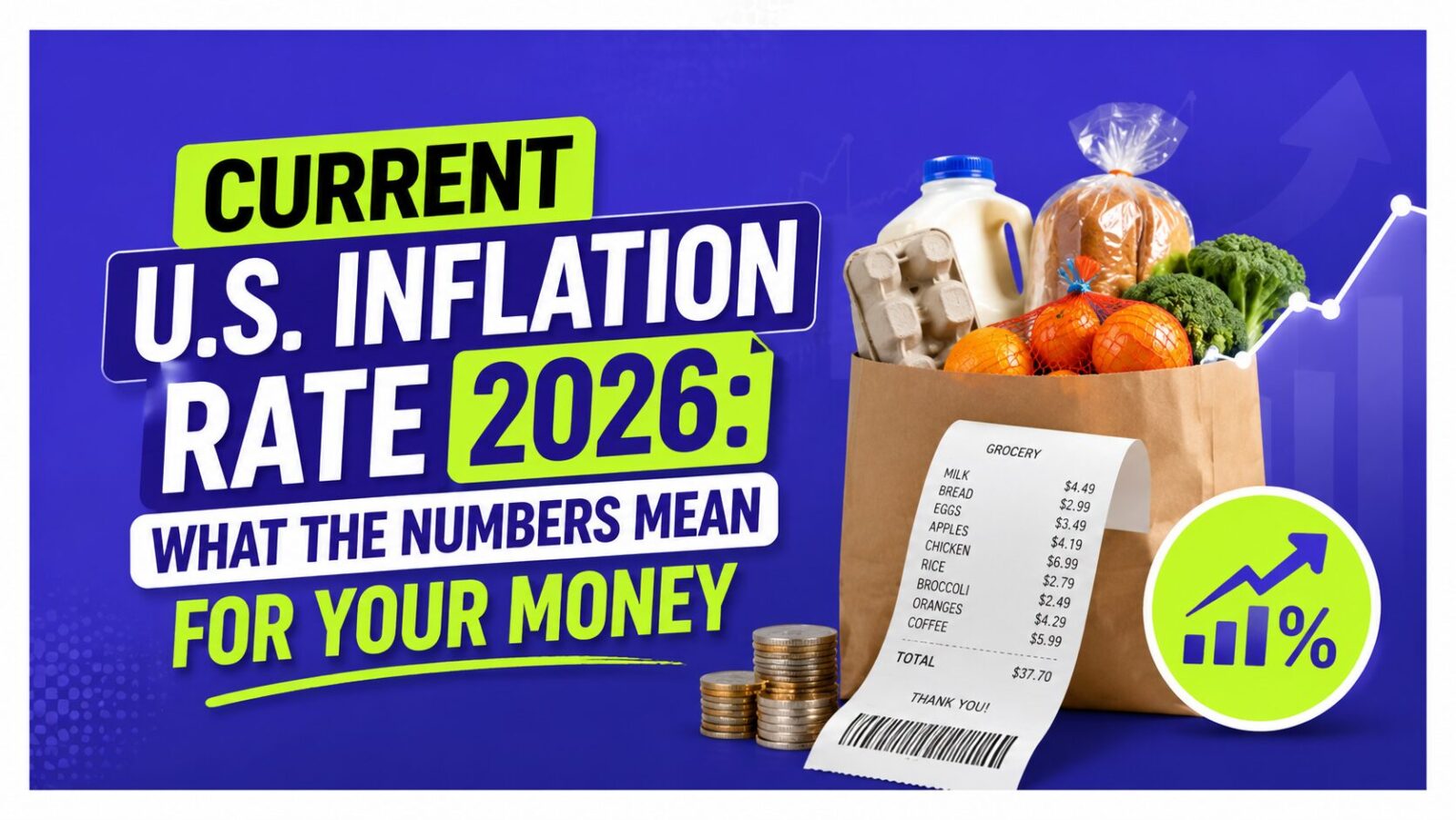
The U.S. inflation rate is 3.8% as of April 2026, nearly double the Federal Reserve’s 2% target. Energy prices driven by the U.S.-Israel-Iran conflict are the primary cause, with gasoline up 28.4% over the past year. This page is updated each month after the Bureau of Labor Statistics releases new data. The next update is June 10, 2026 when May CPI data is released.
- U.S. inflation (CPI) is 3.8% as of April 2026, nearly double the Fed’s 2% target, driven mainly by an energy price spike.
- Core CPI (excluding food and energy) is 2.8%; the gap to headline is almost entirely gasoline and energy.
- At 3.8%, cash in a 0.01% account loses real value every month, while a 4%+ high-yield savings account roughly keeps pace.
- This page updates monthly after each BLS CPI release; the next is June 10 with May data.
Inflation Rate Trend: April 2025 to April 2026
Inflation was relatively contained at around 2.3-2.6% through mid-2025. The escalation of the U.S.-Israel-Iran military conflict in late 2025 sent oil prices surging, pushing inflation progressively higher from Q4 2025 through April 2026. The 3.8% reading in April is the highest since early 2023.
What Is Driving Inflation in 2026?
Three forces are pushing inflation above the Fed’s target in 2026:
Energy and oil prices. Gasoline is up 28.4% over the past 12 months, the single largest contributor to headline CPI. The Iran conflict disrupted oil supply routes through the Strait of Hormuz and sent crude prices to multi-year highs. Energy overall is up 17.9% year-over-year as of April.
Tariff pass-through. Tariffs imposed on imported goods since 2025 continue to filter through supply chains into consumer prices. Core CPI, which excludes food and energy, is at 2.8%, elevated above target even without the energy shock. This reflects producers passing higher input costs to consumers.
Shelter costs. Rent and owners’ equivalent rent accelerated to 0.6% monthly in April, up from 0.3% in March. Shelter has the largest weighting in CPI at approximately 36% of the total index, so even modest shelter increases have an outsized effect on headline inflation.
CPI Breakdown by Category: April 2026
The consumer price index measures price changes across eight major spending categories. Not all categories are rising at the same pace. Energy is the outlier pushing headline inflation well above the core rate.
What Is CPI and How Is It Measured?
The consumer price index (CPI) measures the average change in prices paid by urban consumers for a representative basket of goods and services. The U.S. Bureau of Labor Statistics (BLS) calculates and publishes CPI data monthly, typically in the second week of the following month. When people say “the inflation rate is 3.8%,” they are almost always referring to the CPI.
The BLS tracks approximately 80,000 prices per month across categories including food, housing, apparel, transportation, medical care, recreation, and education. Each category is weighted by how much of the average household’s budget it represents. Shelter alone accounts for about 36% of the total CPI weight, which is why rent increases have such a large impact on the headline number.
CPI-U vs CPI-W. The standard CPI (CPI-U) covers all urban consumers. CPI-W covers urban wage earners and clerical workers specifically. The Social Security Administration uses CPI-W to calculate the annual cost-of-living adjustment (COLA) for Social Security benefits. The 2026 COLA of 2.8% was calculated from CPI-W data in Q3 2025.
Core CPI strips out food and energy prices because of their volatility. Core CPI is 2.8% in April 2026, compared to headline CPI at 3.8%. The 1.0 percentage point gap between headline and core is almost entirely driven by the energy price spike from the Iran conflict. Core inflation tells a more stable story about underlying price pressures in the economy.
When is the next CPI release? The May 2026 CPI report releases on Wednesday, June 10 at 8:30 AM Eastern. This article will update with the May data as soon as it is available.
What Is PCE and Why Does the Fed Use It?
The personal consumption expenditures (PCE) price index is the Federal Reserve’s preferred inflation measure. The Fed sets its 2% inflation target using core PCE, not CPI. In April 2026, PCE was 3.8% and core PCE was 3.3%, both above target.
PCE differs from CPI in two important ways. First, PCE has a different basket weighting. Housing (shelter) has a lower weight in PCE than in CPI, and healthcare has a higher weight. Second, PCE uses a “chain-weighted” methodology that adjusts for consumer substitution: if beef prices rise sharply and consumers shift to chicken, PCE captures that behavioral change while CPI does not. This makes PCE a slightly more flexible and often slightly lower measure of inflation than CPI.
The Fed’s Federal Open Market Committee (FOMC) looks at core PCE when setting interest rate policy. At 3.3%, core PCE is 1.3 percentage points above the 2% target, which is why rate cuts remain unlikely at the June 17-18 FOMC meeting. The next PCE release covering May data is scheduled for June 25.
What Is PPI and Why Does It Matter?
The producer price index (PPI) tracks prices at the wholesale level, measuring what producers and manufacturers charge retailers for their goods before those goods reach consumers. PPI is considered a leading indicator of future consumer inflation because higher wholesale prices typically get passed on to consumers within 1-3 months.
PPI in April 2026 was up 6.0% year-over-year, the highest reading since December 2022. Final demand energy prices within PPI rose 7.8% in April alone. Core PPI (excluding food, energy, and trade services) rose 4.4% year-over-year in April, the highest since February 2023. Both readings suggest consumer price pressures are unlikely to ease quickly. The May PPI report releases on June 11.
How Inflation Affects Your Money Right Now
At 3.8% annual inflation, every $1,000 you hold in cash loses approximately $38 in purchasing power per year. Over 10 years at this rate, $10,000 today would buy what $6,800 buys today. The compounding effect of sustained inflation is severe even at rates that feel modest in any single year.
The specific impacts on different financial products:
Savings accounts. Traditional bank savings accounts pay 0.01-0.5% APY, which means they lose ground to inflation by 3.3 to 3.8 percentage points per year. High-yield savings accounts (HYSAs) at 4.2-4.5% APY currently beat inflation slightly. Every dollar sitting in a traditional savings account is losing real value every month.
Fixed income and bonds. Existing bonds with fixed interest rates pay less in real (inflation-adjusted) terms as inflation rises. A bond paying 3% loses purchasing power when inflation is 3.8%. Treasury Inflation-Protected Securities (TIPS) are indexed to CPI and maintain real value during inflationary periods.
Mortgages and debt. Inflation benefits existing borrowers with fixed-rate debt. If you have a 3% fixed mortgage and inflation is 3.8%, you are effectively paying a negative real interest rate. Your debt shrinks in real terms over time. Variable-rate debt (credit cards, HELOCs, adjustable-rate mortgages) moves in the opposite direction because the Fed keeps rates high to fight inflation.
Wages. Real wage growth (wage growth minus inflation) is negative when wages rise slower than prices. At 3.8% inflation, a 3% raise is actually a 0.8% pay cut in purchasing power terms. Workers whose wages are not keeping pace with the current inflation rate are experiencing a real decline in living standards even if their nominal paycheck is growing.
Retirement accounts. Long-term investors in diversified stock portfolios historically outrun inflation. The S&P 500 has returned approximately 10% annually over long periods, far exceeding 3.8% inflation. For retirement savers with a horizon of 10-plus years, inflation is a manageable headwind as long as they are invested in growth assets rather than cash.
How to Protect Your Money Against Inflation
Inflation erodes the purchasing power of idle cash. The strategies that actually work:
Move cash into a high-yield savings account
HYSAs at online banks are currently paying 4.2-4.5% APY, slightly ahead of the 3.8% inflation rate. This is not a way to grow wealth, but it is the minimum step to stop losing ground on cash you need to keep liquid. Traditional brick-and-mortar savings accounts at 0.01-0.5% are losing to inflation by 3.3 to 3.8 percentage points per year. See our current HYSA rate guide for the best options.
Keep long-term money in equities
The U.S. stock market has historically returned approximately 10% annually over long periods, beating inflation by 6-7 percentage points per year on average. For money you will not need for at least 5-10 years, broad index funds like VTI or VOO provide the best long-term inflation protection available to retail investors. Companies with pricing power raise their prices with inflation, which protects real earnings and stock values.
Consider Treasury Inflation-Protected Securities (TIPS)
TIPS are U.S. government bonds whose principal is adjusted monthly to match the CPI. If inflation runs at 3.8%, your TIPS principal grows by 3.8% per year in addition to whatever interest rate the bond pays. TIPS are ideal for retirees or near-retirees who need inflation protection without equity risk. You can buy TIPS directly at TreasuryDirect.gov or through any brokerage as mutual funds or ETFs (ticker: SCHP, TIPS, or FIPDX).
I Bonds
Series I Savings Bonds are indexed to the CPI and currently paying a composite rate reflecting current inflation. The limit is $10,000 per person per year through TreasuryDirect.gov. I Bonds cannot be redeemed for the first 12 months and have a 3-month interest penalty if redeemed before 5 years. For someone with a 1-5 year horizon who wants guaranteed inflation protection on a specific amount of cash, I Bonds are worth considering.
Pay down variable-rate debt aggressively
Credit card APRs average above 20% in 2026, driven by the Fed’s high-rate policy. Variable-rate debt costs more in a high-inflation, high-rate environment. Every dollar of high-interest debt paid off generates a guaranteed return equal to the interest rate avoided. Paying down a 22% APR credit card is equivalent to a 22% guaranteed return, which no investment can reliably match.
Real assets
Real estate, commodities, and gold have historically retained value during inflationary periods because their prices tend to rise with general price levels. Landlords can raise rents as inflation increases costs. Raw materials (oil, metals, agricultural commodities) rise directly with inflation. Gold has a mixed long-term record as an inflation hedge but tends to outperform during periods of elevated inflation and geopolitical uncertainty, both of which describe 2026.
What the Fed Is Doing About Inflation
The Federal Reserve raises its benchmark federal funds rate to fight inflation. Higher rates make borrowing more expensive, which reduces consumer and business spending and cools demand-driven price pressures. The Fed has kept rates elevated throughout 2025-2026 in response to inflation above target.
The FOMC meets eight times per year. With CPI at 3.8% and core PCE at 3.3%, neither close to the 2% target, rate cuts at the June 17-18 meeting are extremely unlikely. Market expectations for the first rate cut have shifted toward late 2026 or early 2027 depending on how quickly energy prices stabilize.
The relationship between Fed rate policy and inflation is not immediate. Interest rate changes typically take 12-18 months to fully work through the economy. The rate hikes from 2024-2025 are still in the process of slowing inflation. But the energy shock from the Iran conflict added a new inflationary impulse that monetary policy cannot directly address since it is a supply-side rather than demand-side shock.
Historical U.S. Inflation Context
The current 3.8% CPI rate is elevated compared to the post-2008 decade when inflation averaged around 1.5-2.5% annually. It is significantly below the peak of 9.1% reached in June 2022 following the COVID-era supply chain disruption and the Russia-Ukraine conflict’s energy price shock. The current episode more closely resembles the 2022 energy-driven spike than the broad demand-driven inflation of 2021-2022.
The Fed’s 2% inflation target was established because economists consider a low, stable, and predictable inflation rate a sign of a healthy economy. Zero inflation risks deflation (falling prices), which discourages spending and investment. Very high inflation erodes purchasing power and creates economic uncertainty. The 2% target represents the Fed’s best estimate of the right balance between growth and stability.
Frequently Asked Questions
The current U.S. inflation rate is 3.8% as of April 2026, measured by the Consumer Price Index (CPI). This is up from 3.3% in March 2026. Core inflation, which excludes food and energy, is 2.8%. This page updates monthly after each BLS CPI release.
The primary driver is energy prices, specifically gasoline up 28.4% year-over-year following the U.S.-Israel-Iran conflict’s disruption of oil supply. Tariff pass-through and persistent shelter (rent) inflation are secondary contributors. Core inflation at 2.8% reflects these non-energy pressures.
It depends on energy prices. If oil prices stabilize or fall as the Iran conflict de-escalates, headline CPI could decline toward 3% or below in the second half of 2026. If energy prices remain elevated or rise further, 3.8-4% inflation may persist through year-end. The May CPI on June 10 will provide the next data point.
Social Security benefits are adjusted annually using the Cost-of-Living Adjustment (COLA), which is calculated from CPI-W data in July, August, and September of each year. The 2026 COLA was 2.8%, which was below the April 2026 headline CPI of 3.8%, meaning Social Security recipients are seeing their purchasing power decline in real terms in 2026. The 2027 COLA will be announced in October 2026 based on Q3 2026 CPI-W data.
CPI measures all consumer prices including food and energy. Core CPI excludes food and energy because those categories are volatile and subject to supply shocks unrelated to broader economic demand. Core CPI is considered a cleaner signal of underlying inflation trends. In April 2026, CPI is 3.8% but core CPI is 2.8%, with the 1.0 percentage point difference almost entirely attributable to energy prices.
Sources: U.S. Bureau of Labor Statistics April 2026 CPI release; Bureau of Economic Analysis April 2026 PCE report; BLS April 2026 PPI report; Federal Reserve FOMC statements. Data for this page is updated monthly following each BLS CPI release. This article is for informational purposes only and does not constitute financial advice.
Last updated: May 29, 2026 with April 2026 data. Next update: June 10, 2026 with May 2026 data.