By
By 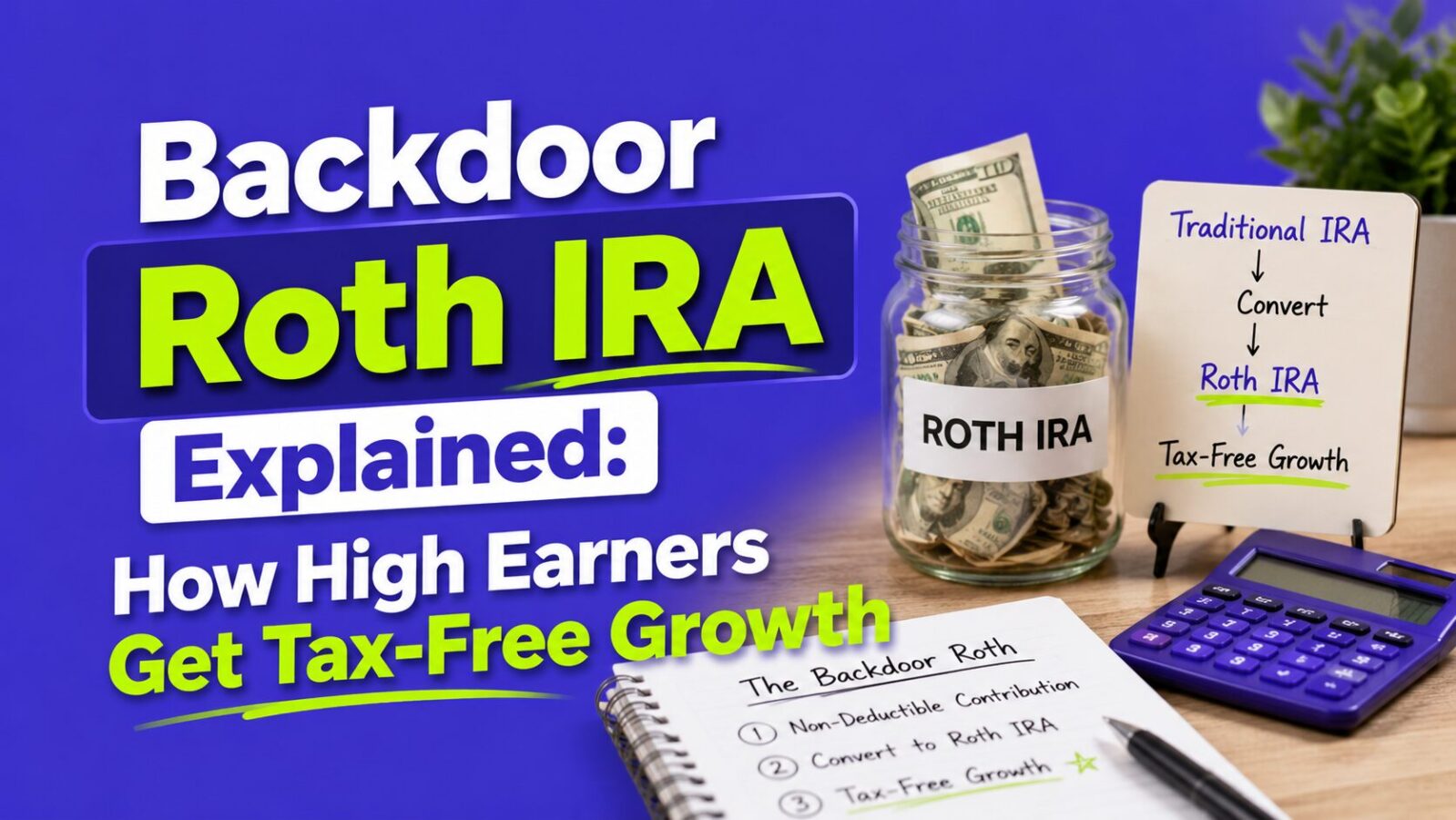
The Roth IRA income limit locks out high earners from one of the best retirement accounts. The backdoor Roth is the legal workaround: contribute to a Traditional IRA, convert to Roth, done. Here is the exact step-by-step process and the one trap that catches people off guard.
The Roth IRA has income limits. In 2026, if your Modified Adjusted Gross Income (MAGI) is above $168,000 (single) or $252,000 (married filing jointly), you cannot contribute directly (IRS). The front door is closed. But the back door is wide open. It is the high earner’s entry point on the retirement account roadmap.
The backdoor Roth IRA is a completely legal strategy that lets high earners bypass the income limit. The IRS has been aware of it since 2010, Congress has repeatedly declined to close it, and millions of Americans use it every year. Financial advisors, CPAs, and IRS publications all acknowledge it as a legitimate planning strategy.
- The backdoor Roth combines two IRS rules: Traditional IRA contributions have no income limit, and Roth conversions have no income limit. Contribute after-tax dollars to a Traditional IRA, then convert to Roth, and the direct Roth income limit becomes irrelevant.
- The pro-rata rule is the single biggest trap. If you have any pre-tax money in a Traditional, SEP, or SIMPLE IRA, the IRS treats every conversion as proportionally drawn from all your IRA money, not just the fresh after-tax contribution. A $92,500 pre-tax IRA plus a $7,500 new contribution means about 92.5% of your $7,500 conversion is taxable. Use the pro-rata calculator below before converting.
- Convert soon after contributing, and do not invest the money first. If your $7,500 grows before you convert, you owe income tax on the growth. Leaving it in the settlement fund keeps the taxable amount at or near $0. Many people contribute and convert on the same or next business day.
- File IRS Form 8606 every year you make a non-deductible contribution. It documents that you already paid tax on the contributed dollars, preventing double taxation at conversion. Most tax software handles Form 8606 automatically if you answer the IRA questions correctly.
- Married couples can each do a backdoor Roth for $15,000/year combined. Even a non-working spouse can contribute via a spousal IRA funded by the working spouse’s income. The pro-rata rule is calculated separately for each spouse.
Why does the backdoor Roth work?
The tax code has two separate rules that create this opportunity:
Rule 1: Traditional IRA contributions have no income limit. Anyone with earned income can contribute to a Traditional IRA regardless of how much they earn. The deduction may be limited if you have a workplace plan, but the contribution itself is always allowed.
Rule 2: Roth IRA conversions have no income limit. Anyone, regardless of income, can convert money from a Traditional IRA to a Roth IRA. Congress removed the previous $100,000 income limit on conversions in 2010.
The backdoor Roth combines these: contribute to a Traditional IRA (no income limit), then convert to a Roth IRA (no income limit). The Roth direct-contribution income limit is bypassed entirely. This is not a gray-area loophole; it is a predictable consequence of how the rules interact. The IRS has had over 15 years to close it, and proposed legislation to eliminate it (the Build Back Better Act, 2021) did not pass.
Check your pro-rata situation first
Pro-Rata Rule Calculator
Checks whether your backdoor Roth conversion will be taxable. Estimates only.
What is the step-by-step process?
Step 1: Open a Traditional IRA (if needed)
Open a Traditional IRA at your preferred brokerage. If you already have a Roth IRA at Fidelity, Schwab, or Vanguard, open the Traditional IRA at the same brokerage, since conversions are then same-day and done online. If you already have a Traditional IRA with a balance from prior years, run the pro-rata calculator above before proceeding.
Step 2: Make a non-deductible contribution
Contribute up to $7,500 (2026, or $8,600 if 50+) to the Traditional IRA. Since your income is above the Roth IRA limit, it is also likely above the Traditional IRA deduction phase-out (if you have a workplace plan), which means the contribution is non-deductible. That is the whole point: you want after-tax money in the Traditional IRA so the conversion is tax-free.
Do not invest the money after contributing. Leave it in the money market or settlement fund. You are converting it quickly, and any growth between contribution and conversion is taxable.
Step 3: Convert to Roth IRA
Convert the entire Traditional IRA balance to your Roth IRA. At most brokerages this is a few clicks online:
- Fidelity: Accounts > Traditional IRA > Transfer > Convert to Roth IRA
- Schwab: Accounts > Traditional IRA > Roth Conversion
- Vanguard: My Accounts > Traditional IRA > Convert to Roth IRA
The money moves from Traditional IRA to Roth IRA, usually same-day. Many people convert the next business day after the contribution settles.
Step 4: Invest the money in your Roth IRA
Once the funds land in your Roth IRA, invest them according to your allocation: a total stock market index fund, target-date fund, or 3-fund portfolio. Do not leave the money in cash inside the Roth.
Step 5: File Form 8606 with your tax return
File IRS Form 8606 (“Nondeductible IRAs”) with your return for the year you made the non-deductible contribution. Part I documents the contribution; Part II documents the conversion. Tax software handles this automatically if you answer the IRA questions correctly (contributed $7,500 non-deductible, converted $7,500 to Roth). If you converted immediately with no growth, tax on the conversion is $0.
Without Form 8606, the IRS may assume your contribution was deductible and tax you again on the conversion. If you forgot to file it in past years, you can file a standalone corrective Form 8606 to establish your after-tax basis.
The tax math: why you owe $0
Contribute $7,500 of after-tax money to a Traditional IRA (non-deductible), then convert $7,500 to the Roth IRA the next day. Since the money was after-tax going in and did not grow, there is nothing to tax on the conversion. Tax owed on conversion: $0.
If you waited a week and earned $15 in interest before converting, you would owe income tax on that $15 of growth (at 24%, about $3.60). That is why you convert quickly and do not invest beforehand. Once inside your Roth IRA, the money grows tax-free indefinitely, with tax-free withdrawals in retirement and no Required Minimum Distributions.
The pro-rata rule, fully explained
This is the single most important thing to understand about the backdoor Roth. The calculator above handles the math; here is the logic behind it. When you convert from a Traditional IRA to a Roth IRA, the IRS does not let you choose which dollars to convert. It treats the conversion as coming proportionally from your pre-tax and after-tax money across all your Traditional IRA accounts combined.
Example: Sarah has $92,500 in a Traditional IRA from old 401(k) rollovers (all pre-tax). She contributes $7,500 non-deductible for a backdoor Roth. Total IRA: $100,000 (92.5% pre-tax, 7.5% after-tax). She converts $7,500.
The IRS says 92.5% of any conversion is taxable. On a $7,500 conversion, that is about $6,938 taxable and $563 tax-free. At a 24% bracket, Sarah owes roughly $1,665 in tax. She expected $0.
How to fix it:
- Often the cleanest option: roll pre-tax IRA money into your 401(k) (reverse rollover). If your employer’s plan accepts incoming rollovers, roll the Traditional IRA balance in. This removes the pre-tax money from the IRA calculation, so your Traditional IRA is $0 and future backdoor conversions are clean.
- Alternative: convert the full pre-tax IRA balance to Roth. Pay income tax on the pre-tax portion now, leaving the Traditional IRA empty for future clean conversions. This can make sense if the balance is small or you expect a lower bracket this year.
- If neither works: proceed knowing each conversion will be partially taxable. Use the calculator above to see your exact annual exposure.
What counts toward pro-rata (the IRS aggregates these): Traditional IRA, SEP IRA, SIMPLE IRA. What does not count: 401(k), 403(b), other employer plans, Roth IRA, inherited IRAs. If all your pre-tax retirement money is in a 401(k), the pro-rata rule does not affect you.
Backdoor Roth vs taxable brokerage: the long-term math
| Backdoor Roth IRA | Taxable brokerage | |
|---|---|---|
| $7,500/year for 25 years at 7% | ~$474,000 | ~$474,000 |
| Tax on withdrawal | $0 (qualified Roth withdrawal) | ~$43,000 (15% cap gains on ~$287K gain) |
| Net after-tax value | ~$474,000 | ~$431,000 |
| Annual time investment | About 30 minutes/year | None (no conversion needed) |
| Advantage | Backdoor Roth wins by roughly $43,000 over 25 years | |
The 30 minutes it takes to do the backdoor Roth each January is worth roughly $1,720/year in future tax savings ($43,000 over 25 years). These figures are illustrative and assume a simplified 15% capital gains rate; your actual numbers will vary.
When should you execute each year?
January is ideal. Contribute on January 2, convert January 3 or 4. The money spends almost no time in the Traditional IRA, minimizing taxable growth, and you get the full year of tax-free growth in the Roth.
You can contribute for the prior year until April 15. IRA contributions for 2026 can be made until April 15, 2027. There is little reason to wait; contributing and converting early maximizes time in the Roth.
Do it every year. The backdoor Roth is not a one-time action. Every year you exceed the income limit, repeat the process. $7,500/year at 7% for 30 years grows to roughly $708,000 in tax-free retirement money.
Married couples: $15,000/year combined
Both spouses can each do a backdoor Roth IRA, for $15,000/year combined. Even a non-working spouse can contribute through a spousal IRA, since the working spouse’s income counts for both. The non-working spouse opens their own Traditional IRA, contributes $7,500, and converts to their own Roth IRA.
The pro-rata rule is calculated separately for each spouse. If your spouse has pre-tax Traditional IRA balances but you do not, your backdoor is clean even if theirs is complicated.
Frequently Asked Questions
Yes. There is no law prohibiting contributing to a Traditional IRA and converting it to a Roth IRA. The IRS discusses Roth conversions in Publication 590-A and has been aware of the backdoor approach since at least 2010, when the $100,000 income cap on conversions was removed. A 2021 attempt to eliminate it did not pass. Until legislation changes, it is a standard, recommended strategy for high earners.
There is no legally required waiting period; many people convert the next business day, and some the same day. The “step transaction doctrine” has not been applied to backdoor Roth conversions in any IRS guidance. Many tax professionals suggest waiting one to three business days for the contribution to settle, as a practical precaution. The key is to convert before the balance grows, to minimize taxable earnings.
That creates an excess contribution subject to a 6% penalty per year until removed. Two options: remove the excess and any earnings before the tax filing deadline (October 15 with extension), or recharacterize it as a non-deductible Traditional IRA contribution and then convert it through the normal backdoor process. The recharacterization route is often cleaner because it still lands the money in a Roth.
Check the 2026 phase-out range of $153,000 to $168,000 for single filers. At $155,000 you are in the partial zone, so you can contribute roughly $6,500 directly and use a backdoor Roth for the remaining $1,000 or so. If your income might rise above $168,000 later in the year (bonus, stock vesting), doing the full backdoor Roth from the start avoids a partial contribution that may need correcting.
Yes, but the SEP IRA balance triggers the pro-rata rule, since SEP balances are aggregated with Traditional IRA balances. With a large SEP IRA, most of your conversion would be taxable. The fix: roll the SEP IRA into your employer’s 401(k) (if it accepts rollovers), or, if self-employed, into a Solo 401(k). Once it is out of the IRA, your Traditional IRA is clean for conversions. Run the calculator above with your SEP balance to see the exposure.
Money already inside your Roth IRA stays there under existing rules; retroactive elimination of Roth benefits for existing balances would be unprecedented. If legislation passes, you would simply stop making new backdoor contributions, while prior years’ converted balances keep their tax-free status. That is one reason many people use the strategy now rather than waiting.
The regular backdoor Roth moves $7,500/year (the IRA limit) into a Roth through a Traditional IRA. The mega backdoor Roth uses after-tax (non-Roth) 401(k) contributions, which can be up to roughly $47,500/year depending on your employee deferral and employer match, converted to Roth inside the plan or rolled to a Roth IRA. It requires a plan that allows after-tax contributions and in-plan conversions or in-service distributions. See our mega backdoor Roth guide. Both strategies can be used at once.
No. The conversion goes into your existing Roth IRA alongside prior contributions, and your brokerage tracks contributions and conversions separately for tax purposes. The 5-year clock for contributions started when you first opened the Roth IRA. Converted amounts have their own 5-year clocks for penalty purposes, which only matter if you are under 59.5 and plan to withdraw the converted principal early.
The bottom line
The backdoor Roth IRA is one of the most powerful tools high earners have for building tax-free retirement wealth. The process is simple: contribute to a Traditional IRA, convert to Roth, file Form 8606. The only real complication is the pro-rata rule, so use the calculator above to check your situation before contributing.
If your Traditional IRA is clean ($0 pre-tax balance), the whole process takes about 30 minutes in January and adds $7,500 of tax-free Roth space. Done every year at 7% growth, 25 years of backdoor Roth contributions accumulates roughly $474,000 of tax-free money.
- New to retirement accounts? Start with our hub, Retirement Accounts Explained.
- Have a large pre-tax IRA to clear first? Read our 401(k) rollover guide; the same process applies to rolling an IRA into a 401(k) (reverse rollover).
- Want to go beyond the $7,500 IRA limit? Read our mega backdoor Roth guide on putting much more into Roth through after-tax 401(k) contributions.
- Deciding between Traditional and Roth? Read our Traditional vs Roth IRA guide, with an interactive decision quiz.
A quick note: this article is for educational purposes only and is not financial, investment, or tax advice. Income limits and contribution amounts come from the IRS and apply to tax year 2026; verify current figures at IRS.gov before you act. The pro-rata rule and Form 8606 can get complex, so it is worth talking with a CPA or qualified tax professional about your situation.