By
By 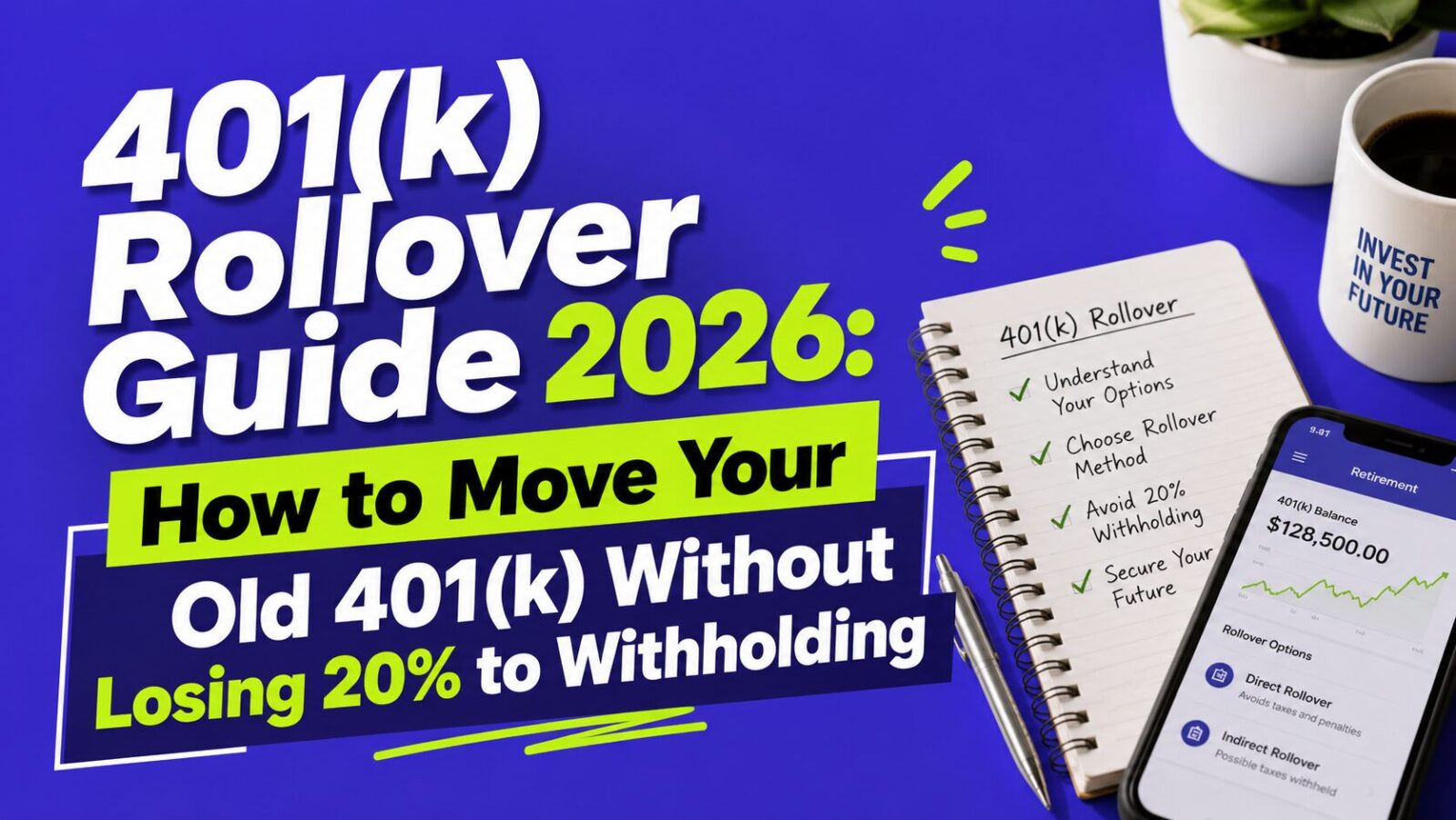
A 401(k) rollover moves money from an old employer’s retirement plan into an IRA or your new employer’s 401(k), and if you do it as a direct rollover, it triggers zero taxes and zero penalties. Do it the wrong way (an indirect rollover) and your old plan is required to withhold 20% for taxes, starting a 60-day clock that turns into a full taxable distribution if you miss it. The good news: the right way is also the easy way, and it takes about 20 minutes of phone calls.
KEY TAKEAWAYS
- Always choose a direct rollover (money goes straight from plan to plan). No taxes, no withholding, no deadline.
- An indirect rollover forces 20% withholding and gives you 60 days to redeposit the FULL amount, including the 20% you never received, or it becomes taxable income plus a possible 10% penalty.
- You have four options for an old 401(k): leave it, roll to your new 401(k), roll to an IRA, or cash out. Cashing out is almost always the expensive mistake.
- Match the account types: traditional 401(k) money goes to a traditional IRA, Roth 401(k) money to a Roth IRA, or you’ll owe tax on the conversion.
- Small balances get forced out: under $1,000 can be cashed out to you automatically; $1,000-$7,000 can be auto-rolled into an IRA chosen by your old employer.
What Are Your Four Options for an Old 401(k)?
| Option | Taxes now | Best when |
|---|---|---|
| Leave it in the old plan | None | The plan has great low-cost funds and your balance is over $7,000 |
| Roll into your new 401(k) | None (direct) | You want one account, plan to use the backdoor Roth, or may retire early (rule of 55) |
| Roll into an IRA | None (direct) | You want the widest fund choice and lowest fees, in an account you control |
| Cash out | Income tax + usually a 10% penalty before age 59½ | Almost never. A $10,000 cash-out can shrink to ~$6,500-7,000 after tax and penalty |
If you’re not sure how a 401(k), IRA, and the rest of the alphabet soup fit together, start with our retirement accounts explained hub, then come back.
Direct vs Indirect Rollover: The 20% Trap
A direct rollover (also called a trustee-to-trustee transfer) sends the money straight from your old plan to the new account. You never touch it, nothing is withheld, and there’s no deadline. This is the method to use, full stop.
An indirect rollover means the plan cuts a check to you personally. The law requires your old plan to withhold 20% for federal taxes, and you then have 60 days to deposit the full original amount into the new account. Here’s the trap in numbers:
- Your old 401(k) balance: $50,000. The plan withholds 20% and sends you $40,000.
- To complete a tax-free rollover, you must deposit $50,000 within 60 days, meaning you come up with $10,000 out of pocket and wait until your tax refund to get the withheld amount back.
- Deposit only the $40,000 you received, and the missing $10,000 counts as a distribution: income tax plus, if you’re under 59½, a 10% early withdrawal penalty.
Miss the 60-day window entirely and the whole amount becomes taxable. There’s no reason to accept any of this risk, because the direct rollover avoids all of it.
Should You Roll Into an IRA or Your New 401(k)?
Both are tax-free moves. The right one depends on what you value:
- An IRA wins on choice and cost. You can hold nearly any index fund or ETF, and expense ratios at the big three brokerages routinely run far below the average 401(k) fund menu. See our reviews of Fidelity, Schwab, and Vanguard for where to open one.
- The new 401(k) wins on three specifics. First, if you earn too much to contribute to a Roth IRA directly and plan to use the backdoor Roth, pre-tax IRA money creates a pro-rata tax problem, so keeping old 401(k) funds inside a 401(k) keeps the backdoor clean. Second, the rule of 55 lets you tap a 401(k) penalty-free if you leave that employer at 55 or later, an option IRAs don’t have. Third, 401(k)s have stronger federal creditor protection in some states.
- Match Roth to Roth, traditional to traditional. Roth 401(k) money rolls tax-free only into a Roth IRA (or new Roth 401(k)). Rolling traditional 401(k) money into a Roth IRA is legal, but it’s a conversion, and the whole amount is taxable income that year. That can be a smart move in a low-income year, our Roth conversion guide covers when, but it should be a decision, not an accident.
Fees compound just like returns do. Run your old plan’s expense ratios through the calculator below; a difference of half a percent on a $50,000 balance is real money over 30 years.
Investment Fee Impact Calculator
How to Do a Direct Rollover in 5 Steps
- Open the destination account first. A rollover IRA at your brokerage of choice (see where to open a Roth IRA in 2026, the same brokerages handle traditional IRAs), or confirm your new employer’s plan accepts roll-ins.
- Call your old plan’s administrator (the number is on your statement or the plan website) and request a direct rollover. They’ll ask where to send it.
- Provide the receiving account’s details. If they mail a physical check, it should be made payable to the new custodian for your benefit (e.g., “Fidelity FBO Your Name”), never to you personally. A check payable to the custodian keeps it a direct rollover even if it’s mailed to your house.
- Deposit and invest it. The money usually arrives as cash, not your old funds. It won’t invest itself: pick your funds the same week it lands, or it can sit in a money market fund for years by accident.
- Watch for the paperwork. You’ll get a Form 1099-R from the old plan (code G = direct rollover, not taxable). Report it on your return; a direct rollover adds $0 to your tax bill.
Rollover Rules That Trip People Up
- Employer match vesting: unvested match money stays behind when you leave. Check your vesting schedule before assuming your full balance moves. (More in our 401(k) employer match guide.)
- Small balances don’t wait for you: if you leave a job with under $1,000 in the plan, it can be cashed out and mailed to you (taxable!). Between $1,000 and $7,000, it can be auto-rolled into a default IRA that’s usually parked in cash. Roll small balances yourself before the plan does it for you.
- RMDs can’t be rolled over: if you’re old enough for required minimum distributions, that year’s RMD must come out first. (See RMDs explained.)
- The once-per-year rule limits indirect IRA-to-IRA rollovers to one per 12 months. It doesn’t apply to direct rollovers or to 401(k)-to-IRA moves, one more reason direct is the default.
- Company stock in your 401(k)? A special rule (net unrealized appreciation) can make it cheaper to move stock to a taxable account than to an IRA. It’s situational enough that it’s worth a session with a tax professional before you move anything.
- A rollover is not a contribution. It doesn’t touch your 2026 contribution limits, so you can roll over $80,000 and still contribute the full annual amount on top.
FAQ
Is a 401(k) rollover taxable?
A direct rollover between matching account types (traditional to traditional, Roth to Roth) is completely tax-free. Indirect rollovers risk taxes through the 20% withholding and 60-day rule, and rolling traditional money into a Roth is a taxable conversion.
How long does a 401(k) rollover take?
Typically 1 to 3 weeks end to end: a few days for the old plan to process, plus mailing time if they send a paper check, plus a few days to invest at the destination.
What happens if I miss the 60-day deadline?
The distribution becomes taxable income, plus a 10% early withdrawal penalty if you’re under 59½. The IRS grants waivers in limited hardship cases, but don’t count on one. Use a direct rollover and the deadline never exists.
Should I roll my old 401(k) into an IRA or my new 401(k)?
An IRA usually offers more fund choices and lower costs. The new 401(k) is better if you plan to use the backdoor Roth, might use the rule of 55, or your new plan has excellent institutional funds. Both are tax-free if done directly.
Can I roll over a 401(k) while still working there?
Usually not for your current employer’s plan, unless the plan allows “in-service” rollovers, most commonly after age 59½. Old plans from previous jobs can be rolled anytime.
Bottom Line
Roll your old 401(k) with a direct rollover into an IRA or your new 401(k), match Roth to Roth and traditional to traditional, and the move costs you nothing in taxes. The only genuinely bad options are cashing out and the indirect rollover’s 20% withholding trap, and both are avoidable with one phone call.
This article is for educational purposes and isn’t investment or tax advice. Rollovers touch taxes, penalties, and occasionally special rules like NUA, so for a large balance or anything unusual, a fee-only advisor or CPA is worth the conversation.