 By
By 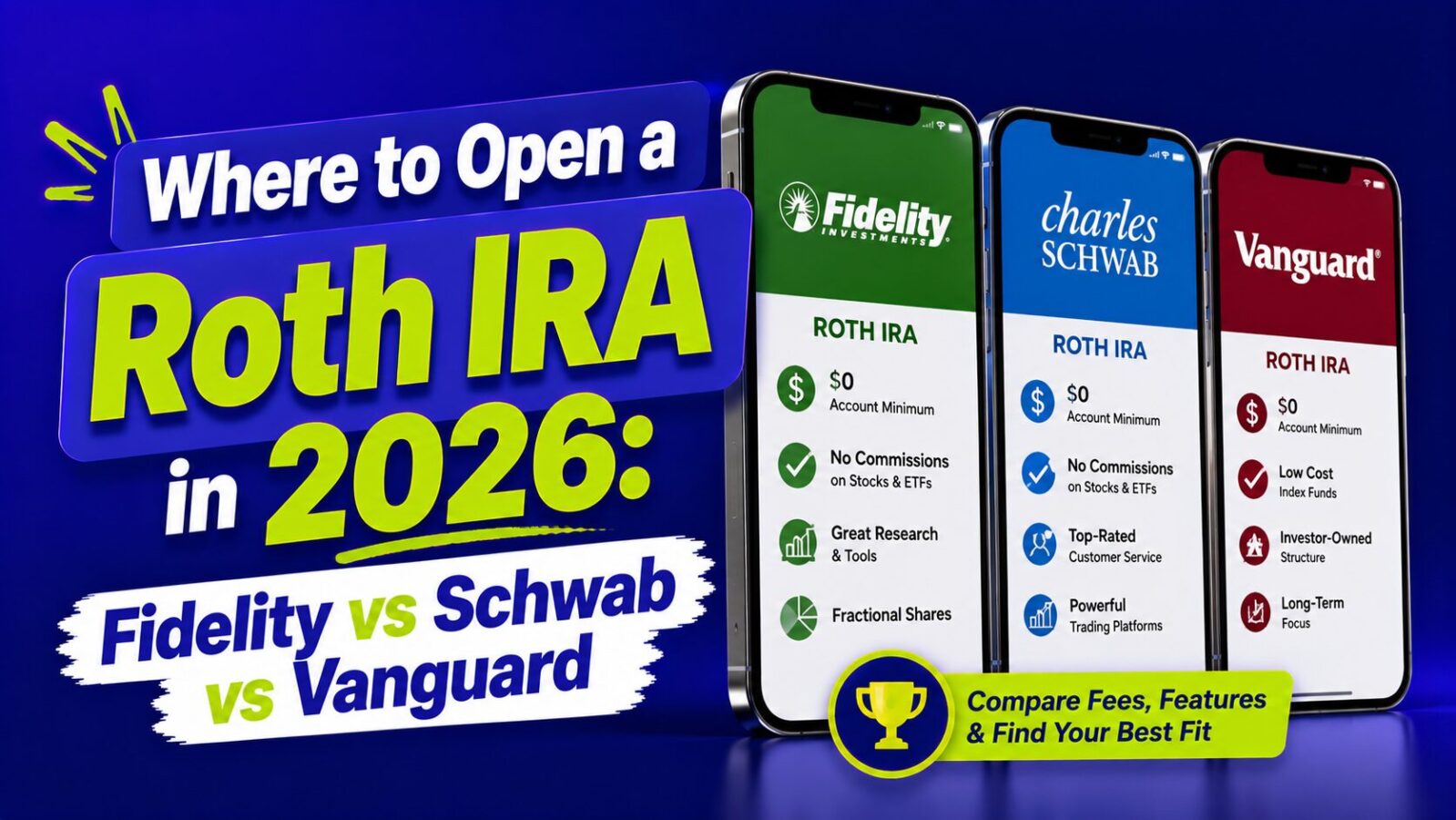
For most people opening their first Roth IRA in 2026, Fidelity is our best overall pick. It combines no IRA account minimum or account fee, $0 online commissions on U.S. stocks and ETFs, fractional investing starting at $1, and Fidelity ZERO index funds with 0.00% expense ratios. Fidelity Go also charges no advisory fee on balances below $25,000.
Schwab is an extremely close second, especially if you value 24/7 support or access to physical branches. Vanguard remains an excellent low-cost investing platform, but its possible $25 account service fee unless waived and higher minimums on many mutual funds make it a little less frictionless for someone starting with a small balance.
Key takeaways
- Best overall: Fidelity. $0 IRA account fees and minimums, broad $1 fractional-share access, zero-expense-ratio mutual funds, and a strong low-balance robo option.
- Best for support: Schwab. $0 opening and maintenance fees, 400+ U.S. branches, 24/7 service, low-cost index funds, and fractional investing in most U.S.-listed stocks and ETFs.
- Best for the Vanguard ecosystem: Vanguard. Excellent low-cost ETFs and funds, but pay attention to mutual fund minimums and the annual account service fee unless you qualify for a waiver.
- The 2026 IRA contribution limit is $7,500, or $8,600 if you are 50 or older. That limit is shared across your Traditional and Roth IRAs.
- Opening a Roth IRA does not invest the money for you. You still need to choose investments unless you use a managed service.
How we compared these Roth IRA providers
For this comparison, we focused on what matters most to someone opening a first Roth IRA:
- IRA account fees and minimums
- online stock and ETF commissions
- low-cost diversified fund choices
- fractional investing
- ease of starting with a small balance
- automated investing options
- access to customer support
We checked current published terms from Fidelity, Charles Schwab, Vanguard, and the IRS as of August 2026.
We put less weight on advanced trading features because someone building a long-term Roth IRA usually does not need a professional trading platform to get started.
Fidelity vs Schwab vs Vanguard at a glance
| Feature | Fidelity | Schwab | Vanguard |
|---|---|---|---|
| Our pick | Best overall | Best for support | Best for Vanguard ecosystem |
| IRA opening minimum | $0 | $0 | $0 |
| IRA account fee | $0 | $0 | Up to $25/year unless waived |
| Online U.S. stock/ETF commissions | $0 | $0 | $0 on ETFs |
| Fractional investing | U.S. stocks and ETFs, from $1 | Most U.S.-listed stocks and ETFs, from $1 | Vanguard ETFs, from $1 |
| Low-cost example | FZROX, 0.00% | SWPPX, 0.02% | VTI, 0.03% |
| Robo option | Fidelity Go | Schwab Intelligent Portfolios | Vanguard Digital Advisor |
| Robo minimum | $10 to start investing | $5,000 | $100 |
| Robo advisory fee | $0 under $25K, then 0.35% | No advisory fee | About $15 to $16 per $10K annually |
| Best fit | Most first-time investors | People wanting support and branches | Investors who prefer Vanguard’s platform |
Fidelity currently charges no account fee or opening minimum for retail IRAs. Schwab lists $0 opening and maintenance fees for its IRAs. Vanguard can charge a $25 annual brokerage account service fee, but signing up for qualifying e-delivery is one way to eliminate it.
Fidelity: best overall for a first Roth IRA
Fidelity gets our top spot because it removes almost every obstacle that matters when you are starting small.
A Fidelity retail IRA has no account-opening minimum and no account fee, and online U.S. stock and ETF trades have $0 commissions. Fidelity also offers fractional investing in thousands of U.S. stocks and ETFs starting at $1.
The real advantage for a beginner, though, is the fund lineup.
Fidelity’s ZERO family includes FZROX, the Fidelity ZERO Total Market Index Fund, and FZILX, the Fidelity ZERO International Index Fund. Both currently have a 0.00% expense ratio and no investment minimum.
You do not have to use those funds. Fidelity also offers conventional low-cost index funds and commission-free ETF trading, so you have plenty of options if you want investments that are available across multiple brokerages.
Fidelity Go is unusually attractive for small accounts
If you do not want to choose and rebalance investments yourself, Fidelity Go is worth knowing about.
There is no minimum to open the account, although Fidelity says you need $10 before it begins investing. The advisory fee is $0 while the account balance is below $25,000. At $25,000 and above, Fidelity currently charges 0.35% per year.
That makes Fidelity especially appealing for someone who wants a managed Roth IRA but is starting with a relatively small balance.
Best for: First-time Roth IRA investors who want low costs, broad investment choices, fractional investing, and the option to automate later.
Read our full Fidelity review.
Schwab: best if support matters to you
Schwab is a strong alternative to Fidelity, especially if you value customer support and access to physical branches.
Schwab Roth IRAs have $0 opening fees, $0 maintenance fees, and $0 commissions for online stock and ETF trades. Schwab also has more than 400 U.S. branches and offers 24/7 service.
Its index funds are also extremely inexpensive.
For example, the Schwab S&P 500 Index Fund, SWPPX, currently has a 0.02% expense ratio and no minimum initial investment. Its total-market fund, SWTSX, currently costs 0.03% and also has no minimum.
Schwab fractional shares are much better in 2026
Older comparisons often say Schwab fractional shares are limited to S&P 500 companies.
That information is now outdated.
Schwab currently says investors can purchase fractional shares of most U.S.-listed stocks and ETFs, starting at $1, with no online commission on those fractional-share trades.
That removes one of Fidelity’s previous advantages over Schwab.
What about Schwab Intelligent Portfolios?
Schwab Intelligent Portfolios charges no advisory fee and no commissions, but it requires at least $5,000 to start. Investors still bear costs associated with the ETFs used in the portfolio, and Schwab notes that other direct and indirect costs can apply.
For someone opening a Roth IRA with $500 or $1,000, Fidelity Go is therefore easier to access. At larger balances, Schwab becomes more competitive if its automated portfolio structure fits what you want.
Best for: Investors who want low costs plus access to branches, phone support, and a broad financial-services ecosystem.
Read our full Charles Schwab review.
Vanguard: excellent funds, slightly more friction for beginners
There is nothing wrong with opening your Roth IRA at Vanguard.
Vanguard remains one of the strongest places to find low-cost diversified investments. Its Total Stock Market ETF, VTI, currently has an expense ratio of just 0.03%.
You can open a Vanguard IRA without funding it immediately, and Vanguard allows fractional purchases of its ETFs for as little as $1.
But there are two details beginners should know.
Vanguard can charge an annual account fee
Vanguard Brokerage Services currently lists a $25 annual account service fee for brokerage accounts.
The good news is that it is easy for many investors to avoid. Vanguard says the fee can be eliminated by signing up for qualifying electronic delivery of statements, confirmations, fund materials, and other account documents. Other waiver conditions also apply.
So this should not automatically stop you from choosing Vanguard, but the original claim that all three providers simply have “$0 account fees” was not accurate.
Not every Vanguard mutual fund has a $3,000 minimum
Vanguard’s mutual fund minimums vary by fund, so it is worth checking the specific investment you want before opening the account.
Vanguard currently lists:
- $1,000 minimums for its Target Retirement Funds and Vanguard STAR Fund
- $3,000 for most actively managed Investor Shares
- $3,000 for most index-fund Admiral Shares
- higher minimums for some other funds
Vanguard ETFs do not have those traditional mutual fund minimums, and fractional Vanguard ETF investing can start much smaller.
Vanguard Digital Advisor is also fairly accessible. It currently requires $100 and costs approximately $15 to $16 annually for every $10,000 invested, according to Vanguard’s published estimate.
Best for: Investors who specifically like Vanguard’s platform, funds, or automated investing service and do not mind checking the fee-waiver requirements.
Read our full Vanguard review.
Do you need a Vanguard account to buy Vanguard ETFs?
No, and this is worth understanding before choosing a brokerage.
ETFs such as Vanguard’s VTI trade on an exchange. You can buy ETFs through other brokerages, including Fidelity and Schwab, both of which currently charge $0 commissions for online U.S. ETF trades.
So if your plan is simply:
“I want to buy a Vanguard ETF in my Roth IRA.”
you do not necessarily need to open the Roth IRA at Vanguard.
You could open the account at Fidelity or Schwab and still buy a Vanguard ETF.
That makes the brokerage decision more about the account experience, fees, automation, support, and other investment choices than about the name printed on your favorite ETF.
Which Roth IRA provider should you choose?
For most beginners, our ranking is straightforward.
Choose Fidelity if: You want the strongest all-around starting point, plan to invest small amounts, want broad fractional-share access, or like the option of zero-expense-ratio funds.
Choose Schwab if: You want similarly low costs but place more value on branches, 24/7 support, or having more financial services under one roof.
Choose Vanguard if: You specifically prefer Vanguard’s ecosystem or Digital Advisor and are comfortable making sure the account service fee is waived.
The difference in investment returns will not come from having the word Fidelity, Schwab, or Vanguard at the top of the screen.
What matters much more is what you invest in, how much you contribute, your investment costs, and whether you stay invested for the long term.
What are the Roth IRA contribution limits for 2026?
The maximum IRA contribution for 2026 is:
| Age | 2026 maximum IRA contribution |
|---|---|
| Under 50 | $7,500 |
| 50 or older | $8,600 |
The extra $1,100 for investors age 50 or older is the IRA catch-up contribution for 2026.
But there are two important catches.
First, $7,500 is not a separate Roth IRA limit and Traditional IRA limit.
The IRS says the annual maximum applies to the combined total of your contributions to all Traditional and Roth IRAs. If you contribute $3,000 to a Traditional IRA in 2026, for example, an otherwise eligible person under 50 generally has no more than $4,500 of the regular annual limit left for a Roth IRA.
Second, you generally cannot contribute more than your taxable compensation for the year if that amount is below the annual limit. Special spousal IRA rules can apply to married couples filing jointly.
What are the 2026 Roth IRA income limits?
Your ability to make a direct Roth IRA contribution also depends on modified adjusted gross income.
For 2026, the IRS phaseout ranges are:
| Filing status | 2026 Roth IRA phaseout |
|---|---|
| Single / head of household | $153,000 to $168,000 |
| Married filing jointly | $242,000 to $252,000 |
| Married filing separately, subject to the special rule | $0 to $10,000 |
For single and head-of-household filers, the permitted direct contribution begins decreasing in the $153,000 to $168,000 range. For married couples filing jointly, the phaseout runs from $242,000 to $252,000.
If your income exceeds the direct-contribution limit, you may want to research a backdoor Roth IRA.
A backdoor Roth is not simply a loophole you can use without checking the tax consequences. Existing pre-tax IRA balances can affect the calculation under the pro-rata rules, so higher-income investors should understand the process before moving money.
How to open your first Roth IRA
The actual account setup is usually the easy part.
1. Choose the brokerage
For most beginners, Fidelity is our default recommendation. Schwab and Vanguard are both reasonable alternatives depending on the features you care about.
2. Open a Roth IRA
Make sure you choose Roth IRA, not a taxable brokerage account or Traditional IRA.
The brokerage will ask for identity and tax information needed to establish the account.
3. Fund the account
Link a bank account and make your contribution.
Remember the 2026 annual limit, your taxable compensation, and the Roth income restrictions before contributing.
4. Choose an investment
This is the step beginners sometimes miss.
Opening and funding a Roth IRA does not necessarily mean the contribution has been invested.
Depending on the brokerage, uninvested money may sit in a cash or settlement position that can earn some interest. But if your goal is long-term market growth, you still need to select an investment or enroll in a managed service.
A simple diversified index fund or appropriate target-date retirement fund can be easier to manage than trying to pick individual stocks.
5. Automate future contributions
Once the account is working the way you want, consider setting up recurring transfers or investments.
You do not need to contribute the full $7,500 at once. Regular smaller contributions can make the annual goal easier to manage.
What should you actually buy inside a Roth IRA?
The brokerage and the investment are two separate decisions.
A Roth IRA can hold many types of investments. For someone building a long-term retirement portfolio, common starting points include:
- a total U.S. stock market index fund
- a broad global stock fund
- a diversified mix of stock and bond index funds
- a target-date retirement fund
The right allocation depends on your time horizon and risk tolerance.
What usually matters more than finding a fund with a 0.00% expense ratio instead of 0.03% is avoiding unnecessarily expensive investments, staying diversified, contributing consistently, and not abandoning the plan when markets fall.
For more on how the account itself works, read our Roth IRA guide.
FAQ
What is the best place to open a Roth IRA in 2026?
For most first-time investors, Fidelity is our best overall choice because it combines no IRA account minimum or account fee, $0 online U.S. stock and ETF commissions, broad fractional investing, and 0.00% expense-ratio index funds. Schwab is a close alternative, particularly if support and branches matter to you.
Is Fidelity or Schwab better for a Roth IRA?
Both are strong. Fidelity has the edge for our beginner recommendation because of its ZERO index funds and Fidelity Go pricing for accounts below $25,000. Schwab offers similarly low self-directed investing costs and currently provides fractional access to most U.S.-listed stocks and ETFs, plus 400+ branches and 24/7 service.
Is Vanguard still good for a Roth IRA?
Yes. Vanguard offers very low-cost funds and ETFs and a $100-minimum Digital Advisor service. Just remember that Vanguard can assess a $25 annual brokerage service fee unless you meet a waiver condition, such as qualifying e-delivery.
How much can I put in a Roth IRA in 2026?
The general 2026 IRA limit is $7,500, or $8,600 if you are age 50 or older, subject to taxable-compensation and Roth income rules. The limit is shared across all of your Traditional and Roth IRA contributions, not multiplied by the number of accounts you own.
Can I have Roth IRAs at more than one brokerage?
Yes. Owning multiple Roth IRA accounts does not multiply your annual contribution limit. Your eligible contributions across your Traditional and Roth IRAs still have to stay within the applicable annual IRA limit.
Does it cost money to open a Roth IRA?
Fidelity and Schwab currently list no opening fee or minimum for their retail IRAs. Vanguard can also be opened without a large account-opening requirement, but a $25 annual account service fee may apply unless you qualify for a waiver. The investments or managed services you choose can have their own expenses.
Can I buy Vanguard ETFs in a Fidelity or Schwab Roth IRA?
Yes. Vanguard ETFs trade on exchanges and can be purchased through other brokerages. Fidelity and Schwab currently offer $0 online commissions on U.S. ETF trades.
Bottom line
Fidelity is our best overall Roth IRA provider for most beginners in 2026. It has no retail IRA account fee or minimum, offers broad fractional investing from $1, has zero-expense-ratio index funds, and gives small investors access to Fidelity Go without an advisory fee below $25,000.
Schwab is the strongest alternative if access to branches and 24/7 support matters more to you. Its fractional-share offering is also much stronger than older comparisons suggest, with most U.S.-listed stocks and ETFs now available fractionally.
Vanguard is still an excellent choice, particularly if you prefer its investing ecosystem, but beginners should know about the potential account service fee and the different minimums across its mutual fund lineup.
Whichever brokerage you choose, opening the Roth IRA is only step one. The bigger long-term decisions are how much you contribute, what you invest in, the costs you pay, and whether you stay consistent.
- Read our Fidelity review
- Read our Charles Schwab review
- Read our Vanguard review
- Learn how Roth IRAs work
- Compare Traditional vs Roth IRA
- Explore our retirement accounts hub
This article is for educational and informational purposes only and is not investment, tax, or financial advice. Brokerage fees, investment expenses, account features, and tax limits can change. Verify current brokerage terms and IRS rules before opening or funding an account.
Disclosure: Some links on this page may be affiliate links. We may earn a commission at no additional cost to you if you open an account through them. Compensation does not determine our recommendations or rankings. See our full affiliate disclosure.