By
By 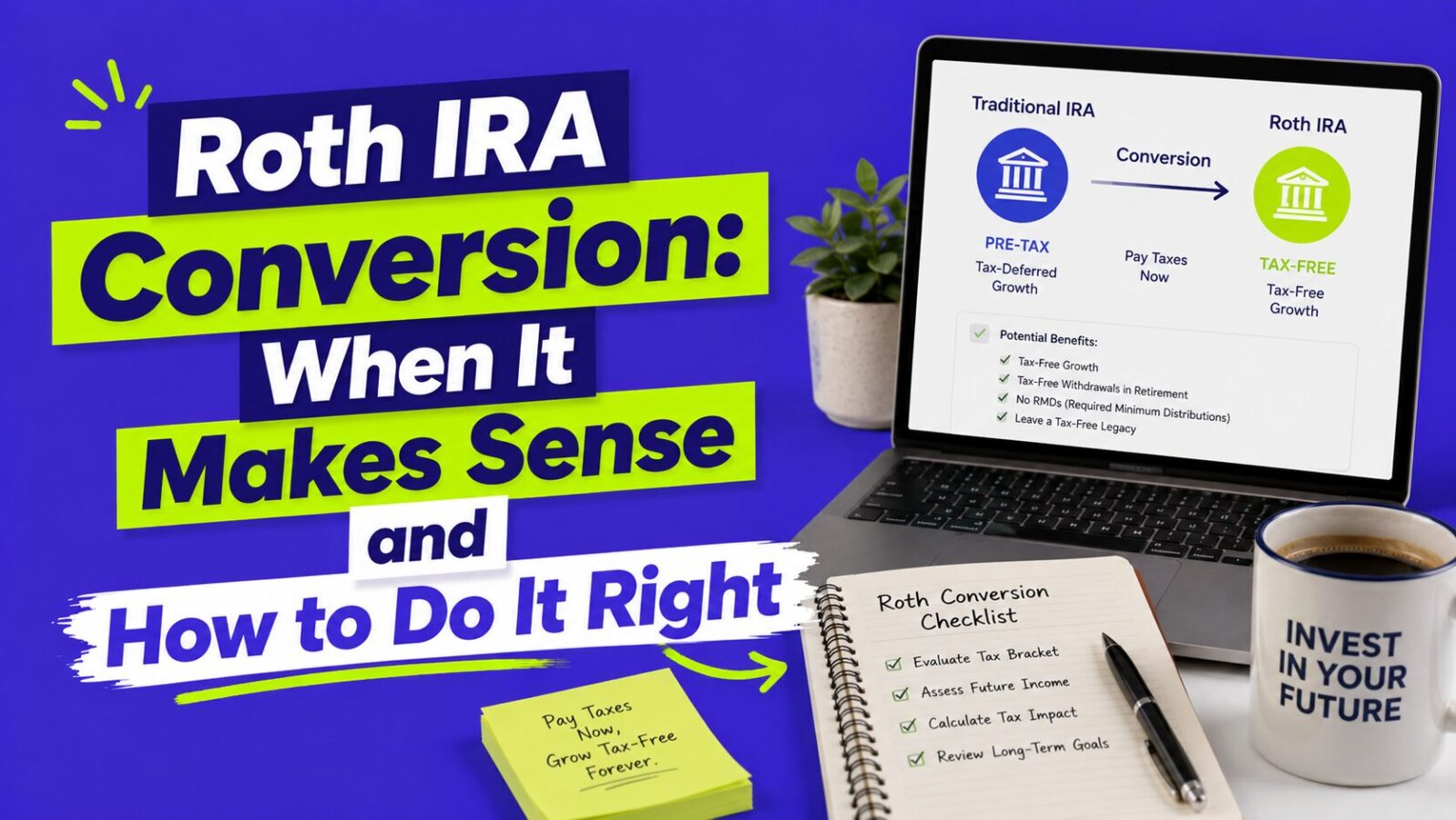
A Roth IRA conversion can be one of the most powerful moves in your retirement toolkit, but it is not right for everyone. Done at the right time, it can save thousands in future taxes. Done carelessly, it triggers a large and unnecessary tax bill.
A Roth IRA conversion is the process of moving money from a pre-tax retirement account (a Traditional IRA, SEP IRA, or Traditional 401(k)) into a Roth IRA. You pay income tax on the converted amount now, and in return all future growth and qualified withdrawals are tax-free. There is no income limit on conversions and no cap on how much you can convert in a year. It is a core tool on the retirement account roadmap.
- The converted amount is added to your ordinary income for the year. On a $75,000 salary plus a $25,000 conversion, the IRS treats your taxable income as about $100,000, and the $25,000 is taxed at your marginal rate (roughly $5,500 at 22%). Pay this tax from outside funds, not from the conversion itself.
- The bracket-filling strategy is the most tax-efficient approach: convert only enough each year to stay in your current bracket. Spreading a $125,000 conversion over five years can keep it all in the 22% bracket (about $27,500 in tax), while converting it all at once stacks much of it into higher brackets and costs more.
- The pro-rata rule prevents you from cherry-picking which IRA dollars to convert. With $90,000 pre-tax and $10,000 after-tax across all your Traditional IRAs, a $10,000 conversion is 90% taxable ($9,000) regardless of which account you pull from.
- Early retirement (between leaving work and taking Social Security) is often the best window. With little or no earned income, large conversions can be taxed at 10 to 12%, far below your working-years bracket. Many FIRE plans are built around conversions during this period.
- Roth IRAs have no Required Minimum Distributions during the owner’s lifetime. Converting reduces future RMDs, which can keep you in a lower bracket in retirement, reduce the taxable portion of Social Security, and preserve more for heirs.
Conversion vs backdoor Roth: what is the difference?
| Feature | Roth conversion | Backdoor Roth IRA |
|---|---|---|
| What it does | Moves existing pre-tax IRA/401(k) money to Roth | Contributes new after-tax money to Roth via a Traditional IRA |
| Amount | No annual limit | Limited to $7,500/year ($8,600 if 50+) |
| Tax impact | Tax on the full converted (pre-tax) amount | Minimal if no pre-tax IRA balances exist (pro-rata rule) |
| Best for | People with existing pre-tax retirement funds | High earners who exceed Roth IRA income limits |
A Roth conversion deals with money already in a pre-tax account. The backdoor Roth IRA is a contribution strategy for high earners who cannot contribute directly to a Roth. They solve different problems and can work together.
Traditional vs Roth: compare your long-term options
Roth vs Traditional IRA Calculator
How much should you convert this year?
Bracket-Filling Conversion Calculator
See how much you can convert this year while staying in your current bracket, and what it costs. Estimates only, 2026 brackets.
The tax math: what you actually owe
When you convert pre-tax dollars to a Roth IRA, the converted amount is added to your ordinary income for that tax year. On a $75,000 salary plus a $25,000 conversion, taxable income becomes about $100,000 (before deductions), and the $25,000 is taxed at your marginal rate.
Critical rule: pay the tax bill from non-retirement funds, a savings account or taxable brokerage. Paying taxes from the conversion itself has two problems: it reduces the amount growing tax-free inside the Roth, and if you are under 59.5, the withheld portion may be treated as an early distribution subject to the 10% penalty.
Who benefits most from a Roth conversion?
You are in a low-income year. Between jobs, on sabbatical, or in a year where business income is lower than usual. Lower income means lower brackets, which means a lower conversion tax rate.
You expect higher taxes in the future. If you are early in your career with income expected to rise, or you believe rates will go up broadly, converting now locks in today’s rate on those dollars.
You have a long time horizon. Converting $50,000 at age 30 that grows to $400,000 by 65 means $350,000 of growth you never pay tax on. The younger you are, the more compounding years that tax-free status covers.
You want to reduce future RMDs. Traditional IRAs require distributions starting at age 73; Roth IRAs have none during the owner’s lifetime. Converting reduces future RMDs, which can keep you in lower retirement brackets and reduce the taxable portion of Social Security.
You want to leave a tax-free inheritance. Inherited Roth IRAs are income-tax-free for beneficiaries (though most must distribute within 10 years under the SECURE Act). Roth money is the cleanest asset to pass on.
A market downturn can be a conversion opportunity. If your Traditional IRA drops from $100,000 to $70,000 in a dip, converting at $70,000 means tax on $70,000 instead of $100,000, and the recovery happens inside the Roth, tax-free.
Who should think twice?
You are in peak earning years and converting would push income into the 32% or 37% bracket. If you expect a lower bracket in retirement, converting at today’s high rate can cost more than it saves.
You do not have cash outside retirement accounts to pay the tax bill. Pulling tax dollars from the conversion defeats much of the purpose.
You are close to retirement and need the money soon. Each conversion has a 5-year holding period before the converted principal can be withdrawn without penalty (if you are under 59.5).
The pro-rata rule: the hidden tax trap
The pro-rata rule says you cannot cherry-pick which dollars to convert. If you have both pre-tax and after-tax (non-deductible) money across all your Traditional IRAs, every conversion is treated as a proportional mix of both, regardless of which account you pull from.
Example: Traditional IRA A holds $90,000 pre-tax; Traditional IRA B holds $10,000 after-tax. Total: $100,000, so the after-tax share is 10%. Converting $10,000 does not let you claim only the after-tax money. The IRS treats 90% ($9,000) as taxable and 10% ($1,000) as tax-free. This is reported on IRS Form 8606, which looks at all Traditional, SEP, and SIMPLE IRA balances combined.
How to avoid it: roll your pre-tax IRA money into your current employer’s 401(k) if the plan accepts incoming rollovers. That leaves only after-tax money in the Traditional IRA, making conversions essentially tax-free. Confirm your 401(k) accepts reverse rollovers before building a strategy around it.
The two 5-year rules
Rule 1, the earnings rule: your Roth IRA must be open at least 5 tax years before you can withdraw earnings tax-free and penalty-free. The clock starts January 1 of the year you first contributed to or converted into any Roth IRA, and it only needs to be satisfied once in your lifetime.
Rule 2, the conversion-specific rule: each conversion has its own 5-year holding period. If you are under 59.5, you must wait 5 years from the conversion year before withdrawing that converted principal without the 10% penalty. This does not apply once you are past 59.5, when there is no early withdrawal penalty regardless.
Practical impact: convert $50,000 in 2026 and you can withdraw that principal (not earnings) penalty-free starting January 1, 2031, even if under 59.5. For long-term retirement conversions, these rules rarely matter because the money stays put for decades.
How do you execute a conversion, step by step?
- Check your current tax situation. Know your taxable income and marginal bracket, and how much room you have before the next bracket. Use the calculator above for the numbers.
- Decide how much to convert. The bracket-filling method: convert just enough to fill your current bracket without spilling into the next. Many people convert a fixed amount annually rather than everything at once.
- Open a Roth IRA if you do not have one. Fidelity, Schwab, and Vanguard all offer free accounts. If you already have one, your 5-year clock may already be running.
- Contact your brokerage. Most allow online conversions in minutes. Converting from a 401(k): roll to a Traditional IRA first (unless your plan allows in-plan Roth conversions), then convert.
- Invest the converted funds immediately. Money landing in a Roth sits in a money market until you invest it. Choose your allocation right away.
- Set aside money for taxes. No taxes are withheld automatically on a conversion. For large conversions, make a quarterly estimated tax payment to avoid underpayment penalties.
- File Form 8606. Your brokerage sends a 1099-R documenting the conversion; report it on Form 8606 with your return.
The multi-year bracket-filling strategy
The real power of Roth conversions is spreading them across years to stay in favorable brackets. Here is a 5-year partial conversion of $125,000 for a single filer with about $70,000 of taxable income (which keeps each year inside the 22% bracket, since that bracket runs to $105,700 in 2026):
| Year | Amount converted | Tax bracket | Estimated tax |
|---|---|---|---|
| Year 1 | $25,000 | 22% | ~$5,500 |
| Year 2 | $25,000 | 22% | ~$5,500 |
| Year 3 | $25,000 | 22% | ~$5,500 |
| Year 4 | $25,000 | 22% | ~$5,500 |
| Year 5 | $25,000 | 22% | ~$5,500 |
| Total (5-year) | $125,000 | 22% | ~$27,500 |
Converting the full $125,000 in a single year on top of $70,000 income pushes most of it into the 24% bracket, for roughly $29,300 in tax. The patient 5-year approach saves about $1,800 here, and the savings grow the larger your conversion is relative to the room in your bracket, or if a lump sum would reach the 32% bracket or higher.
Frequently Asked Questions
No. Anyone can convert regardless of income. The income limits that apply to direct Roth IRA contributions (the phase-out begins at $153,000 single / $242,000 married filing jointly in 2026) do not apply to conversions. That is why the backdoor Roth works for high earners: the conversion step has no income test. You can convert $1 or $1,000,000 in a single year.
No, not under current law. The Tax Cuts and Jobs Act of 2017 eliminated recharacterization of conversions, the ability to reverse one and put the money back in the Traditional IRA. Because you cannot undo it, timing matters: converting during a market downturn (lower valuations) is advantageous, and you should be confident before executing.
This matters most for people 63 and older or near Medicare. Part B and D premiums are income-based through IRMAA, and a large conversion can push your MAGI above a threshold, triggering surcharges that apply two years later. The thresholds sit in the low six figures for singles (roughly double for couples) and adjust annually, so check the current year’s IRMAA brackets before a large conversion, since staying just below a threshold can save on premiums.
Often it is worth considering, especially if you are under 50. You pay a known 22% today in exchange for tax-free growth that may span decades. The bet is that future income (RMDs, Social Security, and other sources stacking together) would put you at or above 22% anyway. If you are confident your retirement income will be very low, keeping the money in Traditional accounts and paying 12% or less on withdrawals may win. Use the calculator above to compare.
Your heirs inherit the Roth IRA income-tax-free. Under the SECURE Act, most non-spouse beneficiaries must distribute within 10 years, but those distributions remain tax-free since you already paid tax at conversion. Traditional IRA money left to heirs is taxed as ordinary income when withdrawn, so Roth is generally the cleanest inheritance structure in a retirement account.
Yes. SEP and SIMPLE IRA balances (both pre-tax) convert to a Roth IRA with the same process and tax treatment, and the pro-rata rule looks at all Traditional, SEP, and SIMPLE IRA balances combined. One difference: a SIMPLE IRA cannot be converted within its first 2 years; after that, conversions proceed normally. SEP IRAs have no such waiting period.
The ideal year has one or more of these: lower-than-normal income (a job gap, early retirement, a business loss year), room left in a low bracket before it ends (the 12% bracket ends at $50,400 for single filers in 2026), no large competing income events, and cash on hand to pay the tax. Market downturns add a bonus, since the same shares convert at lower values. The worst years are peak-earning years when salary, bonus, and conversion all compete for high brackets at once.
The core test: if you expect your effective tax rate in retirement to be higher than your current marginal rate on the conversion, converting tends to make sense. That is harder to know than it sounds, since retirement income stacks RMDs, Social Security (up to 85% taxable), and capital gains together. If your Traditional balance is large relative to expected spending, RMDs alone may push you into higher brackets. A fee-only fiduciary planner can model your specific scenarios.
The bottom line
The Roth conversion question comes down to one judgment: will your effective tax rate be higher or lower in retirement than it is today on the converted amount? For many working Millennials and Gen Z still early in their careers, converting during lower-income years (a gap year, an early retirement period, a year between jobs) can lock in today’s rates on money that compounds tax-free for decades.
The bracket-filling calculator above shows your maximum conversion for this year and the estimated tax cost. Many people start with a small conversion to learn the mechanics, then build a systematic multi-year plan. For timing a year-end conversion specifically, see Roth IRA conversion 2026: should you convert before December 31?
- New to retirement accounts? Start with our hub, Retirement Accounts Explained.
- Considering the backdoor Roth alongside a conversion? Read our backdoor Roth IRA guide, with the pro-rata rule explained.
- Planning to retire early and use conversions as income? Read our Roth conversion ladder guide, the full FIRE strategy with a year-by-year timeline.
- Need to move a 401(k) to a Traditional IRA first? Read our 401(k) rollover guide.
A quick note: this article is for educational purposes only and is not financial, investment, or tax advice. Tax brackets and limits come from the IRS and apply to tax year 2026; verify current figures at IRS.gov before you act. Conversions, the pro-rata rule, and IRMAA can get complex, so it is worth talking with a CPA or qualified tax professional about your situation.