By
By 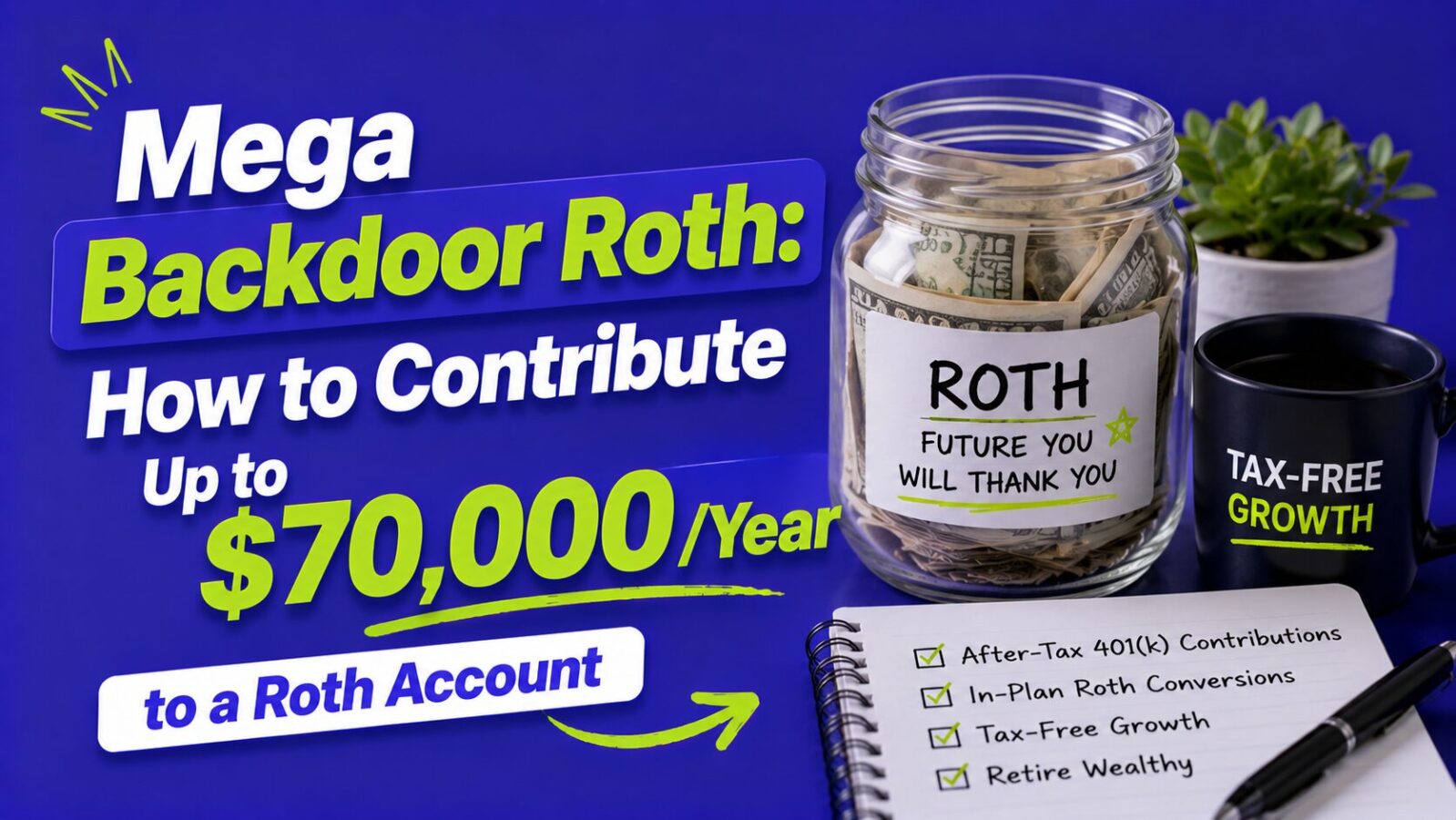
Already maxing your 401(k) and Roth IRA? The mega backdoor Roth lets you funnel a large additional amount into a Roth account each year, completely legal and IRS-recognized, used by thousands of high earners. But it requires a specific type of 401(k) plan.
If you are already maxing out your 401(k) and your Roth IRA (or using the regular backdoor Roth), you might think you have hit the ceiling on tax-advantaged retirement savings. You have not. There is another level called the mega backdoor Roth, and it sits at the top of the retirement account roadmap for high earners.
This strategy can move money into a Roth account up to the $72,000 combined 401(k) ceiling for 2026, well beyond the standard $24,500 employee limit and the $7,500 Roth IRA cap. It is completely legal and IRS-recognized, but it requires a very specific type of 401(k) plan, and most people do not know it exists.
- The mega backdoor Roth uses after-tax (non-Roth) 401(k) contributions, a third contribution type most people do not know exists. These go in beyond the $24,500 standard limit, up to the $72,000 combined employer + employee ceiling, and once converted to Roth they grow tax-free.
- Two plan features are both required: your plan must allow after-tax non-Roth contributions, and it must allow either in-plan Roth conversions or in-service distributions. If either is missing, the strategy does not work in your plan.
- Speed of conversion matters. After-tax contributions are not taxed again on conversion (you already paid tax), but any earnings between contribution and conversion are taxed as ordinary income. Convert quickly, ideally within days. Plans with automatic in-plan conversions are the ideal setup.
- A common priority order: capture the full employer match, max the Roth IRA at $7,500, max the employee 401(k) at $24,500, fund an HSA if eligible, then use mega backdoor space up to the $72,000 combined limit.
- High earners in their 20s and 30s gain the most, since decades of tax-free compounding on converted after-tax contributions can accumulate into the millions of dollars in tax-free assets by their late 60s, depending on market returns.
What are the three types of 401(k) contributions?
Most people only know about two types. There are actually three:
| Type | Tax treatment | 2026 limit | Who uses it |
|---|---|---|---|
| Pre-tax (Traditional) | Deducted from taxable income now, taxed on withdrawal | $24,500 (shared) | Most employees |
| Roth 401(k) | After-tax dollars now, grows tax-free | $24,500 (shared) | Employees preferring tax-free growth |
| After-tax non-Roth | No deduction; earnings taxed on withdrawal unless converted to Roth | Up to $72,000 total minus other contributions | Mega backdoor Roth users |
That third type, after-tax non-Roth contributions, is the key. On their own they are a mediocre deal (earnings are taxed). Combined with immediate Roth conversion, they become powerful.
How much mega backdoor space do you have?
Mega Backdoor Space Calculator
Enter your 2026 contribution details to see your available after-tax space. Estimates only.
Does your plan support it? How to check
Eligibility Checklist
How to verify: log into your 401(k) provider and look at contribution election options (an “after-tax” option separate from “Roth” is a positive sign); call your plan administrator and ask, “Does our plan allow after-tax non-Roth contributions, and does it allow in-plan Roth conversions or in-service distributions?”; or request the Summary Plan Description from HR and search for “after-tax” and “in-service distribution.”
Large employers, including many big tech firms and major financial institutions, are more likely to offer the needed features. Smaller companies and startups are less likely to, though availability is growing.
How does it work mechanically?
Step 1: Max your standard 401(k) first
Max your regular 401(k) contributions at $24,500 (pre-tax or Roth, your choice). If you have not hit this limit, prioritize it before worrying about after-tax contributions.
Step 2: Calculate your after-tax space
Take the $72,000 overall limit and subtract your employee contributions ($24,500) plus employer match and profit sharing. The remainder is your mega backdoor space. Use the calculator above for your numbers.
Step 3: Set your after-tax contribution election
Log into your 401(k) provider and set an after-tax contribution percentage based on your remaining paychecks. Do not exceed the $72,000 total limit. Your plan administrator should have safeguards, but verify the math yourself.
Step 4: Convert immediately to Roth
After-tax contributions are not taxed again on conversion (you already paid tax through your paycheck), but any earnings between contribution and conversion are taxed as ordinary income. Convert as soon as possible, within days or even hours of each contribution.
Option A: in-plan Roth conversion, where after-tax money moves into the Roth 401(k) bucket within the same plan. Many plans offer automatic daily conversions; enable that if available. Option B: in-service distribution to a Roth IRA, where after-tax money rolls out of the 401(k) into your external Roth IRA while still employed, giving you more investment options.
Step 5: Track for taxes
You will receive a 1099-R for the conversion. The taxable portion (earnings only, usually small if you convert quickly) goes on your tax return. Keep records of your after-tax contributions on IRS Form 8606.
The tax math
| Amount | Tax treatment |
|---|---|
| After-tax contributions | Not taxed again on conversion (already paid through paycheck) |
| Earnings between contribution and conversion | Taxed as ordinary income (minimize by converting quickly) |
| All future growth after conversion | Tax-free |
| Qualified Roth withdrawals in retirement | Completely tax-free |
Example: you contribute $5,000 after-tax, it earns $12 before you convert 3 days later, so you convert $5,012 to Roth and owe ordinary income tax on the $12. The full $5,012 then grows tax-free. That is the shift from mediocre tax treatment (after-tax with taxable earnings) to the best available (Roth with tax-free growth).
Mega backdoor Roth vs regular backdoor Roth
| Feature | Regular backdoor Roth | Mega backdoor Roth |
|---|---|---|
| Account used | Traditional IRA to Roth IRA | 401(k) after-tax to Roth 401(k) or Roth IRA |
| Annual limit | $7,500 ($8,600 if 50+) | Up to about $47,500 depending on other contributions |
| Employer plan required | No | Yes, plan must support both features |
| Pro-rata rule concern | Yes (if pre-tax IRA balances exist) | No |
| Available to everyone | Yes (with earned income) | Only if the plan supports it |
These are complementary strategies. If your plan supports the mega backdoor Roth, you can also do the regular backdoor Roth. Combined, that can be roughly $50,000 or more into Roth accounts in a single year (a $7,500 regular backdoor plus your mega backdoor space).
Frequently Asked Questions
Both use after-tax dollars, but earnings are treated differently. Roth 401(k) earnings grow tax-free, and qualified withdrawals are completely tax-free. After-tax non-Roth earnings are taxed as ordinary income when withdrawn, unless converted to Roth. That is why the mega backdoor Roth requires converting the after-tax contributions to Roth quickly, to minimize the taxable earnings before conversion.
It has been discussed. The Build Back Better Act in 2021 proposed eliminating both the regular and mega backdoor Roth; it passed the House but failed in the Senate, and similar proposals have not become law as of 2026. If rules change, money already converted to Roth is generally grandfathered under existing Roth rules, which is a reason many people use the strategy now rather than waiting.
After-tax non-Roth contributions are always 100% yours (vesting applies only to employer match). When you leave, you can roll the pre-tax portion to a Traditional IRA and the after-tax contribution portion directly to a Roth IRA in a “split rollover,” which avoids pro-rata issues. The IRS permits this under Notice 2014-54. Use a direct rollover (check payable to the new custodian, not to you) to avoid withholding.
Only if your plan allows in-service distributions of after-tax contributions, which lets you roll them to a Roth IRA while still employed. Check your Summary Plan Description for “in-service distribution” of after-tax contributions. If your plan allows neither in-plan conversions nor in-service distributions, the strategy does not work, and the after-tax contributions would just accumulate taxable earnings, a poor deal versus a taxable brokerage.
Yes, through a Solo 401(k) whose plan document explicitly allows after-tax non-Roth contributions and in-plan Roth conversions. Some specialized providers support this; the free Solo 401(k) plans from Fidelity and Schwab typically do not include after-tax provisions, and a SEP IRA does not support the strategy at all. With the right plan, a self-employed person can shelter far more than the standard limits into Roth.
Roth conversions, including mega backdoor conversions, have a 5-year seasoning period for penalty-free withdrawal of the converted principal if you are under 59.5. This mainly matters for early retirees using a Roth conversion ladder. For people who will use the funds after 59.5, the 5-year rule is usually not a concern, since the money will have been in the Roth far longer.
You will receive a 1099-R for any in-plan conversion or in-service distribution. For in-plan Roth conversions, Box 7 typically shows code G, and the taxable amount in Box 2a represents earnings before conversion (ordinary income). For in-service distributions to a Roth IRA, the after-tax contributions are non-taxable (reported on Form 8606, Part II) and earnings are taxable. Track your after-tax basis on Form 8606 to prevent double taxation later.
What is the priority order for retirement savings?
- 401(k) up to the full employer match, the free money, always first
- Pay off high-interest debt (above 7 to 8%)
- Max the Roth IRA at $7,500 (directly or via backdoor Roth)
- Max 401(k) employee contributions at $24,500
- HSA if eligible ($4,400 individual / $8,750 family)
- Mega backdoor Roth, after-tax 401(k) contributions converted to Roth
- Taxable brokerage account for anything beyond
The bottom line
The mega backdoor Roth is not for everyone. You need a qualifying plan, enough income to save beyond normal limits, and the willingness to manage a slightly more complex process. But if you check all the boxes, it is one of the most powerful wealth-building tools in the tax code.
If your plan supports it, use the calculator above to see your available space, so you do not leave tens of thousands of dollars of Roth contribution room untapped each year.
- New to retirement accounts? Start with our hub, Retirement Accounts Explained.
- Need to max your standard 401(k) first? Read our 401(k) maximization guide, with the employer match calculator and contribution strategy.
- Want the regular backdoor Roth? Read our backdoor Roth IRA guide, the $7,500 conversion available to high earners regardless of employer plan.
- Self-employed and want similar advantages? Read our SEP IRA guide, with contributions up to $72,000/year through self-employment income.
A quick note: this article is for educational purposes only and is not financial, investment, or tax advice. Contribution limits come from the IRS and apply to tax year 2026; verify current figures at IRS.gov and confirm your plan’s features before you act. The conversion and reporting steps can get complex, so it is worth talking with a CPA or qualified tax professional about your situation.