By
By 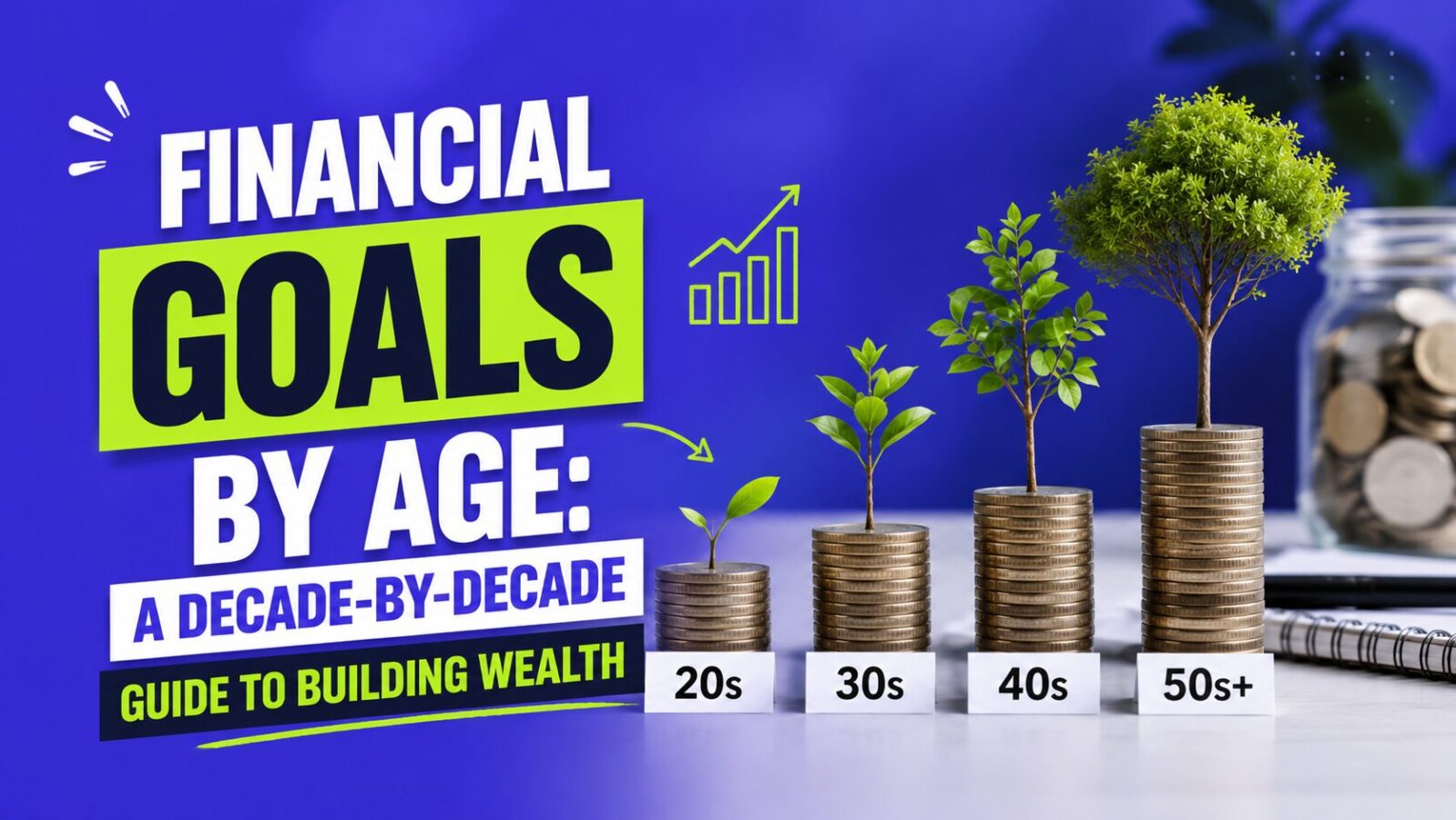
Personal finance loves to throw out big numbers without context. This guide gives you realistic benchmarks by decade — not to stress you out, but to give you direction and show you exactly what to do from wherever you are right now.
Whether you are 22 and opening your first Roth IRA or 55 and playing catch-up, the most powerful financial tool you have is time combined with consistent action. These benchmarks are guideposts, not pass-fail grades.
- The single most important financial decision of your 20s is starting. The difference between beginning retirement contributions at 22 vs 30 is approximately $635,000 at retirement (same monthly amount, 7% average return). No other single decision has this magnitude of long-term impact.
- Fidelity’s widely cited benchmarks: 1x salary by 30, 3x by 40, 6x by 50, 8x by 60, 10x by 67. These targets assume a 15% savings rate throughout your career. If you are behind, delaying retirement by 2 to 3 years has a triple effect: more saving years, more growth, fewer withdrawal years.
- Your 40s are typically peak earning years and the most impactful saving decade. Aggressively maxing all tax-advantaged accounts (401(k), IRA, HSA) in your 40s can offset a slow start in your 20s. The math is unforgiving but not hopeless — 15 years of aggressive saving in your 40s and 50s can still reach meaningful retirement readiness.
- The 4% rule: you need approximately 25x your annual retirement spending saved to retire sustainably. If you plan to spend $60,000/year in retirement, you need $1,500,000 saved. Use this as your target, not a salary multiple, since actual spending needs vary widely.
- Being behind the benchmarks is common — Federal Reserve data consistently shows the median American household carries far less than recommended. The worst response is paralysis. Starting now, even modestly, is better than waiting for the “right” moment.
Am I on track?
Retirement Savings Benchmark Check
Compare your current savings to the Fidelity benchmark for your age and salary.
Your 20s: build the foundation
Your 20s are less about accumulating wealth and more about building the habits and systems that make wealth possible. The stakes are lower now than they will ever be again.
| Milestone | Target |
|---|---|
| Emergency fund | 3 months of expenses by age 25 |
| Retirement savings by 30 | 1x your annual salary (Fidelity) |
| Net worth by 30 | Positive (any amount above zero) |
| Savings rate goal | 15 to 20% of gross income |
Top priorities: Build a $1,000 to $2,000 starter emergency fund first. Pay off high-interest debt aggressively (credit card debt at 20%+ APR is a guaranteed negative return no investment consistently beats). Contribute at least enough to your 401(k) to capture the full employer match. Open a Roth IRA — your 20s are likely your lowest-earning years, making Roth contributions especially valuable. Build your credit score.
Investment allocation: 90% stocks (split U.S. and international), 10% bonds. You can afford to be aggressive with 35 to 40 years until retirement.
Your 30s: accelerate and optimize
Higher income, but also bigger expenses — mortgages, kids, career transitions. The goal is to accelerate savings while managing lifestyle inflation.
| Milestone | Target |
|---|---|
| Emergency fund | 6 months of expenses |
| Retirement savings by 35 | 2x your annual salary |
| Retirement savings by 40 | 3x your annual salary |
| Savings rate goal | 15 to 25% of gross income |
Top priorities: Grow emergency fund to 6 months. Increase retirement savings rate to 15 to 20% (including employer match). Get term life insurance if anyone depends on your income — 10 to 12x annual income for a 20 or 30-year term. Start a 529 plan if you have children. Review homeownership math: only buy if you plan to stay 5 to 7+ years and the total monthly cost is comparable to renting.
Investment allocation: 80 to 85% stocks, 15 to 20% bonds. Keep house down payment funds separate from retirement investments in a high-yield savings account.
Your 40s: peak earning and saving years
For many people, the 40s represent peak earning potential. This is the decade where aggressive saving can make or break your retirement timeline.
| Milestone | Target |
|---|---|
| Retirement savings by 45 | 4x your annual salary |
| Retirement savings by 50 | 6x your annual salary |
| Net worth by 50 | 3 to 5x your annual salary |
| Savings rate goal | 20 to 30% of gross income |
Top priorities: Max all tax-advantaged accounts (401(k), IRA, HSA). Eliminate all non-mortgage debt. Review and update your estate plan — will, healthcare directive, power of attorney, beneficiary designations. Evaluate career trajectory: are you on track for continued income growth or have you plateaued?
Investment allocation: 70 to 80% stocks, 20 to 30% bonds. You still have 20+ years until retirement, so staying majority stocks is appropriate.
Your 50s: the home stretch
The IRS helps here with catch-up contributions. Workers 50+ can contribute extra amounts above the standard limits. This decade is the final big push toward retirement readiness.
| Milestone | Target |
|---|---|
| Retirement savings by 55 | 7x your annual salary |
| Retirement savings by 60 | 8 to 10x your annual salary |
| Savings rate goal | 25 to 35% of gross income |
Top priorities: Max catch-up contributions. Calculate your specific retirement number (25x annual retirement spending using the 4% rule). Check your Social Security estimate at ssa.gov — the difference between claiming at 62 vs 70 can be hundreds of thousands of dollars over your lifetime. Plan for pre-Medicare healthcare coverage if retiring before 65.
Investment allocation: 60 to 70% stocks, 30 to 40% bonds. Risk management becomes increasingly important.
Your 60s: transition to retirement
The 60s are about execution. Converting your portfolio into a reliable income stream that lasts 25 to 30 years or more.
| Milestone | Target |
|---|---|
| Retirement savings at 65 | 10 to 12x your annual salary |
| Total nest egg target | 25x annual retirement spending (4% rule) |
Top priorities: Finalize your retirement budget by tracking actual spending for 6 to 12 months. Coordinate Social Security claiming strategy between spouses. Create a tax-efficient withdrawal order (taxable accounts first, then tax-deferred, then Roth — though Roth conversions in early retirement can change this). Plan for required minimum distributions starting at age 73. Address long-term care planning — approximately 70% of people over 65 need some form of long-term care.
Investment allocation: 40 to 60% stocks, 40 to 60% bonds and cash. You still need growth — a 65-year-old may need the portfolio to last 30+ years.
Quick summary table
| Age | Retirement savings target | Key priority |
|---|---|---|
| 25 | Building toward 1x salary | Emergency fund, employer match, Roth IRA |
| 30 | 1x annual salary | Eliminate high-interest debt, build savings rate |
| 35 | 2x annual salary | Increase savings rate, term life insurance |
| 40 | 3x annual salary | Max tax-advantaged accounts, non-mortgage debt gone |
| 45 | 4x annual salary | Estate plan, career trajectory check |
| 50 | 6x annual salary | Catch-up contributions, Social Security planning |
| 55 | 7x annual salary | Retirement projections, healthcare bridge strategy |
| 60 | 8 to 10x annual salary | Withdrawal strategy, RMD planning |
| 65 | 10 to 12x annual salary | Medicare enrollment, estate plan updates |
What if you are behind?
Federal Reserve data consistently shows the median American household carries far less than recommended targets. Being behind is common. The best response is not guilt — it is a plan.
Increase savings rate aggressively. Even a 5% increase in your savings rate can make a meaningful difference over 10 to 15 years. Track your spending, find the leaks, redirect that money.
Max catch-up contributions after 50. The extra 401(k) and IRA space is specifically designed for people who need to accelerate.
Delay retirement by 2 to 3 years. Triple benefit: more saving years, more investment growth, fewer withdrawal years. Delaying from 65 to 67 can improve financial outcomes by 20 to 30%.
Delay Social Security. Every year you delay past full retirement age (up to 70) increases your benefit by about 8% — a guaranteed return you will not find anywhere else.
Consider part-time work in early retirement. Even $15,000 to $20,000/year from part-time work dramatically reduces portfolio withdrawal pressure, giving it more time to grow.
Frequently Asked Questions
What is the Fidelity retirement savings benchmark based on?
Fidelity’s widely cited benchmarks (1x salary at 30, 3x at 40, 6x at 50, 10x at 67) assume a 15% savings rate throughout your career, Social Security income as a supplement, and retiring at approximately age 67. They are designed as general guideposts, not precise requirements. Your specific number depends on your expected retirement spending, planned retirement age, Social Security benefits (check ssa.gov), and any pension or other income. The 4% rule alternative (save 25x your planned annual spending) is more personalized since it accounts for actual spending needs rather than income replacement.
How much do I need to save per month to reach 1x salary by 30?
It depends on your starting point, salary, and investment returns. A rough calculation: if you are 25 earning $60,000 with $10,000 saved and want to reach $60,000 by 30, you need to accumulate $50,000 more over 5 years. At 7% return, you would need to contribute approximately $700 to $750/month. If your employer matches 3%, contributing 10% of a $60,000 salary is $6,000 plus $1,800 in match = $7,800/year (~$650/month) plus growth. Use the savings benchmark checker above with your specific numbers to see your gap and required monthly contributions.
What is the 4% rule and is it still valid?
The 4% rule states that you can withdraw 4% of your portfolio in the first year of retirement, adjust for inflation annually, and have a high probability of not running out of money over 30 years. It is based on historical stock and bond returns (the Trinity Study). Critics note that current lower bond yields and higher valuations may make 3 to 3.5% a more conservative and durable withdrawal rate. The rule is best used as a starting framework: divide your planned annual retirement spending by 0.04 (or 0.035 for more cushion) to get your target portfolio size. For a $60,000/year retirement lifestyle: $60,000 / 0.04 = $1,500,000 target.
At what age should I shift from aggressive to conservative investments?
There is no single right answer, but a common rule of thumb is “110 minus your age” in stocks (so at 40: 70% stocks, 30% bonds). More aggressive investors use “120 minus age.” The shift should be gradual rather than sudden. Key consideration: you still need growth even at 65, since your portfolio may need to last 30+ years. Going 100% bonds or cash at retirement is actually risky in a different way — inflation erosion. Most financial planners suggest maintaining 40 to 60% stocks well into retirement, with the rest in bonds and cash for stability and near-term withdrawals.
How do I calculate my own retirement number?
Step 1: Estimate your annual retirement spending. Track your current spending and adjust for retirement (typically remove commuting, work clothes, but add travel and healthcare). A common estimate is 70 to 80% of pre-retirement income, but this varies widely. Step 2: Subtract guaranteed income. Estimate your Social Security benefit (ssa.gov), any pension income, or rental income. Step 3: The gap is what your portfolio must cover. Step 4: Multiply the annual portfolio-funded spending by 25 (4% rule). Example: Want $80,000/year, will receive $24,000/year in Social Security. Portfolio must cover $56,000/year. Target portfolio: $56,000 x 25 = $1,400,000.
What should I prioritize if I am behind in my 40s or 50s?
In order of impact: (1) Maximize 401(k) contributions, including catch-up amounts after 50 — this is tax-advantaged and has an employer match layer that cannot be replicated elsewhere. (2) Open or maximize a Roth IRA or do backdoor Roth contributions if income is too high for direct Roth. (3) Eliminate all high-interest debt — the guaranteed 20%+ return from paying off credit cards beats any investment. (4) Evaluate delaying retirement by 2 to 3 years — this single decision often has more impact than 5 additional years of maximum contributions. (5) Consider whether downsizing your primary residence, eliminating a car payment, or reducing housing costs can free up significant monthly cash flow for savings.
The bottom line
Financial goals by age are meant to give you direction, not stress you out. Whether you are right on track or behind the benchmarks, the most important thing is knowing where you stand and taking one concrete action today.
Use the benchmark checker above to see your specific situation. Then look at the decade guide for your age group to identify your highest-priority next steps.
Related reading:
- Ready to maximize your 401(k)? Read our 401(k) maximization guide — employer match calculator + step-by-step instructions.
- Need to set up or update your estate plan? Read our estate planning basics guide — the 4 documents every adult needs and how to create them for under $200.
- Wondering if you need a financial advisor? Read our financial advisor guide — when to hire one, who to trust, and what a fee-only fiduciary actually costs.