By
By 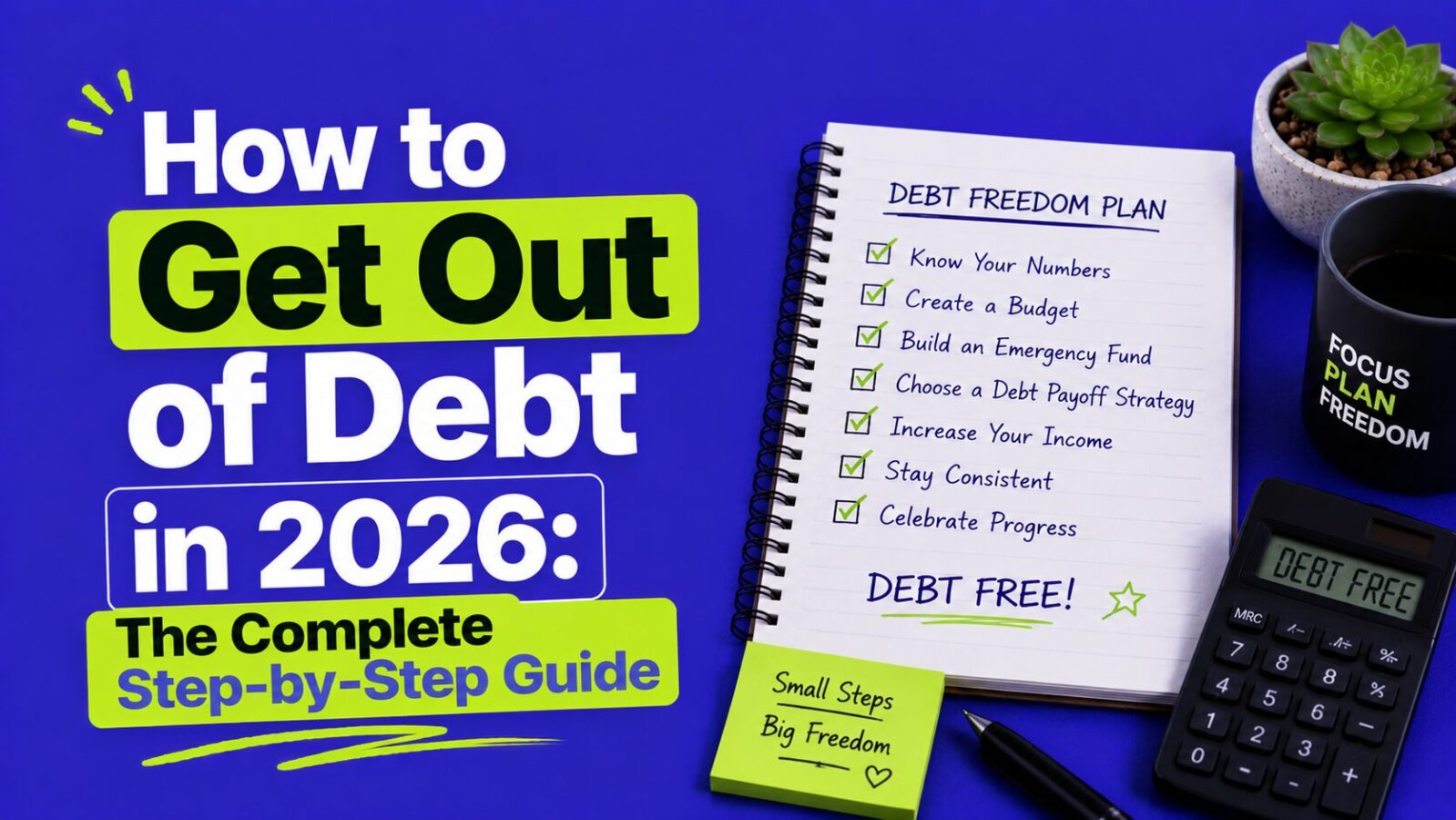
To get out of debt, list everything you owe, stop adding new debt, save a small $1,000 buffer, then attack your balances with the avalanche or snowball method while throwing every extra dollar at them. American credit card debt topped $1.25 trillion in 2026, and the average household carrying a balance owes around $7,951 at about 21.5% APR, which takes over 30 years to clear at minimums. A structured plan cuts that to 2 to 4 years for most people. Here is exactly how.
Key Takeaways
- Start with a complete list of every balance, rate, and minimum payment.
- Stop adding new debt first; you cannot fill a tub with the drain open.
- Save a $1,000 buffer so surprises do not derail your payoff.
- Pick avalanche or snowball, automate it, and aim extra income at the target debt.
Step One: Know Exactly What You Owe
You cannot plan without complete information. Pull every debt into one list with its balance, interest rate, minimum payment, and lender, covering credit cards, personal loans, student loans, auto loans, and medical debt. Most people find their total is higher or lower than they guessed; either way, the list is where everything starts.
Use this calculator to see your overall net worth as a baseline:
Net Worth Calculator
Step Two: Stop Adding New Debt
This is where most plans fail. If you pay down cards while still charging new purchases, you move in circles. Two practical fixes: put the cards away (literally freeze them in a bag of water so emergencies are still possible but impulse buys are not, and do not close them, since that hurts your credit), and switch to cash or debit for discretionary spending, which makes the cost feel real and naturally curbs spending.
Step Three: Build a $1,000 Emergency Buffer
Before attacking debt, save $1,000 in a separate account. It is not a full emergency fund, just a buffer so a $600 car repair does not go straight back on a credit card and undo your progress. Build it first, focus entirely on debt until it is gone, then build the full 3-to-6-month fund. See our guide on the best high-yield savings accounts.
Step Four: Choose Your Payoff Strategy
There are two proven methods, and the choice is about psychology, not math. The debt avalanche sends every extra dollar to the highest-rate debt first, paying the least total interest and finishing fastest on paper. The debt snowball sends extra to the smallest balance first, costing a little more interest but creating quick wins; Harvard Business Review research found it leads to higher completion rates. Use this calculator to compare them for your debts:
Debt Snowball vs Avalanche Calculator
Step Five: Find Extra Money to Accelerate
Your payoff speed is directly tied to how much extra you can add each month. The highest-leverage sources: cancel unused subscriptions (most people find $50 to $150 a month), negotiate bills with your internet, insurance, and phone providers (a 20-minute call can save $30 to $80 a month), sell unused items (a focused weekend can generate $200 to $1,000), and increase income (an extra $500 a month can cut a 3-year payoff to under 2). Direct all of it at your target debt.
Step Six: Consider a Balance Transfer or Consolidation
With good credit (670+), a 0% balance transfer card gives you 12 to 21 months of interest-free payoff; the Citi Double Cash and others offer about 0% for 18 months with a 3% fee. On a $5,000 balance at 21.5%, a $150 fee plus 0% beats paying about $1,075 in interest if you pay it down in the window. For larger amounts across several debts, a consolidation loan at 8% to 16% may be simpler than juggling transfers. See our guide on debt consolidation loans.
Step Seven: Automate Your Payments
Set automatic payments above the minimum on your target debt, scheduled for the day after your paycheck lands, before the money can be spent. If you rely on remembering to pay extra manually, you will miss months; automation removes the decision entirely.
How Long Will It Take?
Here is how long $10,000 at 21.5% takes at different monthly payments:
| Monthly payment | Months to payoff | Total interest |
|---|---|---|
| Minimum only (~$200) | ~94 (7.8 years) | ~$8,622 |
| $300 | ~44 (3.7 years) | ~$3,136 |
| $400 | ~30 (2.5 years) | ~$2,013 |
| $500 | ~23 (1.9 years) | ~$1,496 |
| $750 | ~15 (1.2 years) | ~$936 |
What Should You Do After You’re Debt-Free?
Redirect every dollar you sent to creditors into your own accounts: build a full 3-to-6-month emergency fund in a high-yield savings account, capture any 401(k) employer match, open or max a Roth IRA, and keep one or two cards open and paid in full to maintain your credit. The payment habit you built paying off debt is the same one that builds wealth; only the direction changes.
FAQ
What is the first step to getting out of debt?
List every debt with its balance, rate, and minimum payment. You cannot build a plan without the full picture, and most people misjudge their total until they write it all down.
Should I save or pay off debt first?
Save a small $1,000 buffer first, then focus entirely on debt, then build a full emergency fund. The buffer keeps surprise expenses from sending you back to the credit cards.
How long does it take to get out of debt?
At minimums, $10,000 at 21.5% takes nearly 8 years. A structured plan with extra payments cuts most people to 2 to 4 years, and paying $500 instead of $300 a month can save years.
What is the best debt payoff method?
The avalanche saves the most interest; the snowball has higher completion rates. Both work, so pick the one you will stick with and automate it.
Bottom Line
Getting out of debt comes down to a clear sequence: list it, stop adding to it, save a $1,000 buffer, pick a payoff method, find extra money, and automate, which gets most people debt-free in 2 to 4 years. Then redirect those payments into savings and investing. To go deeper, see our guides on paying off credit card debt fast, avalanche vs snowball, and debt consolidation loans.
This article is for educational and informational purposes only and is not financial advice. Figures are estimates and vary by source and situation. Confirm current rates and options with your lenders.