By
By 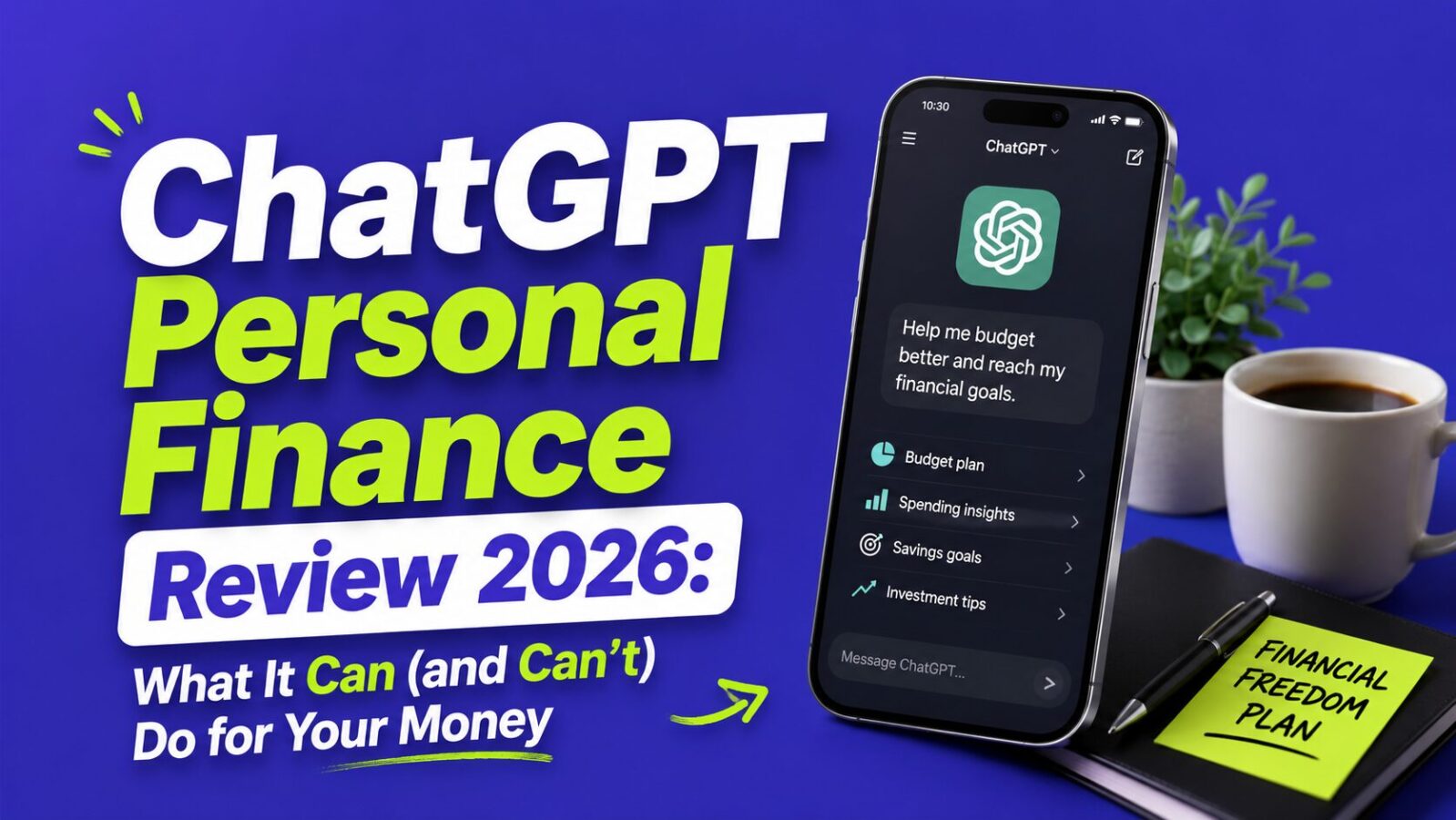
On May 15, 2026, OpenAI launched a personal finance preview inside ChatGPT that lets Pro users connect their bank accounts, credit cards, and investment accounts through Plaid and ask questions about their actual financial data. It is the most significant expansion of what an AI chatbot can do with your money to date. It is also, in its current form, more limited than the launch coverage suggests. Here is an honest assessment of what it does, who it works for, and where dedicated tools still win.
ChatGPT is a tool, not a plan, pair it with the framework in our how to budget guide.
- ChatGPT can now connect to your bank, card, and investment accounts via Plaid, but only for Pro users ($200/mo) in the US right now.
- The connected feature’s edge is the conversational reasoning layer: it explains why spending changed and what to do, not just what happened.
- The free, unconnected version is already excellent for explaining concepts, building budgets from your numbers, and modeling scenarios.
- It is not a fiduciary, cannot take action, and can still be confidently wrong on tax and regulatory details.
- Verdict: a complement to apps like Monarch and YNAB, not a replacement. Wait for the $20/mo Plus rollout before paying for the connected version.
What just launched
OpenAI‘s personal finance feature, currently in preview for ChatGPT Pro users in the United States, allows you to connect your financial accounts through Plaid, which supports more than 12,000 financial institutions including essentially every major US bank, credit union, brokerage, and credit card issuer.
Once accounts are connected, ChatGPT gains access to your balances, transactions, investments, and liabilities. It cannot see full account numbers and cannot make changes to accounts or execute transactions on your behalf. You can disconnect accounts at any time through Settings or the Finances page, and OpenAI states that synced account data is deleted from its systems within 30 days of disconnection.
The feature is currently available only to ChatGPT Pro subscribers in the United States, on web and iOS. Pro costs $200 per month. OpenAI plans to expand the feature to Plus subscribers ($20 per month) after gathering feedback from the Pro rollout. The model powering the feature is GPT-5.5, which OpenAI says brings improved reasoning for the complex, context-dependent questions personal finance requires.
OpenAI has noted that an Intuit integration is planned in addition to the existing Plaid connection, which would eventually bring in TurboTax and QuickBooks data for more complete financial context.
What ChatGPT can do for personal finance
With connected accounts (Pro users)
When your accounts are connected, ChatGPT can answer questions grounded in your actual financial data. OpenAI provided sample questions the feature is designed to handle:
- “I feel like I’ve been spending more recently. Has anything changed?”
- “Help me build a plan to buy a house in my area in the next 5 years.”
- “What recurring charges am I paying that I might want to reconsider?”
- “How am I tracking against my savings goal this month?”
The interface includes a financial dashboard showing spending by category, upcoming payments, subscription charges, investment performance, and net worth across connected accounts. Unlike a passive dashboard, ChatGPT allows follow-up questions in natural language: you can see that dining spending increased 18% last month and immediately ask why, or ask what changes in the past three months would free up $300 per month.
The key differentiator from existing apps is the conversational reasoning layer. Monarch Money and Copilot Money can show you that you spent more on dining, but you have to interpret that yourself. ChatGPT can analyze the pattern, contextualize it against your income and stated goals, and suggest tradeoffs without you needing to run reports or manually calculate anything.
Without connected accounts (all users)
The majority of ChatGPT’s financial utility does not require account connection at all and is available to free, Plus, and Pro users today. The areas where ChatGPT without connected accounts is genuinely useful:
Explaining financial concepts clearly. If you want to understand the difference between a traditional IRA and a Roth IRA, how credit utilization affects your credit score, what amortization means, or how the 4% rule works, ChatGPT provides accurate, clear explanations calibrated to whatever level of detail you ask for. This is one of its strongest use cases and requires nothing beyond typing a question.
Building a budget framework from stated numbers. Tell ChatGPT your take-home pay, your known fixed expenses, and your savings goal, and it can build a complete category budget, flag where your numbers do not add up, and suggest adjustments, including planning sinking funds for irregular expenses. The budget it produces is only as good as the numbers you provide, but the structural reasoning is solid. If you want a proven framework to feed it, start with the 50/30/20 rule or a zero-based budget.
Debt payoff strategy. Provide your balances, interest rates, and monthly payment capacity, and ChatGPT can compare the snowball and avalanche methods, calculate payoff timelines, and show the total interest cost under each approach. This is the same math as a credit card debt payoff calculator but with the ability to ask “what if I put an extra $100 toward this balance instead?” in the same conversation.
Reviewing financial documents in plain language. Upload a credit card agreement, a lease, an insurance policy, or a financial product prospectus, and ChatGPT can summarize the key terms, flag unusual clauses, and answer specific questions about what you are agreeing to. This is genuinely valuable for anyone who does not read fine print.
Scenario modeling with stated assumptions. “If I save $500 per month for 10 years at 7% annual return, what will I have?” takes two seconds. More complex scenarios, such as comparing renting versus buying given your specific numbers, or modeling two different career paths’ impact on retirement savings, are things ChatGPT handles accurately when the inputs are provided.
50/30/20 Budget Calculator
Where ChatGPT falls short
It is not a fiduciary. OpenAI explicitly states that ChatGPT is not a replacement for professional financial advice. Unlike a registered investment advisor or certified financial planner, ChatGPT has no legal obligation to act in your best interest, no liability for incorrect recommendations, and no knowledge of your complete tax situation, estate plan, or long-term obligations. For questions with significant legal or tax consequences, ChatGPT is a starting point for understanding the landscape, not a substitute for professional advice.
The connected account feature is not fully baked yet. As a preview limited to Pro users, the connected account experience is early-stage. OpenAI’s phased rollout language suggests the feature will improve before reaching the broader user base. Early previews of AI features frequently have rough edges in categorization, account sync reliability, and the accuracy of pattern recognition that only become apparent through extended real-world use.
It cannot take action. ChatGPT can identify that you have a streaming subscription you have not used in four months and suggest canceling it, but it cannot cancel it for you. Dedicated apps like Rocket Money offer managed subscription cancellation as a service. ChatGPT produces insight and recommendations; execution is entirely on you.
Privacy considerations are real. Connecting your financial accounts to an AI system means your transaction history, balances, and investment data are being processed by OpenAI’s systems. The 30-day data deletion policy after disconnection is a reasonable commitment, but the data passes through Plaid and OpenAI’s infrastructure during active connection. Users who are privacy-sensitive about financial data should weigh this carefully against the convenience.
It can still be wrong. ChatGPT’s accuracy on financial questions has improved substantially with GPT-5.5, but the model can still produce confident-sounding incorrect answers on specific tax rules, investment product details, or regulatory requirements. Treating ChatGPT as a source of general frameworks and directional guidance, rather than precise compliance or legal answers, reduces the risk of acting on incorrect information.
ChatGPT vs dedicated budgeting apps
The launch of ChatGPT’s personal finance feature does not make Monarch Money, YNAB, or Copilot Money obsolete. The tools serve different purposes (for the full lineup, see our best budgeting apps guide).
Dedicated budgeting apps are purpose-built for ongoing financial management. YNAB enforces zero-based budgeting discipline through a system designed specifically for behavioral change. Monarch Money tracks net worth, investments, and cash flow with reporting depth that ChatGPT’s conversational interface does not currently replicate. Copilot Money’s AI transaction categorization has been trained specifically on financial data patterns with a level of granularity that ChatGPT’s general-purpose model does not match in day-to-day use.
ChatGPT’s advantage is in the reasoning and explanation layer. Where a budgeting app shows you what happened, ChatGPT can help you understand what to do about it. The apps give you data; ChatGPT gives you context, comparisons, and responses to follow-up questions.
The most likely outcome is that ChatGPT’s personal finance feature becomes a complement to dedicated tools rather than a replacement. Use Monarch or Copilot for structured daily and monthly financial management. Use ChatGPT when you need to think through a decision, understand a concept, or model a scenario that no calculator handles directly.
Pricing reality check
The account-connected version currently requires ChatGPT Pro at $200 per month. For most personal finance use cases, that price point does not make sense when Monarch Money costs $99.99 per year and YNAB costs $109 per year, each offering more purpose-built financial management capability than ChatGPT’s connected feature in its current preview state.
The value proposition changes meaningfully when ChatGPT Pro expands to Plus at $20 per month. At that price, the connected account feature becomes a genuinely interesting addition to an existing ChatGPT subscription rather than a standalone financial tool purchase. Most personal finance users should wait for the Plus rollout before evaluating the connected version.
The unconnected version of ChatGPT for personal finance questions is available to free users and costs nothing beyond a ChatGPT account. For concept explanations, budget frameworks, debt payoff planning, and scenario modeling based on numbers you provide manually, the free tier is sufficient for the majority of use cases.
Practical prompts that get good results
The quality of ChatGPT’s financial output depends significantly on how you frame your questions. Vague questions get generic answers. Specific questions with context get useful answers. A few prompt structures that work well:
For budget building: “My monthly take-home pay is $4,200. My fixed monthly expenses are: rent $1,400, car payment $350, insurance $180, subscriptions $85. I want to save $500 per month and pay off $8,000 in credit card debt in 18 months. Build me a monthly budget that accomplishes both goals and tell me where the numbers don’t work.”
For debt comparison: “I have three credit card balances: Card A is $3,200 at 22%, Card B is $1,800 at 19%, Card C is $900 at 26%. I can put $400 per month toward debt. Show me the total interest cost and payoff timeline under the debt snowball and debt avalanche methods, and tell me which one you would recommend for my situation.”
For scenario modeling: “I’m 33 years old, earning $72,000. I currently have $28,000 in my 401(k) and contribute 6% with a 3% employer match. If I increase my contribution to 10%, how much would I have at 67 assuming 7% average annual returns? How does that compare if I also open a Roth IRA and max it out every year?”
The more specific your numbers and the clearer your goal, the more useful the output.
Frequently asked questions
The bank-connected version currently requires ChatGPT Pro at $200/month (US only, preview). OpenAI plans to bring it to Plus ($20/month) later. However, the unconnected version, explaining concepts, building budgets from numbers you provide, debt payoff math, and scenario modeling, works on the free tier at no cost.
Connections run through Plaid (the same service most budgeting apps use), ChatGPT cannot see full account numbers or move money, and OpenAI says synced data is deleted within 30 days of disconnection. That said, your transaction data is processed by OpenAI’s systems while connected, so privacy-sensitive users should weigh the convenience against that exposure.
Not really, it complements them. Dedicated apps are built for ongoing tracking, categorization, and reporting. ChatGPT’s strength is the reasoning layer: explaining what your numbers mean and what to do about them. Most people will use both. See our best budgeting apps guide for dedicated tools.
It can explain concepts and model scenarios, but it is not a fiduciary and has no legal duty to act in your best interest. For decisions with major tax, legal, or estate consequences, treat ChatGPT as a starting point and confirm with a qualified professional.
As of May 2026, the connected-account feature is ChatGPT Pro only ($200/month), US, on web and iOS. A Plus ($20/month) rollout is planned. For most users, waiting for Plus makes more financial sense than paying for Pro purely for budgeting.
The bottom line
ChatGPT’s personal finance feature is the most interesting development in the AI financial tools space since large language models became capable of reliable arithmetic. The account-connected version, once it reaches Plus users and matures beyond early preview, has the potential to become genuinely useful for people who want financial insight without the structured workflow of a dedicated budgeting app.
For right now, in May 2026: the connected feature is Pro-only at $200/month, which is difficult to justify purely for personal finance. The unconnected version, available on the free tier, is already a solid financial education and scenario modeling tool that most people are underusing. The account-connected version is worth watching over the next 6 to 12 months as it expands to Plus and the feature matures.
ChatGPT does not replace a financial advisor, a dedicated budgeting app, or basic financial discipline. It is a reasoning and explanation layer that lowers the barrier to understanding your own financial situation. Used with realistic expectations, it is worth adding to your financial toolkit. Used as a substitute for professional guidance on complex decisions, it can lead you astray.
ChatGPT personal finance feature launched May 15, 2026. Information sourced from OpenAI’s official announcement, OpenAI.com product page, and third-party coverage. Feature details subject to change as the preview expands. ChatGPT Pro pricing $200/month as of May 2026; Plus pricing $20/month. Finance Pulse is not affiliated with OpenAI. This article is for informational purposes only.