By
By 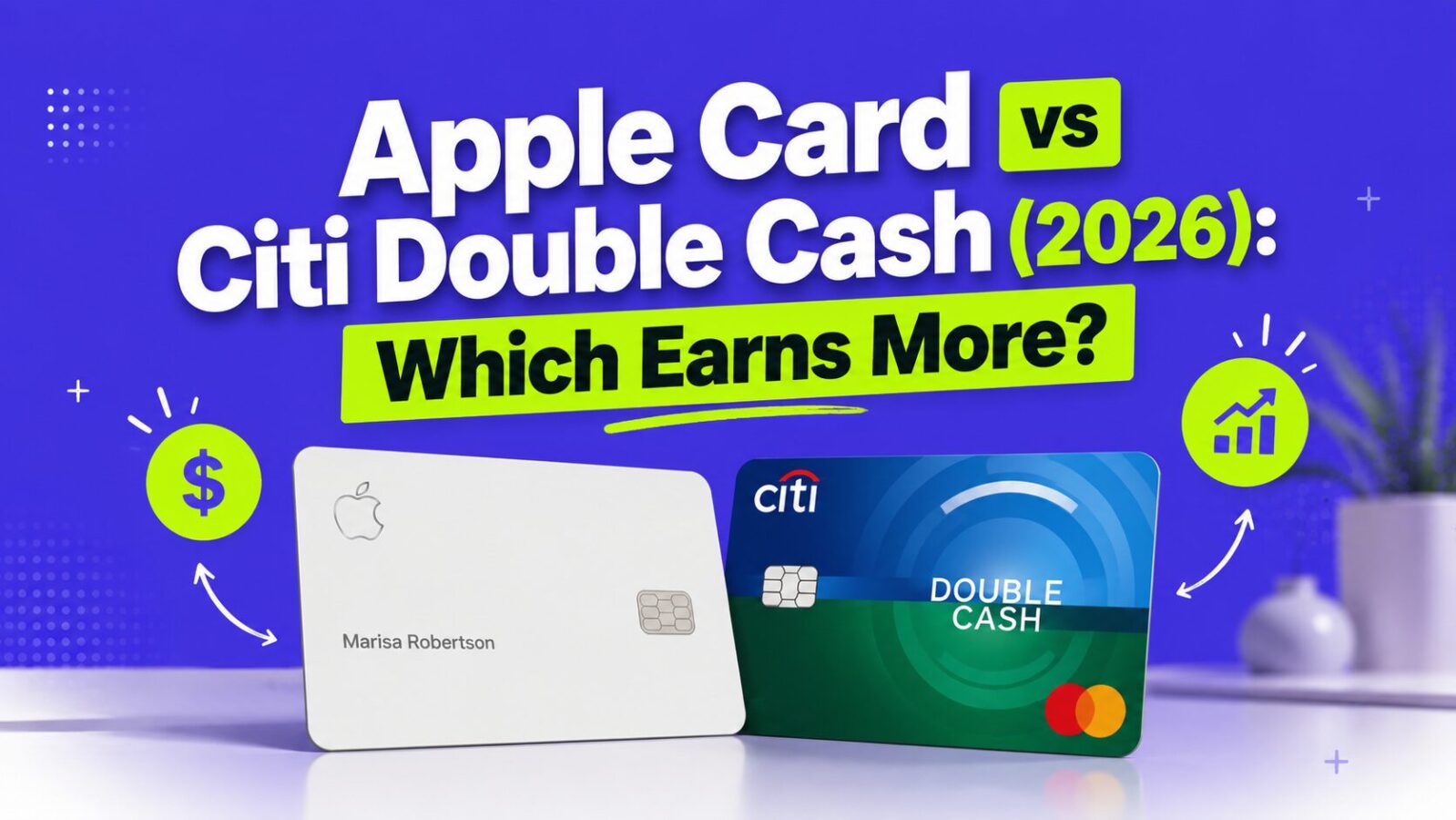
Both the Apple Card and the Citi Double Cash earn 2% cash back with no annual fee. On paper they sound nearly identical. In practice, the Apple Card’s 2% only activates when you pay with Apple Pay, has no sign-up bonus, and has no balance transfer option. The Citi Double Cash earns 2% everywhere, on every card swipe, regardless of how you pay. For most people, that difference matters more than it looks.
Side-by-Side Comparison
| Apple Card | Citi Double Cash | |
|---|---|---|
| Annual Fee | $0 | $0 |
| Base Rewards | 2% via Apple Pay; 1% physical card | 2% on everything (everywhere) |
| Bonus Categories | 3% at Apple + select merchants via Apple Pay | 5% on Citi Travel portal only |
| Welcome Bonus | None | $200 after $1,500 spend in 6 months |
| Intro APR on Purchases | None (0% only on Apple products via ACMI) | None |
| Intro APR on Balance Transfers | None | 0% for 18 months |
| Ongoing APR | 17.49%–27.74% variable | 17.49%–27.49% variable |
| Foreign Transaction Fee | None | 3% |
| Late Payment Fee | None | Up to $41 |
| Extended Warranty | None | Yes (up to 24 months, added Nov. 2024) |
| Apple Device Financing | 0% APR 6–24 months via ACMI | None |
| iPhone Requirement | Yes — applies and manages via iPhone only | No |
| Rewards Redemption | Daily Cash (statement credit, Apple Pay, bank transfer) | Statement credit, direct deposit, check, ThankYou Points |
The 2% Rate Is Not Equal Between These Cards
The most important thing to understand about this comparison is that the Apple Card’s 2% rate comes with a condition: you must pay using Apple Pay. Tap your physical titanium Apple Card at a terminal that does not support contactless payment, and you earn 1%, not 2%. The Citi Double Cash earns 2% on every purchase regardless of payment method: chip, swipe, contactless, online, whatever.
Apple Pay acceptance has expanded significantly, but it is not universal. Gas stations with older pumps, small businesses, government offices, some grocery stores, and many online merchants still do not support it. Every purchase at a non-Apple Pay location drops your Apple Card effective rate to 1%, which is meaningfully worse than any major flat-rate card.
In cities with modern retail infrastructure and among people who shop primarily at large chains with updated terminals, Apple Pay coverage is largely a non-issue. For anyone who shops at a mix of venues or frequently makes purchases online at non-Apple Pay merchants, the Citi Double Cash’s unconditional 2% is a genuine advantage.
Where the Apple Card Earns 3%
The Apple Card earns 3% Daily Cash at Apple directly (App Store, Apple Music, Apple hardware purchases) and at a fixed list of partner merchants when paying with Apple Pay. As of mid-2026, the confirmed 3% merchant list includes:
- Apple (all products and services)
- Ace Hardware
- Booking.com
- ChargePoint
- Exxon and Mobil
- Hertz
- Nike
- Uber and Uber Eats
- Walgreens and Duane Reade
Two notable recent changes: T-Mobile dropped from the 3% list to 2% as of July 1, 2025. Panera Bread dropped off the list in February 2025. Apple can add or remove merchants from this list at any time without advance notice, which means the 3% categories are not guaranteed to stay as-is.
If you spend heavily at Uber, Walgreens, or Exxon, the 3% rate on those merchants is a real advantage over Citi Double Cash’s flat 2%. For the rest of your spending outside the partner list, the comparison reverts to whether you can use Apple Pay (2%) or not (1%).
The Welcome Bonus Gap
Citi Double Cash offers a $200 welcome bonus after spending $1,500 in the first 6 months. Apple Card offers nothing. No sign-up bonus, no introductory offer, no referral bonus for new applicants (though existing cardholders can earn $75 Daily Cash by referring a friend who gets approved and makes a purchase).
That $200 Citi bonus represents roughly 8 to 10 months of cash back equivalent on typical everyday spending before you even factor in the ongoing rewards rate. For a new card applicant evaluating these two options purely on financial return in year one, the Citi Double Cash wins by a wide margin before the first billing cycle closes.
Balance Transfers: Citi Wins Decisively
If you have existing high-interest credit card debt, the Citi Double Cash offers a 0% intro APR on balance transfers for 18 months (then 17.49% to 27.49% variable). The Apple Card offers no balance transfer option at all.
Apple Card does not support balance transfers. You cannot move debt from another card onto an Apple Card account. This is a significant limitation for anyone whose primary motivation for a new card is consolidating or paying down existing debt interest-free.
Apple Card’s Fee Advantage
The Apple Card has zero fees of any kind. No annual fee, no foreign transaction fee, no late payment fee, no cash advance fee, no balance transfer fee (there are no balance transfers to charge). This is genuinely unusual and represents a meaningful advantage in specific situations.
The no-late-fee policy is the most practically useful of these. Citi charges up to $41 for a late payment. The Apple Card charges nothing, though a late or missed payment will still accrue interest on the outstanding balance. For cardholders who occasionally miss a due date, the Apple Card eliminates that particular penalty cost.
The no-foreign-transaction-fee policy makes the Apple Card the better option for international travel and international online purchases, since Citi Double Cash charges 3% on those transactions. If you travel abroad or regularly shop from international merchants, the Apple Card’s 2% via Apple Pay (where accepted internationally) is clearly preferable to paying Citi’s 3% foreign fee and negating the cash back entirely.
Apple Card Monthly Installments: A Genuine Perk for iPhone Buyers
For anyone who buys Apple hardware regularly, Apple Card Monthly Installments (ACMI) is a compelling and unique benefit. Select Apple products can be financed at 0% APR over 6, 12, or 24 months, and you receive 3% Daily Cash back at the time of purchase. This effectively lets you pay for a $1,000 iPhone over 24 months at zero interest while still earning $30 cash back on the purchase.
No other card offers 0% financing specifically on Apple products with a simultaneous 3% cash back earning rate. If you buy a new iPhone, MacBook, or iPad every one to two years, this benefit alone can justify keeping the Apple Card in your wallet alongside a higher-earning flat-rate card for other purchases.
Redemption Flexibility
Apple Card rewards are called Daily Cash and deposit into your Apple Cash account, usually the same day. From there they can be applied as a statement credit, spent through Apple Pay, or transferred to a bank account. The daily cadence is genuinely convenient, and the redemption process is handled entirely in the Wallet app with no minimum redemption amount.
Citi Double Cash earns ThankYou Points redeemable as statement credits, direct deposits, checks, or gift cards. Points can also be transferred to Citi’s airline and hotel partners, though at reduced ratios unless paired with a premium Citi card. For cardholders who only want straight cash back, both cards offer equally flexible redemption.
Which Card Is Better for You
Choose Apple Card if:
- You have an iPhone and use Apple Pay for the majority of your in-store purchases
- You spend significantly at Apple, Uber, Walgreens, or Exxon and can consistently use Apple Pay
- You buy Apple hardware on a regular basis and want 0% ACMI financing
- You travel internationally and want zero foreign transaction fees
- You occasionally miss a payment due date and want to avoid late fees
- You have no interest in balance transfers and carry no existing credit card debt
Choose Citi Double Cash if:
- You want guaranteed 2% back regardless of how or where you pay, with no Apple Pay dependency
- You want a $200 welcome bonus with a reachable spending requirement
- You need to transfer existing high-interest credit card debt (18-month 0% APR)
- You do not have an iPhone or prefer not to rely on a single ecosystem for a financial product
- You want extended warranty protection on electronics and appliance purchases
- You do most of your spending domestically
Can You Have Both?
Yes, and the combination is sensible for iPhone users. Use the Apple Card for purchases at 3% merchants and Apple Pay where the terminal supports it. Use Citi Double Cash for everywhere else, all non-Apple Pay locations, online merchants where Apple Pay is not available, and any international spending where you want to avoid Citi’s 3% foreign fee but are also outside Apple Pay coverage.
The two cards complement each other in the same way many two-card setups work: one handles the bonus categories, one handles everything else. Neither costs an annual fee, so the combined cost of both is zero.
Card terms are accurate as of May 2026 based on issuer websites and verified third-party sources. Apple Card APR range (17.49%–27.74%) per Apple as of January 1, 2026. Apple Card 3% merchant list current as of mid-March 2026 per Apple; T-Mobile dropped from 3% list July 1, 2025. Citi Double Cash terms per Citi.com. All rates and offers subject to change. Finance Pulse is not a financial advisor. This comparison is for informational purposes only. Finance Pulse may earn affiliate compensation if you apply through links on this page.