By
By 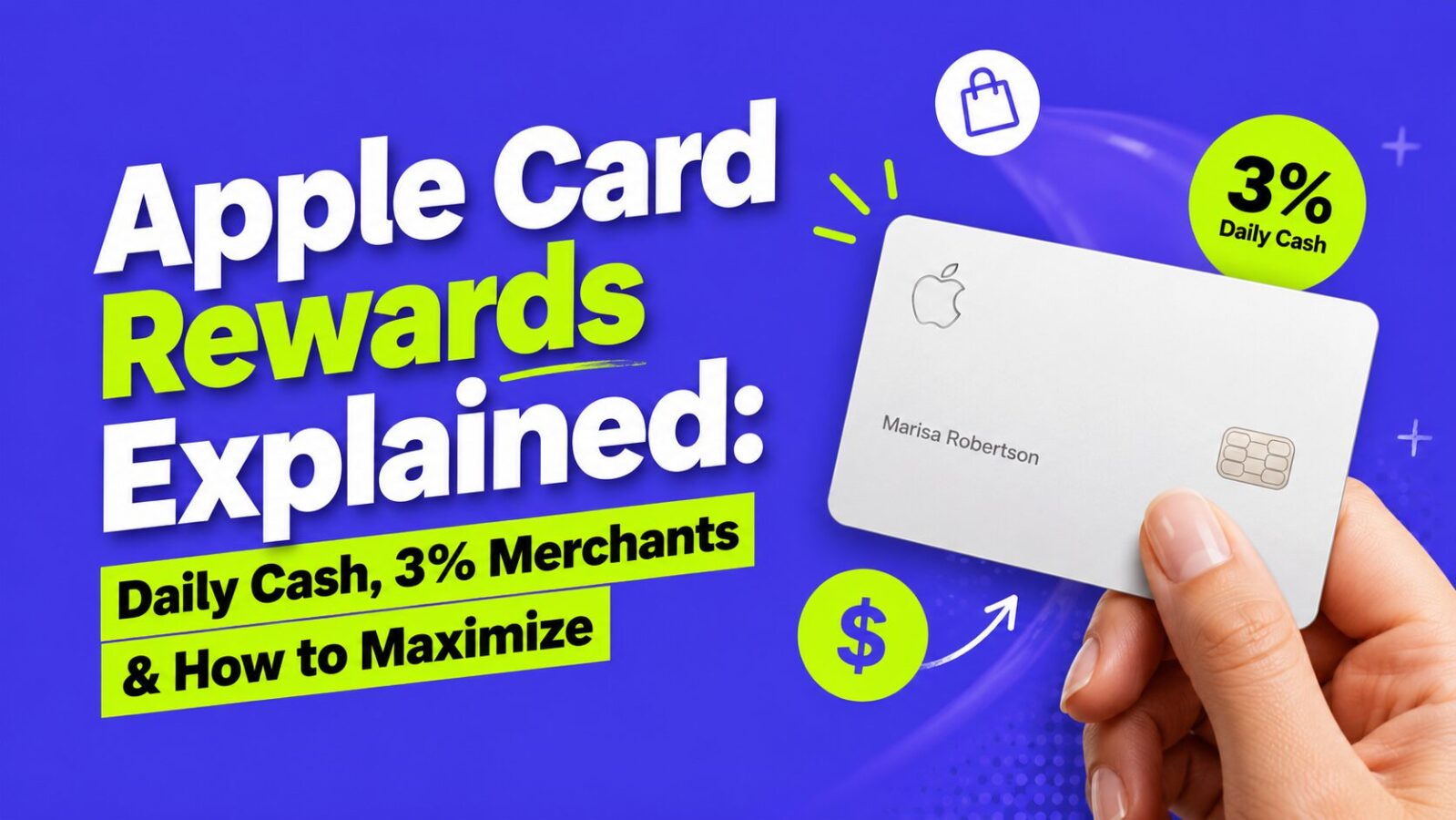
The Apple Card calls its rewards “Daily Cash” and earns between 1% and 3% back depending on where you shop and how you pay. Understanding which tier applies when, which merchants still earn 3% in 2026, and the best ways to actually use what you earn is what separates cardholders who get full value from the card from those who leave money sitting unclaimed.
The Three Reward Tiers
Every Apple Card purchase falls into one of three earning tiers. There is no way to override which tier applies; it is determined entirely by how you pay.
3% Daily Cash applies to purchases made at Apple directly and at a fixed list of partner merchants, as long as you pay with Apple Pay. This is the highest earning tier and requires both the right merchant and the right payment method.
2% Daily Cash applies to all other purchases made using Apple Pay, regardless of merchant. This is the card’s effective base rate for the majority of in-store and app-based purchases for iPhone users who tap to pay.
1% Daily Cash applies to purchases made with the physical titanium card anywhere that does not support Apple Pay, meaning chip swipes and magnetic stripe transactions. This is the lowest tier and is meaningfully below the flat rate offered by most competing no-annual-fee cash back cards.
The practical implication is straightforward: every time you pull out the physical card instead of tapping your phone, you cut your reward in half. The Apple Card is designed to be used via Apple Pay, and its reward structure reflects that design intentionally.
The 3% Merchant List (Updated for 2026)
The 3% tier at partner merchants is only available when paying with Apple Pay at checkout or in-app. As of mid-2026, the confirmed list of 3% merchants is:
- Apple — all purchases including App Store, Apple Music, Apple TV+, iCloud+, Apple hardware at retail stores, apple.com, and the Apple Store app
- Ace Hardware — in-store at participating locations, acehardware.com, and the Ace Hardware app
- Booking.com — hotel and travel bookings via the Booking.com app or website (added November 2024)
- ChargePoint — EV charging sessions via the ChargePoint app (added November 2024)
- Exxon and Mobil — fuel, car wash, and convenience store purchases at US stations, including via the Exxon Mobil Rewards+ app
- Hertz — car rentals booked through the Hertz app
- Nike — purchases at Nike.com, Nike retail stores, and the Nike app
- Uber and Uber Eats — rides and food delivery worldwide via the respective apps
- Walgreens and Duane Reade — in-store, on Walgreens.com, and via the Walgreens app
Two merchants recently left the 3% list. T-Mobile dropped to standard 2% as of July 1, 2025, ending a partnership that had been in place since the card launched in 2019. Panera Bread dropped off the list in February 2025. Apple can add or remove merchants at any time without prior notice, so checking the official Apple Card features page periodically is worth doing.
One promotional note: Walgreens was running 5% Daily Cash through May 20, 2026, as a limited-time offer. That promotion has ended, and Walgreens has returned to its standard 3% rate.
When Is Cash Back Earned?
The “Daily” in Daily Cash is accurate. Rewards post to your account on the same day a transaction settles, not at the end of a billing cycle. Most transactions settle within one to two days of purchase, meaning your cash back is typically available within 48 hours.
This is a genuine difference from most cash back cards, which accumulate rewards across a billing period and make them available for redemption once the statement closes. The daily posting cadence means your rewards are usable almost immediately rather than being locked in a rewards balance for weeks.
Daily Cash is earned on purchases after they post to your account. The exact posting time varies by merchant. Pending transactions do not earn Daily Cash until they clear.
Four Ways to Use Your Daily Cash
Apple Card rewards can be used in four ways, each with different implications for how much value you extract.
Apple Cash (most flexible). Setting Apple Cash as your Daily Cash destination deposits rewards into your Apple Cash account, which functions like a digital debit balance. From Apple Cash you can spend anywhere Apple Pay is accepted, send money to other people via iMessage, or transfer to a linked bank account. This is the most liquid and versatile option.
Apple Savings account (best for growth). Apple Card holders can open a Goldman Sachs high-yield savings account directly in the Wallet app and set it as their Daily Cash destination. As of April 23, 2026, the Apple Savings account earns 3.50% APY. The account has no minimum balance, no fees, and no minimum deposit. Rewards deposit automatically every day they are earned, and you can add additional funds from a linked bank account at any time. The maximum balance is $1 million per account.
Statement credit. If you do not set up Apple Cash or Apple Savings, Daily Cash accumulates and can be applied as a credit to your Apple Card balance when you pay your bill. This option requires contacting Goldman Sachs to apply accumulated cash, making it the least automated of the four choices.
Direct bank transfer. Daily Cash held in Apple Cash can be transferred to a linked external bank account. This adds a step compared to direct Apple Cash spending, but provides a path to conventional banking if you prefer not to keep funds in the Apple ecosystem.
For most cardholders, setting the Apple Savings account as the Daily Cash destination and letting rewards compound at the current APY is the highest-value passive option. There is no effort required beyond the one-time setup in Wallet.
The Apple Savings Account in More Detail
The Apple Savings account launched in April 2023 as a Goldman Sachs high-yield savings account exclusively available to Apple Card holders. It is managed entirely through the iPhone Wallet app without any separate Goldman Sachs login or app required.
The current APY is 3.50%, effective April 23, 2026, down from 3.65% prior to that date. The rate adjusts in response to market conditions and is not guaranteed to remain at any particular level. Interest accrues daily and is credited monthly.
There are no fees of any kind on the Apple Savings account: no monthly maintenance fee, no minimum balance fee, and no fee for transfers. Deposits can come from Daily Cash, from Apple Cash, or from a linked external bank account.
One important consideration given the January 2026 announcement that Chase is taking over Apple Card from Goldman Sachs: existing Apple Savings account holders will not be automatically migrated to any Chase-issued savings product. Chase is expected to introduce its own Apple-branded savings account as part of the partnership, but current Goldman Sachs account holders will need to decide separately whether to remain with Goldman Sachs or move to the new Chase offering. Apple has indicated that details will be shared with cardholders as the transition timeline becomes clearer.
Apple Card Monthly Installments: The Overlooked Rewards Multiplier
For purchases of eligible Apple hardware, Apple Card Monthly Installments (ACMI) offers a combination that no other card matches: 0% APR financing for 6, 12, or 24 months, plus 3% Daily Cash back on the full purchase price, deposited immediately.
On a $1,000 iPhone purchased through ACMI, you receive $30 in Daily Cash the day the transaction posts, then pay off the phone over 24 equal monthly installments of about $41.67 with zero interest. The cash back is immediate and real; the financing is genuinely interest-free with no deferred interest trap.
This benefit is only available when you select ACMI at checkout at an Apple Store, on apple.com, through the Apple Store app, or when calling Apple directly. Using the Apple Card for an Apple purchase through any other payment method earns 3% but does not include the installment financing option.
No Welcome Bonus
The Apple Card offers no sign-up bonus for new cardholders. There is no minimum spend threshold that unlocks a one-time cash reward after the first few months. This is one of the card’s most notable competitive disadvantages against flat-rate cards like Citi Double Cash, which offers $200 after $1,500 in purchases within 6 months.
The one exception is the referral program for existing cardholders. If an existing Apple Card holder refers a friend using their referral link from the Wallet app, both parties receive $75 in Daily Cash after the referred person is approved, opens an account, and makes a purchase within 30 days. This is not available to new applicants; only existing cardholders can generate referral links.
How Much Daily Cash Does the Average Cardholder Earn?
The answer depends almost entirely on Apple Pay penetration in your daily life. Consider a realistic spending scenario of $2,000 per month:
- $200 at Apple (apps, subscriptions, hardware): $6 at 3%
- $150 at Uber and Uber Eats: $4.50 at 3%
- $100 at Walgreens: $3 at 3%
- $800 on Apple Pay at various merchants (groceries, restaurants, gas, retail): $16 at 2%
- $750 on physical card at merchants without Apple Pay: $7.50 at 1%
- Monthly total: $37 in Daily Cash, or approximately $444 per year
Shift more of that $750 physical card spending to Apple Pay-enabled merchants, and the yearly total climbs. Keep it as physical card swipes, and the annual take stays lower than what a flat-rate 2% card would produce on the same overall spending.
Where the Rewards Fall Short
Two gaps in the Apple Card reward structure are worth being clear-eyed about.
The 1% physical card rate is below average. Most no-annual-fee cash back cards guarantee at least 1.5% on every purchase regardless of payment method. Every dollar spent on the physical card rather than through Apple Pay costs you 1 cent per dollar compared to cards like Chase Freedom Unlimited, and 1 cent per dollar compared to Citi Double Cash’s 2% everywhere. For cardholders who regularly encounter non-Apple Pay terminals, this drag compounds quickly.
The 3% merchant list is narrow and can change without notice. The list currently covers about 10 merchant relationships. By contrast, Chase Freedom Unlimited earns 3% at every restaurant and drugstore in the country without any Apple Pay requirement. Apple Card’s 3% is higher-rate but narrower in coverage than category-based alternatives.
Who Gets the Most Value From Apple Card Rewards
The Apple Card reward structure is most favorable for iPhone users who pay with Apple Pay at the majority of their in-store and in-app purchases, spend regularly at one or more 3% partner merchants like Uber, Walgreens, or Exxon, and have no existing credit card debt to transfer (since the card has no balance transfer option).
For cardholders in that profile, the combination of 2% base rate via Apple Pay, 3% at key everyday merchants, same-day rewards posting, and a competitive high-yield savings account as an automatic destination creates a genuinely seamless rewards system with minimal friction.
For cardholders who frequently use the physical card, rarely encounter 3% merchants, or want to earn a substantial welcome bonus from a new card, a flat-rate alternative like Citi Double Cash or Chase Freedom Unlimited is likely to produce more total cash back over the first year.
Apple Card rewards structure and 3% merchant list are accurate as of May 2026 based on Apple’s official benefits page. T-Mobile dropped from the 3% list effective July 1, 2025. Panera Bread dropped February 1, 2025. Apple Savings APY 3.50% effective April 23, 2026; rate may change at any time. Apple Card is issued by Goldman Sachs Bank USA. JPMorgan Chase has agreed to take over Apple Card issuance in a transition expected to take approximately 24 months from January 2026. This article is for informational purposes only and does not constitute financial advice. Finance Pulse may earn affiliate compensation if you apply through links on this page.