By
By 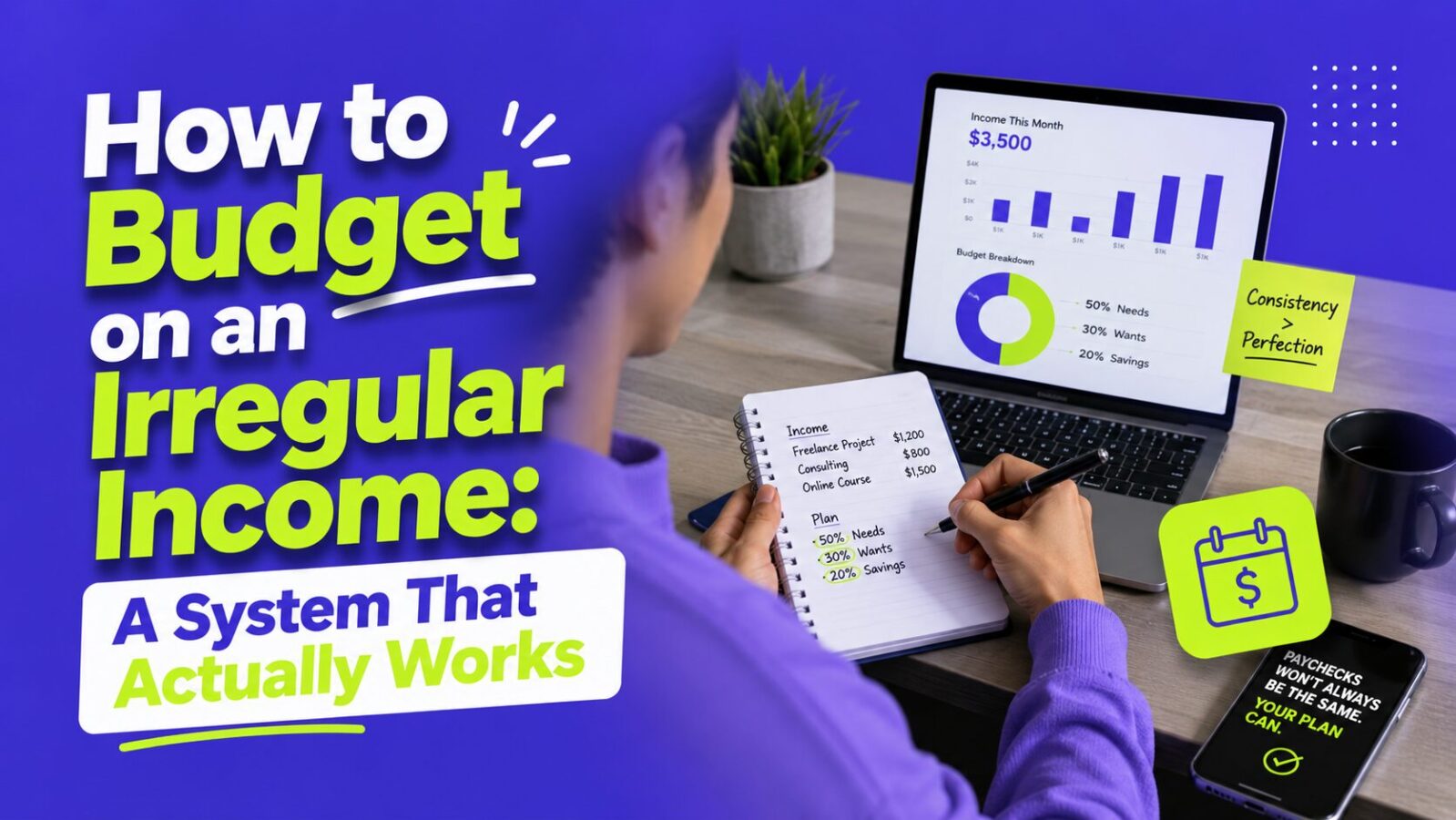
If you are a freelancer, gig worker, or commission-based earner, you already know the drill. One month you are flush. The next month you are anxious. Traditional budgeting advice, the kind that assumes a predictable paycheck landing on the 1st and 15th, does not work for you.
This is the irregular-income version of our broader how to budget guide.
But that does not mean you cannot budget irregular income effectively. You just need different tools and a different mindset. Here is how to take control of your money when your income refuses to stay consistent.
Why traditional budgets fail for irregular income
Most budgeting frameworks assume you know exactly how much you will earn each month. The 50/30/20 rule, for example, divides your income into needs, wants, and savings. Simple enough when you earn $5,000 every month. But when your income swings between $2,500 and $9,000? Those percentages become meaningless without a stable base number.
Here is what typically goes wrong:
Overspending in good months. A big commission check hits and suddenly you are treating it like your new normal.
Panic in lean months. A slow period arrives and you do not have a plan, so you either raid savings or pile on credit card debt.
No system for taxes. When nobody withholds taxes for you, it is easy to spend money the IRS is going to want in April.
Guilt and avoidance. The unpredictability makes budgeting feel pointless, so you stop tracking altogether.
The fix is not to abandon budgeting. It is to use methods designed for variable income.
Method 1: The Baseline Budget (budget for your lowest month)
This is the foundation of budgeting on irregular income. Instead of budgeting based on what you hope to earn, budget based on the least you are likely to make.
How to set your baseline:
- Look at your income over the past 12 months (or 6 months if you are newer to freelancing)
- Find your lowest-earning month
- Build your budget around that number
If your monthly income over the past year ranged from $3,200 to $8,500, your baseline budget is $3,200. Every expense, from rent to groceries to subscriptions, needs to fit within that floor.
What happens when you earn more? In months where you earn above the baseline, the extra money gets allocated with intention:
- Top off your buffer account (see below)
- Pay quarterly estimated taxes
- Contribute to sinking funds for upcoming expenses
- Invest or pay down debt
- Fun money (you earned it, enjoy some of it)
The key: treat above-baseline income as a bonus, not a given.
Method 2: The Buffer Account Strategy
A buffer account is a dedicated savings account that holds 1 to 2 months of expenses. Its purpose is to smooth out your income so you can pay yourself a consistent “salary” regardless of what you actually earned that month.
How it works:
- All income flows into the buffer account first. Client payments, gig earnings, commissions, everything goes here.
- Twice a month, transfer a fixed amount to your checking account. This is your “salary,” based on your baseline budget.
- When the buffer grows, you have a surplus. Allocate it to taxes, savings, and investments.
- When income dips, the buffer covers the gap. You keep paying yourself the same amount without stress.
Think of it like a reservoir. Heavy rain (big income months) fills it up. Dry spells draw it down. As long as the reservoir never empties, your day-to-day finances stay stable.
How much should your buffer hold? Start with one month of essential expenses as your minimum. Work toward two months for more breathing room. This is separate from your emergency fund. The buffer handles normal income fluctuations. Your emergency fund handles genuine emergencies.
Keep your buffer in a high-yield savings account earning 4 to 5% APY while it sits there.
Calculate how long to build your buffer:
Savings Goal Calculator
Enter your target buffer amount (1 to 2 months of essential expenses) as the goal, your current savings as the starting amount, and your estimated monthly contribution to see when you will hit your buffer target.
Method 3: Percentage-Based Budgeting
If the baseline method feels too restrictive, percentage-based budgeting offers more flexibility. Instead of fixed dollar amounts, you allocate percentages of each payment you receive.
| Category | Percentage |
|---|---|
| Taxes | 25 to 30% |
| Essentials (rent, food, utilities) | 30 to 35% |
| Savings and investments | 15 to 20% |
| Discretionary spending | 10 to 15% |
| Business expenses | 5 to 10% |
Every time money hits your account, you immediately split it. A $4,000 payment becomes $1,000 for taxes, $1,400 for essentials, $600 for savings, $600 for fun, and $400 for business costs.
This method works well alongside a zero-based budget, where every dollar gets a job. The advantage is that your spending scales with your income automatically. The downside is that lean months still mean tighter budgets for everything, which is why combining this with a buffer account works best.
Quarterly tax planning: do not get caught off guard
If you earn self-employment income, the IRS expects you to pay estimated taxes four times a year. Missing these payments results in penalties, and the bill at tax time can be brutal if you have not set money aside.
2026 quarterly deadlines:
- Q1: April 15, 2026
- Q2: June 15, 2026
- Q3: September 15, 2026
- Q4: January 15, 2027
How much to set aside: A safe starting point is 25 to 30% of every dollar earned. This covers federal income tax (10 to 37% depending on your bracket), self-employment tax (15.3% up to the Social Security wage base), and state income tax. Verify the current Social Security wage base and rates at IRS.gov.
Open a separate savings account labeled “Taxes.” Every time you get paid, move 25 to 30% into that account before you touch anything else. Our 1099 tax guide for freelancers walks through the specifics in detail, including the Quarterly Tax Estimator to find your exact payment amount.
If your self-employment income exceeds $50,000, a good accountant (typically $500 to $1,500/year) pays for itself in tax savings and can help you determine if an S-Corp election makes sense.
The “Pay Yourself a Salary” System
This combines the buffer account and baseline budget into a complete income-smoothing system.
Step 1: Determine your monthly salary. Calculate your average monthly income over the past 6 to 12 months. Subtract 25 to 30% for taxes. The remaining amount is your gross “salary.” Round down to a clean number.
Example: If you averaged $6,000/month and set aside 30% for taxes, your after-tax average is $4,200. Round down to $4,000 as your monthly salary.
Step 2: Set up your accounts. You need three accounts minimum:
- Business/income account: Where all earnings are deposited
- Tax savings account: Where 25 to 30% of every payment goes immediately
- Personal checking: Where your “salary” gets transferred twice a month
Step 3: Pay yourself on a schedule. On the 1st and 15th of each month, transfer half your salary from your business account to your personal checking.
Step 4: Manage the surplus. In high-income months, your business account balance grows. Once it exceeds 2 months of salary, sweep the extra into investments, debt payoff, or your emergency fund. In low-income months, the existing balance covers your salary.
Sinking funds for lean months
Sinking funds are savings buckets for predictable, irregular expenses. They are essential when your income is unpredictable, because the last thing you need is a $1,200 car insurance bill hitting during your slowest month.
Common sinking fund categories: annual subscriptions and memberships, insurance premiums, holiday and gift spending, vehicle maintenance, business equipment upgrades, vacation.
How to fund them: take each annual expense, divide by 12, and set aside that amount monthly. If your car insurance is $1,200/year, save $100/month. When the bill comes, the money is already there regardless of what you earned that month. Use the free Savings Goal Tracker to track each sinking fund separately.
The best tool for irregular income: YNAB
While plenty of budgeting apps exist, YNAB (You Need A Budget) stands out for people with irregular income. YNAB’s core philosophy is “give every dollar a job.” Instead of predicting what you will earn, you budget the money you actually have right now. When $3,000 hits your account, you assign those dollars to categories. When another $1,500 comes in next week, you assign those dollars too.
This “only budget money you have” approach eliminates the guesswork that makes traditional budgeting impossible for irregular earners.
Other useful tools:
- QuickBooks Self-Employed: Great for tracking business income, expenses, and estimated taxes in one place.
- Paycheck Planner spreadsheet: Our free Paycheck Planner is specifically designed for irregular earners with a calendar view that lets you match each expense to the payment it comes from.
Putting it all together: a sample month
Alex is a freelance graphic designer. Average monthly income: $5,500. Lowest month in the past year: $3,000. Monthly essential expenses: $2,800. Self-set salary: $3,800/month (after 30% tax set-aside from average).
This month, Alex earns $7,200:
- $2,160 goes to the tax savings account (30%)
- $3,800 transfers to personal checking as salary
- $1,240 surplus stays in the business account buffer
From the $3,800 salary: $1,400 rent, $500 groceries/utilities, $300 transportation, $200 insurance sinking fund, $150 subscriptions, $250 investments, $200 fun money, $800 extra to buffer/savings.
Next month, Alex earns $2,800:
- $840 goes to the tax savings account (30%)
- $3,800 still transfers to personal checking (the buffer covers the $1,840 shortfall)
- Alex’s daily budget and spending? Completely unchanged.
That is the power of income smoothing. Good months fund lean months, and Alex never has to stress about whether rent is covered.
Frequently asked questions
6 months minimum, ideally 9 to 12 months. Your income is inherently more volatile than a W-2 employee’s, so you need a larger cushion. The buffer account handles month-to-month fluctuations. The emergency fund handles genuine crises (loss of all clients, medical emergency, major equipment failure).
Yes, but prioritize this order: buffer account first (1 month of expenses), tax savings (non-negotiable), emergency fund (3 to 6 months), then invest. Once those are in place, consistently investing even $200 to $500/month builds real wealth over time. Read our investing in your 20s guide for the full account priority sequence.
Yes, as long as you have earned income. You can contribute up to $7,000/year (2026) to a Roth IRA, no minimum required. Many freelancers contribute in lump sums during high-income months rather than monthly.
The bottom line
Budgeting irregular income is a skill, and like any skill, it gets easier with practice. Start with the baseline budget to know your floor. Build a buffer account to smooth out the highs and lows. Set aside taxes before you touch anything else. And use a tool like YNAB to give every dollar a job the moment it arrives.
Irregular income does not have to mean irregular financial stress. With the right system, you can have more predictability and financial confidence than plenty of people earning steady paychecks.
Ready to set up your system? Start here:
- Step 1: Open a dedicated buffer/income account at an online bank separate from your personal checking. A high-yield savings account at 4.50% APY earns you money while your buffer sits there.
- Step 2: Set up your tax savings account and move 25 to 30% of every payment there immediately. Read our 1099 tax guide for the full quarterly payment system.
- Step 3: Try YNAB free for 34 days, it is built exactly for how irregular earners need to budget, assigning money you have now, not money you expect to earn.