 By
By 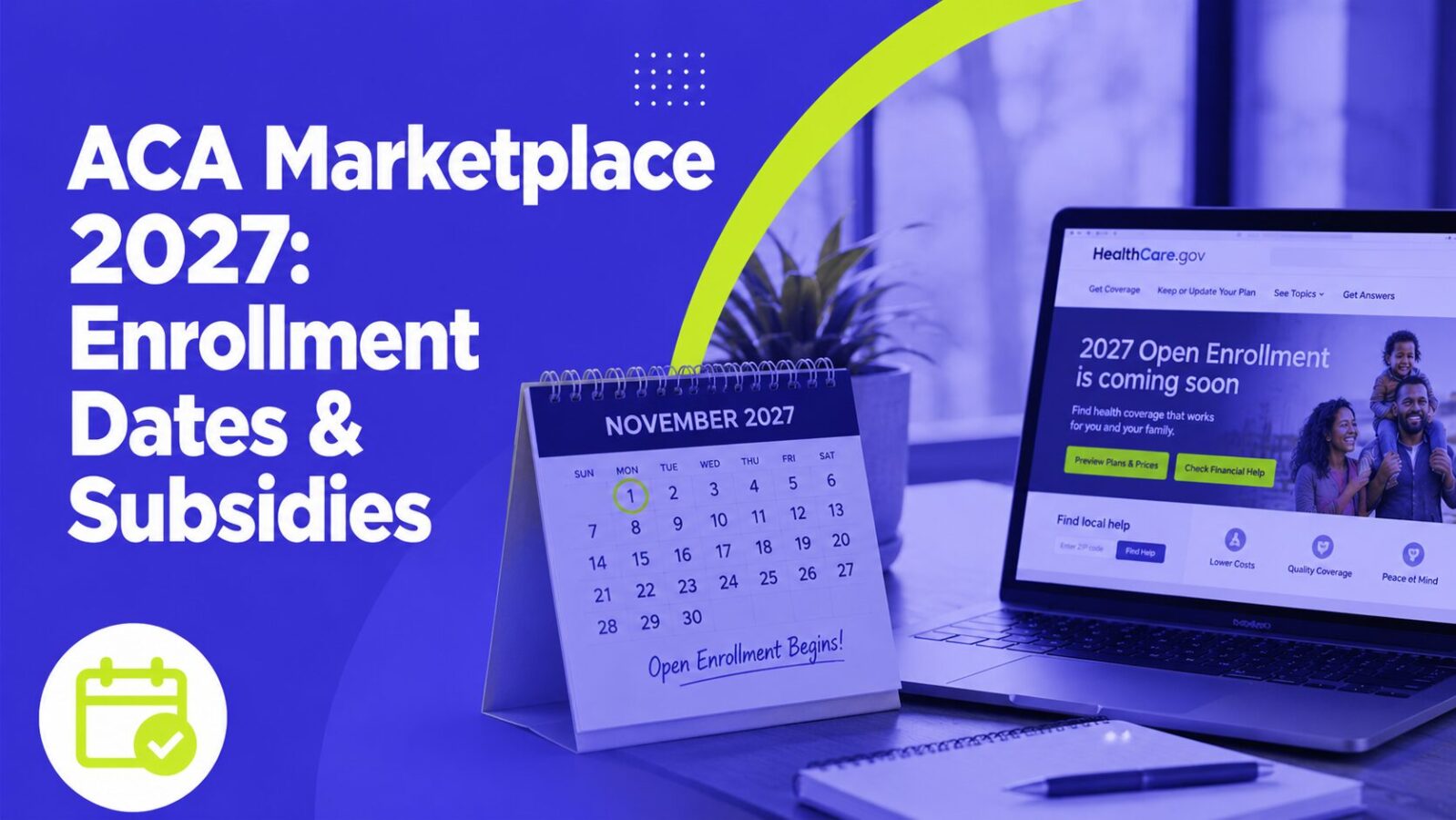
If you use HealthCare.gov, ACA Marketplace open enrollment for 2027 coverage runs from November 1 through December 15, 2026. Coverage selected during that window starts January 1, 2027, assuming you complete enrollment and pay your first premium when required.
That is a major change from recent years. HealthCare.gov previously kept open enrollment running through January 15, but CMS shortened the federal Marketplace window beginning with the 2027 plan year.
If your state operates its own Marketplace, your dates can differ, so check your state exchange rather than assuming the federal December 15 deadline applies.
Key takeaways
- HealthCare.gov open enrollment for 2027 runs November 1 through December 15, 2026.
- Coverage selected through the 2027 Open Enrollment Period is scheduled to start January 1, 2027.
- State-based Marketplaces can set different enrollment windows within CMS rules, so verify your state’s deadline.
- The enhanced ACA premium tax credits expired after 2025. Under current rules, federal premium tax credits generally return to the 100% to 400% federal poverty level range, subject to other eligibility requirements.
- For 2027 coverage, the applicable poverty guidelines are the 2026 FPL figures because those are the most recently published guidelines when the 2027 Open Enrollment Period begins.
- If you are self-employed, Marketplace savings are based on your expected net self-employment income and household MAGI for 2027, not simply gross business revenue.
- Do not choose a plan based only on the monthly premium. Compare the deductible, out-of-pocket maximum, doctors, hospitals, and prescription coverage too.
When is ACA open enrollment for 2027?
For states using the federal HealthCare.gov platform, the schedule is straightforward:
| Date | What happens |
|---|---|
| November 1, 2026 | 2027 Marketplace open enrollment begins |
| December 15, 2026 | Final day of the HealthCare.gov Open Enrollment Period |
| January 1, 2027 | Coverage selected during OEP begins, subject to completing enrollment and premium payment requirements |
CMS finalized the shorter Open Enrollment Period beginning with plan year 2027. For Exchanges using the federal platform, the window runs November 1 through December 15. CMS also finalized that coverage selected during the Open Enrollment Period begins January 1.
So the old advice that you can wait until January 15 and receive February 1 coverage is not correct for HealthCare.gov plan year 2027.
What if your state has its own Marketplace?
State-based Exchanges have more flexibility.
CMS allows Exchanges to set their own Open Enrollment Period within federal parameters. The period must start no later than November 1, end no later than December 31, and cannot last more than nine calendar weeks.
That means a state Marketplace may not use the same November 1 to December 15 dates as HealthCare.gov.
If you are unsure which Marketplace serves your state, start at HealthCare.gov and use its state Marketplace directory.
Who should use the ACA Marketplace?
The Marketplace is mainly for people who need to buy individual or family health coverage rather than receiving qualifying coverage through an employer or another government program.
That can include:
- freelancers,
- independent contractors,
- gig workers,
- self-employed business owners,
- people between jobs,
- early retirees who are not yet eligible for Medicare, and
- households without qualifying employer-sponsored coverage.
You can still buy a Marketplace plan if employer coverage is available, but access to a premium tax credit depends partly on whether the employer plan meets federal affordability and minimum-value standards. If qualifying employer coverage is considered affordable, you generally cannot receive a premium tax credit for Marketplace coverage instead.
What happened to ACA subsidies after 2025?
The enhanced premium tax credits available during 2021 through 2025 expired on December 31, 2025. HealthCare.gov now warns that people who still qualify for financial assistance may pay more than they did when the enhanced subsidies were in effect.
Under current law, the regular ACA premium tax credit generally applies to households with income from 100% through 400% of the federal poverty level, assuming they satisfy the other eligibility requirements.
The old subsidy cliff is therefore back.
If your household income exceeds 400% FPL, you generally do not qualify for the federal premium tax credit under the rules currently in effect.
But do not treat income alone as a guarantee of eligibility. Employer coverage, household composition, tax filing status, eligibility for government coverage, immigration status, and other factors can also affect the result.
What are the 2027 ACA subsidy income limits?
There is an easy detail to get wrong here.
Marketplace premium tax credit calculations for a coverage year use the most recently published federal poverty guidelines available on the first day of that coverage year’s Open Enrollment Period.
Because open enrollment for 2027 begins on November 1, 2026, the 2026 federal poverty guidelines are the relevant starting figures.
For the 48 contiguous states and Washington, D.C., the 2026 FPL is:
| Household size | 100% FPL | 400% FPL |
|---|---|---|
| 1 person | $15,960 | $63,840 |
| 2 people | $21,640 | $86,560 |
| 3 people | $27,320 | $109,280 |
| 4 people | $33,000 | $132,000 |
HealthCare.gov lists these official 2026 poverty guideline amounts. Alaska and Hawaii use different FPL figures.
These numbers are useful for estimating eligibility, but they do not tell you the size of your tax credit.
The actual premium tax credit also depends on factors such as your household income, family size, where you live, and the cost of Marketplace coverage available to you.
What happens below 100% FPL?
Do not assume that everyone below 100% FPL simply gets free Medicaid.
Medicaid eligibility varies by state and household circumstances.
In states that expanded Medicaid under the ACA, many adults can qualify based on income up to roughly 138% of the federal poverty level, subject to program rules.
In non-expansion states, some low-income adults can fall into a coverage gap in which their income is too low for the ordinary Marketplace premium tax credit but they do not qualify for Medicaid under their state’s eligibility rules.
There are also exceptions to the normal 100% FPL minimum for certain lawfully present immigrants who are ineligible for Medicaid because of immigration status.
The Marketplace application will check both Marketplace savings and potential Medicaid or CHIP eligibility.
Who qualifies for cost-sharing reductions?
Premium tax credits lower your monthly premium.
Cost-sharing reductions, or CSRs, are different. They can lower what you pay when you actually use health care, including deductibles, copayments, and coinsurance.
If the Marketplace determines that you qualify for cost-sharing reductions, you generally need to choose a Silver plan to receive those additional savings. Choosing Bronze, Gold, or another metal tier means giving up the CSR benefit even if your income otherwise qualifies.
This is why the cheapest monthly premium is not automatically the cheapest health plan overall.
If you qualify for strong cost-sharing reductions, a Silver plan may have a much lower deductible and out-of-pocket exposure than a seemingly cheaper Bronze plan.
How do you estimate Marketplace income if you are self-employed?
Freelancers and self-employed workers should pay special attention to the income section of the application.
HealthCare.gov says Marketplace savings are based on your expected net self-employment income for the year you are receiving coverage, not the prior year’s income and not simply your gross revenue.
Marketplace eligibility generally uses household modified adjusted gross income, or MAGI.
For ACA purposes, MAGI starts with adjusted gross income and adds certain amounts, including tax-exempt interest, nontaxable Social Security benefits, and excluded foreign income when applicable.
So if your business brings in $80,000 but you have legitimate business expenses that reduce your net self-employment income, you should not automatically enter $80,000 as your Marketplace income.
At the same time, do not deliberately underestimate income just to increase your subsidy.
Use the best realistic estimate you can make and update your Marketplace application if your income changes materially during the year.
Why accurate income estimates matter more in 2027
If you take the premium tax credit in advance, the Marketplace sends that advance credit to your insurer each month to reduce your premium.
You then reconcile those advance payments with the premium tax credit you actually qualify for when you file your federal tax return.
Beginning in 2026, the previous limits on repaying excess advance premium tax credits no longer apply. IRS guidance says taxpayers can be required to repay the full excess APTC amount when they received more advance credit than they ultimately qualified for.
That makes accurate income estimates especially important for freelancers whose income moves up and down throughout the year.
If your earnings rise significantly, update your Marketplace application instead of waiting until tax season.
How to enroll in ACA coverage for 2027
Step 1: Go to the correct Marketplace
If your state uses the federal Marketplace, apply through HealthCare.gov.
If your state operates its own Marketplace, HealthCare.gov can direct you to the appropriate state exchange.
Step 2: Update your household information
Enter the people in your household and indicate who needs coverage.
Marketplace income calculations generally consider your tax household, so household size and tax relationships matter.
Step 3: Estimate your 2027 income
Use your best estimate of expected household income for 2027, the year you will have the coverage.
HealthCare.gov specifically says Marketplace savings are based on expected income for the coverage year rather than simply copying last year’s income.
Step 4: Review your eligibility result
The application will determine whether you appear eligible for:
- a premium tax credit,
- cost-sharing reductions,
- Medicaid, or
- CHIP.
Do not assume that an income table alone gives you the final answer.
Step 5: Compare the plans carefully
Look beyond the monthly premium.
Compare:
- deductible,
- out-of-pocket maximum,
- primary care and specialist copays,
- prescription formulary,
- hospital network,
- doctors you already use,
- mental health coverage, and
- expected total annual cost.
A $50 cheaper monthly premium can be a bad trade if it comes with a much larger deductible or excludes a medication or doctor you regularly use.
Step 6: Finish enrollment and pay the first premium
Choosing a plan on the Marketplace is not the final step.
You pay your first premium directly to the insurance company, not HealthCare.gov. HealthCare.gov states that your coverage will not start until the first premium is paid when a premium is due.
Do this before the insurer’s payment deadline.
What documents should you have ready?
Depending on your household and application, you may need information such as:
- Social Security numbers for applicants who have them,
- immigration documentation when applicable,
- employer and wage information,
- information about current health coverage,
- household and tax information, and
- documentation supporting income if the Marketplace asks you to verify it.
For self-employment income that is difficult to document, HealthCare.gov says applicants may be able to use records such as a self-employment ledger or other supporting documentation when verification is required.
You do not necessarily need to upload every document when initially applying. The Marketplace will tell you if verification is required.
What if you miss the December 15 deadline?
If you use HealthCare.gov and miss December 15, 2026, you generally cannot simply enroll in January as you could under the old federal schedule.
You may still be able to enroll if you qualify for a Special Enrollment Period.
Common qualifying life events include losing qualifying health coverage, getting married, having a baby, adopting a child, or certain moves. SEP timing depends on the event, but many common situations provide a window around the qualifying event.
Medicaid and CHIP enrollment are different. You can generally apply for those programs throughout the year rather than waiting for Marketplace open enrollment.
Should you automatically renew your current plan?
I would not.
Even if your insurer offers the same plan for 2027, review it again.
Premiums, deductibles, provider networks, drug formularies, and subsidies can change from one plan year to the next. Your household income may also have changed, which can change the premium tax credit available to you.
At minimum, compare your current plan against several alternatives before allowing automatic re-enrollment to make the decision for you.
The goal is not necessarily to find the lowest premium.
It is to find the plan that gives you the best combination of premium, expected medical costs, provider access, prescriptions, and financial protection if you have an expensive medical year.
Frequently asked questions
When does ACA open enrollment start for 2027?
For HealthCare.gov, open enrollment begins November 1, 2026 and ends December 15, 2026. Coverage selected during the Open Enrollment Period begins January 1, 2027.
Is the ACA deadline still January 15?
Not for HealthCare.gov plan year 2027. CMS shortened the federal-platform Open Enrollment Period to November 1 through December 15 beginning with 2027 coverage. State-based Marketplaces may use different dates within CMS requirements.
What is the ACA subsidy income limit for 2027?
Under current federal rules, premium tax credits generally apply to eligible households with income from 100% through 400% of the applicable federal poverty level. For a one-person household in the 48 contiguous states and D.C., 400% of the applicable 2026 FPL is $63,840. For a family of four, it is $132,000. Other eligibility requirements also apply.
Can I get an ACA subsidy if I make more than 400% FPL?
Under the rules currently in effect after the enhanced premium tax credits expired, households above 400% FPL generally do not qualify for the federal premium tax credit.
What income should a freelancer report?
Use your best estimate of expected net self-employment income and total household income for the coverage year. Marketplace savings are based on expected annual household income, not simply gross business revenue or last year’s earnings.
Can I enroll after open enrollment?
Usually only if you qualify for a Special Enrollment Period based on a qualifying event or another applicable circumstance. Medicaid and CHIP enrollment can generally occur year-round.
Does everyone between 100% and 400% FPL get a subsidy?
No. Income is only one part of premium tax credit eligibility. Access to qualifying employer coverage, government coverage, household circumstances, and other eligibility rules can prevent someone in that income range from receiving the credit.
Bottom line
If you use HealthCare.gov, the key dates for 2027 coverage are November 1 through December 15, 2026. Do not plan around the old January 15 deadline.
The enhanced ACA subsidies have expired, so the federal premium tax credit is again generally limited to eligible households between 100% and 400% of the federal poverty level. For 2027 coverage, the relevant planning figures come from the 2026 poverty guidelines.
Before enrolling, estimate your 2027 household income carefully, compare total plan costs rather than premiums alone, verify your doctors and prescriptions, and pay the first premium on time.
If your state operates its own Marketplace, check its enrollment dates separately because they may differ from HealthCare.gov.
This article is for general educational purposes and is not individualized insurance, financial, tax, or legal advice. Marketplace rules, plan availability, premiums, and eligibility can change. Verify your specific enrollment dates, subsidy eligibility, and plan details through HealthCare.gov or your state Marketplace before enrolling.