By
By 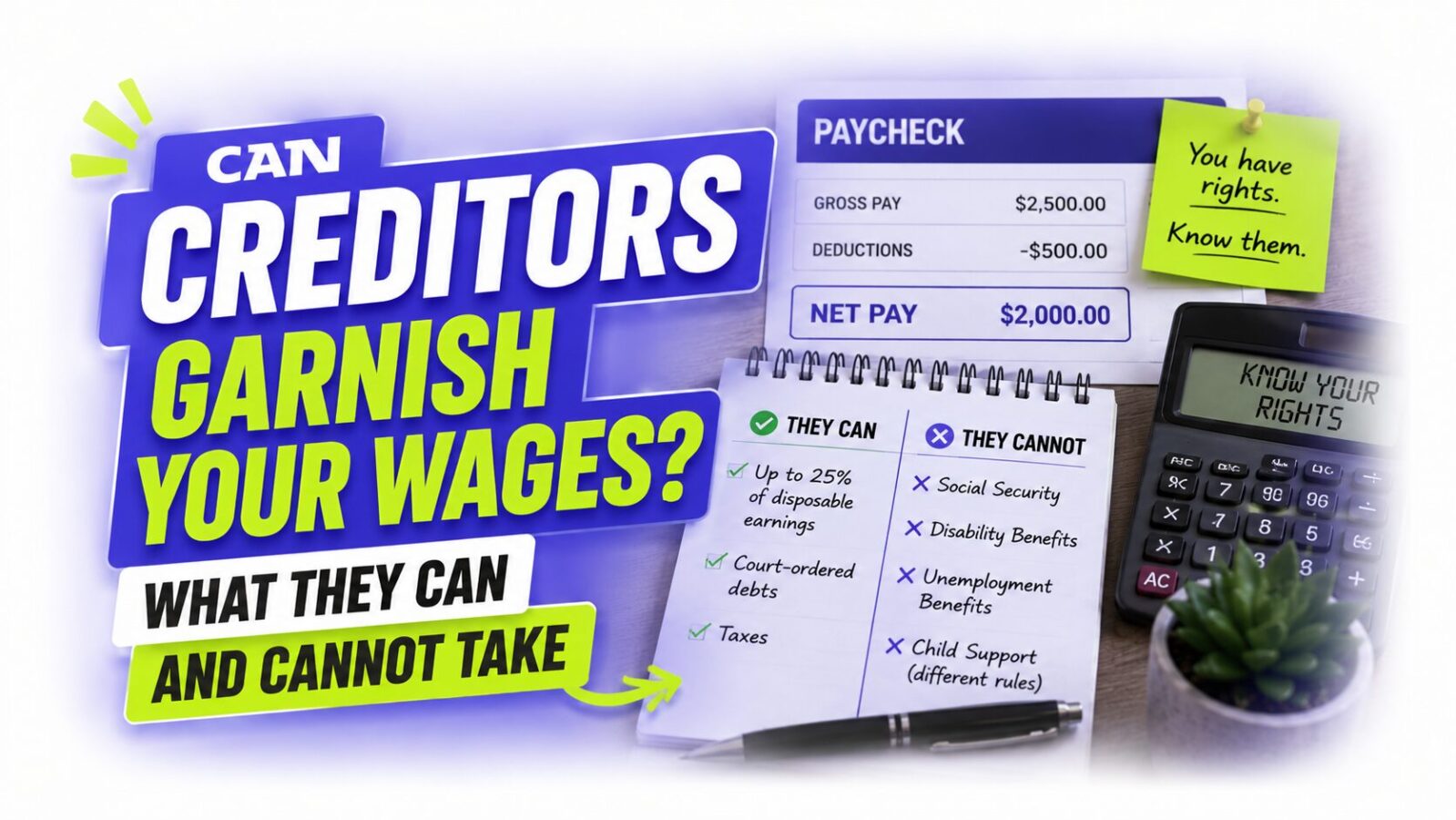
Most creditors cannot just take money from your paycheck. Wage garnishment requires a lawsuit, a court judgment, and a garnishment order first, and federal law caps how much they can take at 25% of your disposable earnings. The major exceptions that skip the lawsuit are federal student loans, unpaid taxes, and child support. A few states ban wage garnishment for consumer debt entirely. Here is exactly what creditors can and cannot do.
Key Takeaways
- Most creditors must sue and win first before they can garnish your wages.
- Federal student loans, taxes, and child support can garnish without a court order.
- Consumer-debt garnishment is capped at 25% of disposable earnings under federal law.
- Always respond to a lawsuit; ignoring it guarantees a default judgment.
Who Can Garnish Wages Without a Court Order?
Most creditors need a court judgment first, but a few debts are different:
- Federal student loans in default: the Department of Education can garnish up to 15% of disposable pay without a lawsuit, after a 30-day notice.
- Federal and state taxes: the IRS can garnish through an administrative levy with no lawsuit, the amount depending on your filing status and dependents.
- Child support and alimony: up to 50% to 65% of disposable income for court-ordered support, depending on whether you support other dependents.
For everything else (credit cards, personal loans, medical debt, private student loans), the creditor must sue you, win a judgment, and then get a garnishment order, which typically takes 6 months to 2 years.
How Does the Lawsuit-to-Garnishment Process Work?
For credit card debt, the path usually runs: you stop paying for 90 to 180 days, the creditor or collector files a civil lawsuit, you are served a summons (you must respond within 20 to 30 days or lose automatically), and if you do not respond, a default judgment is entered. If you do respond, a hearing is scheduled, and only if the creditor wins can they apply for a garnishment order that goes to your employer.
The single most important step is to respond to the lawsuit. Ignoring a summons means an automatic default judgment, while responding forces the creditor to prove they own the debt and that the amount is correct. Many debts are sold multiple times with incomplete documentation, so an attorney’s review of the summons can surface defenses you did not know you had. See our guide on the debt validation letter.
How Much of Your Paycheck Can Be Garnished?
For consumer debts, federal law (the Consumer Credit Protection Act) limits garnishment to the lesser of:
- 25% of disposable earnings (pay after legally required deductions), or
- the amount by which disposable earnings exceed 30 times the federal minimum wage ($7.25 x 30 = $217.50 a week).
Example: at $15 an hour for 40 hours, disposable earnings run roughly $550 a week. 25% is $137.50, while the floor protects $217.50, leaving up to $332.50 garnishable. The lesser figure applies, so the garnishment would be $137.50. Some states cap it lower or ban it outright.
Which States Prohibit Most Wage Garnishment?
| State | Wage garnishment for consumer debt |
|---|---|
| Texas | Prohibited (except taxes, student loans, child support) |
| Pennsylvania | Prohibited for most consumer debts |
| North Carolina | Prohibited for most consumer debts |
| South Carolina | Prohibited for most consumer debts |
| All other states | Allowed, up to federal limits or lower state limits |
In these states, a judgment creditor generally cannot garnish wages, though they may still pursue bank accounts.
How Do You Stop or Prevent Wage Garnishment?
Before judgment, resolving the debt is your best protection: negotiate a settlement, set up a payment plan, or file bankruptcy before a judgment exists, because afterward your options narrow.
After judgment but before garnishment, you typically have 30 days from the notice to request a hearing and object. Valid objections include that the debt is not yours, the amount is wrong, you qualify for an exemption (like head of household), or you are already being garnished for another debt.
Head of household exemption. Many states exempt or give a higher protected threshold to anyone providing more than half the support for a child or dependent. File the claim before garnishment begins.
Bankruptcy. Filing triggers an automatic stay that immediately halts garnishment, and Chapter 7 can permanently discharge the underlying debt. See our guide on your credit score after bankruptcy.
What If Garnishment Has Already Started?
You still have options. Negotiating directly with the judgment creditor often works, since many will accept a lump-sum settlement for less than the full judgment to end the garnishment now rather than wait years for payments. You can also file a claim of exemption after garnishment begins if you qualify; contact your county court clerk for the right form.
FAQ
Can a creditor garnish my wages without going to court?
Usually no. Most creditors must sue and win a judgment first. The exceptions are federal student loans, unpaid taxes, and child support, which can garnish through administrative processes without a lawsuit.
How much of my paycheck can be garnished?
For consumer debt, the lesser of 25% of disposable earnings or the amount above 30 times the federal minimum wage ($217.50 a week). Some states cap it lower or ban garnishment entirely.
Which states do not allow wage garnishment?
Texas, Pennsylvania, North Carolina, and South Carolina prohibit wage garnishment for most consumer debts, though creditors may still target bank accounts there.
How do I stop a wage garnishment?
Object within the notice window if you have grounds, claim a head-of-household exemption, settle with the creditor, or file bankruptcy, which triggers an automatic stay that immediately halts garnishment.
Bottom Line
Most creditors cannot touch your paycheck without suing and winning first, and even then federal law caps garnishment at 25% of disposable earnings, with several states banning it for consumer debt. Always respond to a lawsuit, claim any exemption you qualify for, and consider settlement or bankruptcy to stop garnishment. To go deeper, see our guides on the debt validation letter, talking to debt collectors, and your credit score after bankruptcy.
This article is for educational and informational purposes only and does not constitute legal advice. Garnishment rules and exemptions vary by state, so consult an attorney for guidance specific to your situation.