By
By 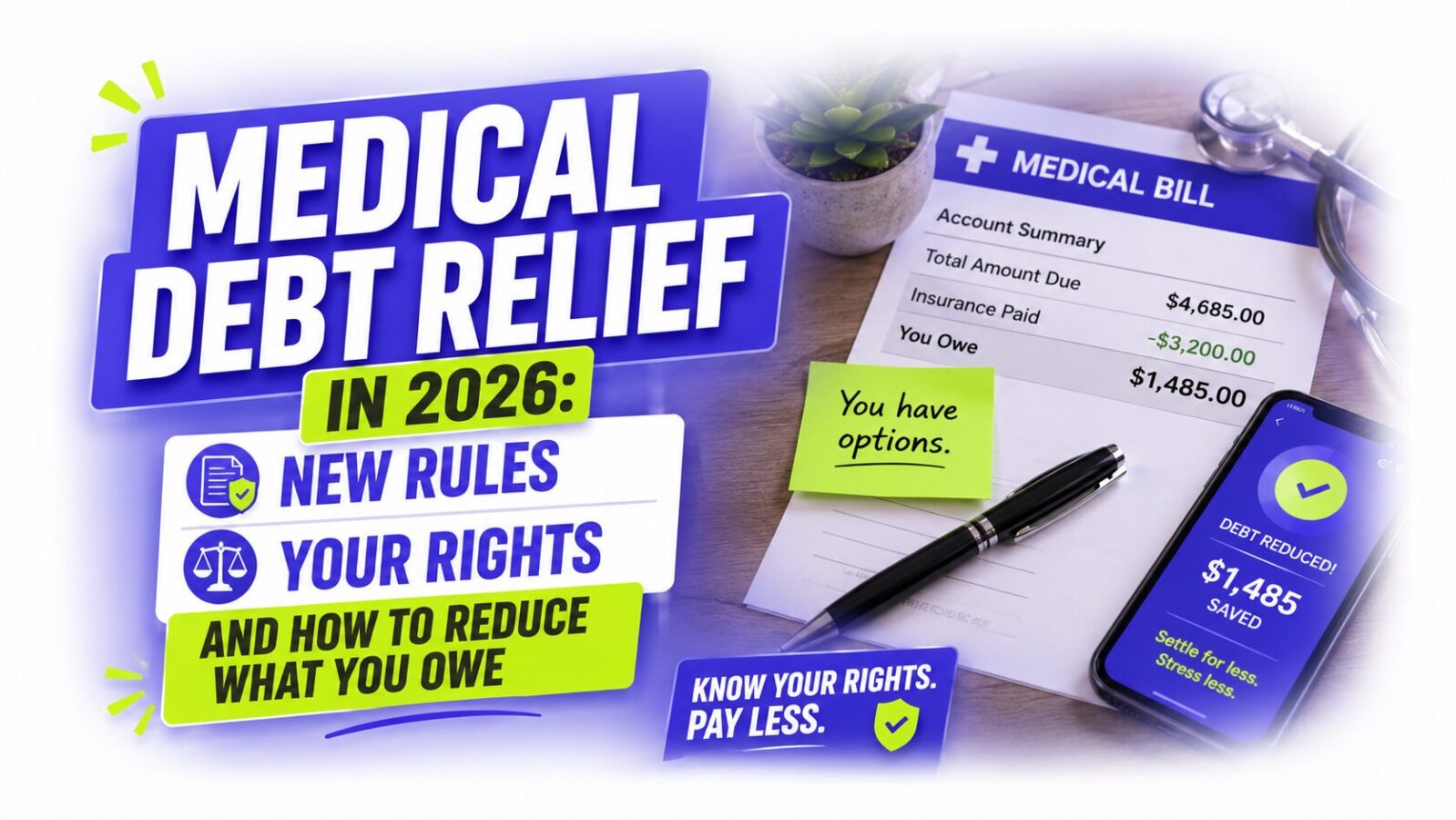
Medical debt is a leading cause of personal bankruptcy and affects roughly 100 million Americans, but your options in 2026 are better than they used to be. Paid medical collections and those under $500 are already off credit reports, newer scoring models weigh medical debt far less, and medical bills are among the most negotiable debts there are. The key moves: check your bill for errors, ask about the cash-pay rate, apply for hospital charity care, and negotiate. Here is what changed and what to do.
Key Takeaways
- Paid and under-$500 medical collections are off credit reports, and newer scoring models weigh medical debt less.
- The broader CFPB ban was struck down in court (2025), so larger unpaid medical collections can still appear.
- Nonprofit hospitals must offer charity care; you may qualify for big discounts or full forgiveness.
- Medical bills are highly negotiable, so check for errors and ask for the cash-pay rate.
What Changed With Medical Debt on Credit Reports?
In 2022 and 2023, Equifax, Experian, and TransUnion voluntarily stopped reporting paid medical collections, removed medical collections under $500, and added a 12-month grace period before any medical collection can appear. Those changes are permanent.
The CFPB went further with a rule, finalized in early 2025, that would have removed essentially all medical debt from credit reports. However, a federal court vacated that rule in July 2025, finding it exceeded the agency’s authority under the Fair Credit Reporting Act. So as of 2026, larger unpaid medical collections can still appear on your reports, though newer scoring models (FICO 9 and 10, VantageScore 4.0) weigh medical debt much less than older models. If a paid or under-$500 medical collection is still showing, you have the right to dispute it at equifax.com, experian.com, and transunion.com. See our guide on disputing credit report errors.
What Are Your Rights Against Medical Debt Collectors?
Itemized bill rights. You can request an itemized statement of every charge in writing. Billing errors are common, affecting an estimated 80% of bills according to Medical Billing Advocates of America, including duplicate charges, wrong codes, services not received, and charges insurance should have covered.
Charity care (financial assistance). Nonprofit hospitals (501(c)(3)) are required under the ACA to maintain financial assistance programs. If your household income is below roughly 200% to 400% of the federal poverty level, you may qualify for major discounts or full forgiveness, and you generally have up to 240 days from the first bill to apply. Ask the hospital’s financial counseling office before assuming you must pay in full.
Surprise billing protection. The No Surprises Act protects you from surprise out-of-network bills for emergency care and certain services at in-network facilities. Separately, many nonprofit hospitals offer interest-free payment periods, and some states cap interest on medical debt, so ask about interest before agreeing to any plan.
How Do You Negotiate a Lower Medical Bill?
Medical bills are among the most negotiable debts in existence, because the billed amount is usually far higher than what insurers actually pay.
Request an itemized bill and check for errors. Look for upcoding (billing a pricier procedure than performed), unbundling (charging separately for services that should be combined), duplicates, and services not rendered. Correcting errors is not negotiation, it is fixing a mistake.
Ask about the cash-pay rate. Uninsured patients are charged the “chargemaster” rate, the highest possible, often several times what insurers pay. Ask for the cash or self-pay rate; many hospitals offer 20% to 40% off simply because no one actually pays chargemaster.
Apply for financial assistance. This is separate from insurance and can reduce your remaining balance by 10% to 100% on a sliding scale based on income.
Negotiate a lump sum. If you do not qualify for assistance and cannot pay in full, offer a lump-sum settlement. Starting around 40 to 60 cents on the dollar is reasonable: “I cannot pay the full balance, but I can pay $[X] today to resolve this account. Is that something you can work with?”
Set up a 0% payment plan. If you cannot settle, most hospitals will arrange an interest-free payment plan. Always get the terms in writing.
Should You Pay Medical Debt or Credit Card Debt First?
Because medical debt is usually interest-free or low-interest and weighs less on your credit, it is generally less urgent than high-rate credit card debt. A reasonable 2026 priority order:
- Debt that could cost you housing (mortgage, rent).
- Debt tied to a vehicle you need for work.
- Credit card and other high-rate debt (15%+ APR).
- Medical debt on a 0% or low-interest payment plan.
This does not mean ignoring medical debt; it means killing the highest-cost debt first while keeping up minimum payments on medical bills. See our guide on paying off debt on a low income.
Can Bankruptcy Clear Medical Debt?
Yes. Medical debt is unsecured and fully dischargeable in Chapter 7 bankruptcy. If your medical debt plus other unsecured debt is causing a genuine financial crisis, bankruptcy can eliminate it. Chapter 7 stays on your report for 10 years, but the score damage is often not much worse than years of collections. Consult a bankruptcy attorney first, since many offer free consultations and can tell you whether negotiation or charity care is the better path. See our guide on your credit score after bankruptcy.
FAQ
Is medical debt off credit reports in 2026?
Partly. Paid medical collections and those under $500 are off reports, and there is a 12-month grace period. But a 2025 court ruling struck down the broader CFPB ban, so larger unpaid medical collections can still appear, just with less weight in newer scoring models.
Can I negotiate a medical bill down?
Yes, medical bills are highly negotiable. Check for errors, ask for the cash-pay rate, apply for charity care, and offer a lump-sum settlement starting around 40 to 60 cents on the dollar.
What is hospital charity care?
Nonprofit hospitals must offer financial assistance under the ACA. If your income is roughly 200% to 400% of the federal poverty level or below, you may get large discounts or full forgiveness, with about 240 days from the first bill to apply.
Should I pay medical debt before credit card debt?
Usually no. Credit card debt carries much higher interest and hurts your credit more, while medical debt is often interest-free and weighs less. Pay high-rate debt first while maintaining medical payment plans.
Bottom Line
Your medical debt options in 2026 are strong: paid and small collections are off credit reports, charity care can forgive large balances, and bills are highly negotiable, so rarely pay the first number you are billed. Check for errors, ask for the cash-pay rate, apply for assistance, and negotiate, prioritizing high-rate debt over interest-free medical bills. To go deeper, see our guides on paying off debt on a low income, disputing credit report errors, and your credit score after bankruptcy.
This article is for educational and informational purposes only and does not constitute legal or medical advice. Rules and programs vary by state and hospital and can change, so confirm current details with the provider or a qualified professional.